

Pandiculation is the scientific name for the instinctive sequence of stretching and lengthening that appears when a person wakes or rises after stillness. It is often accompanied by yawning, yet yawning is not required for the reflex to occur. The movement unfolds as a coordinated pattern that engages many muscles at once, often includes a deep inhalation that expands the chest, and settles into a gentle release. This reflex is not a deliberate routine. It is a natural transition that prepares the body for movement after rest.
In Tamil, everyday language draws on the word sombal and the phrase sombal murithal to describe this familiar gesture, embedding it in the vocabulary of comfortable, unhurried ease rather than clinical terminology. Spanish speakers use the verb desperezarse to describe the act of shaking off sleepiness through a waking stretch, and Japanese expressions such as nobi o suru capture the same instinctive lengthening of the body after rest. These linguistic variations show how different cultures name or frame the gesture while pointing to the same underlying reflex. The scientific term offers a shared foundation, while vernacular expressions reveal how communities interpret the same universal act.
The quiet shift from rest to readiness begins with changes inside the body, and understanding these internal transitions helps explain why this reflex emerges so reliably.
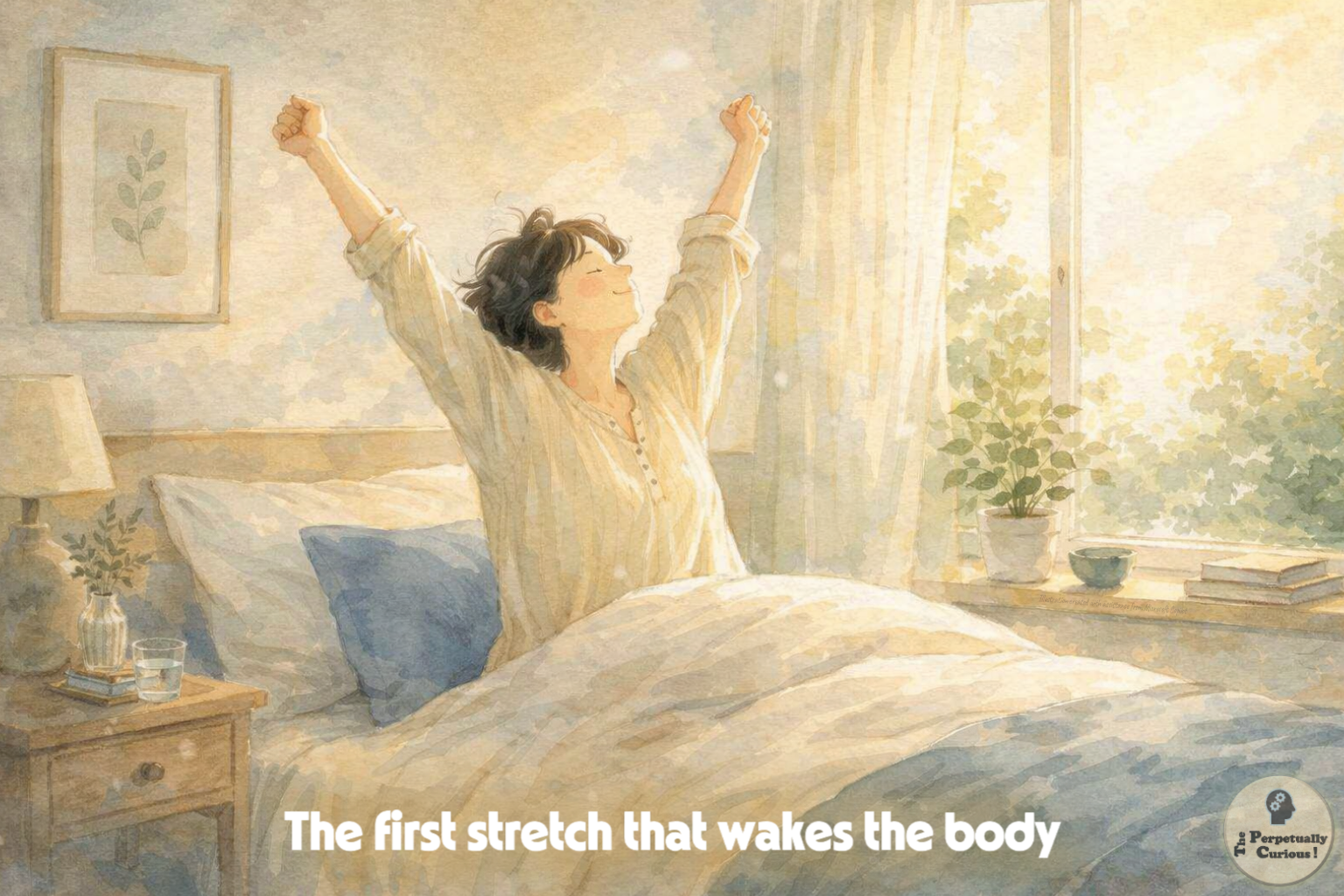
A quiet rise moves through the body as it returns to itself.
The first motion after stillness carries the memory of rest and the promise of readiness.
In that small awakening, the shape of being alive becomes clear again.
🌅 The body in stillness and the need for a reset
During sleep or prolonged sitting, the body enters a state of reduced activity. Muscle tone decreases, circulation slows in certain regions, and sensory input becomes quieter. These changes are part of normal physiology, yet they create conditions in which a reset becomes useful when movement resumes. A deeper look at how the body manages time based on its internal biological clocks can further illuminate why these transitions feel so distinct.
Muscles that have spent long intervals in similar postures may feel heavy or stiff. Blood flow that has slowed during rest begins to increase again when the body moves, and this shift can create a sensation of warmth or renewed energy. Sensory pathways that have been quiet during sleep begin to awaken, and the nervous system receives a strong wave of feedback that helps it regain a precise sense of the body’s position.
These internal shifts create a landscape in which pandiculation naturally emerges as a coordinated burst of movement that helps the body transition from stillness to readiness. It is a bridge between two states, and its timing reflects the body’s broader patterns of restoration and reawakening.
🌱 How the body senses itself: proprioception and internal awareness
The body maintains a continuous sense of its own position through proprioception. This sense depends on specialized receptors in muscles, tendons, and joints. Muscle spindles detect changes in muscle length, while Golgi tendon organs respond to changes in tension. Together, they send information to the spinal cord and brain about how the body is arranged in space. The integration of these signals across the spinal cord and brain draws on the coordinated activity of diverse neurons whose distinct functions together produce a unified sense of bodily position.
During pandiculation, many of these receptors activate at once. The gradual increase in tension, the lengthening of limbs, and the release that follows create a wave of sensory input that refreshes the body’s internal map. This process helps restore voluntary control and reduces accumulated tension.
A person may not consciously think about these receptors, yet the familiar sensation of returning to one’s own awareness after waking reflects their activity. The reflex is not only mechanical. It is sensory, and it helps the nervous system regain clarity after quiet.
The body does not recalibrate in isolation; it does so as part of a broader transition that the nervous system has been quietly preparing from the first moments of waking.
🌤 The sleep-wake transition and the rise of readiness
Pandiculation appears most often during transitions between rest and activity. When a person wakes, the hypothalamus adjusts its activity, hormone levels shift toward daytime patterns, and the autonomic nervous system prepares for engagement with the environment. The hypothalamus, which governs sleep, temperature, and hormonal balance, may participate in the broader sleep‑wake and hormonal context in which the reflex appears, although the precise trigger remains an area of active research. The movement of cerebrospinal fluid, which shifts in character across sleep and waking states, illustrates how broadly the brain orchestrates its internal environment during these transitions.
Preliminary research suggests that neurotransmitters such as dopamine and others may be involved in the pleasant sensation associated with pandiculation, although the exact basis of this feeling is still being studied. What is clear is that the reflex supports the shift from low arousal to higher alertness. It helps the body regain tone, circulation, and awareness in a single integrated movement. A related transition appears in the physiology of yawning, which often accompanies the same moments of rising alertness.
This shift unfolds gradually, like the slow brightening of early morning light, and pandiculation is one of the first gestures that marks the return to wakefulness.
🌙 The circadian rhythm behind the reflex
The body’s internal clock influences many physiological processes, including muscle tone, alertness, and hormone release. Pandiculation often appears at moments when circadian‑regulated processes move from nighttime rest toward morning wakefulness. As the body’s hormonal landscape shifts toward daytime patterns, including the gradual rise in cortisol that unfolds in the early hours, pandiculation appears at a moment aligned with this broader physiological transition.
This relationship between circadian timing and pandiculation reinforces the idea that the reflex is not random. It is part of a larger choreography that guides the body through cycles of rest and readiness.
🐾 A reflex shared across species
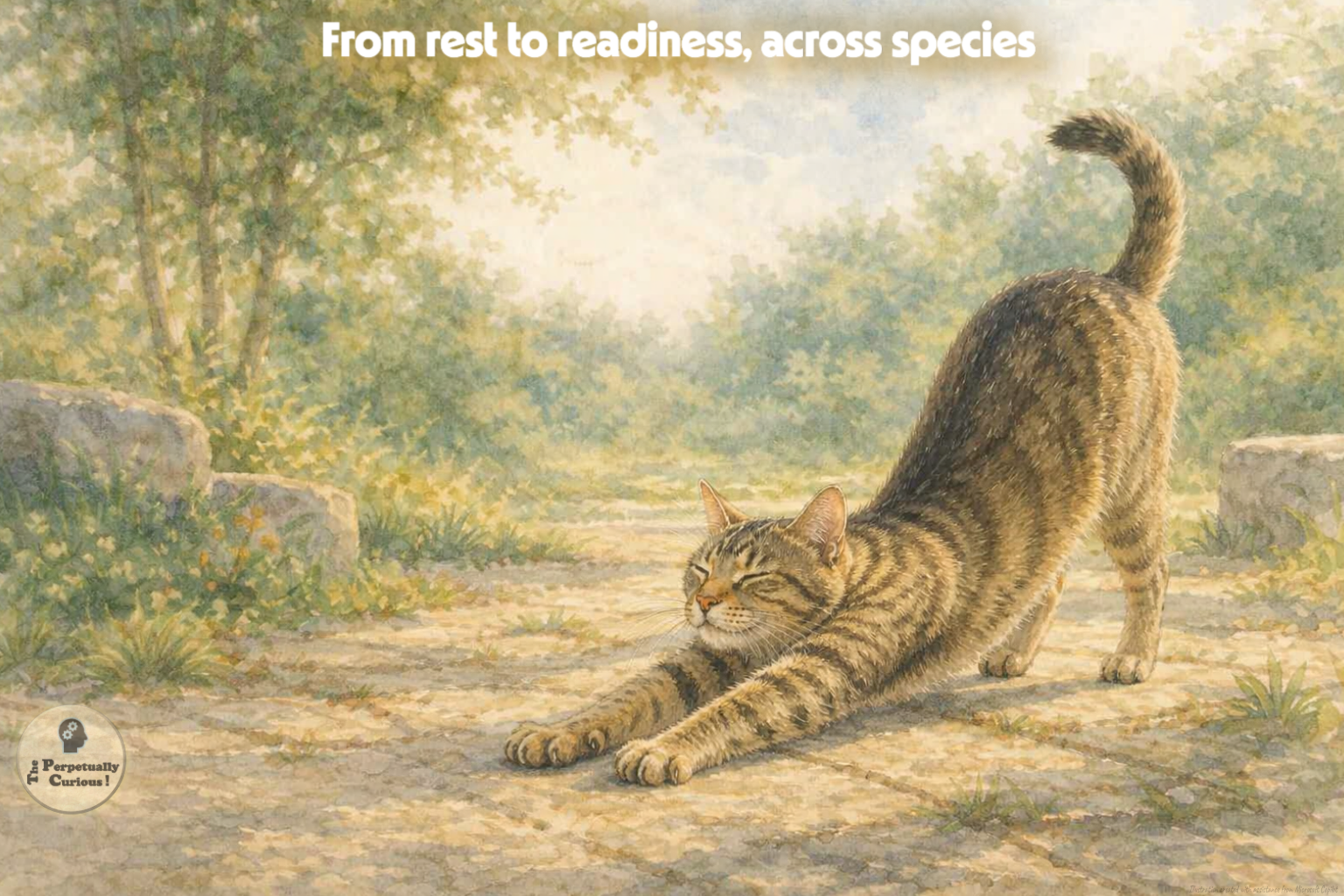
Pandiculation is not unique to humans. Cats extend their front legs and arch their backs after sleep. Dogs lengthen their bodies in a movement similar to a gentle bow. Primates stretch their limbs before climbing or walking. Even fetuses in the womb have been observed performing movements that resemble pandiculation, which suggests that the reflex emerges early in development.
Research outside mammals is more limited, yet the presence of similar behaviors across many vertebrates indicates that pandiculation serves a fundamental biological function. Animals often pandiculate during transitions from rest to activity, and the gesture that feels so familiar in humans is part of a larger pattern that spans species and environments. A similar evolutionary thread appears in the reflex that produces goosebumps, which also reflects ancient patterns of physiological readiness.
🧬 Evolutionary echoes in a simple gesture
The presence of pandiculation across species suggests that it may have offered advantages to early mammals. A reflex that resets muscle tone and sensory awareness could have supported survival in environments where sudden movement was necessary. Although research continues to refine this understanding, the persistence of the reflex across evolutionary time hints at its usefulness.
Pandiculation may have helped animals maintain readiness after sleep, conserve energy during rest, and transition smoothly into alertness when needed. These possibilities remain areas of active study, yet they add depth to the story of a gesture that appears simple on the surface. These evolutionary threads also surface in individual development, where the reflex emerges long before deliberate movement is possible.
👶 The developmental arc of pandiculation
Pandiculation appears early in life. Infants stretch and yawn in ways that resemble adult pandiculation long before they learn deliberate stretching. Observations of fetuses show similar movements, which suggests that the reflex is rooted in the nervous system rather than learned behavior. Similar early developmental imprinting appears in palm line formation, which takes shape during fetal growth long before the hands are used for deliberate grip.
This early presence may support the formation of proprioceptive maps, helping infants develop awareness of their bodies. The reflex may also assist in regulating muscle tone during early growth. These developmental layers highlight the deep roots of pandiculation in human physiology.
🌾 Cultural lenses on a universal reflex
While the biology of pandiculation is shared, the ways cultures describe it reveal how language frames familiar bodily gestures. The examples introduced earlier, from Tamil to Spanish to Japanese, show that communities often anchor the reflex in the vocabulary of ease, transition, or waking. In Japanese, nobi o suru describes the familiar act of stretching the body, while akubi refers to yawning; together, the two terms reflect how waking, stretching, and yawning can be closely linked in everyday language.
These linguistic patterns do not change the underlying physiology. Instead, they show how different cultures interpret the gesture. Some associate it with comfort, others with informality, and others with natural transitions between states. Recognizing these differences enriches understanding and highlights the universality of the reflex. The emotional nuance of tears offers another example of how the body expresses internal states in ways that are both biological and shaped by culture.
This cultural diversity adds texture to the scientific explanation, showing that a single biological reflex can carry many meanings across human experience.
🌉 How the pieces come together
Seen together, these layers show that pandiculation is more than a simple stretch. It is a quiet expression of how living bodies restore readiness, reawaken sensory clarity, and reconnect with their internal sense of position. Its presence across species and its emergence early in development reveal a reflex shaped by biology and time, while cultural interpretations show how a universal gesture can carry different meanings in different communities. It is both biological and familiar, scientific and deeply human.
🌍 Everyday experience and the scale of stillness
A person who sleeps for about eight hours may spend long intervals in similar postures, and this repeated stillness can contribute to sensations of stiffness in the shoulders, hips, or lower back. Studies have noted that sitting for more than about six hours per day is associated with an increased risk of neck pain, placing extended stillness within a broader context of how the body responds to prolonged periods of reduced movement.
These everyday experiences align with the idea that the body benefits from periodic resets of muscle tone and sensory awareness. Pandiculation is one of the simplest and most natural of these resets. It appears without planning, and it reflects the body’s own way of preparing for motion.
Pass this article along to someone curious and let the learning travel.
💡 Did You Know
🌙 Pandiculation often aligns with circadian‑regulated processes, appearing at moments when the body shifts from low alertness to higher readiness.
🚗 People naturally pandiculate after long journeys, such as flights or extended car rides, which reflects the reflex’s role in transitions between stillness and movement.
👶 Infants and fetuses show movements that resemble pandiculation long before deliberate stretching is learned, which highlights its deep developmental roots in the nervous system.
🐾 Animals often pandiculate during transitions from rest to activity, a pattern that appears across many vertebrate species.
😮 In some research frameworks, yawning is described as a specialized form of pandiculation that engages the muscles of the mouth, respiratory system, and upper spine, making the familiar yawn‑and‑stretch pairing a single integrated event.
📜 The word pandiculation comes from the Latin pandiculari, meaning “to stretch oneself,” and shares the Latin root pandere, meaning “to spread or extend,” with the English word expand.
What is the difference between pandiculation and regular stretching?
Pandiculation is an involuntary reflex that appears during transitions between rest and activity. It involves a coordinated sequence of tension, lengthening, and release. Regular stretching is voluntary and often focuses on specific muscles. The two movements may look similar, but their purposes and origins differ.
Why does stretching when waking often feel pleasant?
The pleasant sensation may arise from increased blood flow, renewed sensory input, and the recalibration of proprioceptive pathways. Preliminary research suggests that neurotransmitters may contribute to this feeling, although the details are still being studied.
Do all animals exhibit pandiculation?
Pandiculation has been documented in many mammals and in fetuses. Research outside mammals is more limited, yet the presence of similar behaviors across species suggests that the reflex is widespread.
Is stretching the same as warming up?
Stretching and warming up are not the same. Warming up involves a gradual increase in activity that prepares the body for more intense movement. Pandiculation is a natural reflex that appears during transitions and is not a substitute for structured preparation.
Is pandiculation related to yawning?
Pandiculation and yawning often appear together, especially during transitions between rest and wakefulness. Both involve coordinated activation of muscles in the torso, neck, and upper spine, and both support the shift from lower arousal to higher readiness. Their overlap reflects shared neural pathways rather than a single unified reflex, and the exact nature of their relationship is still being explored.
What is the stretch‑yawning syndrome?
The stretch‑yawning syndrome is the formal term used when full‑body pandiculation and yawning occur simultaneously. The two reflexes share neural pathways and often arise together during transitions between rest and wakefulness, reinforcing the body’s return to higher alertness.
Is pandiculation linked to fascia?
Research has explored the possibility that pandiculation activates the myofascial system, the network of connective tissue that links muscles throughout the body. This activation may help maintain the structural and functional integration of this network during transitions between rest and activity, although the mechanisms remain an area of active study.
Does pandiculation change with age?
Pandiculation appears across the lifespan, although the frequency and intensity may vary with changes in muscle tone, sleep patterns, and overall activity levels.
Can pandiculation be consciously controlled?
Pandiculation is involuntary by definition. People can imitate the movement, yet the natural reflex arises without deliberate planning. Scientific discussions focus on understanding the reflex rather than controlling it.
🌺 A gentle invitation to share
If this exploration has offered a new way to see the first stretch of the day, we warmly invite you to share it with others who enjoy the quiet science of ordinary human gestures.
“Why We Stretch When We Wake: The Quiet Reflex that Resets the Body.” The Perpetually Curious!, June 2026.
https://www.theperpetuallycurious.org/articles/why-we-stretch-when-we-wake/Continue Exploring
For the curious mind: want to explore this theme through a few questions? Visit the Classic Quiz Studio, nestled under Explorations opens in a new tab ,and see where a few well-placed questions lead: Biology & Health Quizzesopens in a new tab
For what comes next
Site Updates gathers occasional notes, new additions, and ways to keep in touch. RSS brings new publications to your feed reader in chronological order.
Choose the path that speaks to you, and let the next curiosity find you wherever your wondering takes you.