

Every time an incandescent light bulb brightens a room, something remarkable begins inside its fragile glass world. A current enters through the base, flows through a tightly coiled tungsten filament, and raises the metal to a temperature hot enough to shine. What seems like a simple household glow is, in fact, a carefully sustained encounter between electricity, metal, gas, glass, and heat.
That glow has accompanied evening reading, kitchen conversations, workshop benches, and late-night thinking for generations. Yet the familiar bulb often hides the precision of what is happening within it. Electrical energy meets resistance. Matter grows intensely hot without immediately melting. The hot filament emits radiation across a broad spectrum, and the visible portion reaches the eye as warm light.
Within this small, sealed sphere, physics becomes something we can see. The incandescent bulb offers more than illumination. It reveals how carefully chosen materials can endure extreme conditions, how temperature can shape color, and how an unseen current can become a visible presence. In that transformation, an everyday object becomes a quiet invitation to look more closely.
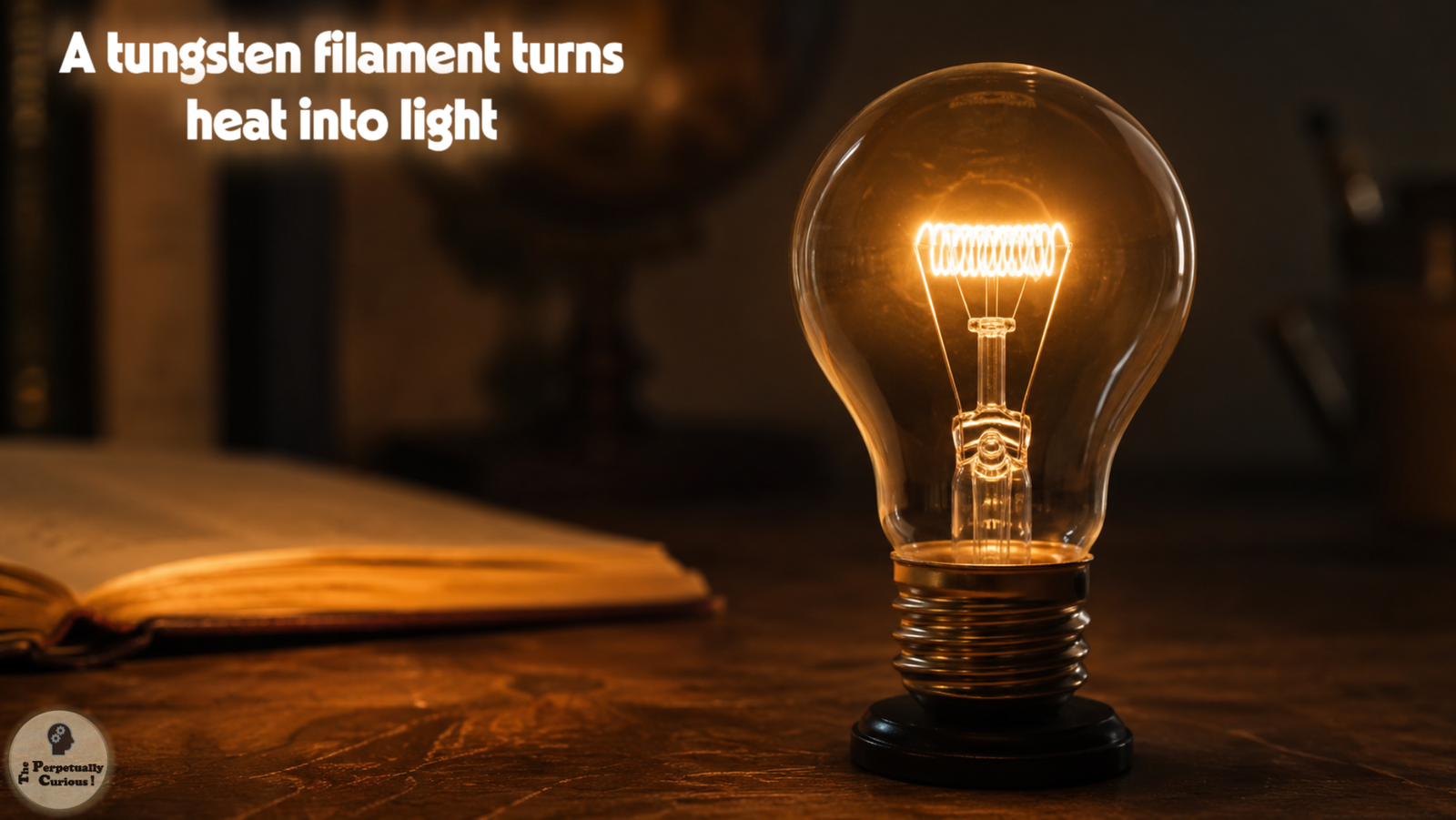
In the small world behind a bulb’s glass, heat becomes color and matter learns to glow.
A filament holds its quiet storm, shaping light from the simplest motion of electrons.
In that fragile brightness, the everyday reveals a gentle reminder that wonder often lives in the smallest places.
💡 From current to glow: when resistance becomes light
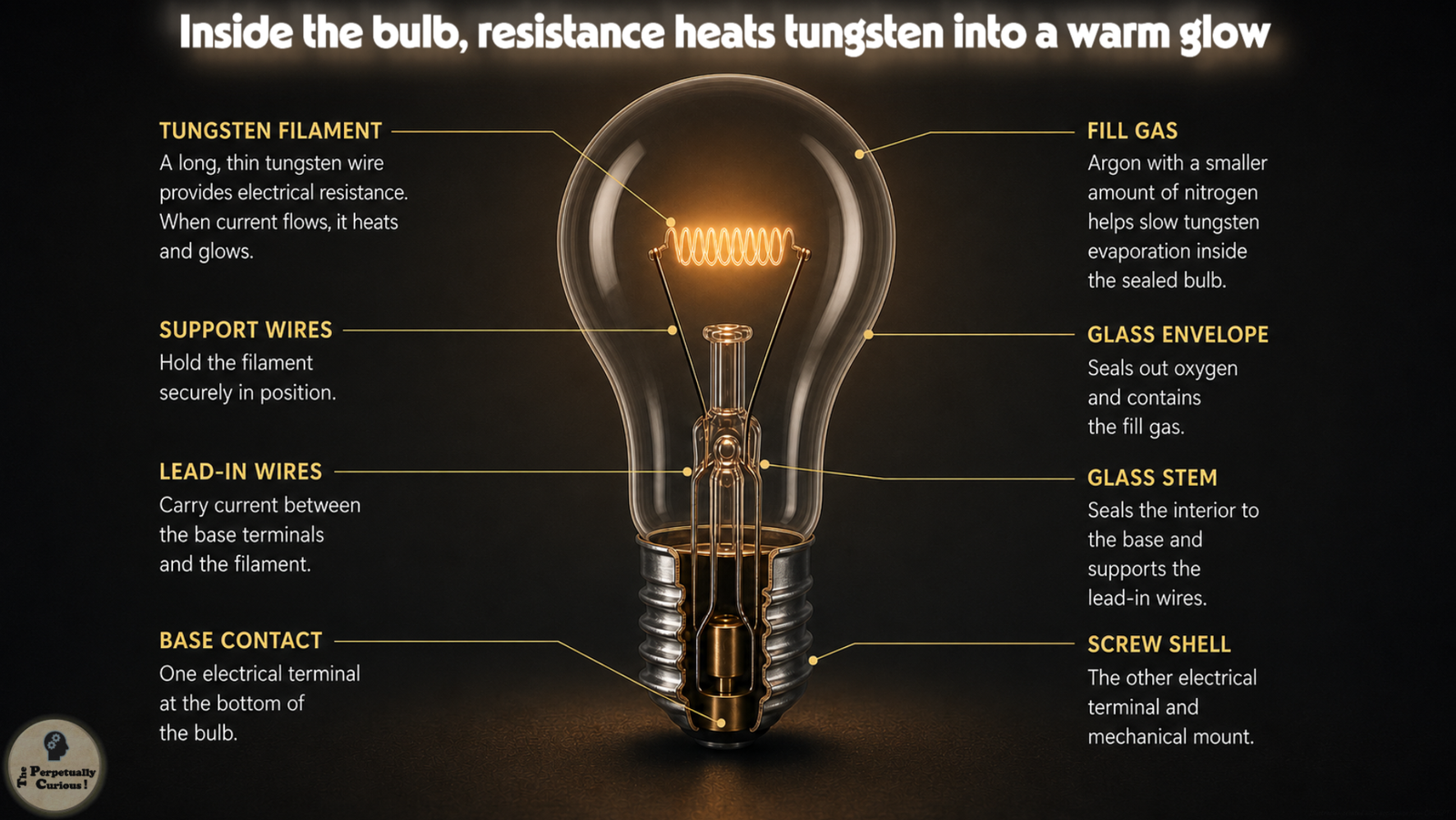
When electrical current enters an incandescent bulb, it travels from one contact at the base through a lead-in wire, across the thin tungsten filament, and back through a second lead and contact, completing the circuit. As electrons move through the filament, interactions within the metal impede their motion. This electrical resistance produces heat, raising the filament to temperatures often around 4,500°F (about 2,500°C). At such temperatures, the filament does not simply become warm. It emits electromagnetic radiation across a broad spectrum, including visible light, through thermal radiation.
This glow follows a familiar pattern seen in heated metal. As temperature rises, the color shifts from dull red to orange and then toward a yellowish-white. The filament operates well below tungsten’s melting point, yet the sustained heat still places extraordinary demands on the material, gradually encouraging evaporation, deformation, and local hot spots over time. That tension between intense brightness and material endurance leads naturally to the next question: what substances and structures can survive such extreme conditions without melting or failing too quickly?
🔧 Why tungsten, a coiled filament, and a glass bulb filled with quiet gas
Tungsten is chosen for the filament because it combines an exceptionally high melting point, about 6,190°F (3,420°C), with comparatively low vapor pressure and useful strength at extreme temperatures. These properties allow it to glow intensely while operating well below its melting point. Early incandescent lamps used carbon filaments, but tungsten could withstand higher operating temperatures and produce brighter, more stable light. Creating a durable filament still requires specialized processing that turns tungsten powder into fine wire suitable for repeated heating and cooling.
The filament is not simply a straight wire. A long length of tungsten is wound into a coil and often into a coiled coil, a spiral shaped into a second spiral. This compact geometry fits more resistive wire inside the bulb while reducing the effective surface exposed to the surrounding gas. With less heat transferred through the fill gas, the filament can remain hot enough for incandescence without requiring a larger envelope.
The filament is enclosed within a sealed bulb whose interior is usually filled with an inert gas, often argon mixed with a smaller amount of nitrogen. The sealed envelope keeps oxygen away from the hot tungsten, preventing rapid oxidation. The gas atmosphere slows the net evaporation of tungsten, while argon’s relatively low thermal conductivity helps limit gas-mediated heat loss compared with lighter fill gases. Nitrogen can also help reduce the risk of electrical arcing. Together, these functions help the filament retain its shape and thickness for longer than it would in ordinary air.
Many household bulbs use soda-lime glass, selected for its transparency, manufacturability, and suitability for common operating temperatures. Some higher-temperature incandescent and halogen lamps instead use heat-resistant hard glass or fused silica. In halogen lamps, the envelope material works together with a halogen-containing gas and a sufficiently hot bulb wall to support the regenerative halogen cycle. The result is a carefully controlled micro-environment in which tungsten, glass, gas, and electricity cooperate to sustain a steady glow, shaping not only how brightly the bulb shines but also the warm character of the light that follows.
🌈 Warm light, color, and the feel of incandescence
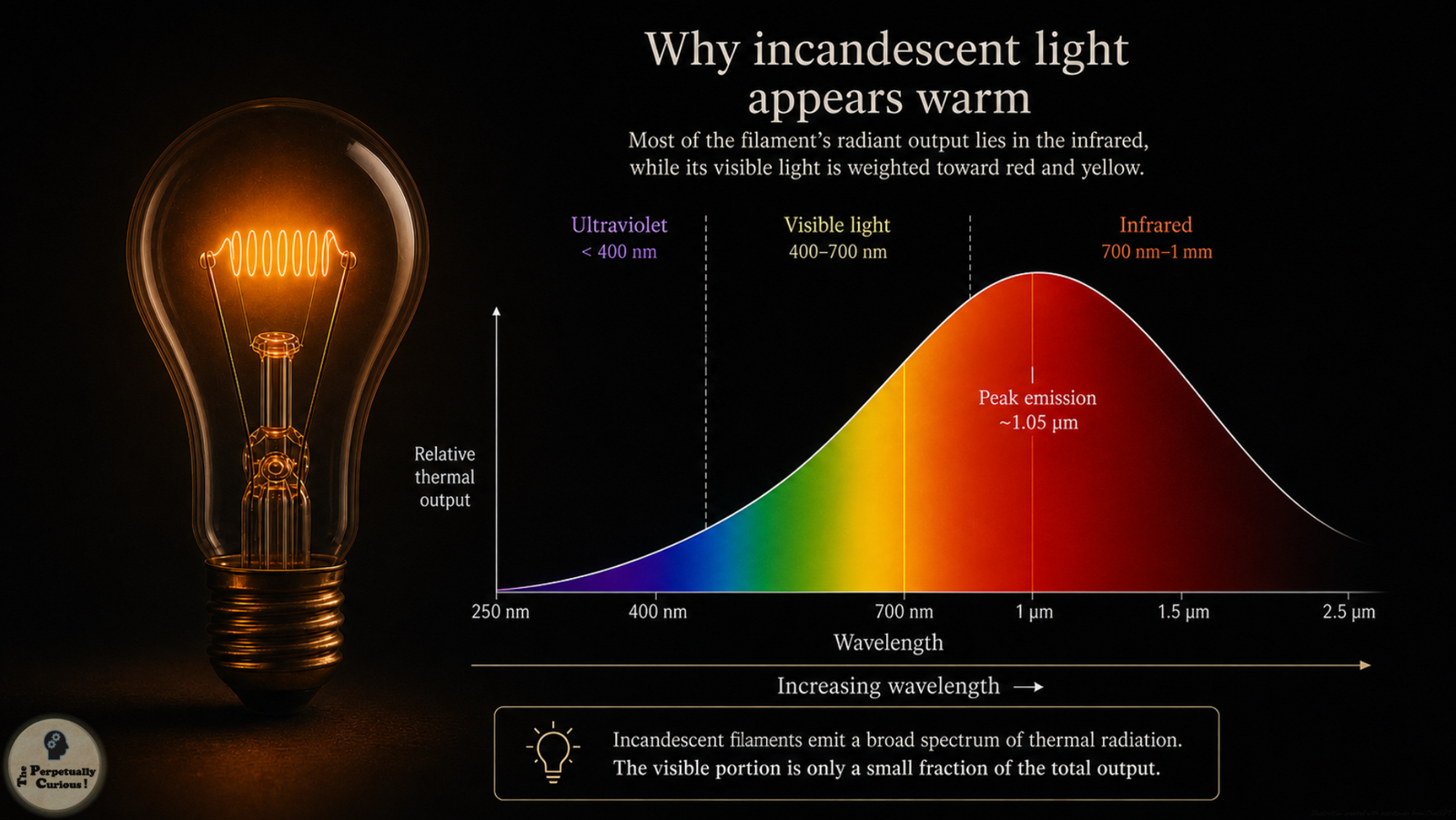
The light from an incandescent bulb is often described as warm. That warmth is not only emotional. It is rooted in the physics of thermal radiation. At filament temperatures around 2,700 to 2,800 K, the bulb emits energy across a broad range of wavelengths, but its visible light is weighted more strongly toward reds and yellows than toward blues. As a result, the glow appears yellowish-white, similar to the light of a candle or fireplace.
This broad spectrum arises from the intense thermal agitation within the hot tungsten filament, which produces electromagnetic radiation across many wavelengths. The filament behaves approximately like a blackbody radiator, so the overall shape of its spectrum follows the temperature-dependent curves described by Planck’s law. Real tungsten is not a perfect blackbody because its emissivity varies with wavelength and temperature, but the approximation remains useful for understanding why hotter filaments appear whiter and cooler ones appear redder.
This relationship becomes especially noticeable when an incandescent bulb is dimmed. Reducing the electrical power lowers the filament’s temperature, decreasing its brightness while shifting more of its radiation toward longer, redder wavelengths. The bulb therefore does not merely produce less light. Its glow also becomes warmer in color.
Because incandescent light forms a smooth, continuous spectrum, it renders many colors with unusual fidelity. Incandescent bulbs therefore commonly receive a Color Rendering Index close to 100, meaning that objects tend to appear natural and familiar under their light. That warm color and faithful rendering are closely tied to the heat that produces them, which leads directly to the next question: how much of the bulb’s electrical energy becomes useful light, and how much remains as warmth?
🔥 Heat, efficiency, and why most of the energy becomes warmth
The elegance of the incandescent bulb is accompanied by a significant tradeoff. Because the filament must become extremely hot before it produces substantial visible light, much of the electrical energy entering the bulb ultimately leaves as heat. The familiar estimate that roughly 90 percent of a traditional incandescent bulb’s energy becomes heat is useful household shorthand. In physical terms, the filament emits both visible and infrared radiation, and only a small fraction of the electrical input becomes visually useful light.
A familiar 60-watt incandescent bulb may produce about 800 lumens, giving it a luminous efficacy of roughly 13 lumens per watt, with common designs often falling between about 10 and 18 lumens per watt. Lumens measure light according to the sensitivity of human vision, so this value describes how effectively electrical power becomes useful illumination rather than merely how much radiation the filament emits. The remaining energy warms the surrounding air, the fixture, and the glass envelope, which can become hot to the touch.
This low luminous efficacy encouraged engineers and scientists to seek methods of producing light without first heating a material to several thousand degrees. Their work led to fluorescent lamps and, later, semiconductor devices that generate photons through mechanisms very different from the thermal glow of a filament.
🔍 From filaments to semiconductors: a gentle step toward modern light
Fluorescent lamps introduced a different way of producing illumination. An electrical discharge excites mercury vapor, generating ultraviolet radiation that phosphor coatings convert into visible light. Later, light-emitting diodes offered another path, using semiconductor physics to produce photons without first heating a material to incandescence.
An LED contains a junction between two differently prepared semiconductor regions. When electrons and positively charged vacancies called holes recombine near this junction, they release energy as photons. The energy of those photons, and therefore the color of the emitted light, depends largely on the semiconductor’s bandgap. Because this process does not require the device to reach thousands of degrees, LEDs can achieve much higher luminous efficacy than incandescent bulbs, commonly producing 80 to 100 lumens per watt or more.
The transition from glowing filaments to glowing semiconductors marks a quiet change in how everyday light is made. Incandescent bulbs generate light as a consequence of extreme heat, while LEDs produce it through controlled quantum interactions within a solid material. That contrast shows how a familiar household glow can emerge through very different physical pathways. Yet the incandescent story remains governed by the endurance of its hot filament, which raises a final practical question: how long can such a delicate structure survive?
⏳ Lifespan, wear, and the delicate fate of a filament
The life of an incandescent bulb is shaped by gradual changes in its filament. Even within an inert-gas environment, tungsten atoms slowly evaporate from the filament’s surface. As the wire becomes thinner, small differences in thickness can create regions of higher resistance that run hotter than the surrounding metal. These hot spots accelerate further evaporation and may eventually lead to local melting or fracture.
Many household incandescent bulbs are designed to last from several hundred to about one thousand hours, although actual life depends on wattage, construction, supply voltage, and operating conditions. Each time the bulb is switched on, the cold filament initially has much lower electrical resistance than it does when hot. This produces a brief inrush current while the filament heats and expands rapidly, placing extra stress on any region that has already thinned or weakened. Repeated heating and cooling can also contribute to deformation, sagging, and eventual breakage.
On alternating current, electrical power rises and falls during both halves of each cycle, so the filament’s temperature and light output vary slightly at twice the supply frequency, typically 100 or 120 hertz. The filament’s thermal inertia smooths most of this variation, making it far less noticeable than the flicker associated with many other lighting systems.
The filament’s gradual aging mirrors the quiet aging of everyday objects. When a bulb finally goes dark, it marks the end of a delicate journey shaped by evaporation, heat, electrical stress, and time. That small disappearance of light leads naturally to the symbolism the incandescent bulb has carried for more than a century.
🌍 A familiar symbol of ideas and a quiet lesson in physics
Beyond its technical details, the incandescent light bulb has become a familiar symbol of ideas, insight, and invention. The image of a bulb appearing above a person’s head serves as visual shorthand for a sudden thought. The symbolism is fitting. Inside the glass envelope, a carefully designed structure transforms invisible electrical energy into visible light through a mechanism that is both direct and profound.
The glow that illuminates a page or room arises from electrical resistance, thermal radiation, spectral distribution, and the carefully chosen properties of metals and gases. Understanding how an incandescent light bulb works offers a gentle introduction to these ideas while reminding us that even familiar objects contain deep mechanisms waiting to be noticed. The bulb becomes both a practical tool and a quiet metaphor for the way visible understanding can emerge from unseen processes.
Pass this article along to someone curious and let the learning travel.
💡 Did You Know?
🔩 A coiled-coil filament compresses a surprisingly long electrical path into a small luminous region. This allows a compact bulb to contain enough resistive tungsten wire to reach incandescence without requiring a much larger glass envelope.
🧪 Some high-temperature incandescent and halogen lamps use heat-resistant hard glass or fused silica rather than ordinary soda-lime glass. In a halogen lamp, the envelope material, halogen-containing gas, and hot bulb wall work together to support the regenerative halogen cycle.
🌫️ As an incandescent bulb ages, its light output may decline as the filament changes and evaporated tungsten accumulates on the inner surface of the envelope.
🔬 The hot filament behaves approximately like a blackbody radiator, so its spectrum broadly follows the temperature-dependent curves described by Planck’s law. Real tungsten is not a perfect blackbody, but the approximation helps explain why hotter filaments appear whiter and cooler ones appear redder.
⚡ On alternating current, the filament’s temperature and light output vary slightly at twice the electrical supply frequency, typically 100 or 120 hertz. Its thermal inertia smooths most of this variation, so it is usually difficult to notice.
🔥 Tungsten can glow intensely without melting because it has an exceptionally high melting point, comparatively low vapor pressure, and useful strength at the temperatures reached inside the bulb.
✨ Light does not always require extreme heat. Firefly bioluminescence produces visible photons through a controlled chemical reaction with very little accompanying warmth, creating a striking contrast with incandescent light.
🌐 Incandescent bulbs designed for different supply voltages require different filament geometries. For a similar power rating, a bulb intended for a higher voltage generally uses a longer, thinner filament to provide the greater electrical resistance required.
Why does an incandescent bulb produce light?
An incandescent bulb produces light by passing electrical current through a thin tungsten filament. Electrical resistance heats the filament to several thousand degrees, causing it to emit electromagnetic radiation across a broad spectrum that includes visible light.
Why is incandescent light often described as warm?
At typical filament temperatures, incandescent light contains a greater proportion of visible red and yellow wavelengths than blue wavelengths. This spectral balance gives the light a yellowish-white appearance resembling candlelight or firelight.
Why are incandescent bulbs considered inefficient compared with LEDs?
An incandescent filament must become extremely hot before it produces substantial visible light, so much of the electrical input ultimately becomes heat. LEDs use semiconductor processes to produce photons without heating a material to incandescence, allowing a larger proportion of the input power to become visually useful light.
Why can a small increase in voltage shorten an incandescent bulb’s life?
A voltage above the bulb’s rated level drives more power through the filament, raising its temperature and making the bulb brighter and slightly whiter. The additional heat also accelerates tungsten evaporation and the development of weak spots, so even a modest overvoltage can shorten filament life. Lower voltage generally extends life, but the bulb becomes dimmer and warmer in color.
What role does the inert gas inside the bulb play?
Many incandescent bulbs contain argon mixed with a smaller amount of nitrogen. The sealed envelope keeps oxygen away from the hot filament, preventing rapid oxidation. The gas atmosphere slows the net evaporation of tungsten, while argon’s relatively low thermal conductivity helps limit gas-mediated heat loss compared with lighter fill gases. Nitrogen can also help reduce the risk of electrical arcing.
Why does a bulb sometimes fail with a bright flash?
When a weakened filament breaks, an electrical arc may briefly cross the new gap. This short-lived discharge can produce a bright flash before the circuit opens completely or a fuse element built into some bulbs interrupts the current.
Why does the glass sometimes appear smoky after long use?
Tungsten atoms gradually evaporate from the hot filament and may settle on the cooler inner surface of the glass. Over time, this deposit can form a thin dark coating that reduces light transmission and makes the bulb appear dimmer.
Why is the filament shaped like a coil instead of a straight wire?
Coiling allows a long length of resistive tungsten wire to fit inside a compact bulb. A coiled or coiled-coil filament also presents a smaller effective heat-loss surface to the surrounding gas, helping it remain hot enough for incandescence.
Why do halogen bulbs contain a small amount of halogen in addition to their fill gas?
The halogen supports a regenerative chemical cycle inside the lamp. Evaporated tungsten reacts with the halogen near the bulb wall and can be transported back toward the hotter filament, reducing glass darkening and allowing the lamp to operate at higher temperatures.
Why does incandescent light often render colors naturally?
Incandescent light has a smooth, continuous spectrum produced through thermal radiation. Because it contains visible energy across a broad range of wavelengths, many objects appear familiar and accurately colored beneath it, and incandescent lamps commonly receive a Color Rendering Index close to 100.
Why does the filament sometimes sag before a bulb fails?
At its extreme operating temperature, tungsten can gradually deform through high-temperature creep. Evaporation, local thinning, gravity, and repeated heating cycles may weaken parts of the filament, allowing them to sag and develop hotter regions that accelerate failure.
Why does the filament often break when the bulb is switched on?
A cold tungsten filament has much lower electrical resistance than a hot one. Switching on the bulb therefore produces a brief inrush current while the filament heats and expands rapidly. If part of the filament has already become thin or damaged, this added stress can cause it to break.
Why might an incandescent bulb flicker?
Flickering can result from voltage fluctuations, a loose socket connection, a worn switch or dimmer, or an intermittent connection inside the bulb. It is not a reliable sign of one specific filament failure process.
Why can the base of an incandescent bulb become hot?
Heat reaches the base through conduction along the metal lead wires and support structures, as well as through radiation and moving gas inside the lamp. Its temperature depends on the bulb’s wattage, orientation, ventilation, and fixture design, so the base is not necessarily hotter than the glass nearest the filament.
📨 Let the light travel a little farther
If this exploration illuminated something new, consider sharing it with friends, colleagues, or fellow curious readers. Each shared link helps this quiet story travel a little farther, connecting more people with the hidden physics inside an everyday glow. Your support is deeply appreciated.
“Listening to Matter When It Learns to Glow: How an Incandescent Light Bulb Works.” The Perpetually Curious!, July 2026.
https://www.theperpetuallycurious.org/articles/how-incandescent-light-bulb-works/Continue Exploring
For the curious mind: want to explore this theme through a few questions? Visit the Classic Quiz Studio, nestled under Explorations opens in a new tab ,and see where a few well-placed questions lead: Physics Quizzesopens in a new tab
For what comes next
Site Updates gathers occasional notes, new additions, and ways to keep in touch. RSS brings new publications to your feed reader in chronological order.
Choose the path that speaks to you, and let the next curiosity find you wherever your wondering takes you.