

The human gut contains a vast community of microorganisms that quietly accompanies nearly every moment of life. Often described as the gut microbiome, this living system includes bacteria, archaea, viruses, fungi, and other microscopic inhabitants, together with the genes, chemical products, and interactions that shape their shared environment. The thought that trillions of unseen organisms inhabit the digestive tract can feel astonishing, yet their presence is neither accidental nor passive. They participate in digestion, influence immune signaling, help transform nutrients and other compounds, and contribute to the ways different parts of the body communicate.
To understand this hidden city, it helps to begin not with a list of organisms, but with the changing landscape that sustains them. The sections that follow move from definition and habitat into microbial activity, immunity, metabolism, gut-brain signaling, scientific methods, and the limits of what current research can claim. Seen this way, the microbiome is not an isolated feature within the body, but one responsive layer of a larger and deeply interconnected biological system.
In the quiet interior, life moves in patterns we rarely see, shaping its own slow conversation with us.
A hidden city continues its work, steady and unhurried, carrying its rhythms beneath our awareness.
We walk through the world while another world walks with us, patient and ever present.
🧬 What the gut microbiome is, really
The term “gut microbiota” refers to the microorganisms that inhabit the gastrointestinal tract, including bacteria, archaea, viruses, fungi, and other microscopic life. “Gut microbiome” is often used more broadly for these organisms together with their genes, chemical products, biological functions, and ecological setting, although scientific usage is not completely uniform. Current estimates place the number of bacterial cells in the human body in the tens of trillions, with most concentrated in the colon.[1] Their importance comes not from their total weight, but from the many interactions they form with one another and with the body around them.
This microbial community is not uniform. Its composition differs among individuals and also changes across locations within the digestive tract. Birth mode, early feeding, diet, environment, medications, illness, and antibiotic exposure can all influence how it develops. During infancy and early childhood, microbial communities often change through recognizable stages as new organisms arrive, compete, cooperate, and respond to a changing diet and immune system. Later in life, the microbiome remains dynamic, but it does not follow one universal or predictable sequence.
These definitions provide the foundation for understanding the gut microbiome as an ecological community rather than a fixed collection of species. Its structure and activity depend partly on the physical landscape in which it lives, including differences in oxygen, acidity, nutrients, transit time, mucus, and host secretions along the digestive tract.
🚶♂️ The landscape of the gut: a habitat for microbes
The gastrointestinal tract extends from the mouth to the anus and includes the stomach, small intestine, and large intestine. Along this route, food is broken down, nutrients are absorbed, and remaining material is prepared for elimination. The gut is therefore more than a passageway. It is a sequence of specialized habitats shaped by movement, chemistry, structure, and the availability of nutrients.
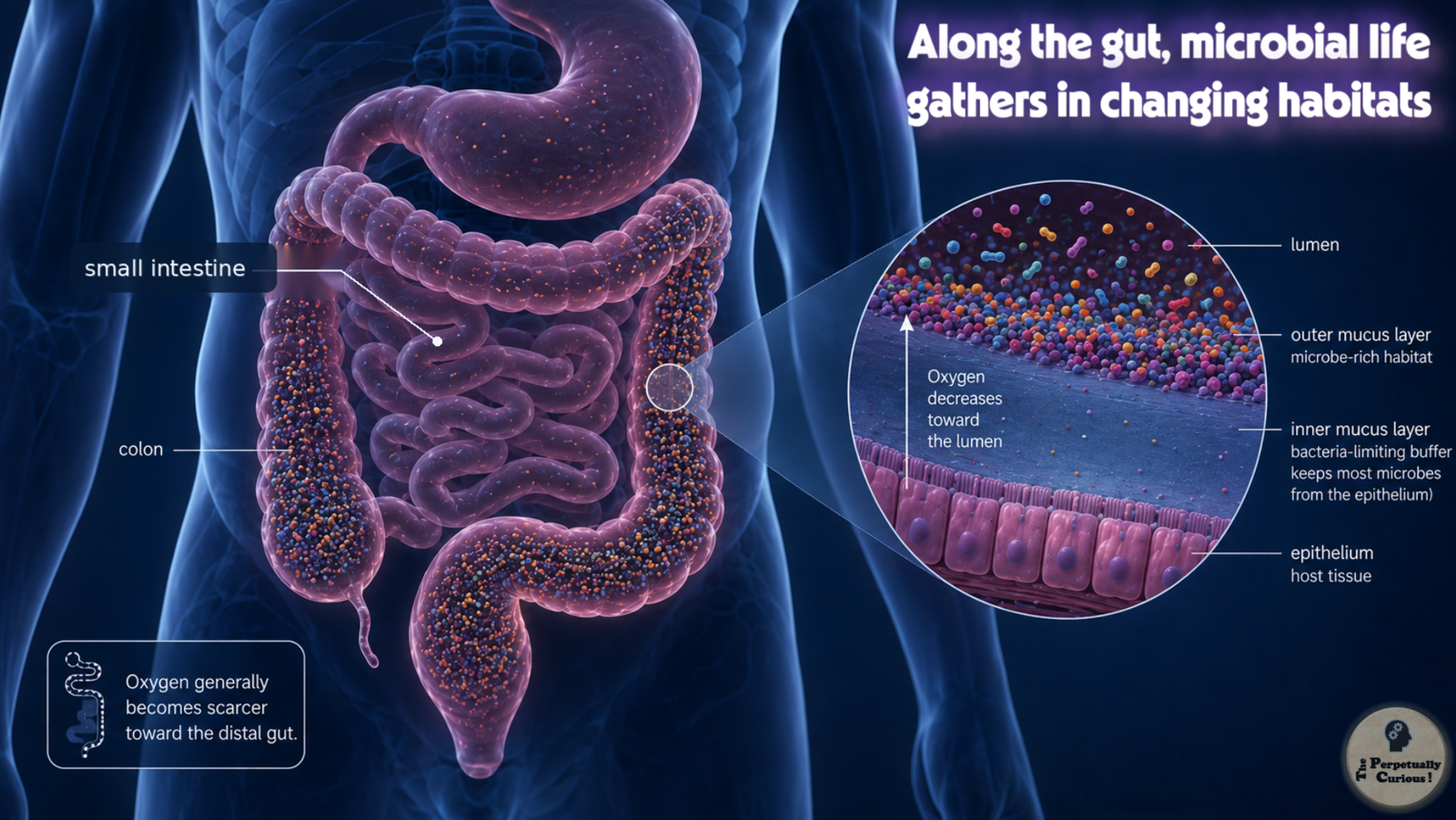
In the small intestine, millions of fingerlike projections called villi increase the surface area available for nutrient absorption. Microbial populations are generally less dense there than in the colon because food moves more quickly and conditions are influenced by oxygen, bile acids, digestive enzymes, and host secretions. The large intestine offers a slower, more densely populated environment where microbes can ferment compounds that escaped digestion earlier in the tract.
Chemical gradients further divide this landscape. Oxygen generally becomes scarcer toward the lower intestine and from the tissue surface toward the intestinal contents, while acidity, transit time, bile acids, nutrients, and water availability favor different microbial groups. Many microorganisms live within the intestinal contents or in outer mucus-associated habitats. In the healthy colon, a denser inner mucus layer helps keep most bacterial communities separated from the epithelial surface.[2]
The gut wall is not guarded by a single line of immune cells. Immune cells are distributed through the epithelium, the underlying lamina propria, and organized gut-associated lymphoid tissues. Together with mucus, epithelial cells, and antimicrobial compounds, these tissues form an active barrier that continually senses microbial signals while limiting unwanted penetration.
Within this varied landscape, microorganisms encounter different resources and constraints. The next question is how they use those conditions to transform nutrients, exchange metabolites, and carry out their biochemical work.
🍽️ Microbial work in progress: digestion, fermentation, and nutrient production
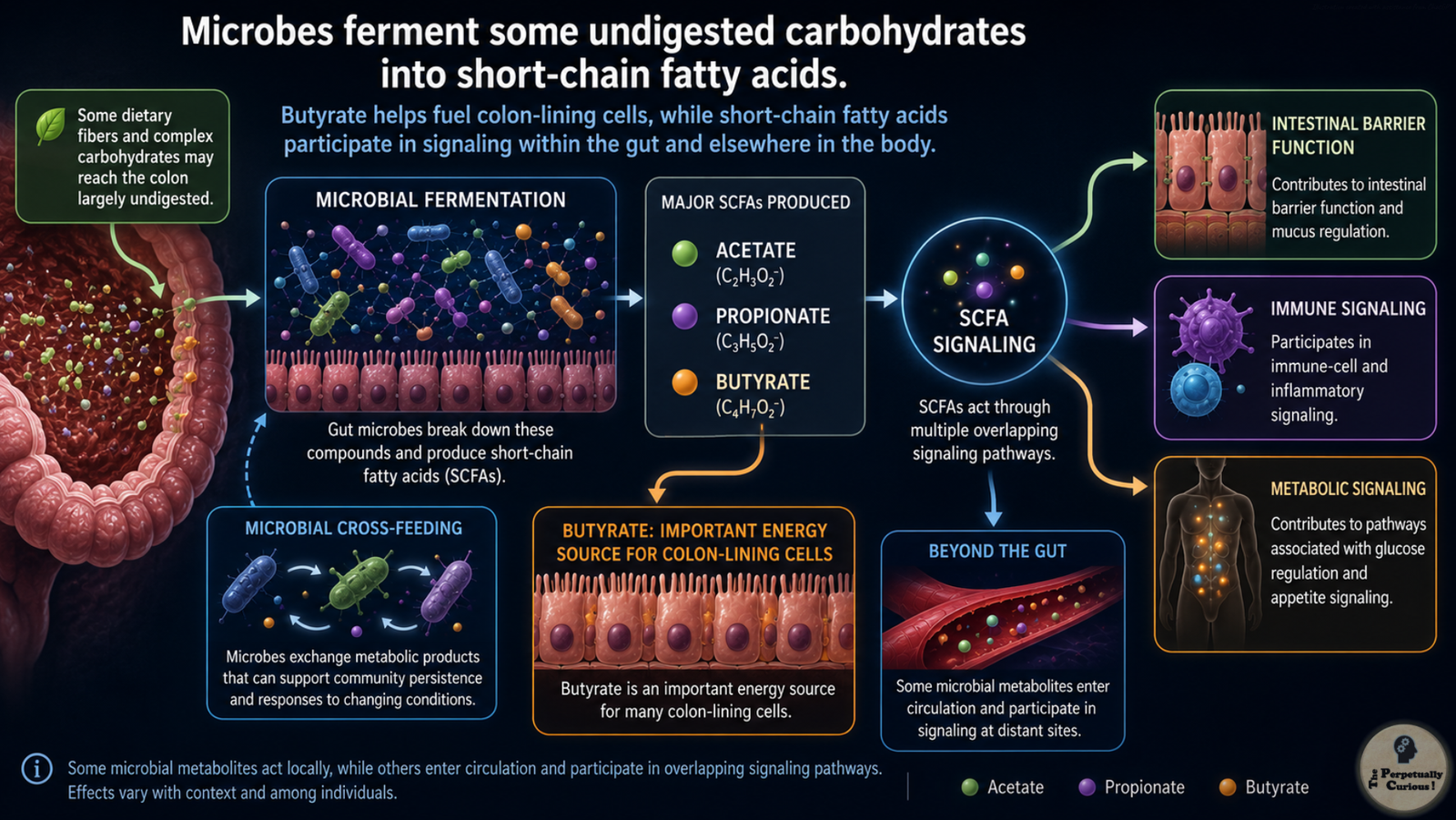
One of the most direct contributions of the gut microbiome is the breakdown of dietary compounds that human enzymes cannot fully digest. Complex carbohydrates and certain fibers may reach the large intestine largely intact. There, microbial communities ferment them and produce short-chain fatty acids, including acetate, propionate, and butyrate. Butyrate is an important energy source for many cells lining the colon, while these molecules collectively participate in metabolic and immune signaling within the gut and elsewhere in the body.
This internal process differs from the microbial transformations used to produce fermented foods, which occur before consumption, although both involve microorganisms reshaping available compounds.
Short-chain fatty acids can bind to receptors on intestinal, immune, and metabolic cells, influencing pathways associated with glucose regulation, appetite, barrier function, and inflammatory responses. Their effects depend on concentration, location, host physiology, and the wider microbial community, so they should not be understood as uniformly beneficial in every context.[2]
Gut microorganisms also possess pathways that can produce vitamin K and several B vitamins. The amount produced, the location of production, and the extent to which these compounds become available to the host vary considerably. Microbial contributions therefore complement, rather than replace, nutrients obtained through diet.
Many organisms also exchange metabolic products through cross-feeding. One species may release a compound that another organism uses as a source of energy or as material for further transformation. These exchanges can support community persistence and help microbial populations respond to changes in diet and intestinal conditions, although cooperation exists alongside competition for space and resources.
The products of microbial metabolism do not remain confined to the microorganisms that produce them. They are sensed by epithelial and immune cells, creating a direct path from digestion and fermentation to the immune relationships embedded within the gut.
🛡️ Guardians at the gate: microbiome and immune system
The gastrointestinal tract contains extensive immune tissue and a large, diverse population of immune cells. This concentration reflects the gut’s role as a major boundary between the body and material arriving from the outside world. Food components, microorganisms, and environmental compounds move through the intestinal lumen, while mucus, epithelial cells, antimicrobial molecules, and immune tissues work together to regulate what remains separated, what is tolerated, and what requires a defensive response.
Resident microbes can contribute to this protection by competing with potentially harmful organisms for nutrients and attachment sites, producing compounds that inhibit some competitors, and supporting conditions that help maintain the intestinal barrier. These effects are not identical across all species or circumstances. The same organism may behave differently depending on its location, abundance, surrounding community, and the condition of the host.
Microbial signals also participate in the development and regulation of immune responses. During early life, exposure to a changing microbial community helps shape the maturation of immune tissues and the distinction between tolerated signals and possible threats. This process is distinct from adaptive immune memory, which enables recognition of previously encountered threats. Infections such as measles can disrupt that memory. The relationship between microbes and immunity continues throughout life as immune activity influences which organisms can persist, while microbial products affect epithelial and immune-cell behavior.
Changes in community composition or function are often described as dysbiosis. The term identifies a departure from an expected microbial pattern, but it does not represent one universal condition or establish a diagnosis by itself. Dysbiosis has been associated with many disorders, although it may act as a cause, a consequence, a contributing factor, or simply a correlated feature depending on the condition being studied.[2]
Because immune signaling is closely connected with nutrient use, energy balance, and inflammatory regulation, these local relationships also provide a path toward the microbiome’s wider metabolic effects.
⚙️ Metabolism, energy, and the wider body
The gut microbiome may influence metabolism through several interconnected pathways. By fermenting dietary compounds and producing short-chain fatty acids, microbial communities can affect how nutrients are processed and how metabolic signals are transmitted. These metabolites can interact with receptors in the intestine and other tissues, contributing to pathways involved in glucose regulation, appetite, lipid metabolism, immune activity, and intestinal barrier function. Their effects vary with concentration, location, diet, host physiology, and the composition of the wider microbial community.
Gut microorganisms can also transform bile acids after they enter the intestine. These modified molecules do more than support fat digestion. They can act as signaling compounds that interact with receptors involved in glucose balance, lipid metabolism, inflammation, and energy regulation. Because bile acids also influence which microbes can thrive, the relationship operates in both directions.
Studies have identified associations between certain microbial patterns and conditions such as obesity and type 2 diabetes. These findings do not establish one universal microbial cause. Diet, genetics, medications, physical activity, environment, and existing disease can all shape both metabolism and microbial composition. For this reason, researchers increasingly focus on community function, metabolic products, and host context rather than dividing microorganisms into fixed categories of “good” and “bad.”
Metabolic signals are also one route through which the gut may communicate beyond the digestive system. Alongside immune, hormonal, and neural pathways, they form part of the wider gut–brain axis, where the next layer of the microbiome’s influence begins to emerge.
🧠 The gut–brain conversation: signals across the body
One of the most intriguing areas of microbiome research involves the gut–brain axis, a network of bidirectional communication between the gastrointestinal tract and the central nervous system. This exchange does not occur through one pathway alone. The vagus nerve carries signals between the brainstem and organs of the digestive tract, while immune mediators, hormones, and microbial metabolites can influence communication across the body.
Some microbial products act locally on intestinal cells or stimulate neural and endocrine responses without entering the brain themselves. Others may circulate through the bloodstream, and a limited number can cross physiological barriers under particular conditions. Their effects depend on concentration, host physiology, barrier integrity, and interactions with many other signaling systems.
Gut microorganisms can also influence the metabolism of tryptophan, an amino acid used in several biological pathways, including those related to serotonin, kynurenine, and microbial indole compounds. Much of the body’s serotonin is produced outside the central nervous system, particularly by enterochromaffin cells in the intestine, and this peripheral serotonin does not freely cross the blood-brain barrier. Microbiome-related effects on the brain are therefore thought to arise through combinations of neural, immune, endocrine, and metabolic signaling rather than through a simple transfer of intestinal serotonin into the brain.[3]
Human studies have reported associations between microbial patterns and mood, stress responses, cognition, and certain neurological conditions. These findings remain heterogeneous and do not establish a single microbial cause. Evidence for specific mechanisms is often stronger in experimental models than in broad human populations, where diet, medication, environment, genetics, and existing health conditions can all influence the results.[3]
The emerging picture is not of microbes directing the brain, but of microbial activity contributing one set of signals within a much larger physiological conversation. Understanding that conversation requires methods capable of separating microbial presence, genetic potential, biological activity, and host response.
🔬 How scientists study the microbiome: tools for an invisible world
Because the gut microbiome is microscopic, diverse, and constantly changing, researchers use several complementary methods to study it. No single test can capture the full community, its spatial organization, and all of its activity at once. Most investigations begin with samples such as stool, intestinal contents, or tissue-associated material, each of which represents a different part of the gut environment.
One widely used approach is 16S ribosomal RNA gene sequencing, which examines selected regions of a conserved microbial gene to estimate the bacterial and, in some studies, archaeal groups present in a sample. This method is useful for describing broad community patterns, but it may not distinguish closely related species or strains, and it does not directly reveal what microbial genes are doing. Shotgun metagenomic sequencing examines a much wider collection of community DNA, providing greater taxonomic detail and identifying genes associated with possible biological functions.
Many sequencing results describe relative abundance rather than absolute microbial numbers. A group may appear to become more prominent because another group declined, even when its own cell count did not increase. For this reason, changes in proportional composition must be interpreted carefully and, when possible, considered alongside measurements of total microbial abundance.[4]
Metagenomic data reveal functional potential rather than direct evidence that a pathway is active. To investigate activity more closely, researchers may use metatranscriptomics to examine RNA expression, metaproteomics to identify proteins, and metabolomics to measure chemical products. These layers can be combined with information about diet, medications, immune responses, and host physiology to build a more complete picture of microbial function.
Much microbiome research has concentrated on bacteria. The gut’s viruses, fungi, archaea, and their interactions with bacterial communities are increasingly studied, but they remain less completely characterized. This imbalance means that even sophisticated microbial surveys may capture some parts of the ecosystem more fully than others.
Interpretation also depends on where and how a sample is collected. Stool samples provide valuable information, especially about microorganisms and metabolites shed from the colon, but they do not perfectly represent communities living higher in the digestive tract or closely associated with mucosal surfaces. Sampling procedures, storage conditions, laboratory methods, analytical databases, and study populations can all influence the results.
Research has shown that microbiomes vary substantially among individuals and across time. Genetics may contribute to some patterns, but diet, environment, age, medications, illness, geography, and life history also shape microbial communities. For this reason, scientists have not established one universal microbial profile that defines a healthy gut for every person.
These methodological limits matter beyond the laboratory. As microbiome findings move into public discussion and commercial interpretation, understanding what each method can and cannot show becomes essential to communicating the science responsibly.
📚 Ethics, communication, and intellectual humility in microbiome science
The rapid growth of microbiome research has brought widespread public interest in the organisms that inhabit the human body. That curiosity can deepen understanding of biology and interconnected systems, but it can also encourage explanations that move faster than the evidence. Microbiome findings are often complex, population-dependent, and sensitive to sampling and analytical methods. Responsible communication therefore requires clear distinctions between association and causation, functional potential and measured activity, and promising hypotheses and established conclusions.
Commercial microbiome testing illustrates these challenges. Different services may use different sampling procedures, sequencing methods, reference databases, and interpretive models, which can produce substantially different descriptions of the same person’s microbial community. Because there is no single universally accepted profile of a healthy microbiome, an individual stool report cannot by itself provide a complete or definitive assessment of intestinal health.[4] These limitations do not make microbiome testing scientifically meaningless, but they do require restraint in how results are presented and understood.
Ethical questions also arise around data ownership, privacy, informed consent, and the future use of biological samples. Microbiome data may reveal information not only about microbial communities but also about diet, environment, medication exposure, and aspects of host biology. Researchers, laboratories, and testing organizations therefore carry responsibilities concerning how samples and associated information are collected, stored, analyzed, shared, and explained.
The populations represented in microbiome research also matter. Some regions, communities, and ways of life have been studied far more extensively than others, so existing reference datasets should not be mistaken for complete maps of global microbial diversity. Findings drawn from one population may not transfer neatly to another when diet, geography, living conditions, healthcare access, medication use, and environmental exposures differ.
The microbiome is also shaped by food traditions, cultural practices, and everyday patterns of living. No single dietary pattern, microbial profile, or way of life can serve as a universal biological standard. An inclusive approach recognizes variation without ranking communities or cultures against one presumed ideal.
Intellectual humility is therefore not a retreat from scientific understanding. It is part of scientific rigor. By stating what is known, what remains uncertain, whose data are represented, and how conclusions were reached, microbiome science can invite curiosity without turning complexity into certainty. From that position, the article can return to the reader and to the quiet wonder of living alongside an unseen community that science is still learning to understand.
🌙 A quiet invitation to wonder: the microbiome as a companion
The gut microbiome is more than a collection of organisms or a catalog of biochemical pathways. It is a changing ecological community that participates in digestion, immune regulation, metabolism, and communication across the body. Its members compete, cooperate, adapt, and respond to conditions within the gut, while the body continually shapes the environment in which they live.
The scientific details are intricate, but they reveal a quietly profound idea: the human body does not function in isolation. It exists in continuous relationship with microbial communities that develop alongside it and respond to diet, environment, medication, illness, age, and many other influences. These relationships are neither uniformly helpful nor harmful, and they cannot be reduced to a simple balance between “good” and “bad” organisms.
This perspective can invite wonder without turning uncertainty into certainty. A meal may alter the nutrients available to microbial communities. Stress and physiological change may influence the gut environment through neural, hormonal, and immune pathways. In turn, microbial products may become part of the body’s wider signaling networks. Each effect depends on context, and much remains to be understood.
Microbes are not hidden directors of human life, nor are they passive passengers. They are participants in a shared and responsive system whose patterns continue to emerge through careful research. The story of the microbiome is therefore not one of perfect harmony, but of relationship, adaptation, disturbance, and ongoing discovery.
Pass this article along to someone curious and let the learning travel.
💡 Did you know?
🌿 The gut contains steep oxygen gradients. Oxygen generally becomes scarcer from the upper digestive tract toward the colon and from the tissue surface toward the intestinal contents. These gradients help determine which microbial groups can persist in different regions.
🧩 Microbes can communicate through chemical signals. Many microorganisms use quorum-sensing systems that allow members of a population to coordinate gene expression as their numbers and surroundings change. These signals may influence activities such as biofilm formation, competition, and the production of shared extracellular compounds.
🌐 Microbial neighborhoods form across different gut habitats. Many microorganisms live within intestinal contents or in the outer mucus layer. In the healthy colon, a denser inner mucus layer normally helps prevent large bacterial communities from reaching the epithelial surface, creating an important spatial boundary between microbes and host tissue.
🧭 Microbial communities can reorganize after disturbance. Illness, antibiotic exposure, travel, or major dietary changes may alter the composition and activity of the gut microbiome. Some communities move toward an earlier state, while others recover only partly or settle into a different configuration.
🧪 Some microbes help transform environmental compounds. Certain gut microorganisms can modify xenobiotics, which are substances originating outside the body. These transformations may change how particular compounds are activated, deactivated, absorbed, or eliminated, although the effects vary among compounds, microbial communities, and individuals.
🔬 Stool samples reveal only part of the gut ecosystem. They are especially useful for studying microorganisms and metabolites shed from the colon, but they do not perfectly represent communities living higher in the digestive tract or closely associated with mucosal surfaces.
🌙 Microbial activity can follow daily rhythms. Feeding schedules, sleep-wake patterns, hormones, and host metabolism may influence microbial composition and activity across the day. These fluctuations interact with the body’s wider biological clocks, adding a temporal dimension to the gut ecosystem.
What is the difference between “microbiome” and “microbiota”?
“Microbiota” refers to the microorganisms inhabiting a particular environment. “Microbiome” is often used more broadly for those organisms together with their genes, functions, chemical products, and ecological setting, although scientific usage is not completely uniform.
How many bacterial cells live in the human gut?
Current estimates place the number of bacterial cells in the human body in the tens of trillions, with the large majority concentrated in the colon. The exact number varies among individuals and over time.[1]
Does everyone have the same gut microbiome?
No. Microbial communities vary considerably among individuals. Age, diet, environment, geography, medications, illness, early-life exposures, and other aspects of life history all contribute to these differences.
Is there a single definition of a “healthy” microbiome?
No universally accepted microbial profile defines a healthy gut for every person. Researchers instead consider community function, stability, resilience, host health, and the presence or absence of biological disturbances within a broader context.
Does the microbiome change over time?
Yes. The microbiome changes rapidly during infancy and early childhood as diet, environment, and the immune system develop. Adult communities may become more stable, but they continue to respond to aging, diet, medication, illness, travel, and other changes. Some viral illnesses may also be followed by post-viral digestive changes involving motility, barrier function, or microbial composition, although these effects vary and do not occur in everyone.
Do microbes live directly on the gut wall?
Most gut microorganisms live within intestinal contents or in outer mucus-associated habitats. In the healthy colon, a denser inner mucus layer helps keep large bacterial communities separated from the epithelial surface while still allowing microbial products and host signals to interact across the barrier.
How do scientists study the gut microbiome?
Researchers use methods such as 16S ribosomal RNA gene sequencing, shotgun metagenomic sequencing, metatranscriptomics, metaproteomics, and metabolomics. Each method captures a different layer of the community, from which organisms and genes are present to which molecules are being expressed or produced.
Can a commercial microbiome test determine whether a person’s gut is healthy?
Not reliably on its own. Commercial tests may differ in sampling procedures, sequencing methods, reference databases, and interpretation. A stool sample also represents only part of the intestinal ecosystem, and no universal microbial profile currently defines health for every individual.[4]
What is dysbiosis?
Dysbiosis describes a change in microbial composition or function relative to an expected pattern. It is not one universal condition or a precise diagnosis. Depending on the context, it may be a cause, consequence, contributing factor, or correlated feature of illness.
Does microbial diversity matter?
Diversity can contribute to ecological resilience, but greater diversity is not automatically healthier in every setting. The identities, functions, locations, and interactions of community members may be more informative than diversity alone.
Can the gut microbiome influence mood or cognition?
Research suggests that the gut and brain communicate through neural, immune, endocrine, and metabolic pathways collectively described as the gut–brain axis. Microbial patterns have been associated with mood, stress responses, cognition, and some neurological conditions, but human findings remain complex and do not establish simple cause-and-effect relationships.[3]
Can microbes influence gut movement?
Microbial metabolites may affect intestinal nerves, smooth muscle activity, immune signaling, and hormone release, all of which can contribute to gut motility. These relationships remain under investigation and depend on both microbial and host factors.
Do microbial communities follow daily or seasonal patterns?
Some microbial populations and activities fluctuate across the day in relation to feeding, sleep-wake cycles, hormones, and host metabolism. Seasonal changes have also been observed in certain populations, especially where diet and living conditions vary markedly across the year, but these patterns are not universal.
Do microbes interact with compounds from the environment?
Yes. Some microorganisms can transform xenobiotics, including dietary compounds, pollutants, and medications. These transformations may change how particular substances are activated, deactivated, absorbed, circulated, or eliminated.
Continue through the wider landscape of Biology and Health articles, where the body’s rhythms, signals, defenses, and changing systems meet.
🌍 Let curiosity travel beyond this page
If this exploration of the gut microbiome has sparked curiosity or offered a new way of seeing the human body, consider sharing it with friends, family, or colleagues. A thoughtful article can travel quietly from one reader to another, opening fresh paths of wonder along the way.
By passing this piece forward, you may help someone else discover the remarkable microbial communities that live within us and the many ways they participate in the larger story of human life.
A gentle note: This exploration of the gut microbiome is offered for educational information only and is not medical advice. Microbiome findings vary among individuals and should not be used alone to diagnose or treat a health condition. A qualified healthcare professional is the appropriate resource for personal symptoms, testing questions, or treatment decisions.
Selected sources
- Sender R, Fuchs S, Milo R. (2016). Revised Estimates for the Number of Human and Bacteria Cells in the Body. PLOS Biology, 14(8), e1002533. [PMID: 27541692]
- Thursby E, Juge N. (2017). Introduction to the human gut microbiota. Biochemical Journal, 474(11), 1823-1836. [PMID: 28512250]
- Cryan JF, O’Riordan KJ, Cowan CSM, et al. (2019). The Microbiota-Gut-Brain Axis. Physiological Reviews, 99(4), 1877-2013. [PMID: 31460832]
- Porcari S, Mullish BH, Asnicar F, et al. (2025). International consensus statement on microbiome testing in clinical practice. The Lancet Gastroenterology & Hepatology, 10(2), 154-167. [PMID: 39647502]
“Listening to the Hidden City Within: Understanding the Gut Microbiome.” The Perpetually Curious!, July 2026.
https://www.theperpetuallycurious.org/articles/gut-microbiome/Continue Exploring
For the curious mind: want to explore this theme through a few questions? Visit the Classic Quiz Studio, nestled under Explorations opens in a new tab ,and see where a few well-placed questions lead: Biology & Health Quizzesopens in a new tab
For what comes next
Site Updates gathers occasional notes, new additions, and ways to keep in touch. RSS brings new publications to your feed reader in chronological order.
Choose the path that speaks to you, and let the next curiosity find you wherever your wondering takes you.