

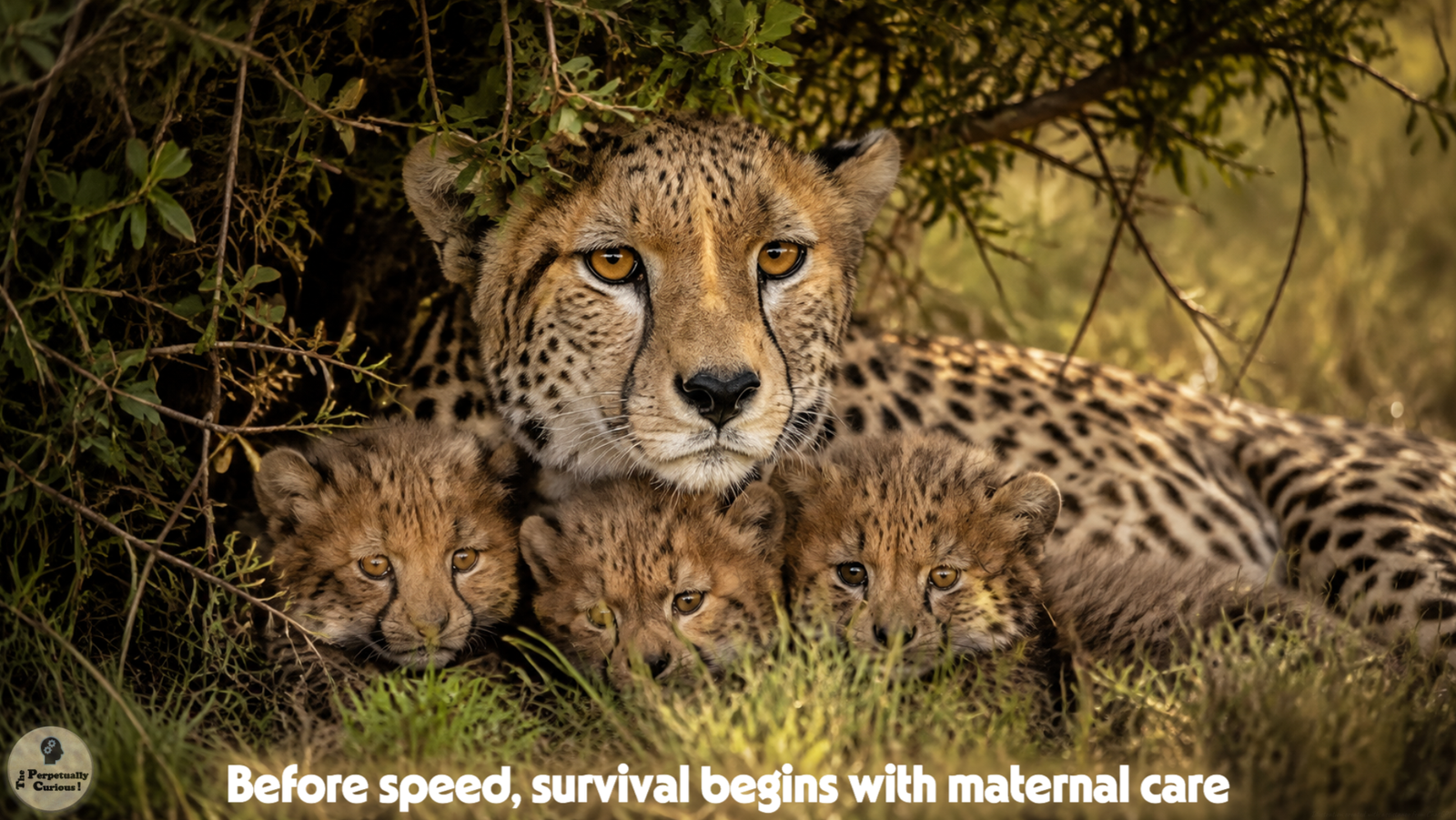
The story of a baby cheetah begins in a place few eyes ever see. Long before speed defines the adult, a cub’s earliest days unfold in a hidden den, where concealment, shelter, and maternal care shape its chances of survival. Newborn cubs arrive small, with their eyes closed and a pale mantle of longer fur along their backs. They depend entirely on a mother who must leave them hidden while she hunts, then return to nurse, relocate, and protect them.
From those concealed beginnings, development unfolds gradually. Senses sharpen, movement becomes steadier, play begins to resemble practice, and observation of the mother helps prepare the cubs for hunting. By the time young cheetahs separate from her, their journey has carried them from hidden vulnerability toward an independent life shaped by movement, temporary sibling bonds, and the landscapes around them. That long transition begins within the fragile refuge of the den.
In the hush of early grass, a small life learns the shape of the world.
Each step gathers its own courage, each moment a quiet thread in the long weave of the savanna.
And in that slow unfolding, the future begins its gentle rise.
🌾 A fragile beginning in a hidden den
A newborn cheetah cub typically weighs about 5 to 14 ounces (150 to 400 grams). Gestation lasts roughly 90 to 95 days, after which a mother commonly gives birth to three to five cubs. Their first shelter is usually concealed in tall grass, beneath shrubs, or among rocks, where cover helps reduce the chance of detection by predators. During these earliest days, the cubs depend entirely on their mother for warmth, milk, and protection.
Lactation places substantial demands on the mother, yet she must still leave the den to hunt. Because her ability to defend the litter directly against larger carnivores is limited, concealment becomes one of the cubs’ most important protections. The den is therefore more than a birthplace. It is a temporary refuge shaped by stillness, cover, and the mother’s repeated returns.
As the cubs grow, their survival depends increasingly on more than the den itself. The mother’s vigilance, hunting schedule, and decisions about when and where to relocate the litter begin to define the next stage of their early lives.
🛡️ Maternal care in the earliest days
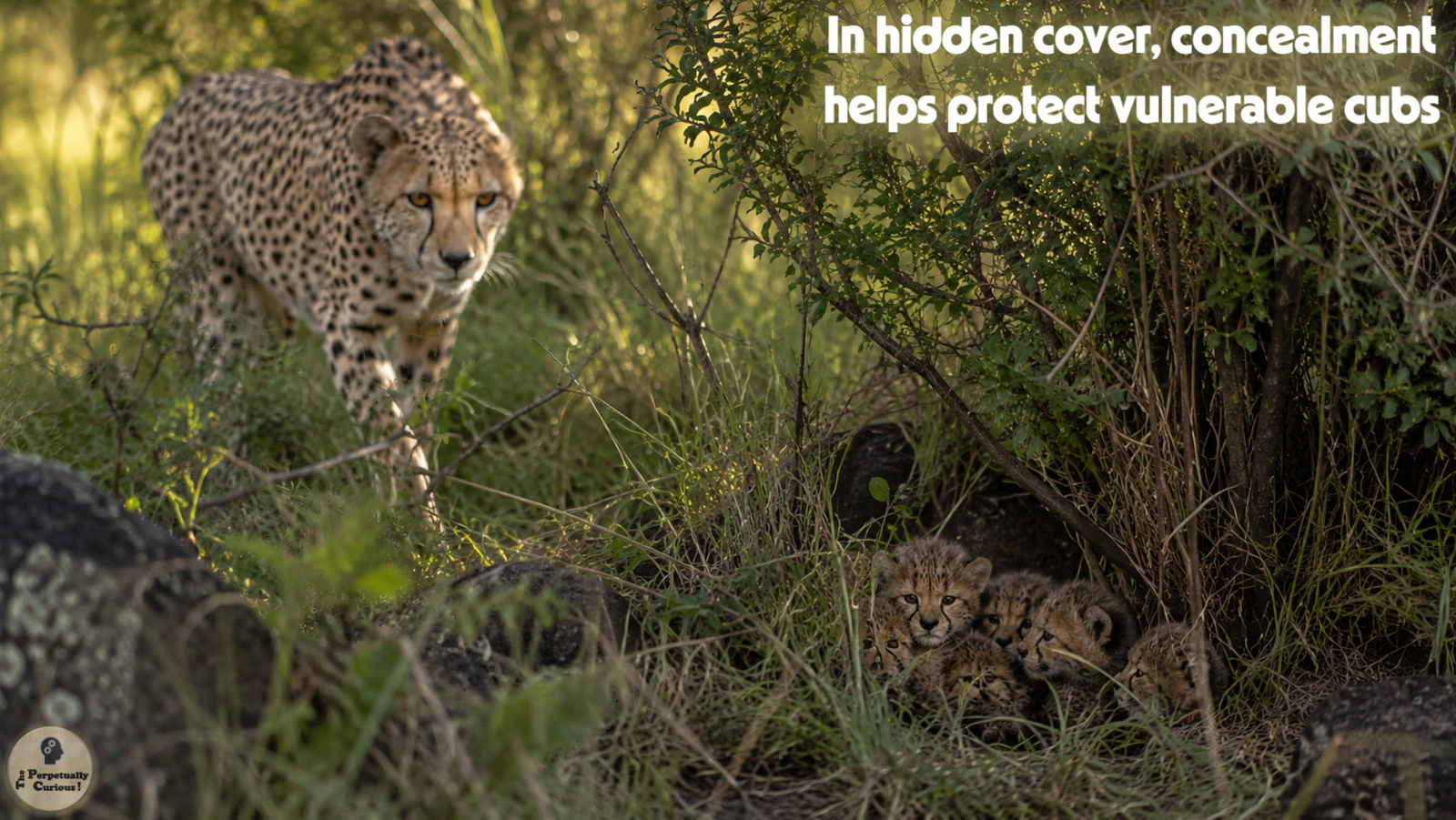
Adult female cheetahs are generally solitary except while raising cubs, and the mother provides their care alone. Male cheetahs may live singly or form coalitions, but they do not normally participate in rearing offspring. The mother must therefore balance two competing demands: leaving the litter to hunt and returning often enough to nurse and protect cubs that remain vulnerable in her absence.
For roughly the first six to eight weeks, the cubs remain within or close to concealed den sites. The mother may relocate them every few days, reducing the chance that predators such as lions, hyenas, or leopards will repeatedly encounter the same hiding place. Her movements are shaped by the need to find prey while staying within reach of the litter.
Nursing continues for several months as the cubs gradually begin eating meat. Survival during this period varies among populations and habitats, but losses can be substantial, especially where predator pressure is high or the mother is lost. Early life is therefore shaped not by a single protective behavior, but by a continuing cycle of concealment, hunting, return, and relocation.
While the mother manages that cycle, the cubs are changing rapidly within the den. Their eyes begin to open, hearing develops, and their awareness of the surrounding world gradually expands.
👁️ Emerging senses and early awareness
Cheetah cubs are born with their eyes closed, and they typically begin opening them between about 4 and 11 days after birth. Hearing also develops during the early weeks, allowing the cubs to respond more readily to their mother’s movements and calls within the den.
As these senses develop, the cubs become increasingly responsive to movement, sound, and changes in their immediate surroundings. This growing awareness supports more active interactions with their littermates and gradually prepares them for the wider environment beyond the den.
Sensory development unfolds alongside visible physical change. Among the most distinctive features of this early stage is the pale mantle of longer fur extending along a young cub’s back.
🌿 The mantle and a changing coat
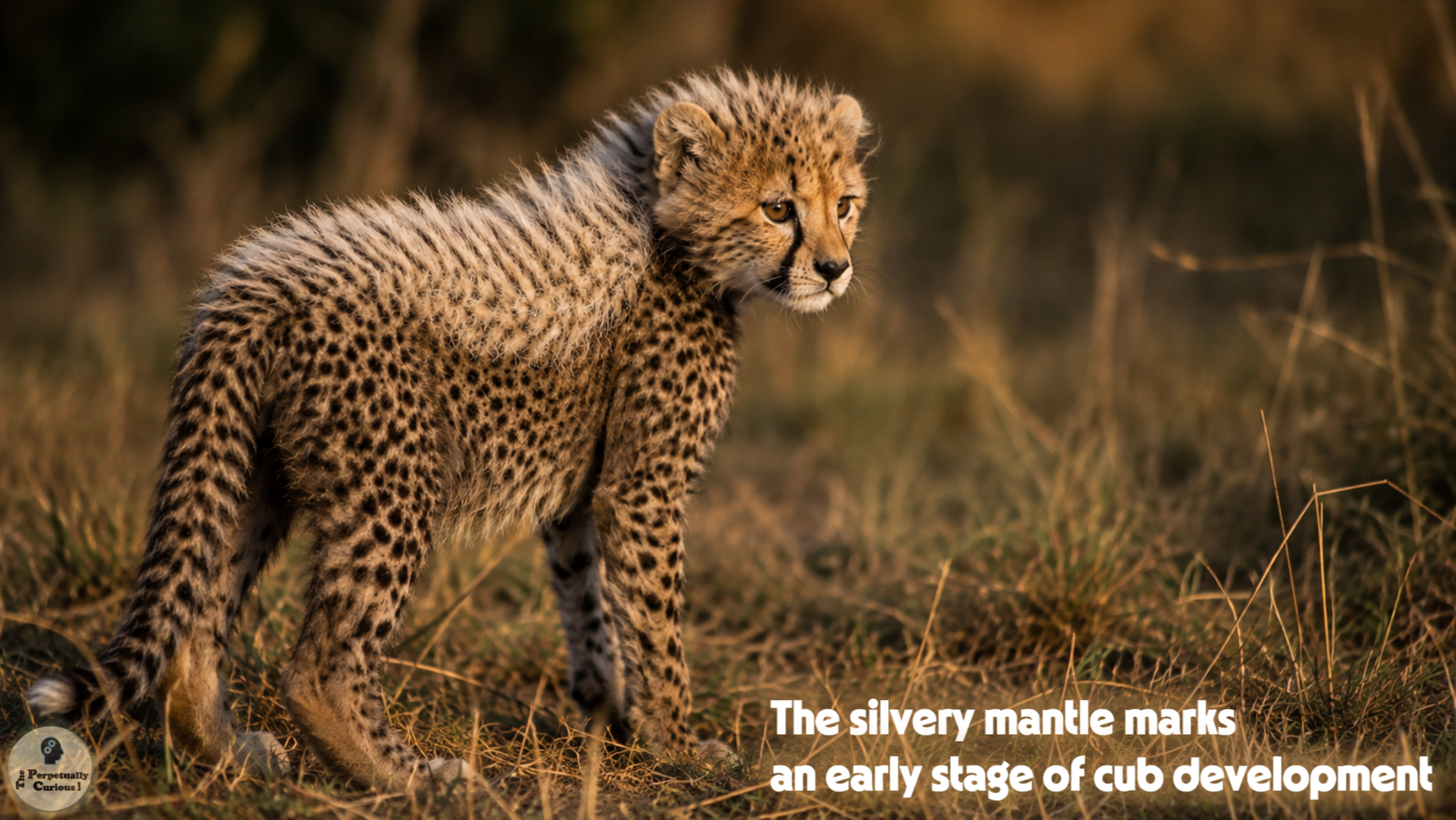
One of the most distinctive features of a young cheetah cub is its mantle, a band of longer silvery or grayish fur extending along the back. The mantle may help the cub blend with dry grasses, broken shadows, and uneven vegetation. It may also provide some warmth during the earliest months, although its precise functions are not fully established.
Some researchers have proposed that the mantle makes a cub resemble a honey badger, an animal that certain predators may be reluctant to approach. This remains an intriguing hypothesis rather than a confirmed example of mimicry, so the resemblance is best treated cautiously.
The mantle usually begins to thin after the first few months and may remain partly visible into the cub’s first year. As it recedes, the spotted coat and leaner proportions associated with older cheetahs become increasingly prominent. These visible changes unfold alongside improving strength, balance, and coordination, preparing the cubs for their first movements beyond the shelter of the den.
🐾 First steps into the wider world
At about six to eight weeks of age, cheetah cubs begin accompanying their mother beyond the den. These first excursions are brief and cautious, and the mother continues to select resting places with nearby cover. The cubs follow close behind her, investigate their surroundings, and attempt short bursts of running. Their movements are uneven at first, but balance and coordination improve as they learn to follow their mother’s direction and pace.
During this same period, the cubs may begin eating small amounts of meat while continuing to nurse. The transition is gradual, with milk remaining important as meat becomes an increasing part of their diet. By travelling with their mother, the cubs also begin observing how she moves through cover, responds to nearby animals, and approaches prey.
Exploration therefore becomes an early form of preparation. Walking, running, watching, and following gradually develop into the playful chases, turns, and pounces through which young cheetahs begin rehearsing the movements of a hunt.
🎯 Practice, play, and the making of a hunter
Cheetah hunting depends on stealth, timing, balance, and sudden acceleration. Cubs do not acquire these abilities all at once. Their earliest preparation appears through play, as they chase siblings, pounce, wrestle, stalk moving objects, and attempt rapid changes of direction. These repeated movements help develop coordination, strength, and control while allowing the cubs to rehearse parts of the hunting sequence.
By about six months of age, a mother may capture live prey and allow the cubs to pursue it. Their first attempts are often hesitant and poorly coordinated. They may mistime a chase, lose balance during a turn, or struggle to subdue the animal. Through repeated opportunities, they begin connecting pursuit with the final actions needed to secure prey.
Speed is only one part of this development. A young cheetah must also learn when to remain still, when to begin a pursuit, how to change direction without losing control, and how to bring a chase to an effective end. The slow road to speed is therefore also a road toward judgment, timing, and control.
During the following months, the cubs accompany their mother more frequently and gain experience around active hunts. Their ability to hunt independently develops gradually as they approach separation from her, commonly at around 18 months. By then, play has become practical experience, and the sibling bonds formed during development begin to influence the paths they follow after the family group separates.
🧭 Independence and the branching of paths
Sibling relationships remain important as young cheetahs approach independence. Cubs chase, wrestle, rest, and explore together, and these shared experiences help refine coordination and social awareness. Young cheetahs commonly separate from their mother at around 18 months, although timing varies. Littermates may then continue travelling together for a time before their paths begin to diverge.
Young males often move farther from the maternal range. Brothers may remain together and form coalitions, sometimes joined by an unrelated male. These alliances can support shared hunting, territorial defense, survival, and access to females, and some persist for many years. Young females usually become solitary, but they may establish home ranges near or partly overlapping their mother’s range rather than dispersing over the same distances as males.
Independence therefore does not lead to one uniform outcome. The family group gradually divides into different social patterns, carrying the cubs from maternal dependence into adult lives shaped by sex, kinship, habitat, and opportunity. From that point onward, survival depends not only on what they have learned, but also on the wider ecological conditions through which they must move.
🌍 The wider landscape around young cheetahs
The pressures surrounding cheetah cubs extend beyond the vulnerable months spent near the den. Habitat loss and fragmentation can reduce access to prey, restrict movement across the landscape, and bring cheetahs into closer contact with livestock and people. Competition and predation from larger carnivores also influence cub survival, although their effects vary with region, vegetation cover, prey abundance, and the mother’s ability to find secure denning and resting sites.
Research on maternal behavior, cub survival, habitat use, and population change helps scientists identify the conditions under which young cheetahs are more likely to reach adulthood. These observations contribute to population assessments and to locally adapted efforts to maintain connected habitat and reduce conflict between cheetahs and surrounding communities.
The early life of a cheetah is therefore part of a much wider ecological story. The hidden den, the fading mantle, the first excursions, and the gradual acquisition of hunting skill all unfold within African wildlife and landscapes where cover, prey, movement, competition, and human land use shape the conditions in which a mother raises her cubs.
Pass this article along to someone curious and let the learning travel.
💡 Did You Know?
🎵 Calls help maintain family contact
Cheetah cubs use chirps, mews, yelps, and other vocalizations to communicate with their mother and littermates. These calls may help family members locate one another through vegetation, signal distress, or restore contact after temporary separation.
🌀 Play becomes practice
For cheetah cubs, chasing, pouncing, wrestling, and turning rehearse movements later used in hunting. A related developmental role appears in young elephants at play, where movement and social interaction help build coordination and social understanding, although the adult skills of the two species differ greatly.
🌦️ Seasonal timing differs among populations
Cheetahs can reproduce throughout the year, but local rainfall and prey cycles may influence when conception and birth are most common. In strongly seasonal environments, conceptions may peak during wetter periods while births occur about three months later, so no single seasonal pattern applies across the species’ range.
What are baby cheetahs called?
Baby cheetahs are called cubs. The same term is used for the young of several other large cat species.
How much does a baby cheetah weigh at birth?
A newborn cheetah cub typically weighs about 5 to 14 ounces (150 to 400 grams). Its small size and complete dependence on maternal care make a concealed den especially important during the earliest weeks.
When do cheetah cubs open their eyes?
Cheetah cubs usually begin opening their eyes between about 4 and 11 days after birth. Their vision continues developing as they become more responsive to movement and activity within and around the den.
Why does a mother cheetah move her cubs between hiding places?
During the first six to eight weeks, a mother may relocate her litter every few days. Changing den sites helps prevent one location from remaining predictable and may reduce the chance that predators will repeatedly encounter the cubs. Each new site must still provide enough cover for the mother to leave the litter while she hunts.
What is the mantle on a cheetah cub?
The mantle is a band of longer silvery or grayish fur along a young cub’s back. It may help the cub blend with grasses, broken shadows, and uneven vegetation. Its resemblance to a honey badger has also inspired a protective mimicry hypothesis, although that idea has not been conclusively established.
What do cheetah cubs eat as they grow?
Cubs depend on milk during their earliest weeks and may begin eating small amounts of meat at around six weeks. Nursing and meat consumption overlap for several months as the cubs gradually move toward a meat-based diet.
How do cheetah cubs communicate with their mother?
Cubs use chirps, mews, yelps, and other calls to maintain contact, indicate distress, or help family members locate one another. These vocalizations vary in intensity and purpose.
How do cheetah cubs learn to hunt?
Cubs first rehearse hunting movements through chasing, stalking, pouncing, wrestling, and rapid turns during play. They also observe their mother and later gain experience pursuing live prey that she captures and allows them to chase. The long learning period reflects the fact that successful hunting requires timing and control as well as speed.
Why does it take so long for a cheetah cub to become an independent hunter?
Running is only one part of hunting. Young cheetahs must learn how to approach prey without being detected, judge when to begin a chase, turn without losing control, subdue an animal, and complete the hunt successfully. Play and observation begin early, but practical experience develops across many months.
How long do cheetah cubs stay with their mother?
Young cheetahs commonly remain with their mother until around 18 months of age, although the timing varies. During this period, they gain experience in travelling, recognizing danger, approaching prey, and hunting. Littermates may remain together temporarily after separating from their mother before male and female paths begin to diverge.
Do male cheetahs help raise cubs?
Male cheetahs do not normally participate in raising cubs. The mother selects den sites, nurses the litter, moves the cubs between hiding places, provides food, and guides their early hunting development.
Why is mortality high among some cheetah cub populations?
Young cubs may be vulnerable to predation, the loss of their mother, limited prey, and difficult environmental conditions. Survival rates vary among regions and habitats, so no single mortality figure describes every cheetah population.
Do all cheetah cubs grow up in open savanna?
No. Cheetahs also inhabit grasslands, shrublands, arid regions, areas with denser vegetation, and some mountainous environments. The cover, prey, and competing predators present in each habitat can influence how a mother hides and raises her cubs.
How does cheetah cub care differ from the care of African wild dog pups?
A cheetah mother raises her cubs alone, while African wild dog pups are supported by a cooperative pack whose members may guard, feed, and accompany the young. The contrast shows how two African carnivores use very different social systems to meet the demands of early life.
🕊️ Let the story travel farther
We invite you to share this story with friends, colleagues, and fellow curious readers. Each shared link opens another path into the early life of a cheetah, from the shelter of a hidden den to the uncertain first steps toward independence.
“Baby Cheetahs: Early Life, Survival, and the Slow Road to Speed.” The Perpetually Curious!, August 2026.
https://www.theperpetuallycurious.org/articles/baby-cheetahs/Continue Exploring
For the curious mind: want to explore this theme through a few questions? Visit the Classic Quiz Studio, nestled under Explorations opens in a new tab ,and see where a few well-placed questions lead: Wilderness & Homestead Creatures Quizzesopens in a new tab
For what comes next
Site Updates gathers occasional notes, new additions, and ways to keep in touch. RSS brings new publications to your feed reader in chronological order.
Choose the path that speaks to you, and let the next curiosity find you wherever your wondering takes you.
🎬 Baby cheetahs in motion
Continue the journey with Baby Cheetahs | Cubs | #16.1 Extended, a visual companion from the Baby Animals Series within Wilderness & Homestead Creatures. The film offers another way to encounter the article’s themes of vulnerability, play, learning, and gradual independence.
Related viewing paths lead to hyena cubs, baby lion cubs, each revealing a different pattern of maternal care, social development, and preparation for adult life. Hyena clan life widens the perspective further, moving from early development into the complex social world of another African carnivore.
The Video Atlas brings these journeys together within the wider visual ecosystem of The Perpetually Curious!, including the Baby Animals Series, African Wildlife, Big Cats, and other themed collections.
🐣 Explore the Baby Animals Series
▶️ Watch Baby Cheetahs on YouTube