
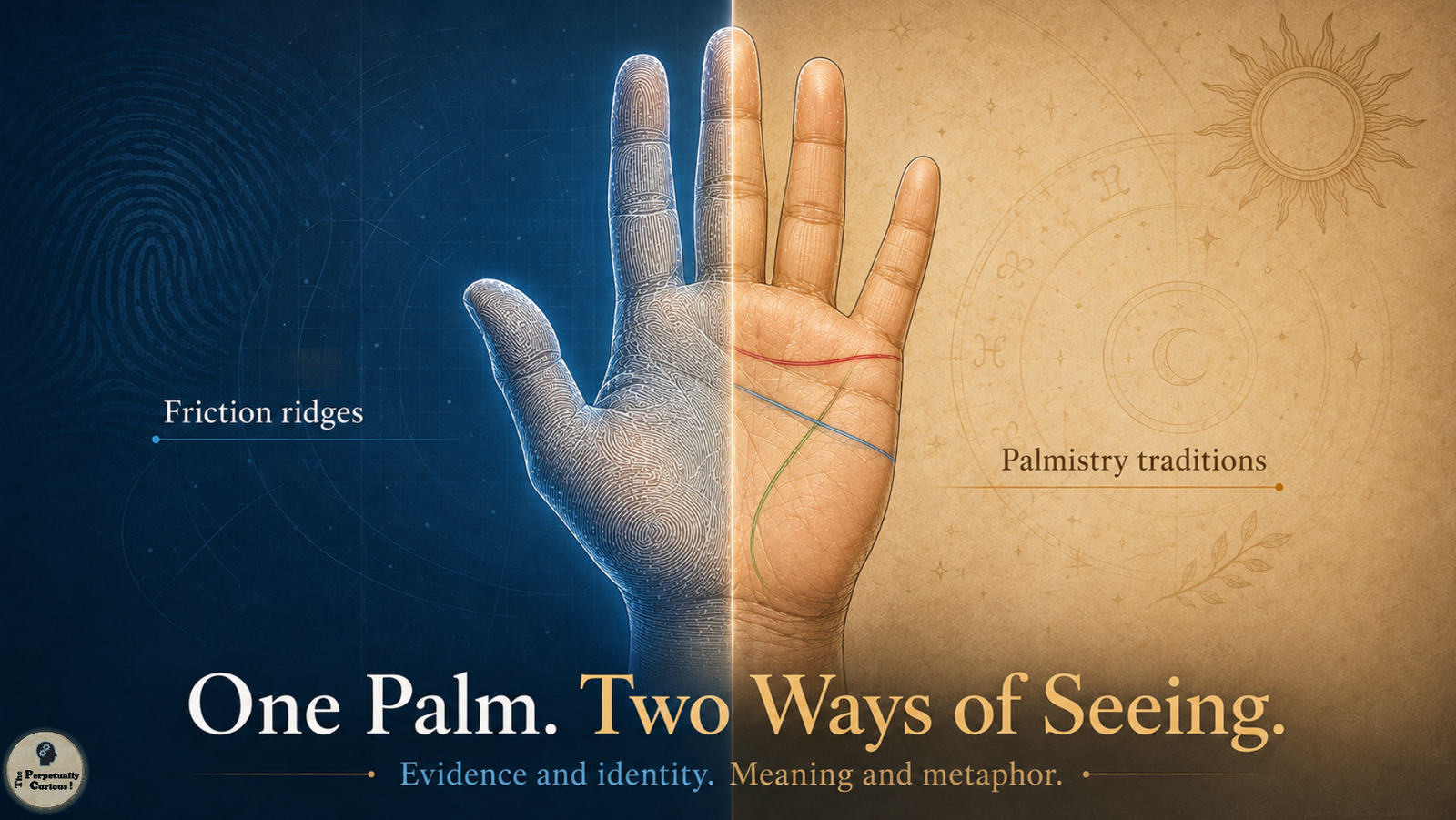
Look closely at an open hand and two different kinds of pattern appear at once. Fine friction ridges cover the fingertips and continue across the palm, while broader creases cross the skin where the hand folds. Both begin taking shape before birth, but fingerprint ridges and palm creases develop differently. Their histories also moved in strikingly different directions.
Fingerprint identification depends on very small features within friction ridges, including places where ridges end, divide, and change course. These details create a dense pattern that can be recorded and compared, while much of the underlying ridge arrangement remains sufficiently stable over time for identification. By the late nineteenth and early twentieth centuries, systems for classifying and searching fingerprints made those patterns increasingly practical for civil and criminal identification. The hand had become something institutions could systematically record and compare.
Major palm creases entered another kind of reading tradition. Long before modern biometric systems, palmistry and chiromancy treated conspicuous lines and regions of the hand as signs to be interpreted. Different traditions developed different names, correspondences, and meanings, sometimes associating lines with character, life events, health, or fate. These interpretations belong to symbolic and divinatory systems rather than scientifically validated methods of identifying a person or predicting a life.
The contrast, however, is not simply fingerprints on one side and palms on the other. Forensic examination also uses palmprints. What matters there is largely the fine friction-ridge detail across the palm, not merely the few major flexion creases that palmistry traditionally names. Palm creases themselves have also been studied in anatomy, anthropology, development, and medicine.
The historical fork is therefore more subtle than “science read the fingers while culture read the palm.” The same hand offered several kinds of visible information, and different practices learned to value different features. Friction ridges became especially useful where repeatable comparison and classification were required. Major creases became prominent within traditions that treated the hand as a symbolic map.
The hand became both record and metaphor, but the two readings did not come from the skin alone. They also came from what people chose to measure, preserve, name, and interpret.
Related path: Why some palmistry traditions read the hand astrologically