

A zebra in morning light seems to wear its answer in plain sight. Black meets white along the shoulder, and the bands bend around the legs. From a distance, the bands are part of a familiar silhouette. For a horsefly coming in to land, the important part may be what happens in the last moments of flight.
That change in perspective brings a long-standing question into focus. Of the ideas scientists have tested, the strongest evidence is that stripes make it harder for some biting flies to land. One clue came from watching flies get close enough to touch a zebra, then seeing what happened next.
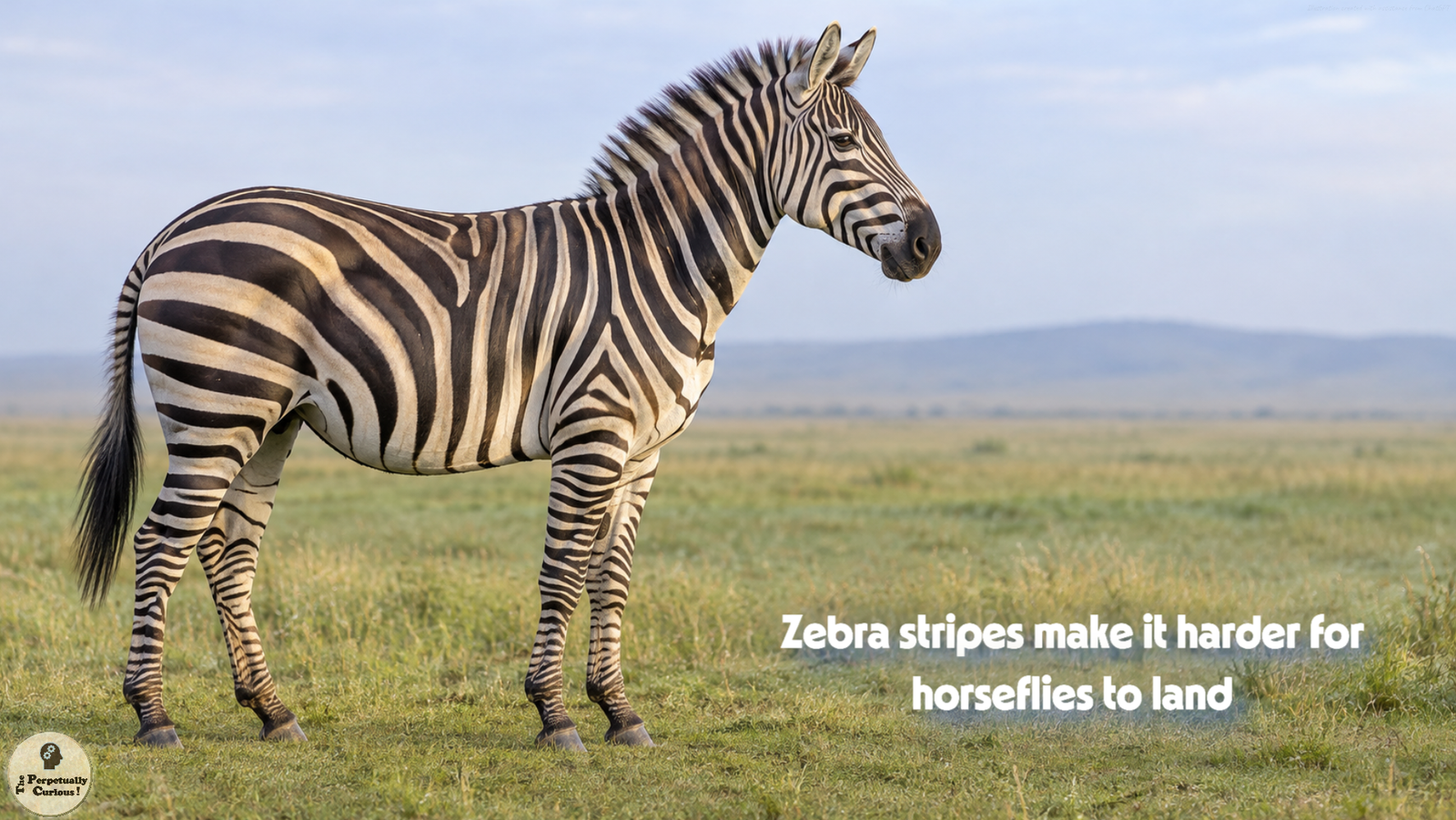
In the morning light, the stripes seem almost familiar, as though their meaning should already be known.
Yet every close look reveals another layer, another question, another way of seeing.
Between the eye that watches and the wing that approaches, the same pattern can tell an entirely different story.
🔬 What happens when a fly comes close
In one study, researchers filmed horseflies around captive plains zebras and domestic horses. The flies approached both animals, but fewer landed on the zebras. In the final moments before contact, flies approaching zebras did not show the same controlled slowdown seen in flies approaching horses. A fly could reach the coat, brush against it and keep going.
The researchers then put black, white and striped coats on the same horses in turn. Fewer horseflies landed on the striped fabric. The horses’ uncovered heads gave the team a useful comparison. Landings there did not differ significantly between coat treatments. The pattern affected how often flies landed on the covered part of the same animal.[1]
Later experiments found that sharply contrasting stripes deterred landings more effectively than stripes with little contrast. One possibility is that narrow bands leave fewer large, uninterrupted dark patches, which horseflies appear more likely to land on.[2] How a fly uses that visual information is still being worked out.
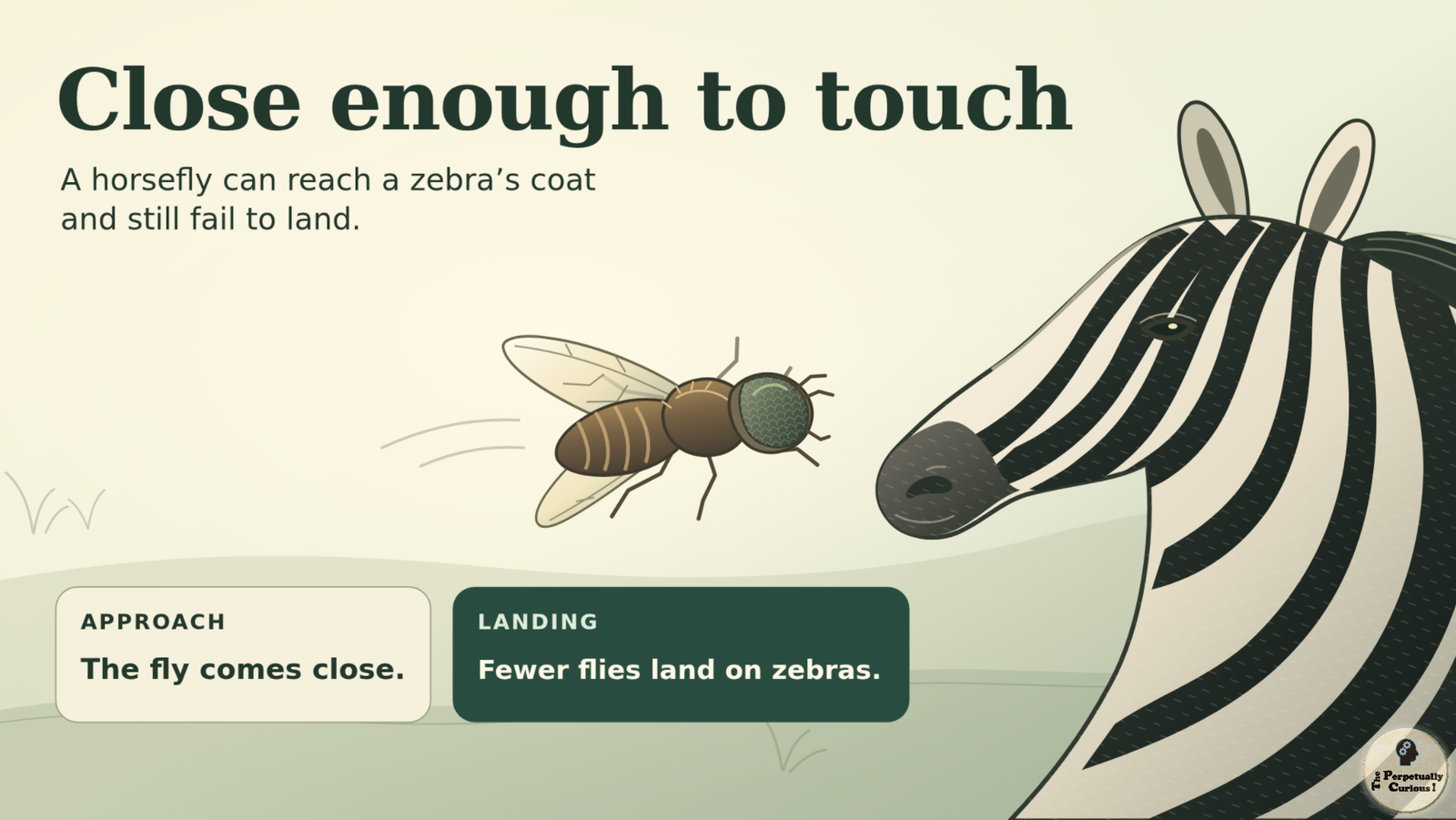
🔍 What the other explanations would need to show
A coat experiment can show what stripes do in the last moments of a flight. To ask why they evolved, researchers also compared markings across zebras and their relatives. Several features of striping were associated with environments where biting flies were expected to be active. That association supports the fly hypothesis.[3]
It still leaves a finer question open. In an experiment in Kenya, stable flies landed less often on zebra pelts than on impala pelts, but showed no clear preference between the narrower stripes of Grévy’s zebras and the wider stripes of plains zebras.[4] The test supports a benefit of striping while leaving open why the bands are wider in some zebras than in others.
The other ideas involve different tests. If stripes help a zebra blend into the open plains, the whole animal should be harder for a predator to pick out. Simulations of lion and spotted hyena vision suggest that the bands can blur together at distances where the zebra itself remains visible. Camouflage in particular settings and visual confusion during a chase are separate possibilities, with weaker evidence than fly deterrence.
Cooling raises a similar distinction. In direct sunlight, dark bands can become warmer than neighboring white bands. A warmer stripe, however, tells us about the surface of the coat. In experiments with dry hides stretched over water-filled barrels, the water temperatures did not differ significantly between the striped and gray barrels.[5] In a separate laboratory imaging study, the proposed cooling swirls did not form over the heated striped surfaces tested. The dry barrels could not sweat, so the barrel experiment leaves open questions about heat loss in a living animal.
📷 How a stripe becomes a signature
The coat also offers clues about identity. Whether zebras themselves use stripes to recognize one another remains uncertain. Researchers can use the markings to tell individuals apart. By matching the bands in photographs of the flank, they can tell whether a zebra seen on another day is an animal they have already recorded. The mottled coats of African wild dogs serve a similar purpose in wildlife surveys, even though patches and stripes look very different.
That raises a question about the growing zebra. How does a coat develop the familiar rhythm of stripes while leaving enough variation to tell one animal from another? Mathematical models inspired by Alan Turing show how interacting signals that spread through tissue could create regular bands. Models have also explored how growth might change the spacing and orientation of a pattern once it is laid down. These ideas show how a coat like this could take shape, while the actual sequence of events that lays out stripes in a zebra embryo remains uncertain.
In morning light, the stripes are what first catch our eye. In a photograph, their details can tell a researcher which zebra passed by. For a horsefly coming in close, those same bands can change how the flight ends.
Pass this article along to someone curious and let the learning travel.
💡 Did you know?
🟫 Zebra foals often start out with brown and white markings, and the dark bands deepen in color as they grow. A changing coat can tell a different kind of story in another savanna youngster. Baby cheetahs lose the mantle of long fur along their backs as they mature, while their spots remain.
♟️ In another horse-coat experiment, fewer horseflies landed on a black-and-white checkerboard than on a plain gray coat. The result weighed against one proposed visual explanation that requires long, parallel stripes.
🦴 The extinct quagga was a form of plains zebra. Its stripes were typically concentrated on the head, neck and forequarters, while much of its hindquarters was plain.
Are zebras black with white stripes or white with black stripes?
A zebra generally has dark skin beneath its coat, but the stripes we see belong to the hair. The dark hairs contain pigment. The white hairs lack it.
Do all zebras have the same kind of stripes?
No. Grévy’s zebras have especially narrow stripes and a white belly. Mountain zebras also have a mostly white underside, usually with a dark line down the center. Plains zebras vary in how far the stripes extend across the body and down the legs.
Can biting flies still land on a zebra?
Yes. In one study, fewer horseflies landed on zebras than on horses. After landing, they stayed for less time on zebras and were less likely to probe for blood. The researchers suggested that behaviors such as tail swishing and moving away may help explain the shorter stays. The comparison of how long flies stayed included only five observations on zebras.[1]
Can striped patterns reduce the number of biting flies on other animals?
In an experiment with six Japanese Black cows, researchers counted fewer biting flies on the animals when they were painted with black-and-white stripes than when they were left unpainted or painted with black stripes alone.
For more on how animals meet the challenges of their surroundings, see Wilderness & Homestead Creatures.
📚 Educational context
This article explores zebra striping and the experiments scientists use to test what the pattern does and why it may have evolved.
Selected sources
- Caro T, Argueta Y, Briolat ES, et al. (2019). Benefits of zebra stripes: Behaviour of tabanid flies around zebras and horses. PLOS ONE, 14(2), e0210831. [PMID: 30785882]
- Caro T, Fogg E, Stephens-Collins T, et al. (2023). Why don’t horseflies land on zebras? Journal of Experimental Biology, 226(4), jeb244778. [PMID: 36700395]
- Caro T, Izzo A, Reiner RC Jr, et al. (2014). The function of zebra stripes. Nature Communications, 5, 3535. [PMID: 24691390]
- Tombak KJ, Gersick AS, Reisinger LV, et al. (2022). Zebras of all stripes repel biting flies at close range. Scientific Reports, 12(1), 18617. [PMID: 36329147]
- Horváth G, Pereszlényi Á, Száz D, et al. (2018). Experimental evidence that stripes do not cool zebras. Scientific Reports, 8(1), 9351. [PMID: 29921931]
📤 Let the question travel
If this story changed how you see a zebra’s stripes, share it with a friend or colleague who enjoys finding a new question in a familiar sight.
🎬 Zebra stripes at different ages
A zebra’s stripes are already distinct in its first days. Baby Zebras shows foals and older zebras in motion, bringing out a difference that is easy to miss: the dark bands often start out brown and deepen in color as the foals grow.
“Why Do Zebras Have Stripes? The Pattern at the End of a Flight.” The Perpetually Curious!, November 2026.
https://www.theperpetuallycurious.org/articles/why-do-zebras-have-stripes/Continue Exploring
For the curious mind: want to explore this theme through a few questions? Visit the Classic Quiz Studio, nestled under Explorations opens in a new tab ,and see where a few well-placed questions lead: Wilderness & Homestead Creatures Quizzesopens in a new tab
For what comes next
Site Updates gathers occasional notes, new additions, and ways to keep in touch. RSS brings new publications to your feed reader in chronological order.
Choose the path that speaks to you, and let the next curiosity find you wherever your wondering takes you.