
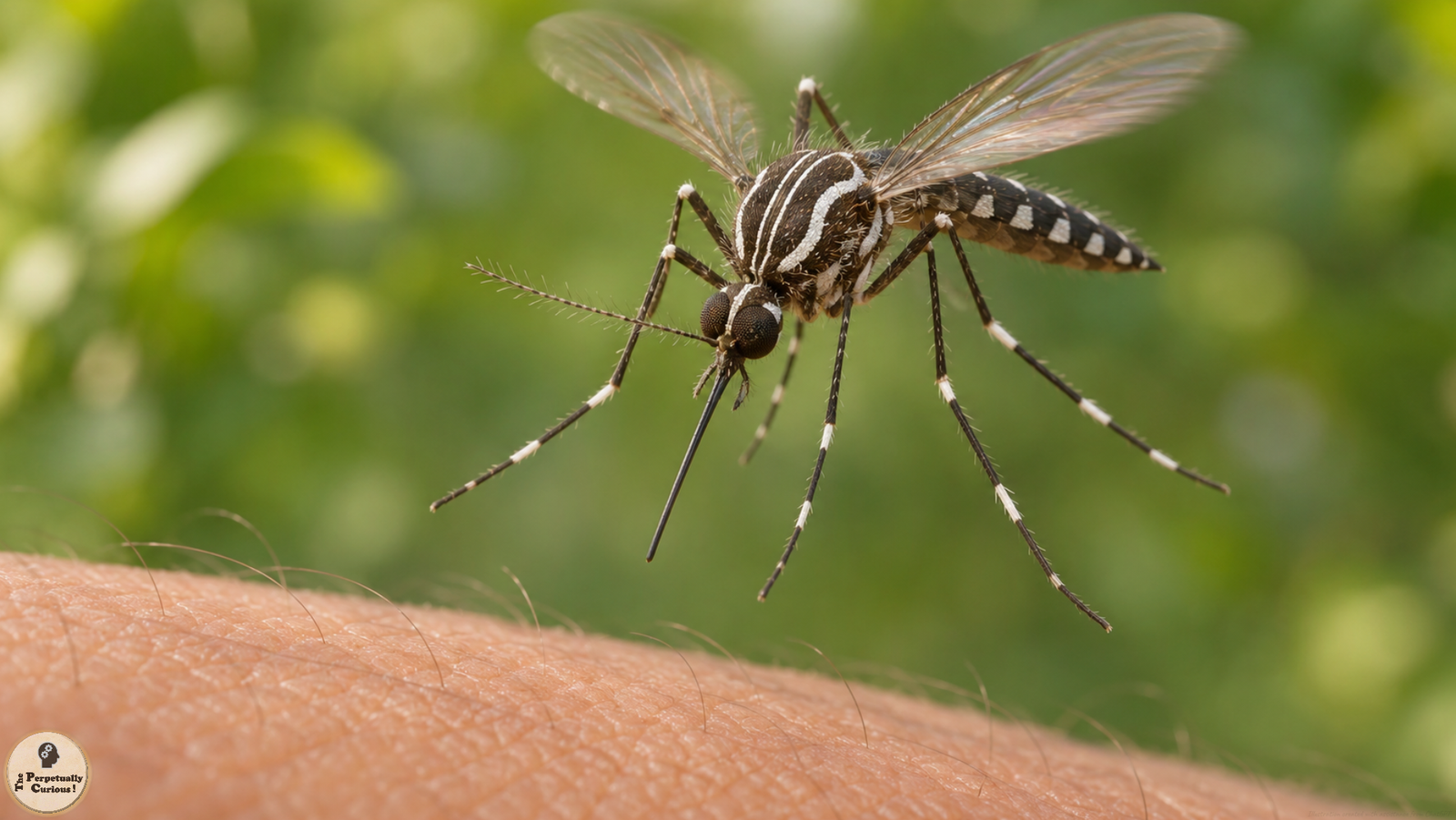
You can sit almost motionless and still give a mosquito plenty of information. Each breath changes the air around you. Your skin releases a mixture of chemical compounds and transfers heat to its surroundings. A mosquito approaching a person can draw on several of these signals, even before it touches the skin.
The familiar trio of carbon dioxide, body odor, and warmth is well supported by research. Vision also contributes. Much of the detailed experimental work concerns blood-seeking female Aedes aegypti, a mosquito that often feeds on humans. In this species, finding a host involves combining different kinds of information, with the available cues changing as the insect moves. [1, 2]
Carbon dioxide can provide an early signal. Exhaled breath contains more of this gas than the surrounding atmosphere, and mosquitoes have specialized sensory neurons that detect it. Air currents carry the gas away in an uneven plume. In wind-tunnel studies, mosquitoes encountering a carbon dioxide plume showed upwind flight and searching movements that helped them follow its source. The route can be indirect because the signal itself is patchy. [1, 2]
That makes breath informative without making it uniquely human. Other animals exhale carbon dioxide too. Detecting it can increase a female mosquito’s activity and responsiveness to other host cues, but the gas alone cannot tell her which nearby object is a person. The search gains specificity when additional information becomes available. [1]
Skin odor supplies some of that information. What leaves the skin is a blend of compounds, many shared with other animals. Their relative proportions can matter. In a study that compared human and animal odors, researchers found that particular regions of the Aedes aegypti brain responded differently to the blends. One region responded especially strongly to two aldehydes, decanal and undecanal, enriched in human odor. In wind-tunnel experiments, synthetic odor blends that activated this human-sensitive brain region increased long-range host seeking. [3]
Odor can remain informative even when the person is absent from the test. In another study, volunteers wore nylon sleeves that collected material from their skin. Mosquitoes were then offered the scent samples under controlled conditions. Some people’s samples attracted more mosquitoes than others, demonstrating that the collected skin cues carried information relevant to the insects’ choices. These tests measured attraction to collected skin cues, rather than how often participants were bitten in everyday settings. [4]
Higher levels of certain carboxylic acids were associated with greater attractiveness in that study, but the association did not establish a complete chemical explanation. The important point here is that the odor blend itself can influence host seeking. Warmth and breath are part of the picture, while skin chemistry adds more specific information about the potential host. [4]
Vision helps connect the airborne search with a possible landing target. In wind-tunnel experiments, female mosquitoes became more interested in dark, contrasting objects after encountering carbon dioxide. An object that stands out against its background can therefore draw inspection during the search. That response does not establish that the object is a person. It helps bring the insect into a position where other cues can become useful. [2]
Closer to a host, warmth provides further information. Heat carried through nearby air can help guide an approach to skin, but this signal falls off over a short distance. A warm surface and a visually noticeable object also need not be the same thing, so experiments that separate them help reveal what each cue contributes. [2]
Research published in 2024 added another thermal pathway: infrared radiation emitted by a warm surface. The investigators separated radiant heat from heat transferred through the air and tested it alongside human odor and carbon dioxide. Under those conditions, adding infrared radiation from a source at skin temperature increased host-seeking behavior. Infrared on its own produced little or no such behavior in the assay. [5]
That separation matters: an insect moving toward a heated object might otherwise be responding to warmed air, radiation, or both. Testing them separately helps identify which physical signal the insect is using. [5]
This finding concerns a thermal sense associated with the antennae. The researchers proposed that absorbed radiation causes local warming near the antennal tips, activating temperature-sensitive neurons. It does not establish that mosquitoes form an infrared picture of a person. It shows how radiant heat can contribute to locating a host when other cues are present. [5]
These studies also explain why a tidy sequence of breath, then odor, then heat is too rigid. Signals overlap, their availability changes with the surroundings, and one response can bring another cue within reach. [1, 2] In a semi-field experiment, female Aedes aegypti unable to detect carbon dioxide remained attracted to humans, with attraction only slightly reduced. The cue was therefore not indispensable in that setting. [1]
By the time a mosquito reaches the skin, the approach may have involved chemical traces, visual contrast, and thermal information. A person sitting still continues to release several of those cues. What looks like an abrupt arrival can be the endpoint of a search through information already moving around the body. [1, 2, 5]
Selected sources
- McMeniman, C. J., et al. (2014). Multimodal integration of carbon dioxide and other sensory cues drives mosquito attraction to humans. Cell, 156(5), 1060–1071. PMID: 24581501.
- van Breugel, F., et al. (2015). Mosquitoes use vision to associate odor plumes with thermal targets. Current Biology, 25(16), 2123–2129. PMID: 26190071.
- Zhao, Z., et al. (2022). Mosquito brains encode unique features of human odour to drive host seeking. Nature, 605, 706–712. PMID: 35508661.
- De Obaldia, M. E., et al. (2022). Differential mosquito attraction to humans is associated with skin-derived carboxylic acid levels. Cell, 185(22), 4099–4116.e13. PMID: 36261039.
- Chandel, A., et al. (2024). Thermal infrared directs host-seeking behaviour in Aedes aegypti mosquitoes. Nature, 633, 615–623. PMID: 39169183.