
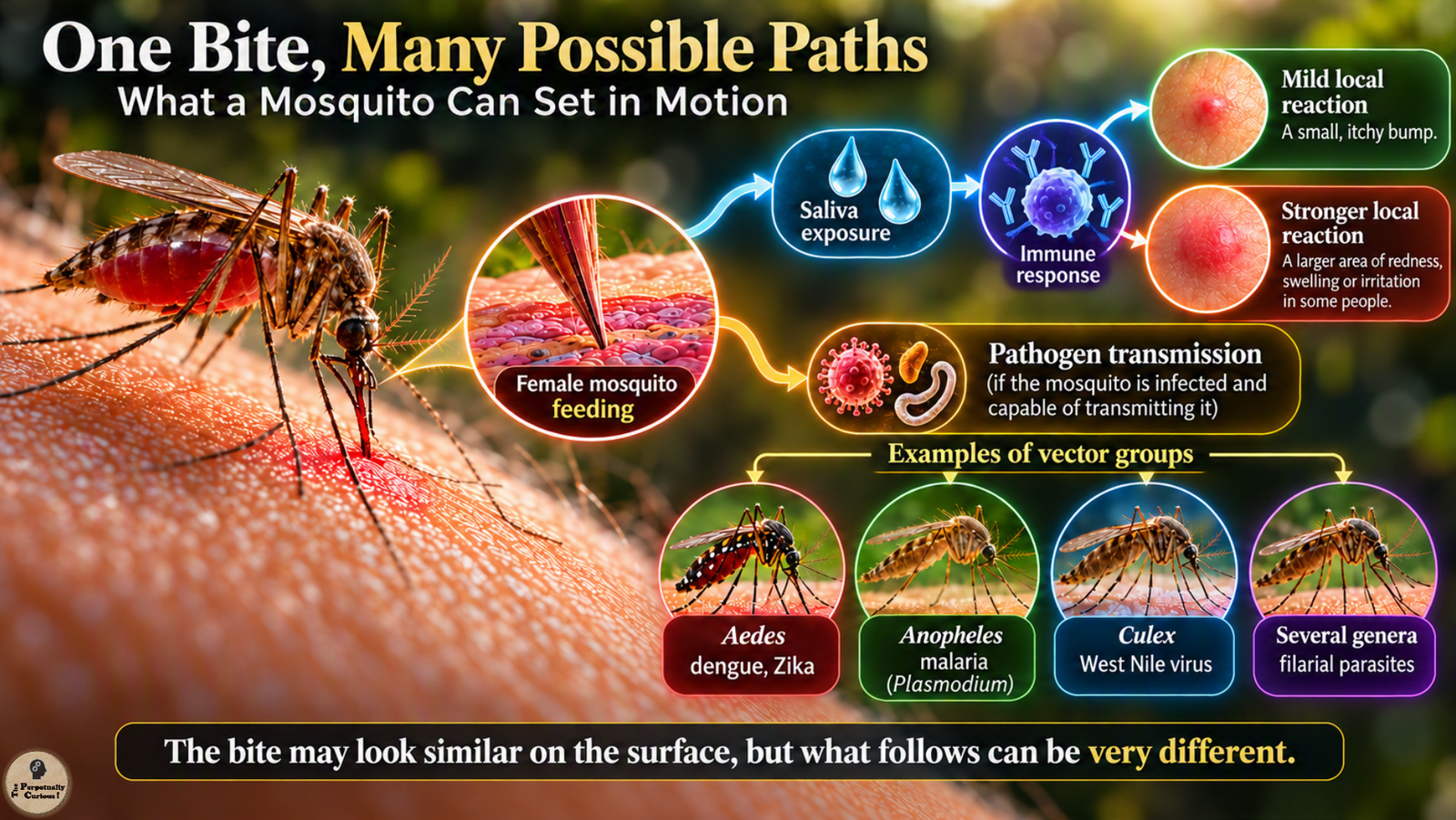
A blood-feeding female mosquito performs a remarkably small act: it pierces the skin and takes a blood meal. Yet what follows can range from almost nothing at all to an itchy welt, an unusually strong local reaction, or, under very different circumstances, an infection that reaches far beyond the bite.
As a female mosquito feeds, saliva enters the skin. Components of that saliva help the mosquito obtain blood, while the human immune system responds to their presence. Some people barely notice the encounter. Others develop the familiar itching, redness, and swelling, and occasionally the local response becomes much larger or more intense.
None of those reactions requires the mosquito to be carrying a disease-causing organism. They arise from the encounter between mosquito saliva and the human body.
A different biological path becomes possible when the feeding mosquito is both infected and capable of transmitting the pathogen it carries. Some Aedes species can transmit viruses such as dengue and Zika. Some Anopheles species transmit Plasmodium parasites that cause malaria, while some Culex species can transmit West Nile virus. Mosquitoes from several genera can also transmit filarial parasites. The same outward act of blood feeding can therefore serve as a route for very different kinds of pathogens.
Even then, a bite does not determine a single outcome. The pathogen, mosquito species, human host, and circumstances of transmission all matter. An ordinary-looking bite may transmit nothing, and the bite mark itself does not reveal whether a pathogen was transmitted. For dengue, how dengue affects the body after transmission is a separate biological story from the local reaction at the skin.
A mosquito bite is therefore better understood not as one event with one inevitable consequence, but as a point where several biological pathways can begin. One may end with little more than a transient itch. Another may produce a stronger local immune response. Still another, possible only when the mosquito and pathogen are compatible and the mosquito is infectious, may begin a systemic infection.
The puncture may look much the same from the outside. What follows beneath the skin can be profoundly different.