

A rash is the part of measles that can be seen. Much of its story unfolds out of sight: in the air before a room has emptied, in immune cells before the first spots appear, and sometimes in the body long after the fever has passed. The visible illness marks only one stage of an infection whose effects reach beyond the skin.
At the center of that story is an unexpected contrast. Recovery from measles usually leaves lasting protection against measles itself, yet the infection can weaken parts of the immune memory built against other pathogens. Understanding that contrast begins with the route the virus takes from one person to another.
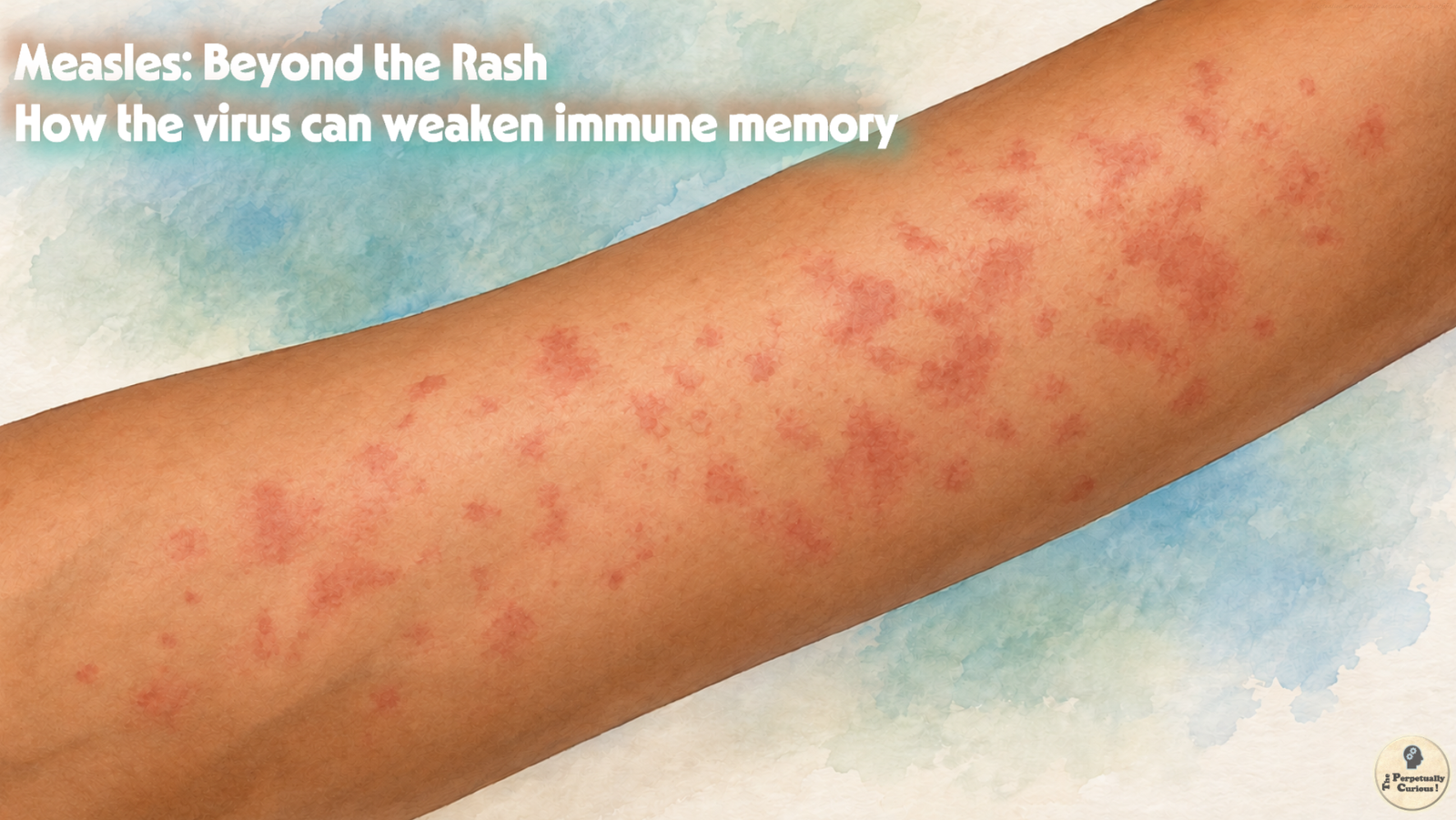
A body carries quiet histories that no eye can see.
Some remain, some fade, and some are rewritten by unexpected encounters.
Beneath every visible mark lies a deeper story of what is remembered, and what is changed.
🌬️ The story begins in shared air
Measles is caused by a virus that spreads through infectious respiratory particles released by an infected person during breathing, coughing, or sneezing. Other people can become infected by breathing contaminated air. Among susceptible people in close contact with someone who has measles, up to 9 in 10 can become infected.[1]
The virus can remain infectious in an airspace for up to two hours after an infected person has left, so transmission does not always require both people to be in the room at the same time. This is a possible upper limit rather than a fixed interval for every setting. Ventilation and other environmental conditions influence how long infectious particles remain in the air.
The route also distinguishes it from other infections that can cause fever and a rash. For comparison, dengue transmission depends mainly on infected Aedes mosquitoes rather than airborne spread.
Once measles enters the respiratory tract, it can spread through immune tissues and then more widely through the body.
🌡️ The first signs arrive before the rash
Symptoms usually begin about 7 to 14 days after exposure. Fever, cough, a runny nose, and red, watery eyes often appear first. The fever can rise above 104°F (40°C), although its height and the course of the illness vary.
Small pale spots called Koplik spots may appear inside the cheeks during the early illness. They are a characteristic clinical clue, but they can be brief and are not always noticed. Symptoms and appearance alone do not provide a reliable basis for confirming every case; laboratory testing helps establish the diagnosis.
The rash usually appears about three to five days after the first symptoms. It commonly begins on the face near the hairline and spreads downward across the neck, trunk, and limbs. Flat spots may be accompanied by small raised areas, and neighboring patches can merge.
People with measles are generally infectious from four days before the rash appears through four days afterward. Those with severely weakened immune systems may remain infectious longer. The rash therefore arrives after transmission has already become possible, which helps explain why the visible spots cannot mark the beginning of the entire story.
Nor do they capture its full severity. To understand what the infection can leave behind, the view must widen from the skin to the organs and immune cells beneath it.
🩺 The illness reaches beyond the skin
Measles can cause ear infections, diarrhea, dehydration, and pneumonia. Less commonly, inflammation of the brain, called encephalitis, can cause lasting neurological injury. Some infections are fatal. Complication risks vary with age and are higher in young children, pregnant people, and people with weakened immune systems. Poor nutritional status and limited access to care can worsen outcomes.
Measles during pregnancy can also be associated with pregnancy loss, premature birth, and low birth weight. These outcomes are risks rather than inevitable consequences, and the course of illness varies considerably between individuals and settings.
A separate, rare complication can emerge years after apparent recovery. Subacute sclerosing panencephalitis, or SSPE, is a progressive and usually fatal brain disorder associated with persistent measles infection. It is distinct from the encephalitis that can occur during the initial illness.
The course of measles therefore cannot be described by the rash alone. Even after the acute illness has settled, changes in the immune system may affect responses to other infections.
🧠 Some immune memories can be lost
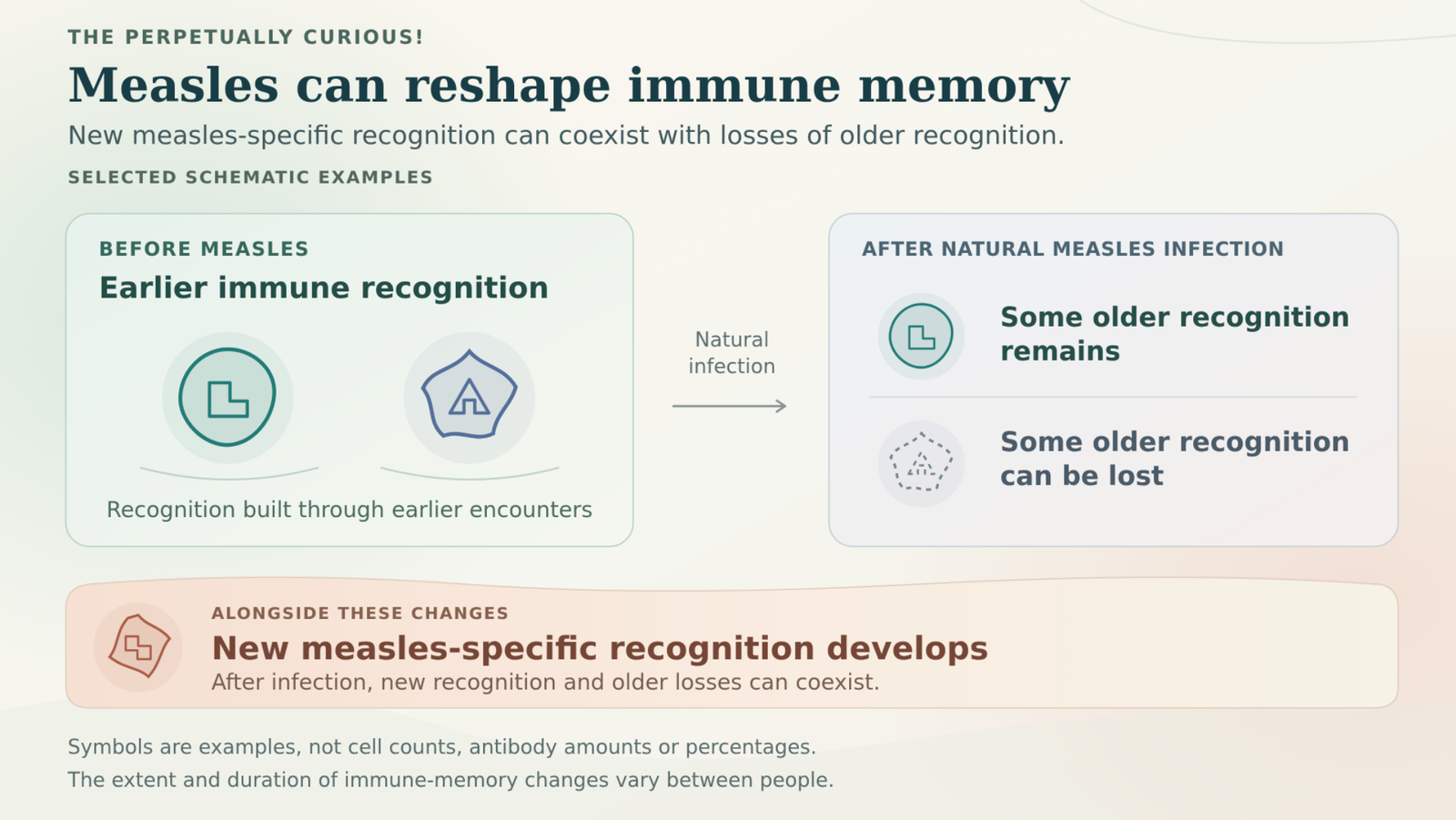
Immune memory allows the body to respond more effectively to pathogens it has encountered before. It includes specialized cells that recognize particular targets and cells that maintain antibodies against them. Measles can infect and deplete important immune-cell populations, including memory B cells, disrupting parts of that accumulated protection.
In a 2019 study, researchers examined blood samples from 77 unvaccinated children before and after natural measles infection. They found losses ranging from 11 to 73 percent of the previously detected antibody repertoire across individuals. Here, repertoire refers to the variety of antibody recognition measured by the study, rather than the total quantity of antibodies in the body. The result does not mean that every child lost that proportion of all immunity.[2]
Related research has found changes in B-cell populations that preserve and generate antibody responses. This helps explain immune amnesia, the loss of some previously acquired recognition, which can increase vulnerability to other infections. It is one aspect of the broader immune suppression associated with measles, rather than the disappearance of every immune function.
The effects can extend for months and, in some studies, years after measles. Their extent and duration vary, so there is no single recovery timetable for all parts of immune protection.
Meanwhile, the body develops a strong response to measles itself, usually leaving lifelong protection against another measles illness. The apparent contradiction is possible because immunity is specific: strengthening recognition of one virus does not guarantee that older defenses against other pathogens remain intact.[3]
Vaccination offers a different route to measles-specific recognition, without requiring the body to undergo the disease.
🛡️ Recognition can develop without the disease
Measles vaccines contain a live, weakened form of the virus. In people eligible to receive them, they stimulate immune recognition without the illness caused by naturally circulating measles virus. Measles protection is often provided through combined vaccines, including measles, mumps, and rubella, or MMR, and measles and rubella, or MR.
Two appropriately administered doses are about 97 percent effective at preventing measles. Protection is long-lasting for most people, although no vaccine prevents every infection. Research has not found the same loss of pre-existing antibody repertoire after MMR vaccination that was observed after natural measles infection.
Vaccination can cause side effects, commonly soreness at the injection site, fever, or a mild rash; serious reactions are rare. Because these are live vaccines, they are generally not used during pregnancy or in people with certain forms of severe immune suppression. Eligibility and timing depend on the vaccine, age, health circumstances, and national program.
Immune recognition has consequences beyond the person who develops it. When fewer people are susceptible, the virus has fewer opportunities to move onward, connecting the biology of immune memory with the pattern of an outbreak.
🌍 Outbreaks follow gaps in protection
Measles transmission depends on how susceptible people are connected. High immunity across a population makes sustained spread less likely, while clusters of people without protection can allow transmission even when a wider region reports high vaccination coverage.
Public health programs commonly aim for at least 95 percent coverage with two doses of measles-containing vaccine.[4] Coverage is also different from immunity: receiving a dose does not mean that every recipient develops protection. Local gaps and patterns of contact matter alongside national averages.
Such gaps can reflect limited access to vaccination, interruptions in health services, missed doses, and other circumstances. Travel can introduce the virus into a susceptible population, but what happens afterward depends in part on the protection already present. High community immunity also reduces opportunities for exposure among people who are too young for routine vaccination or cannot receive a live vaccine.
The story therefore returns to what the rash alone cannot show. Measles can leave strong recognition of itself while weakening parts of an older immune history. Vaccination builds measles-specific protection without that disease, and high community immunity reduces opportunities for transmission. The visible rash belongs to one person, but the unseen story connects what a body remembers with how an infection moves between us.
Pass this article along to someone curious and let the learning travel.
💡 Did You Know?
The rash reflects an immune response as well as an infection. Immune cells responding at sites of infection in the skin help produce the characteristic rash. Its appearance is therefore part of the interaction between the virus and the body’s defenses, rather than simply a map of where virus particles have landed.[3]
Recovering cell numbers do not tell the whole story. After measles, the number of lymphocytes, a group of immune cells, can rebound while the composition of B-cell populations remains altered. Returning numbers therefore do not necessarily mean that the same collection of previously learned immune responses has returned.[3]
Is measles the same as rubella, sometimes called German measles?
No. Measles, also called rubeola, and rubella are caused by different viruses. Rubella is often milder in the person infected, but infection during pregnancy can cause serious harm to the developing baby. The similar names do not make the illnesses interchangeable, even though combined vaccines can protect against both.
Why is a second measles vaccine dose used?
Some people do not develop adequate protection after the first dose. The second provides another opportunity to establish immunity, rather than serving only to refresh a response that has faded. Routine ages differ between national programs and can also change in particular exposure or outbreak settings.
Can a vaccinated person still catch and spread measles?
Breakthrough infection is uncommon but possible. People with pre-existing immunity often have milder illness and appear less likely to transmit the virus, although transmission can still occur. This is different from a mild rash after vaccination: the measles vaccine virus has not been shown to spread from vaccinated people to their contacts.
Does immune amnesia affect ordinary memory or thinking?
The term refers to immune recognition, not the loss of personal memories. It describes changes in defenses against previously encountered pathogens. Neurological complications of measles are separate processes, even though both involve consequences beyond the initial fever and rash.
Do all viral infections affect immune memory in the same way?
No. The effect depends on the virus and the immune response involved. Measles can reduce parts of previously acquired immune recognition. In dengue fever, some antibodies from an earlier infection can contribute to more severe illness during a later infection with a different viral type. These are distinct processes, so immune amnesia should not be treated as a general rule for every viral illness.
Why does vitamin A appear in discussions of measles care?
Vitamin A supports normal immune function and the health of tissues such as those lining the eyes and respiratory tract. Measles can lower vitamin A levels, and clinician-supervised vitamin A treatment has a role in pediatric measles care. It does not prevent measles or replace vaccination, and excessive amounts can be toxic.[1]
Is there a specific medicine that cures measles?
In the United States, no antiviral therapy is specifically approved for measles. Medical care is primarily supportive and addresses the illness and its complications. Antibiotics do not treat the measles virus, although they may be used for secondary bacterial infections.[1]
What is the difference between measles elimination and eradication?
Elimination refers to the interruption of sustained local measles transmission in a defined area, as assessed through surveillance. Imported cases and limited outbreaks can still occur. Eradication would mean the permanent end of naturally occurring transmission worldwide. The absence of a nonhuman reservoir is one reason measles eradication is considered biologically feasible, although achieving it would require overcoming substantial practical barriers.
🌱 Let understanding travel a little farther
We kindly invite you to share this piece with your friends and colleagues and help us reach a wider audience. Your support in spreading the word is greatly appreciated. A clearer understanding can travel quietly from one reader to another, carrying curiosity beyond the page.
📚 Educational context
This article explains measles transmission, immune responses, and vaccination for general educational purposes. It does not provide individual medical advice, a diagnosis, or treatment instructions. Symptoms, possible exposures, and vaccination or treatment decisions require assessment by a qualified healthcare professional.
Selected sources
- Centers for Disease Control and Prevention (CDC). (2026). Clinical Overview of Measles. Updated August 5, 2026.
- Mina MJ, Kula T, Leng Y, et al. (2019). Measles virus infection diminishes preexisting antibodies that offer protection from other pathogens. Science, 366(6465), 599-606. [PMID: 31672891]
- Griffin DE. (2021). Measles immunity and immunosuppression. Current Opinion in Virology, 46, 9-14. [PMID: 32891958]
- World Health Organization (WHO). (2017). Summary of the WHO position on Measles Vaccine- April 2017.
“Beyond the Rash: How Measles Spreads and Reshapes Immune Memory.” The Perpetually Curious!, November 2026.
https://www.theperpetuallycurious.org/articles/measles-immune-amnesia/Continue Exploring
For the curious mind: want to explore this theme through a few questions? Visit the Classic Quiz Studio, nestled under Explorations opens in a new tab ,and see where a few well-placed questions lead: Biology & Health Quizzesopens in a new tab
For what comes next
Site Updates gathers occasional notes, new additions, and ways to keep in touch. RSS brings new publications to your feed reader in chronological order.
Choose the path that speaks to you, and let the next curiosity find you wherever your wondering takes you.