
Before the alarm sounds, the body is already moving toward morning. Hormone signals change, temperature follows its daily curve, and the balance between sleep and wakefulness begins to shift. Much of this preparation happens beyond awareness. The body does not simply wait for daylight to begin its work; its internal timing helps it anticipate the coming day.
Human biological clocks help create that anticipation. Circadian rhythms are the roughly daily patterns they generate, shaping sleep, metabolism, hormone release, and other functions. Yet the body has no single dial that tells every tissue what to do. Its timing emerges from a network of cellular clocks, coordinated with one another and continually adjusted to the world outside.
The intriguing question is therefore more than how we know when to sleep. It is how living tissue keeps time, and how many different rhythms become one working body.
Beneath every sunrise lies an older rhythm, already in motion before the day is noticed.
In the quiet exchange between light, time, and living tissue, the world arrives not as a surprise, but as something gently anticipated.
🔄 A rhythm is a pattern; a clock helps produce it
A rhythm is a recurring change. A biological clock is an internal timing system that helps generate such a change. This distinction matters because an activity that happens every day is not necessarily driven by an internal clock. It may simply follow an external schedule.
The word circadian comes from the Latin circa, meaning “around,” and dies, meaning “day.” Circadian rhythms have a revealing property: they can persist under controlled conditions without a daily sunrise or a visible clock. Their natural period is close to, rather than invariably exactly, 24 hours. Without suitable synchronizing cues, internal time can gradually drift relative to the local day. Researchers call this free-running.
An early clue came from the daily rhythms of plants. In 1729, the French astronomer Jean Jacques d’Ortous de Mairan observed that a sensitive plant continued its daily leaf movements in darkness. The observation suggested that living things could carry a rhythm within them, although the modern case for internal clocks required much more evidence.
Light and other recurring signals adjust this internal timing through a process called entrainment. The clock is therefore neither a passive reflection of daylight nor a sealed mechanism running independently of its surroundings. It generates a rhythm of its own while remaining responsive to the environment. To see how that is possible, the story must move inward, from the daily pattern to the cell.
🧬 A day written in changing proteins
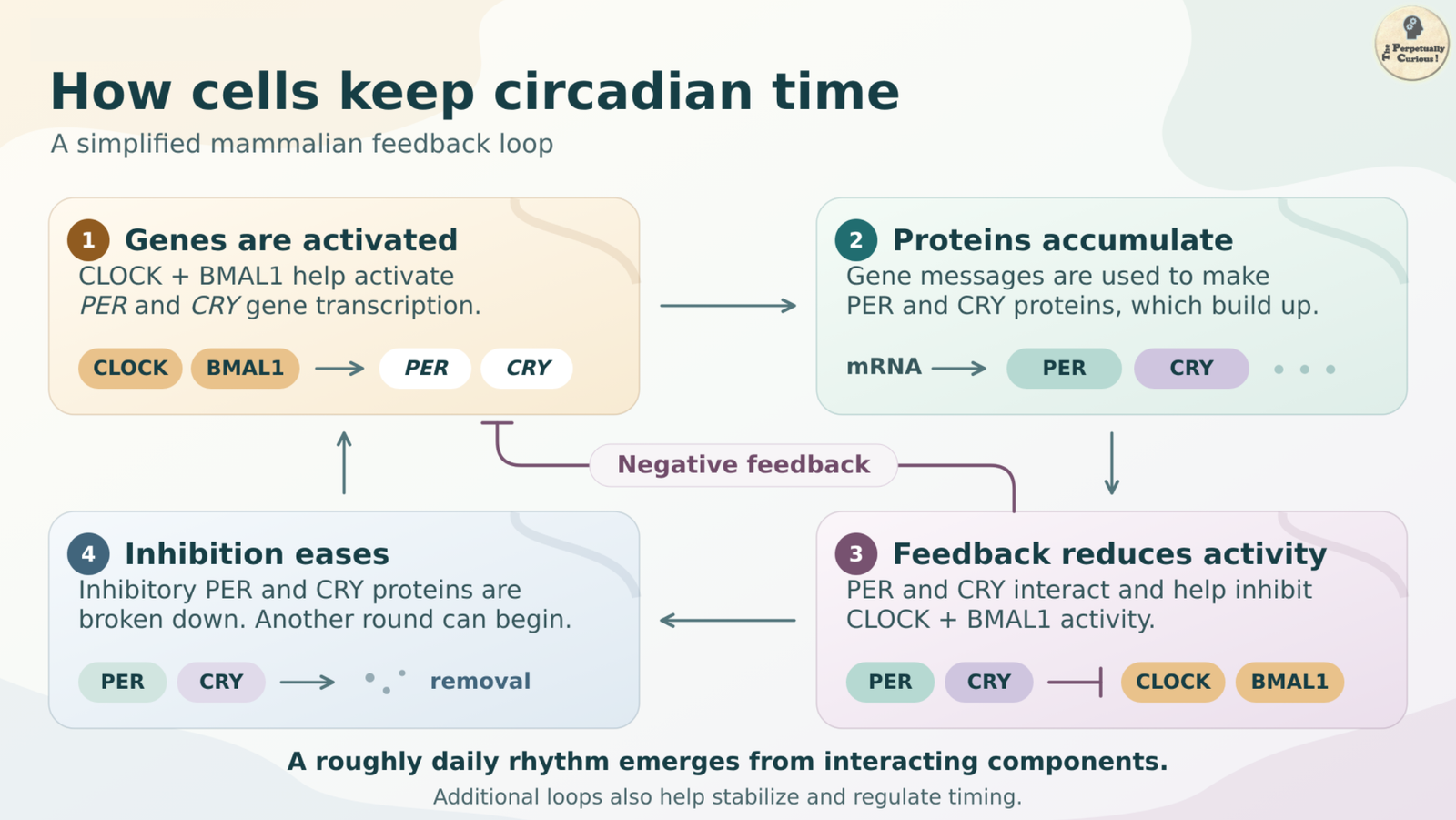
Within many cells, circadian timing involves a delayed molecular feedback loop. In a simplified account of the mammalian clock, proteins called CLOCK and BMAL1 help activate genes in the PER and CRY families. The resulting PER and CRY proteins accumulate, interact, and help suppress the activity that led to their production.
As those inhibitory proteins are eventually broken down, the suppression eases and another round can begin. The time taken for proteins to build up, act, and be removed helps stretch this molecular cycle across roughly a day. Additional interacting loops help stabilize and regulate its timing.
No individual gene acts as a complete clock by itself. The interacting components create the rhythm, while their influence on other genes helps turn cellular timekeeping into a daily sequence of work.
Many such clocks could keep different time unless there were ways to coordinate them. The next part of the story therefore begins where the outside world sends its clearest daily signal: the eyes.
🌅 Light brings the outside day into the brain
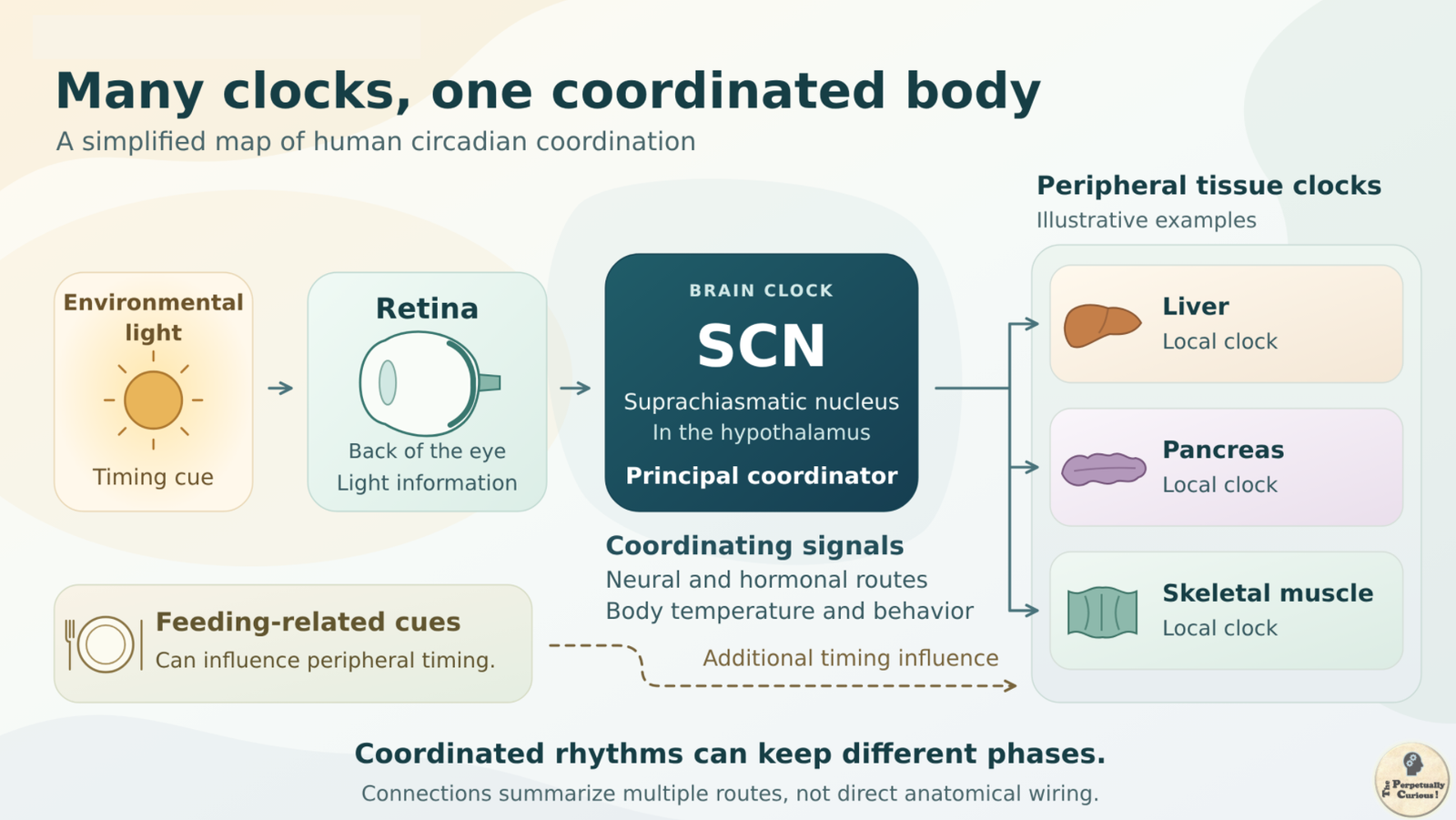
In the hypothalamus, a small paired region called the suprachiasmatic nucleus, or SCN, serves as the principal circadian coordinator. Its position just above the crossing of the optic nerves is reflected in its name. Light information reaches it from the retina, helping align internal timing with the environmental light-dark cycle.
Specialized retinal ganglion cells contain melanopsin, a light-sensitive pigment. These cells can respond to light themselves and also receive information originating in rods and cones. This gives the circadian system information about environmental illumination, alongside the retinal pathways involved in forming images.
The effect depends on when the light arrives relative to internal time, which can differ from the hour shown on a local clock. Exposure during the biological evening or early night can shift timing later, while exposure later in the biological night or around biological morning can shift it earlier. Brightness, spectrum, duration, and previous light exposure all influence the response. Short-wavelength light can be especially effective, but “blue light” alone is an incomplete explanation, and screens are only one possible source.
Light can also suppress melatonin secretion while an exposure is occurring. That immediate change in a clock-controlled signal is different from a lasting shift in the clock’s phase. Researchers therefore distinguish what light does to a signal during exposure from how it changes the timing of later cycles.[1]
This pathway helps explain how daylight can adjust the clock. It does not, by itself, explain why the need for sleep grows during a long day. That requires a second process working alongside circadian timing.
🌙 The clock and the growing pressure to sleep
Sleep reflects an interaction between circadian signals and homeostatic sleep pressure. The latter generally builds during wakefulness and declines during sleep. Adenosine signaling in parts of the brain is one contributor to this process, although no single molecule accounts for the entire need for rest.
The circadian system adds a changing tendency toward wakefulness or sleep at different internal times. Its wake-promoting influence can help sustain alertness late in a waking day, even when sleep pressure has accumulated. As that influence changes, the same underlying need for sleep may become much more apparent.[2]
Caffeine illustrates why the two processes should be distinguished. By blocking adenosine receptors, it can reduce the expression of sleepiness without replacing sleep. Differences in dose, clearance, and nervous-system sensitivity help explain why coffee affects people differently.
Sleep is one visible meeting point of these mechanisms. Elsewhere in the body, clocks help organize functions that have their own demands and their own relationships with the day.
⚙️ One body, several local timetables
The liver, pancreas, muscles, and many other tissues contain circadian timing machinery. These peripheral clocks participate in the regulation of metabolism and other local functions. Coordination occurs through several routes, including neural and hormonal signals, daily temperature changes, and the timing of activity and feeding.
Coordination does not mean that everything peaks together. In people following a broadly daytime schedule, melatonin usually rises during the biological evening and remains elevated through much of the biological night. This nightly rise is driven chiefly by secretion from the pineal gland. Melatonin signals internally timed night and can promote sleepiness, but it does not generate sleep by itself.
Cortisol generally rises toward biological morning, while core body temperature typically reaches its low point late in the biological night and its high point later in the day. Their exact timing varies with the person and conditions.
The useful relationship is an organized sequence, rather than simultaneous activity. Different tissues can perform different work at different phases while remaining part of a coordinated system.
Food provides an additional timing signal. Animal experiments show that feeding schedules can shift liver rhythms while the SCN remains aligned with the light-dark cycle. In a small controlled study in healthy young men, delaying meals shifted the glucose rhythm and the rhythm of PER2 gene expression in fat tissue, without comparably shifting melatonin or cortisol timing.[3] These findings reveal several routes for setting biological time, rather than a single switch that resets every organ together.
🧭 The same hour can mean different biological times
Different phases can coexist within one coordinated body. Differences also appear between people, so the same hour on a wall clock need not mean the same internal time. Two people sitting under the same evening sky may be at somewhat different points in their biological day.
Chronotype describes differences in the timing of sleep and activity, often expressed as morningness or eveningness. Genetic variation contributes, alongside age, light exposure, and social circumstances. These tendencies form a range rather than two sharply separated kinds of people.
Timing also changes across life. Sleep schedules commonly shift later during adolescence and earlier again across much of adulthood, although individuals vary. A later schedule is therefore not explained by preference or willpower alone, and an early schedule is not a biological measure of greater diligence.
Even this daily variation is only part of the picture. The body also contains rhythms that unfold within a night or across much longer intervals.
🌊 Rhythms within the day and beyond it
Chronobiology studies biological timing across different scales. Ultradian rhythms recur more frequently than once a day. The cycling of non-REM and REM sleep is a familiar example, although the duration and composition of successive cycles vary. The often-quoted sleep cycle is not a fixed countdown that repeats identically throughout every night.
Infradian rhythms extend beyond a day. The menstrual cycle is one example, with its timing varying between people and across life stages. Its hormonal regulation is distinct from the molecular machinery that generates circadian rhythms. Describing both as biological rhythms does not mean they are produced by the same clock.
Seasonal patterns have also been detected in aspects of human physiology, including gene expression in blood and other tissues. Such observations do not, by themselves, establish a single autonomous annual clock. Changes in environment, behavior, infections, and the composition of sampled cells can contribute to the pattern.
The body is therefore rhythmic at several scales, without being governed by one universal metronome. This distinction becomes especially useful when the timing of daily life changes abruptly.
✈️ When internal time and daily life diverge
After rapid travel across time zones, the local morning can arrive while the circadian system is still organized around another place. Sleepiness, difficulty sleeping, and digestive discomfort can follow. Changing the displayed time is immediate; biological adjustment takes longer and varies with the direction and extent of travel, light exposure, and the person.
Night work can create a related mismatch between internal timing and the schedules of waking, eating, and sleeping. Adaptation varies, and different rhythms need not shift together. Circadian misalignment is also distinct from sleep loss, although the two often occur together and can compound one another.
Controlled human experiments have found changes in glucose regulation and other physiological measures during imposed misalignment.[4] Long-term studies also associate shift work with elevated risks of some metabolic and cardiovascular conditions.[5]
These are different kinds of evidence. A short laboratory experiment does not establish a lifetime disease outcome, while an observational association cannot assign every effect to the clock rather than to sleep, working conditions, or other influences.
Social jet lag describes a related discrepancy between biological tendencies and social schedules, often estimated from differences in sleep timing on workdays and free days. That estimate can also reflect recovery from insufficient sleep. It is a useful window onto timing, rather than a complete measurement of internal desynchrony.
🔬 What biological timing can tell medicine
The consequences of misalignment raise a wider question: if physiology changes with internal time, can the timing of a treatment change its effects? This is the premise behind chronotherapy. Drug processing and the biological systems a treatment acts upon can vary across the day, although some measured variations may be too small to matter clinically. A plausible mechanism does not establish a universally superior dosing hour.
For example, the large randomized TIME study did not detect a difference in major cardiovascular outcomes between evening and morning dosing of usual blood-pressure medicines in adults with hypertension.[6] Findings for one treatment or condition cannot simply be transferred to another. The relevant questions concern the particular medicine, outcome, and patient group, as well as how biological time was measured.
That last question is essential. An hour on a clinic clock does not necessarily represent the same circadian phase in everyone. Researchers often estimate phase from the onset of melatonin secretion under controlled dim-light conditions. Such measurements help distinguish internal timing from the visible schedule of daily life. That distinction brings the story back from the clinic to an ordinary morning, when the same sunrise meets bodies keeping somewhat different time.
🌌 A day held together from within
The body’s clocks do more than mark the passage of a day. They help arrange a sequence of changing biological possibilities, bringing cellular processes into relationships with light, food, activity, and rest.
Their coordination is neither perfect uniformity nor rigid obedience to an hour. It is a living pattern, responsive to surroundings and different from one person to another. By the time morning reaches the window, much of this quiet work is already underway: molecules changing, signals passing, and a body preparing for what comes next.
Pass this article along to someone curious and let the learning travel.
💡 Did You Know?
🔬 Fruit flies helped reveal the genetic basis of circadian timing. Ronald Konopka and Seymour Benzer identified mutations that shortened, lengthened, or disrupted daily behavioral rhythms. Later molecular work by Jeffrey C. Hall, Michael Rosbash, and Michael W. Young revealed how interacting clock components could sustain a rhythm, discoveries recognized by the 2017 Nobel Prize in Physiology or Medicine. The early mutant experiments and the later molecular discoveries were successive chapters of the same investigation.
🧠 In foundational hamster experiments, grafts from the SCN region restored activity rhythms after the recipient’s own SCN had been destroyed. The restored rhythm followed the donor’s genetically determined period. The finding helped establish that this small brain region contains a circadian pacemaker, rather than merely relaying a schedule created elsewhere.
🌿 Biological timekeeping extends beyond animals. Experiments with Arabidopsis thaliana found that plants whose circadian period matched the surrounding light-dark cycle gained advantages in photosynthesis and growth over plants whose periods did not match. The study gives a tangible example of why plant timekeeping matters: anticipating a recurring environment can change how effectively an organism functions within it.
🌡️ Circadian clocks can resist some temperature-related changes in their cycle length while still responding to temperature as a timing cue. These are different properties, called temperature compensation and temperature entrainment. Mammalian experiments show that peripheral tissue clocks can be shifted by temperature cycles to which the coupled SCN network is comparatively resistant, helping explain how daily body-temperature changes can contribute to internal coordination.
Why can someone feel tired but still have difficulty falling asleep?
Sleep pressure and circadian timing can temporarily pull in different directions. A person may have accumulated a need for sleep while the circadian system still favors wakefulness. Stress, discomfort, environmental conditions, and sleep disorders can also affect sleep, so this interaction explains one possibility rather than every case of difficulty falling asleep.
Can coffee change biological timing as well as reduce sleepiness?
In a small controlled human study, evening caffeine delayed the nightly melatonin rhythm.[7] This suggests an effect on timing beyond the immediate masking of sleepiness. The result does not predict a fixed delay for every person or cup, because dose, timing, and individual response differ. A phase shift changes when a rhythm occurs; a temporary reduction in sleepiness describes a different outcome. These overlapping influences are part of the biology of coffee sensitivity.
Do blind people still have circadian rhythms?
Yes. Circadian clocks generate rhythms internally. However, when the retinal pathway that conveys light information is absent or ineffective, those rhythms can drift relative to the local day. Some people without conscious light perception retain light responses that influence circadian timing. Visual experience and the light input used to synchronize the clock are related but separable functions. The relevant distinction is the function of that pathway, rather than a single outcome shared by everyone described as blind.
Does sunlight set the body clock by producing vitamin D?
The principal light pathway for synchronizing the circadian system begins in the eyes and carries signals toward the SCN. By contrast, sunlight-driven vitamin D synthesis begins when suitable ultraviolet B radiation acts on a precursor in the skin. These are different biological routes, so vitamin D production is not required for light to provide a circadian timing signal. Conversely, the skin’s production of vitamin D does not by itself indicate whether the circadian system has received an effective synchronizing signal.
Can a smartwatch read the body’s internal clock directly?
Sleep and activity records can help researchers estimate circadian phase, especially when combined with validated mathematical models. That is different from directly measuring a molecular clock or the onset of melatonin secretion. The accuracy of an estimate depends on the device, model, population, and schedule being studied; recording a bedtime alone does not reveal the phase of every tissue.
Do plants and humans use the same molecular clock?
They share broad principles, including internal oscillations, feedback, and adjustment to environmental cues, but their molecular components are not identical. Plants have networks of interacting clock genes that differ from the mammalian CLOCK-BMAL1 and PER-CRY system described here. The comparison is most useful at the level of a common biological problem: anticipating a recurring environment. The plant experiment in Did You Know illustrates the potential value of that anticipation, rather than demonstrating identical machinery across species.
Why can daylight saving time affect biological timing?
In places using a one-hour seasonal clock change, the displayed hour and many social schedules move abruptly, while the Sun’s daily path does not change because of that decision. The relationship between scheduled activities and local daylight therefore shifts. Circadian adjustment still depends on the timing of light and other cues, so changing a clock face does not instantly move internal phase by the same amount. Responses differ with chronotype, season, location, and exposure patterns. This is a distinction between civil time, the solar day, and biological time, rather than a claim that everyone experiences the same adjustment or symptoms.
💬 Let the hours carry the curiosity
If this glimpse of the body’s quiet timekeepers brought a familiar day into a new light, we kindly invite you to share it with friends and colleagues. Your help in carrying the story to a wider circle of curious readers is greatly appreciated. An ordinary morning may hold more wonder when its unseen rhythms come into view.
📖 Educational context
This article describes biological timing and research findings for general education. It does not provide an individual assessment or guidance on sleep, light exposure, supplements, or medication schedules.
Selected sources
- Zeitzer JM, Dijk DJ, Kronauer RE, et al. (2000). Sensitivity of the human circadian pacemaker to nocturnal light: melatonin phase resetting and suppression. Journal of Physiology, 526(Pt 3), 695-702. [PMID: 10922269]
- Dijk DJ, Czeisler CA. (1995). Contribution of the circadian pacemaker and the sleep homeostat to sleep propensity, sleep structure, electroencephalographic slow waves, and sleep spindle activity in humans. Journal of Neuroscience, 15(5 Pt 1), 3526-3538. [PMID: 7751928]
- Wehrens SMT, Christou S, Isherwood C, et al. (2017). Meal Timing Regulates the Human Circadian System. Current Biology, 27(12), 1768-1775.e3. [PMID: 28578930]
- Scheer FAJL, Hilton MF, Mantzoros CS, et al. (2009). Adverse metabolic and cardiovascular consequences of circadian misalignment. Proceedings of the National Academy of Sciences of the United States of America, 106(11), 4453-4458. [PMID: 19255424]
- Kecklund G, Axelsson J. (2016). Health consequences of shift work and insufficient sleep. BMJ, 355, i5210. [PMID: 27803010]
- Mackenzie IS, Rogers A, Poulter NR, et al. (2022). Cardiovascular outcomes in adults with hypertension with evening versus morning dosing of usual antihypertensives in the UK (TIME study): a prospective, randomised, open-label, blinded-endpoint clinical trial. The Lancet, 400(10361), 1417-1425. [PMID: 36240838]
- Burke TM, Markwald RR, McHill AW, et al. (2015). Effects of caffeine on the human circadian clock in vivo and in vitro. Science Translational Medicine, 7(305), 305ra146. [PMID: 26378246]
“The Body’s Quiet Timekeepers: How Circadian Rhythms Work.” The Perpetually Curious!, November 2026.
https://www.theperpetuallycurious.org/articles/circadian-rhythms/Continue Exploring
For the curious mind: want to explore this theme through a few questions? Visit the Classic Quiz Studio, nestled under Explorations opens in a new tab ,and see where a few well-placed questions lead: Biology & Health Quizzesopens in a new tab
For what comes next
Site Updates gathers occasional notes, new additions, and ways to keep in touch. RSS brings new publications to your feed reader in chronological order.
Choose the path that speaks to you, and let the next curiosity find you wherever your wondering takes you.