

Two people share a pot of coffee. For one, the cup brings a welcome lift that seems to fade into the afternoon. For the other, its presence may still be felt when the room grows quiet at night. The drink looks familiar, yet the experience follows a different course.
Why does coffee affect people differently? Part of the answer lies in how much caffeine reaches the body, part in how quickly it is cleared, and part in how the nervous system responds. Genes contribute to this variation, but they do not write the entire story. An ordinary cup opens a small window onto the changing chemistry of being human.

A cup of coffee carries its own quiet story, shaped by the shifting chemistry within us.
Each sip meets a different moment, revealing how familiar rituals can open small windows into our shared complexity.
In that gentle meeting of drink and biology, there is a reminder that even ordinary experiences hold their own quiet wonder.
☕ The difference can begin inside the cup
Before comparing two bodies, it helps to compare what entered them. A cup is a serving, not a fixed caffeine dose. Bean variety, the amount of ground coffee, brewing conditions, and serving size can all change the quantity delivered. The journey through coffee cultivation and brewing therefore helps shape the starting point of the experience.
Even when the dose is similar, however, the response can differ. Once swallowed, caffeine is absorbed through the digestive tract and enters the circulation. It readily crosses the blood-brain barrier, reaching the nervous system where its best-known effects begin. Arrival is only the first part of the story. What matters next is the signal caffeine encounters there.
🧠 A quieter signal beneath wakefulness
Adenosine is one of the chemical signals in the brain involved in the growing pressure to sleep. Its activity in parts of the brain changes with waking and sleep, helping connect time spent awake with the need for rest. It is an important participant in sleep regulation, although it is not the brain’s only measure of tiredness.
At ordinary dietary exposures, caffeine acts mainly by blocking adenosine receptors, particularly the A1 and A2A subtypes. It binds without activating them in the same way as adenosine. A useful image is a visitor occupying a seat intended for a messenger: the signal has not disappeared, but some of its usual reception is interrupted.
This can reduce sleepiness and increase alertness. It does not replace sleep or erase the physiological need for it. Meanwhile, the body’s biological clocks contribute a separate rhythm to wakefulness and sleep, which helps explain why the same drink can meet a different nervous system in the morning and evening.
For caffeine to keep influencing those signals, enough of it must remain available. That brings the story from the brain to the liver.
⏳ The liver gives caffeine a changing timetable
In liver cells, an enzyme called CYP1A2 carries out most of caffeine’s initial metabolism. Among its reactions is the removal of a small chemical unit called a methyl group, producing related molecules such as paraxanthine. Further processing eventually creates products that leave the body largely through urine.
The pace of this process varies between people. Researchers often describe caffeine’s persistence using its half-life: the time taken for its concentration to fall by about half during elimination. In adults, this commonly takes several hours, with considerable variation.
For a simplified example, imagine a five-hour half-life after absorption. About half the caffeine would remain after five hours and about a quarter after ten, assuming unchanged clearance and no additional caffeine. Another cup can therefore arrive while part of the earlier dose is still present. Half-life describes a gradual decline, not a moment when the substance suddenly switches off.
Genetic variation can contribute to differences in CYP1A2 activity. Some commonly studied variants are associated with how strongly the enzyme’s activity rises in response to exposures such as tobacco smoke. This increase in activity is called induction. Such variants do not reliably divide everyone into two permanent groups with fixed clearance times. “Fast” and “slow” are useful shorthand in some studies, but they are incomplete descriptions of a living system.
🎚️ Clearing caffeine and feeling caffeine are different
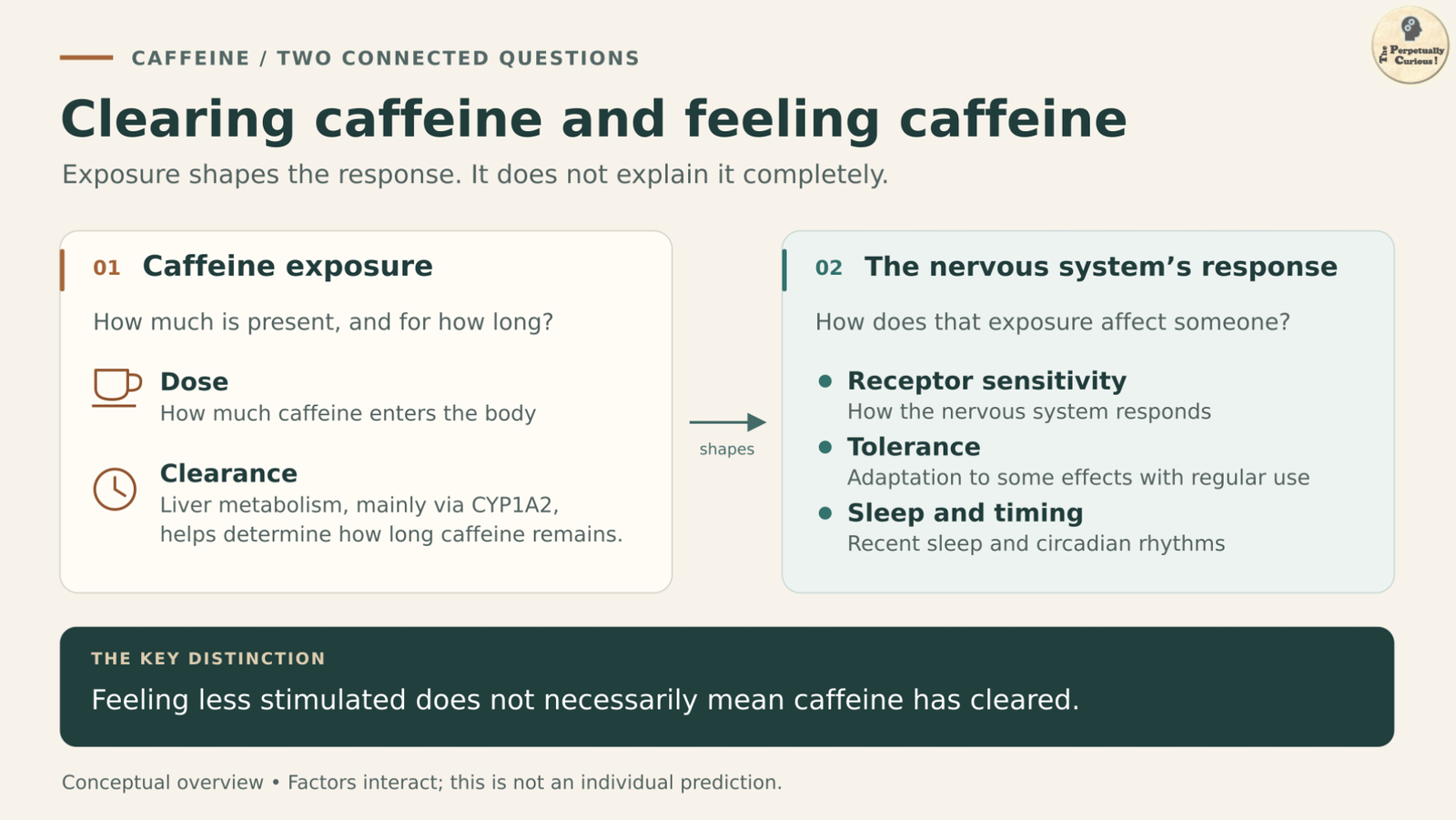
A longer residence time can extend caffeine exposure, but exposure alone does not determine the experience. The strength of the nervous system’s response matters too.
Variation in a receptor-related gene called ADORA2A has been associated with differences in caffeine-related sleep disturbance and anxiety in human studies. These findings help explain why metabolism is only one part of sensitivity. They do not make a single genetic result a reliable forecast of how someone will feel after every cup.
Habit also changes the picture. Regular use can produce tolerance to some effects, while tolerance to other effects may be incomplete. Feeling less stimulated does not necessarily mean caffeine has disappeared from the bloodstream. Nor does the ability to fall asleep after coffee establish that sleep is unaffected.
Pharmacology distinguishes these two questions: what the body does to a substance, and what the substance does to the body. In everyday terms, one concerns caffeine’s journey; the other concerns the response along the way. Neither can be read completely from the other.
🔄 The same person can respond differently over time
If genes were the whole explanation, caffeine handling would be much more fixed than it is. Enzyme activity also responds to physiological state and chemical exposures.
During pregnancy, CYP1A2 activity generally decreases, slowing caffeine clearance. Estrogen-containing oral contraceptives can also slow its elimination. Certain medicines inhibit the enzyme; fluvoxamine, for example, has markedly prolonged caffeine’s half-life in controlled studies. The size of an interaction depends on the circumstances, so one multiplier cannot describe every person or treatment setting.
Tobacco smoke provides an example in the other direction. Chemicals in smoke can increase CYP1A2 activity, and that induction diminishes after smoking stops. The point is that enzyme activity can change while the underlying DNA sequence remains the same.
Changes in caffeine use, recent sleep, dose, and timing can also alter the felt response. Yesterday’s familiar cup may meet a different combination of conditions today. This changing context is central to understanding caffeine, and it becomes even more consequential when the substance is a medicine.
💊 What coffee reveals about medicines, and what it cannot
CYP1A2 helps metabolize medicines as well as caffeine, including theophylline and clozapine. Changes in its activity can therefore matter beyond the coffee table. Yet the feeling produced by a cup is not a dosing test for those medicines. Each drug has its own pathways, targets, and relationship between concentration and effect.
Standard doses are useful, evidence-based starting points. Organ function and other medicines can change drug exposure, while the person’s response helps guide any adjustment. For selected treatments, measured drug concentrations add further information. Individual variation explains why these distinctions matter; it does not make dosing standards meaningless.
Pharmacogenetics examines how genetic differences affect medication response. For some established gene-drug relationships, genetic information can help guide treatment decisions. Its value depends on the evidence for that particular medicine, and a genetic result remains one part of the wider clinical picture.
Coffee makes this principle tangible without turning it into a personal prescription. A shared molecular pathway can connect everyday experience with medicine, but that connection has limits as well as insights.
🌇 The same ritual, a different molecular story
By evening, the two cups on the table may look equally empty. Their journeys through the people who drank them need not be complete in the same way. Dose, clearance, receptor sensitivity, habit, and timing have each contributed to what followed.
The “molecular democracy” is a metaphor for that shared participation, not a claim that every factor carries equal weight. No single contributor explains every response. The chemistry is recognizable across people, while its timing and expression remain individual.
There is a quiet kind of wonder in this. A familiar ritual can reveal how much variation lives beneath an ordinary surface. The cup is small; the biology it meets is not.
Pass this article along to someone curious and let the learning travel.
💡 Did you know?
🧪 Breaking caffeine down does not immediately end all related biological activity. Paraxanthine, its principal metabolite, is active too. Controlled human studies have found that paraxanthine can produce physiological effects of its own, adding another layer to the journey beyond the original molecule.
🔬 Caffeine can serve as a research probe for CYP1A2 activity. Investigators use a controlled dose and timed measurements of caffeine or its metabolites to study enzyme function. This laboratory approach is fundamentally different from inferring a metabolism type from how alert a cup makes someone feel.
🕰️ Caffeine can influence timing as well as alertness. In a small controlled human study, evening caffeine delayed the nightly rise in melatonin, a marker of circadian timing. The result suggests a route beyond simply masking sleepiness, although the size of the shift is not a universal prediction for every cup or person.
Does stronger-tasting coffee necessarily contain more caffeine?
No. Caffeine contributes bitterness, but other coffee compounds also shape taste and can alter how that bitterness is perceived. The chemistry of roasting and brewing influences flavor as well as extraction, so sensory intensity is not a dependable measure of caffeine dose. Concentration and serving size also differ: a small espresso can contain less total caffeine than a larger, milder-tasting brewed coffee. Taste describes the experience in the mouth; dose describes the amount consumed.
Can my reaction to coffee tell me whether I am a fast or slow metabolizer?
Not reliably. The reaction combines dose, clearance, receptor sensitivity, tolerance, and sleep-related factors. A strong or long-lasting effect does not identify a genotype. Genetic testing measures inherited variants, while carefully controlled caffeine measurements can investigate enzyme activity under the conditions tested. These are different kinds of information.
Can someone feel sleepy after coffee even when caffeine is still present?
Yes. Caffeine can reduce sleepiness without overcoming every influence on it. Recent sleep, tolerance, and the daily rhythms coordinated by human biological clocks still matter. Feeling sleepy, calm, or alert is therefore not a direct measure of the caffeine concentration in the body.
Falling asleep is also different from sleeping unaffected. In controlled studies, caffeine has altered measures such as sleep duration or continuity without participants always recognizing the full change. Perceived alertness, the ability to fall asleep, and measured sleep quality are related, but they are not interchangeable.
Does caffeine stop working after one half-life?
No. About half remains in the simplified elimination model. The noticeable effect may weaken before caffeine is fully cleared, and different effects can follow different time courses. Another dose can overlap with caffeine still present from an earlier one, so the pattern of drinking matters as well as the amount in each cup. Half-life is a measure of persistence, not a personal countdown to feeling normal or falling asleep.
Can caffeine handling change without a change in genes?
Yes. Pregnancy, interacting medicines, and exposure to tobacco smoke can alter enzyme activity. Tolerance can also change the response to a given exposure. A person’s inherited variants are only part of the explanation for what happens at a particular time.
Why can missing a usual coffee bring a headache or unusual tiredness?
With regular exposure, the nervous system can adapt to caffeine’s presence. When that exposure falls, some people experience temporary withdrawal symptoms, including headache, fatigue, and difficulty concentrating. Changes in adenosine-related signaling and cerebral blood flow are among the processes implicated. This is another expression of adaptation to habitual exposure, distinct from how quickly the liver clears a particular dose.
Is decaffeinated coffee completely caffeine-free?
Usually not. An 8-fluid-ounce (237-milliliter) cup of decaffeinated coffee typically contains about 2 to 15 milligrams of caffeine, although products and preparation vary. The remaining caffeine is the same molecule found in regular coffee; decaffeination substantially reduces the dose rather than creating a different form of caffeine.
Can coffee sensitivity predict how someone will respond to a medicine?
It cannot reliably predict a medicine’s effects or establish an appropriate dose. Even when a medicine shares CYP1A2 as a metabolic pathway, other pathways, drug-specific properties, and the person’s clinical circumstances can change the outcome. Coffee illustrates the importance of individual variation without serving as a substitute for drug-specific evidence.
💬 Let the curiosity travel
If this glimpse beneath the surface of a familiar drink brought a new question into view, share it with a friend or colleague whose coffee experience differs from yours. A conversation over two cups can become an invitation to notice the science within everyday life.
📚 Educational context
This article explores caffeine metabolism and individual variation for educational purposes. It does not provide medical advice or personalized guidance on caffeine intake or medication use. A person’s reaction to coffee cannot reliably identify their metabolism type or predict their response to a medicine. Questions about caffeine use during pregnancy, with health conditions, or alongside medicines should be discussed with a qualified healthcare professional.
“The Molecular Democracy: Why Coffee Affects People Differently.” The Perpetually Curious!, September 2026.
https://www.theperpetuallycurious.org/articles/coffee-affects-people-differently/Continue Exploring
For the curious mind: want to explore this theme through a few questions? Visit the Classic Quiz Studio, nestled under Explorations opens in a new tab ,and see where a few well-placed questions lead: Biology & Health Quizzesopens in a new tab
For what comes next
Site Updates gathers occasional notes, new additions, and ways to keep in touch. RSS brings new publications to your feed reader in chronological order.
Choose the path that speaks to you, and let the next curiosity find you wherever your wondering takes you.