

When sunlight reaches human skin, a subtle and ancient exchange begins. There is no visible shimmer or outward sign of change, yet a quiet transformation unfolds within the epidermis[1]. There, a molecule waits for a particular kind of light. When that light arrives, its energy begins a transformation that will eventually produce vitamin D3. What starts at the skin’s surface continues through the bloodstream, liver, and kidneys, turning a moment of illumination into a carefully coordinated biological pathway.
The journey begins with the light itself. Only a narrow band of the Sun’s ultraviolet radiation can initiate this photochemical sequence, making wavelength the first key to understanding how sunlight and skin meet.

A narrow band of sunlight travels across space and settles upon human skin, shaping chemistry in quiet ways.
In that meeting of star and body, something ancient moves without sound.
It is a small reminder that even the faintest light can leave a gentle trace of its passage.
🔆 The kind of sunlight that matters
Sunlight contains many wavelengths, but only a narrow portion of ultraviolet B (UVB) initiates vitamin D synthesis in the skin. These wavelengths, roughly between 290 and 315 nanometers (nm), carry enough energy to alter a specific chemical bond in a precursor molecule within the epidermis. Ultraviolet A (UVA) has longer wavelengths and accounts for most of the ultraviolet radiation reaching Earth’s surface, but it does not initiate this reaction.
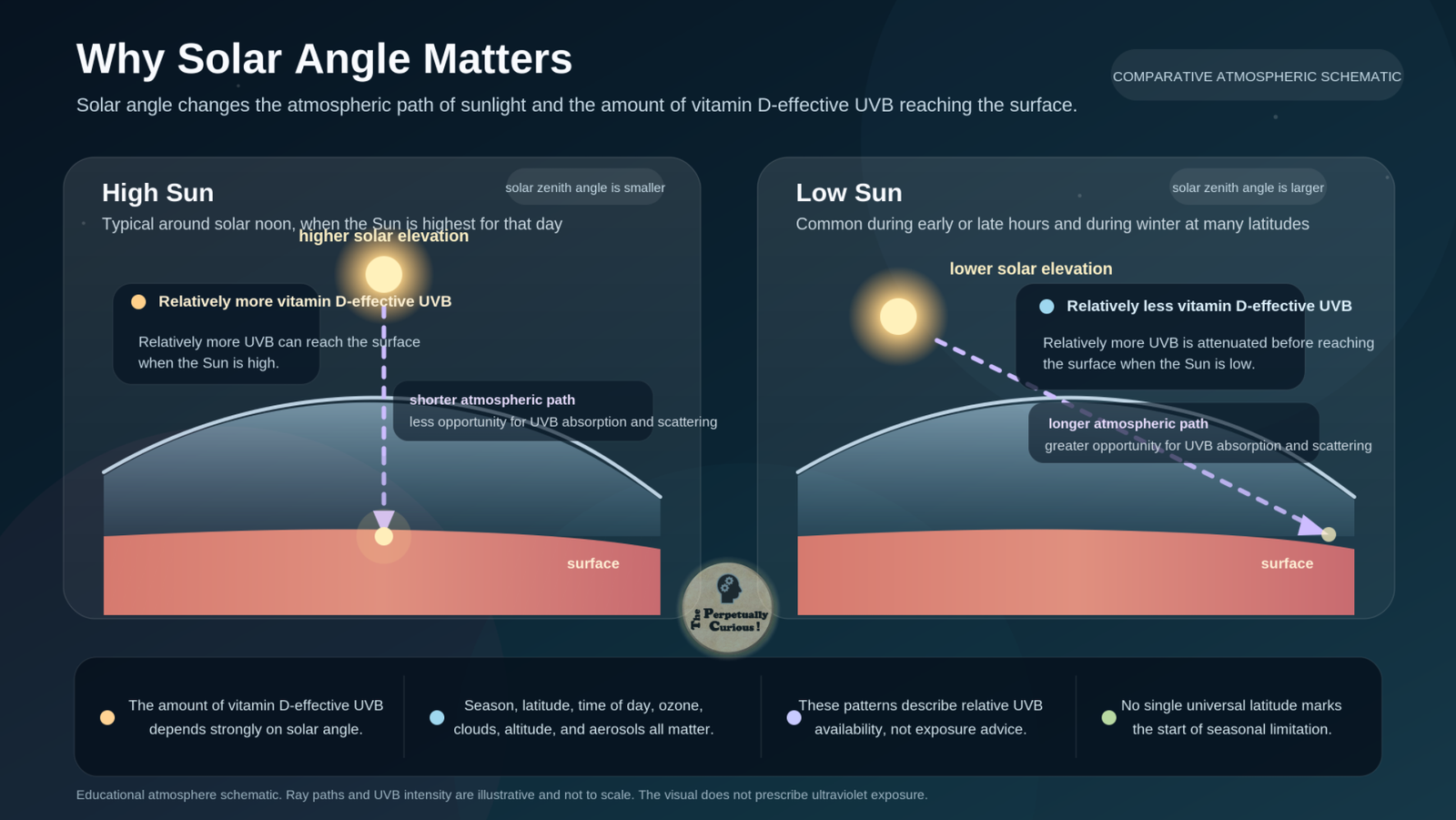
UVB is a comparatively scarce traveler among the Sun’s many wavelengths. Atmospheric gases filter much of it before it reaches the ground, with ozone absorbing a substantial share. When the Sun is high in the sky, its rays travel along a shorter atmospheric path, allowing more UVB to reach the surface. When the Sun is low, such as during early morning, late afternoon, or winter at higher latitudes, its rays follow a longer atmospheric path, giving ozone and other atmospheric constituents more opportunity to absorb or scatter UVB before it reaches the ground.
Once the relevant light is identified, the question shifts to the molecule that receives it. Within the epidermis, incoming UVB encounters a molecular precursor capable of beginning the first photochemical transformation.
🔬 A waiting molecule in the skin
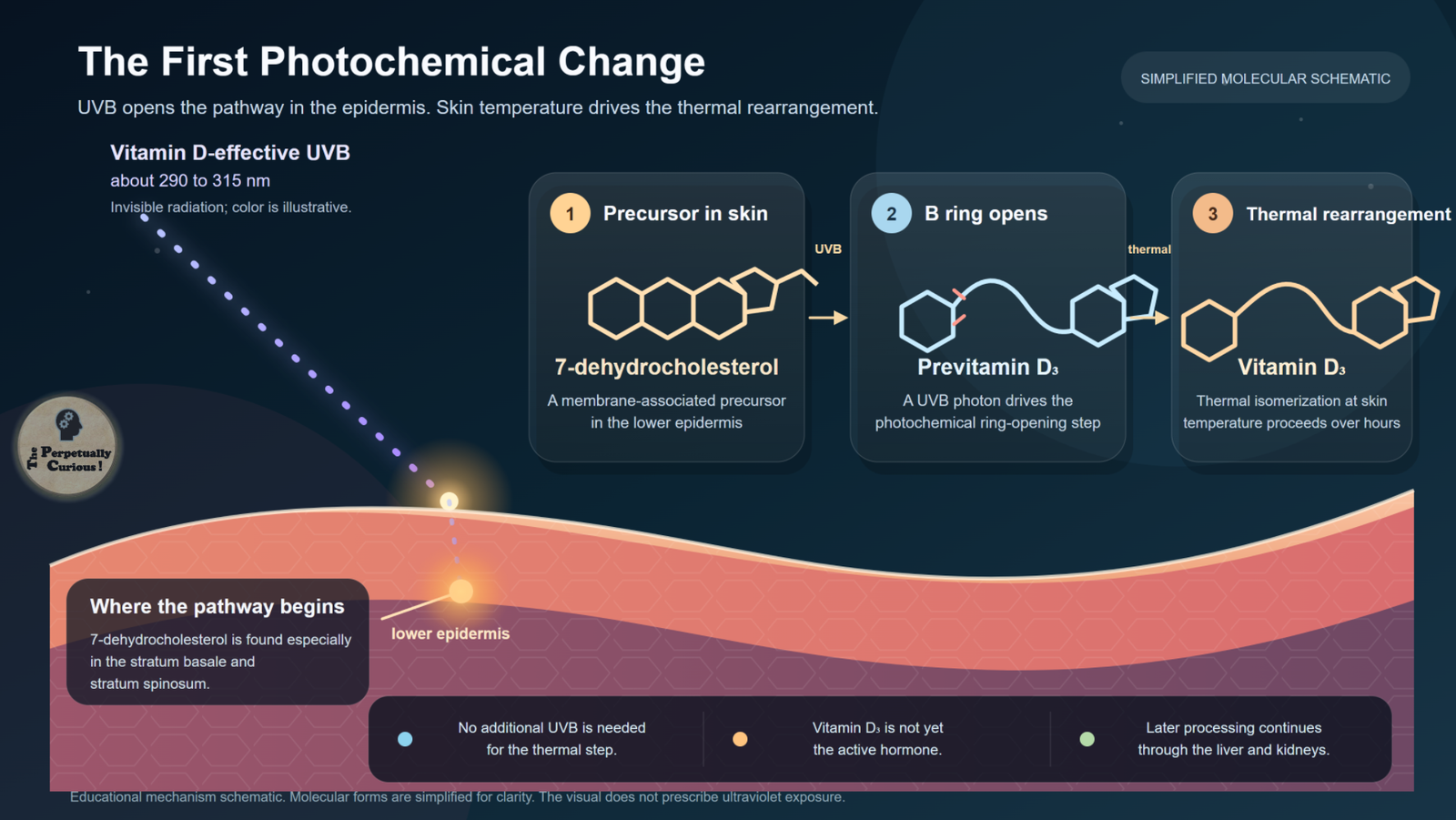
Within the epidermis, particularly in the stratum basale and stratum spinosum, lies a cholesterol-related molecule called 7-dehydrocholesterol. Embedded in the membranes of skin cells, it serves as the precursor for vitamin D3 synthesis. Its molecular structure allows it to absorb incoming UVB photons and respond to their energy.
When 7-dehydrocholesterol absorbs UVB, that energy breaks a specific bond in its B ring, opening the ring and producing previtamin D3. This photochemical conversion is most efficient within a narrow portion of the UVB spectrum, commonly reported near 295 to 300 nm.[2]
At this scale, the skin is more than a protective barrier. It becomes a site of photochemistry, where light reshapes a molecule and begins a pathway that continues after the illumination ends. The next transformation requires no additional UVB. It proceeds gradually through the warmth of the skin itself.
🌡️ From previtamin D3 to vitamin D3
Previtamin D3 is a transient intermediate rather than the form carried through the bloodstream. After forming in the epidermis, it undergoes thermal isomerization, a temperature-dependent rearrangement of its molecular structure. At the temperature of human skin, this process gradually converts previtamin D3 into vitamin D3, also known as cholecalciferol, over the course of several hours.
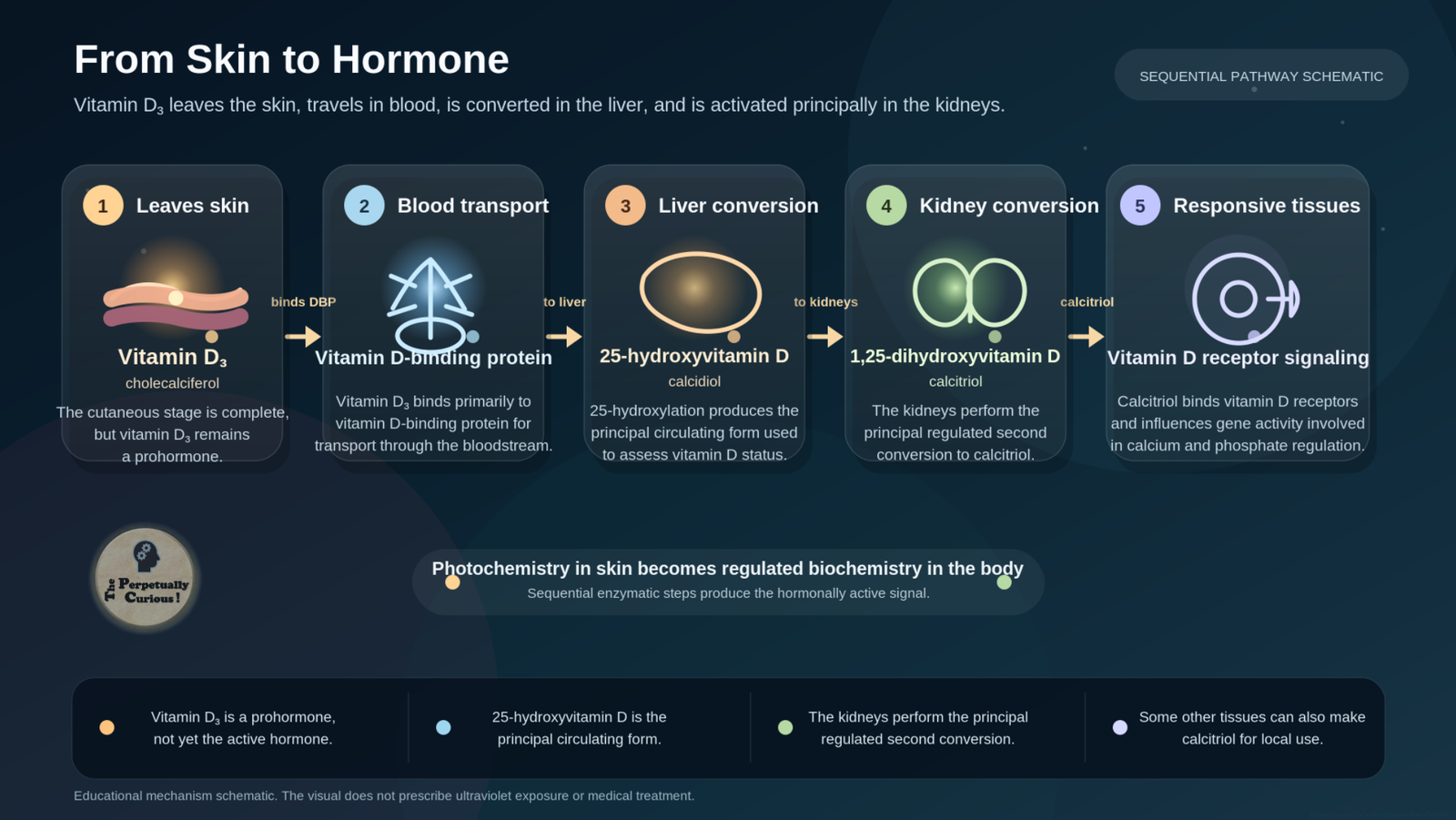
Vitamin D3 then moves from the skin into the dermal circulation, where it binds primarily to vitamin D-binding protein for transport through the bloodstream. With this transfer, it completes the cutaneous part of its journey, although it is not yet the hormonally active form. Reaching that stage requires further enzymatic processing in internal organs.
The pathway has now crossed an important boundary. What began as photochemistry in the epidermis continues as biochemistry within the body, carrying vitamin D3 from the illuminated surface toward the liver and kidneys.
🧪 The liver and kidney steps
Vitamin D3 carried through the bloodstream reaches the liver, where enzymes add a hydroxyl group and convert it into 25-hydroxyvitamin D, also known as calcidiol. This relatively stable metabolite is the principal circulating form of vitamin D and the form most commonly measured to assess vitamin D status. Its concentration reflects vitamin D arising from both cutaneous synthesis and dietary sources.
The kidneys perform the principal regulated second hydroxylation, converting 25-hydroxyvitamin D into 1,25-dihydroxyvitamin D, also known as calcitriol. Some other tissues can also produce calcitriol for local use. As the hormonally active form, calcitriol binds to vitamin D receptors in cells and influences gene activity involved in calcium and phosphate regulation, among other physiological processes.[3]
These transformations reveal why vitamin D occupies an unusual biological category. Vitamin D3 functions as a prohormone rather than the final hormonal signal. Sunlight begins the pathway in the skin, while the body governs its later activation through sequential enzymatic steps, placing the initial photochemical event within a regulated physiological system.
Vitamin D activation is therefore not a single reaction but a linked process extending from skin to bloodstream, liver, kidneys, and responsive tissues. The amount of vitamin D3 available for activation, however, varies with UVB availability and individual biology. That variability begins with changes in season, location, and solar angle.
🌍 Latitude, season, and time of day
The amount of UVB reaching Earth’s surface depends strongly on the Sun’s position in the sky. When the Sun is high, its rays pass through a shorter atmospheric path, allowing more UVB to reach the ground. When the Sun is low, the path becomes longer, increasing the opportunity for UVB to be absorbed or scattered. Scientists describe this geometry using the solar zenith angle, which decreases as the Sun rises higher above the horizon.
Earth’s axial tilt changes the Sun’s apparent height through the seasons. During winter at many mid- and high-latitude locations, the Sun remains lower in the sky, and vitamin D-effective UVB may become greatly reduced or temporarily negligible. This seasonal pattern does not begin at one universal latitude. Its extent varies with location, atmospheric ozone, altitude, cloud cover, aerosols, and other local environmental conditions[1].
Time of day produces a similar pattern. UVB availability is generally greatest during the hours around solar noon, when sunlight follows its shortest path through the atmosphere. Earlier in the morning and later in the afternoon, the lower Sun creates a longer path and stronger atmospheric filtering. These patterns describe how UVB availability changes rather than prescribing any particular duration or schedule of sunlight exposure.
Environmental conditions therefore determine how much vitamin D-effective UVB reaches the skin, while biological differences influence how that incoming radiation is filtered and used.
🧬 Skin tone and the filtering of light
Human skin contains melanin, a pigment that contributes to skin color and helps protect underlying tissues by absorbing ultraviolet radiation and dissipating much of its energy. Because melanin also attenuates UVB, it can reduce the amount that reaches 7-dehydrocholesterol in the deeper layers of the epidermis.
Under otherwise comparable conditions, greater melanin pigmentation may reduce the amount of vitamin D3 produced from a given UVB dose. The relationship is not governed by a universal exposure multiplier, however, and studies do not produce identical results in every setting. An individual’s vitamin D status also reflects season, latitude, clothing, time spent outdoors, diet, age, body composition, genetics, metabolism, and other biological and environmental factors.
Human pigmentation evolved through multiple genetic pathways as populations lived and moved across different ultraviolet environments. In regions with intense ultraviolet radiation, greater eumelanin pigmentation provides stronger photoprotection. In lower-UV environments, reduced baseline pigmentation may allow more UVB to participate in cutaneous vitamin D synthesis. This history was not shaped by vitamin D alone. Proposed selective pressures also include protection from ultraviolet injury and folate-related effects, while migration, admixture, diet, clothing, and culturally shaped patterns of exposure influenced how pigmentation and sunlight interacted over time.
Skin tone therefore influences one part of the pathway without determining its outcome by itself. Even when sufficient UVB reaches the precursor molecule, vitamin D3 production does not continue indefinitely because the skin contains its own photochemical controls.
⚖️ Natural limits and self‑regulation
The cutaneous vitamin D pathway includes built-in photochemical controls that limit excessive accumulation. As UVB exposure continues, previtamin D3 can be diverted into photoproducts such as lumisterol and tachysterol rather than continuing toward vitamin D3[2]. Vitamin D3 itself can also undergo additional photochemical transformations. These products do not function like hormonally active vitamin D in the classical calcium-regulating pathway, although some may be metabolized into derivatives with other biological effects.
As these competing reactions increase, the net production of vitamin D3 tends to reach a plateau. This self-limiting chemistry helps explain why sunlight exposure does not ordinarily cause vitamin D intoxication. It does not, however, make continued ultraviolet exposure harmless. UV radiation can still contribute to cellular and DNA damage, sunburn, photoaging, and increased skin-cancer risk even after vitamin D3 production has leveled off.[4]
Vitamin D status therefore depends on more than the amount produced in the skin. Dietary intake, supplementation, metabolism, age, and other biological factors can also contribute. Beyond these internal controls, familiar external barriers such as glass, clothing, and sunscreen alter how much UVB reaches the skin.
🛡️ Glass, clothing, and sunscreen
Ordinary window glass allows visible light to pass while blocking most of the UVB needed for cutaneous vitamin D synthesis. Sunlight indoors may therefore appear bright and feel warm, yet contain little of the UVB range required to convert 7-dehydrocholesterol. Visible brightness alone does not reveal whether the photochemically effective wavelengths are present.
Clothing creates another physical barrier between UVB and the skin. The amount transmitted depends on the fabric’s fiber, thickness, weave, color, stretch, moisture, and overall coverage. In general, denser and more tightly woven fabrics allow less ultraviolet radiation to reach the epidermis.
Sunscreen also reduces the ultraviolet radiation reaching the skin, including UVB. Under controlled conditions, uniform application can reduce immediate cutaneous vitamin D3 production. In everyday use, however, effects on circulating vitamin D status are generally smaller and more variable because application thickness, coverage, reapplication, time outdoors, diet, and baseline vitamin D status differ among individuals and studies[3]. The clearest distinction is therefore between reduced UVB transmission at the skin and the less predictable effect on vitamin D status across real-world populations.
Glass, clothing, and sunscreen influence the same pathway in different ways. Each alters how much vitamin D-effective UVB reaches the precursor molecule. With these familiar filters in view, the story can now widen from individual reactions to the larger relationship between sunlight, skin, and the body.
🌌 Where a star meets living skin
Seen at its widest scale, cutaneous vitamin D synthesis connects events separated by immense distance and biological scale. Photons emitted by the Sun travel about 93 million miles (150 million kilometers) before reaching Earth. A narrow band of the UVB that survives atmospheric filtering can reach the skin and initiate molecular changes that continue through the bloodstream, liver, kidneys, and responsive tissues. The pathway is not a single act of sunlight but a coordinated sequence shaped by wavelength, atmosphere, season, pigmentation, temperature, and metabolism.
The skin forms an active boundary between the external environment and internal physiology. In this pathway, it is more than a protective covering. It becomes a place where radiant energy is translated into biochemical change. The mechanism belongs to no single culture or region, although its expression varies with geography, environment, and individual biology. Described through chemistry, it still retains its wonder: light from a nearby star reaches living tissue and becomes part of a regulated physiological process.
Pass this article along to someone curious and let the learning travel.
Did You Know
🌫️ Clouds do not affect UVB in a simple all-or-nothing way. Dense cloud cover can substantially reduce UVB at the surface, while thin, broken, or scattered clouds may allow considerable UVB to pass through. Under some conditions, scattering around cloud edges can briefly increase local ultraviolet intensity.
🔬 Scientists mapped the vitamin D action spectrum through controlled experiments. This research identified the UVB wavelengths most effective at converting 7-dehydrocholesterol into previtamin D3.
🏔️ Elevation can change UVB intensity. At higher altitudes, sunlight passes through less atmosphere before reaching the ground, so UVB levels may be greater than at sea level under otherwise comparable conditions.
⏳ The skin’s capacity to begin vitamin D synthesis may decline with age. Older skin generally contains less 7-dehydrocholesterol in the epidermis, which can reduce vitamin D3 production under comparable UVB conditions.
🔆 Vitamin D-effective UVB overlaps with wavelengths capable of damaging skin. Melanin helps attenuate ultraviolet radiation, while photochemical reactions limit continued vitamin D3 accumulation. These mechanisms do not eliminate the risk of sunburn or other ultraviolet injury.
🧩 Vitamin D3 belongs to a molecular family called secosteroids. UVB opens the B ring of 7-dehydrocholesterol to form previtamin D3. A temperature-dependent rearrangement then produces vitamin D3 with the broken-ring structure characteristic of this molecular family.
🌟 The story behind solar luminosity unfolds across two very different timescales. Models estimate that energy generated in the solar core may take tens of thousands to hundreds of thousands of years to reach the photosphere. Once it emerges as sunlight, the journey to Earth takes about 8 minutes and 20 seconds.
Can vitamin D be synthesized from sunlight passing through a window?
Ordinary window glass blocks most of the UVB required for cutaneous vitamin D synthesis. Sunlight passing through typical glass panes may appear bright and feel warm, but it generally contains too little vitamin D-effective UVB to support meaningful production in the skin.
Why is sunlight around midday often associated with vitamin D synthesis?
Around solar noon, the Sun is highest in the sky and its rays follow their shortest path through the atmosphere. More UVB can therefore reach the surface than during early morning or late afternoon. This describes a pattern in UVB availability rather than prescribing a particular exposure schedule.
Does skin tone change how much vitamin D is produced from sunlight?
Under otherwise comparable conditions, greater melanin pigmentation can reduce the amount of UVB reaching 7-dehydrocholesterol and may lower vitamin D3 production from a given UVB dose. There is no universal exposure multiplier, however. Vitamin D status also depends on season, latitude, age, diet, clothing, genetics, metabolism, and patterns of outdoor activity.
Is there a risk of producing too much vitamin D from sunlight alone?
Sunlight does not ordinarily cause vitamin D intoxication because continued UVB redirects previtamin D3 into photoproducts such as lumisterol and tachysterol. Vitamin D3 can also undergo additional photochemical reactions that limit its continued accumulation.
Does this self-regulation make prolonged ultraviolet exposure safe?
No. The photochemical controls that limit vitamin D3 accumulation do not prevent ultraviolet radiation from damaging cellular DNA or contributing to sunburn, photoaging, and increased skin-cancer risk. Regulation of vitamin D production and protection from UV injury are separate biological matters.
How do the liver and kidneys contribute to vitamin D activation?
After vitamin D3 enters the bloodstream, the liver converts it into 25-hydroxyvitamin D, the principal circulating form used to assess vitamin D status. The kidneys perform the principal regulated conversion to 1,25-dihydroxyvitamin D, or calcitriol, the hormonally active form. Some other tissues can also produce calcitriol for local use.
Why is vitamin D called a vitamin if its active form is a hormone?
Vitamin D was originally identified through its nutritional role, and the historical name persisted. Unlike most vitamins, vitamin D3 can also be synthesized in the skin and functions as a prohormone. After processing in the liver and kidneys, calcitriol acts as a hormone by binding to vitamin D receptors and influencing gene activity.
Can artificial UVB lamps trigger vitamin D synthesis?
Artificial sources that emit suitable UVB wavelengths can initiate cutaneous vitamin D synthesis. Their effects depend on spectral output, intensity, exposure duration, distance, and exposed skin area. UV-emitting devices can also cause burns, DNA damage, and increased skin-cancer risk, so their capacity to produce vitamin D should not be interpreted as evidence that unsupervised exposure is safe.
Why does vitamin D synthesis vary across the year?
Earth’s axial tilt changes solar angle through the seasons. During winter at many mid- and high-latitude locations, sunlight follows a longer atmospheric path, and vitamin D-effective UVB may become greatly reduced or temporarily negligible. The timing and severity of this reduction vary with location and atmospheric conditions rather than beginning at one universal latitude.
Does sunlight affect the body only through vitamin D synthesis?
No. Light reaching the eyes helps synchronize the body’s biological clocks with the daily cycle of light and darkness. This retinal signaling pathway is distinct from the UVB-driven photochemistry occurring in the skin, although both illustrate how human biology responds to environmental light.
Is vitamin D synthesis unique to humans?
No. UVB-driven conversion of sterol precursors occurs across many vertebrate lineages. The location of the precursor, dependence on cutaneous production, contribution of diet, and later metabolic steps vary among species. The broad photochemical principle therefore extends well beyond humans, even though its biological expression differs among animals.
📣 Let the sunlight story travel
If this exploration of sunlight, skin, and vitamin D helped illuminate how a familiar natural event becomes a coordinated biological process, please consider sharing it with friends, colleagues, and other curious readers. Your support in helping this story reach a wider audience is greatly appreciated.
ℹ️ Note: This article is intended for general educational and informational purposes only. It does not provide individualized medical guidance or recommend any specific pattern, duration, or intensity of sun exposure. Ultraviolet exposure and vitamin D needs vary according to personal, environmental, and health-related factors. Questions about vitamin D status, supplementation, or safe sun practices should be discussed with a qualified healthcare professional.
Selected sources
- Webb AR, Kline L, Holick MF. (1988). Influence of season and latitude on the cutaneous synthesis of vitamin D3: exposure to winter sunlight in Boston and Edmonton will not promote vitamin D3 synthesis in human skin. The Journal of Clinical Endocrinology & Metabolism, 67(2), 373-378. [PMID: 2839537]
- MacLaughlin JA, Anderson RR, Holick MF. (1982). Spectral character of sunlight modulates photosynthesis of previtamin D3 and its photoisomers in human skin. Science, 216(4549), 1001-1003. [PMID: 6281884]
- National Institutes of Health (NIH), Office of Dietary Supplements (ODS). (2025). Vitamin D: Fact Sheet for Health Professionals. Updated June 27, 2025.
- World Health Organization (WHO). (2024). Radiation: The known health effects of ultraviolet radiation. 16 July 2024.
“Sunlight, Skin, and the Quiet Alchemy of Vitamin D.” The Perpetually Curious!, July 2026.
https://www.theperpetuallycurious.org/articles/how-sunlight-makes-vitamin-d/Continue Exploring
For the curious mind: want to explore this theme through a few questions? Visit the Classic Quiz Studio, nestled under Explorations opens in a new tab ,and see where a few well-placed questions lead: Biology & Health Quizzesopens in a new tab
For what comes next
Site Updates gathers occasional notes, new additions, and ways to keep in touch. RSS brings new publications to your feed reader in chronological order.
Choose the path that speaks to you, and let the next curiosity find you wherever your wondering takes you.