

Henna has traveled quietly through human history, carried as leaves, powder, and prepared paste across deserts, river valleys, and coastal plains. It has found a place in celebrations, household customs, ceremonies, and everyday adornment across many regions. Here, color refers to the visible hue, while stain refers to the temporary mark that forms when lawsone binds within keratinized skin and nail tissue. When the dried paste is lifted away, the first orange stain begins to deepen toward reddish-brown, turning the fingertips into small living canvases where chemistry, climate, culture, and time meet in a pattern that gradually fades.
The story begins with Lawsonia inermis and the pigment held within its leaves. From there, it moves to the hands and fingers that often receive the deepest stains, the communal and cultural meanings attached to decorated skin, and the molecular interactions that allow the stain to remain until the outer skin cells are naturally shed. A simple plant dye thus opens into a wider account of material, memory, and human expression.
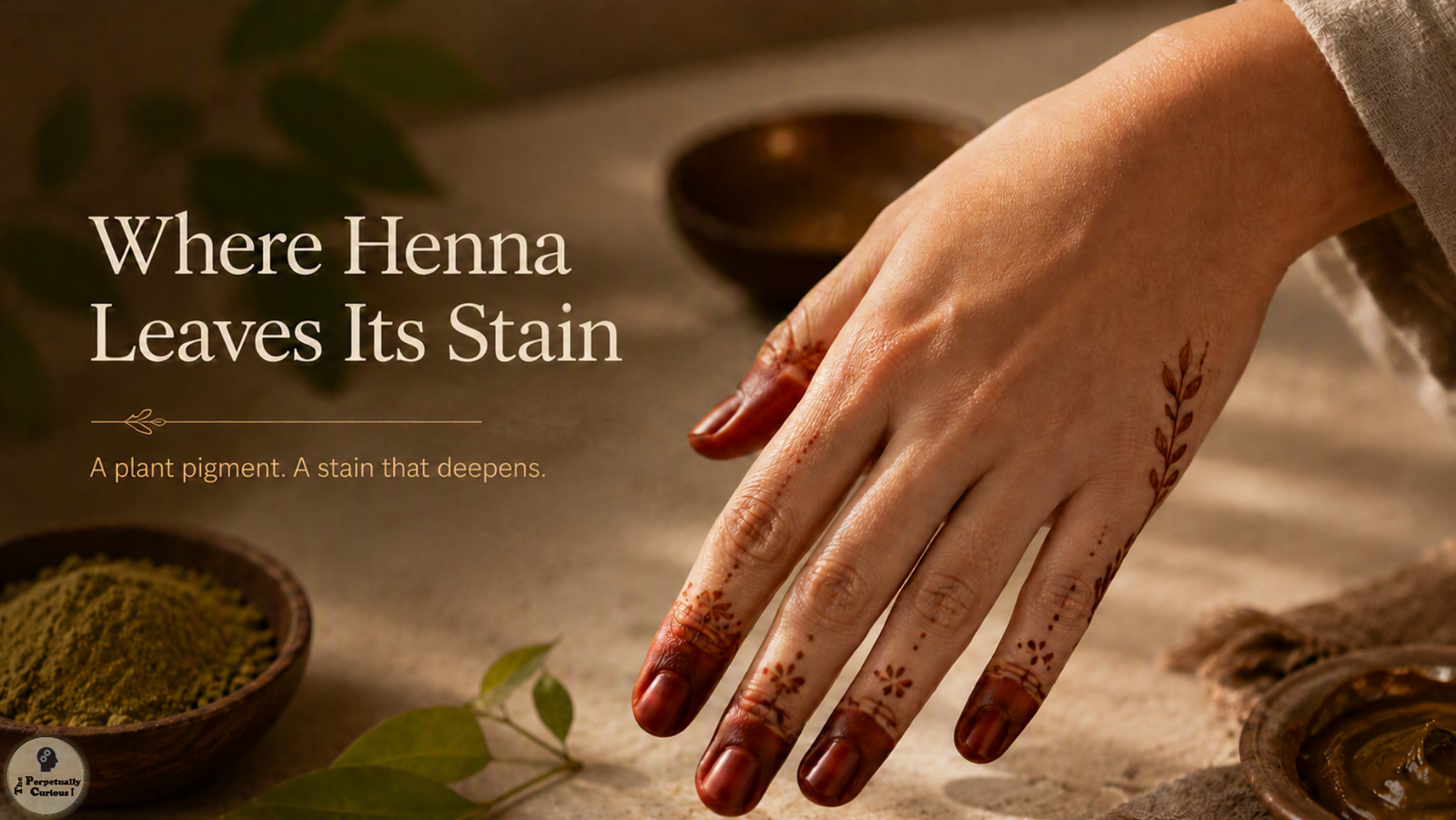
A trace of color lingers on the fingertips, holding a quiet memory of plant and person.
It rests for a moment on the surface of the skin, then begins its gentle departure.
In that fading light, the simple act of staining becomes a small reminder of how touch carries meaning across time.
🌱 A plant, a pigment, and a long human story
Henna comes from Lawsonia inermis, a shrub native to northeastern tropical Africa, the Arabian Peninsula, and a region extending from southern Pakistan into India. Centuries of cultivation have carried it into many other warm, seasonally dry regions across Africa, Asia, Australia, and elsewhere. Its leaves contain lawsone, a plant-derived pigment used for thousands of years to color skin, hair, nails, and materials such as wool, silk, and leather, placing henna within the wider human history of natural dyes.
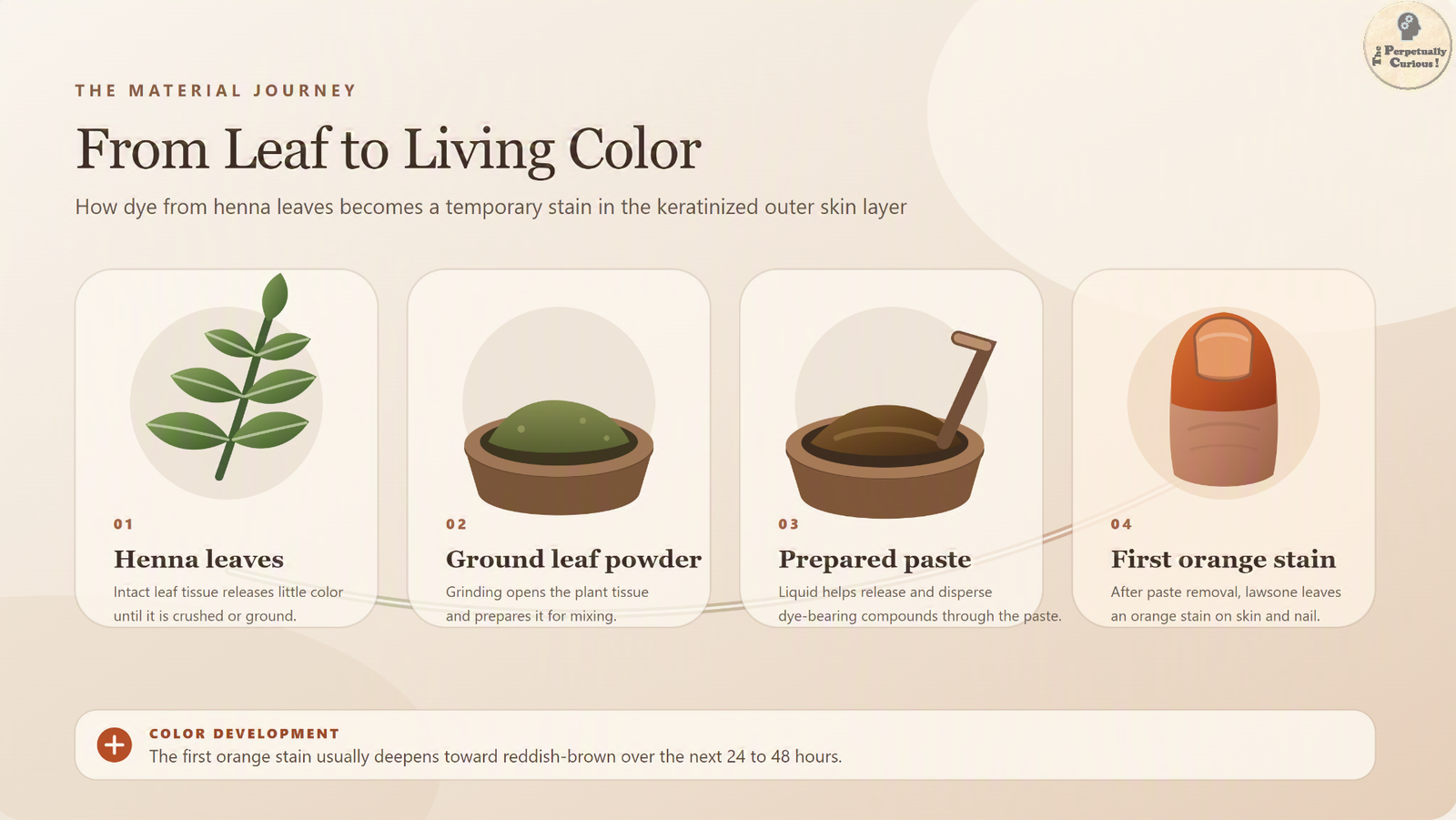
Intact leaves release little color because their dye-bearing compounds remain enclosed within the plant tissue. Once fresh leaves are crushed, or dried leaves are milled into powder and mixed with liquid, lawsone becomes available within the paste. When applied to the skin, the pigment migrates into the stratum corneum and reacts with keratin proteins. The visible stain often lasts about one to two weeks and may persist longer on thicker skin, depending on its location, the duration of paste contact, friction, washing, and the natural renewal of the skin.
Henna paste carries an earthy aroma inherited from the leaves. Lemon juice, tea, or other mixing liquids can alter the scent, making it sharper or more herbal. As moisture evaporates, the paste gradually tightens as it dries. Once the paste flakes away or is gently removed, an orange stain appears beneath it. During the following 24 to 48 hours, oxidation and continuing chemical reactions within the keratinized layer deepen the color toward reddish-brown or mahogany.
Henna’s natural range and later cultivation helped make the plant available to communities across many warm regions, but its cultural roles did not arise from one universal origin. Its vivid color, temporary persistence, and tactile application acquired everyday, decorative, and ceremonial meanings that varied across places and generations. The environment shaped where the plant could flourish, while the properties of the human hand helped determine where its color would appear most strongly.
🤲 Why hands and fingers become the canvas
Hands are among the most expressive parts of the human body. They greet, bless, work, create, carry, and offer comfort. Touch itself becomes a kind of language, with the fingertips serving as some of its most sensitive instruments. Even before color is added, the hand carries its own visible geometry through palm lines, flexion folds, and fingertip ridges. When henna is applied to this moving surface, everyday gestures become more visibly patterned, turning motion and touch into small acts of color.
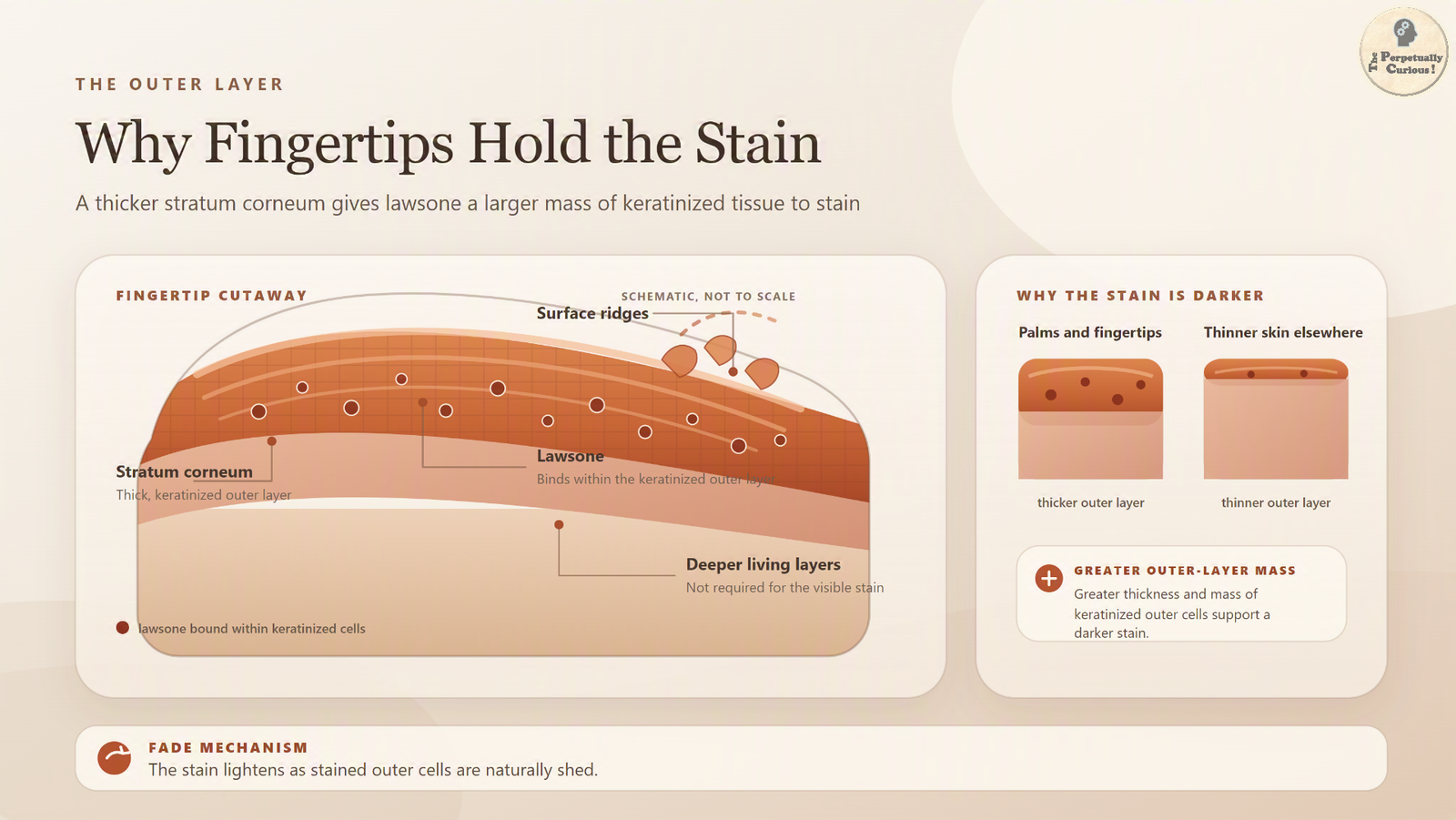
The palms and fingertips have a much thicker stratum corneum than most other areas of the body. This outer layer contains a greater mass of keratinized tissue, giving lawsone more material through which to migrate and react. For that reason, henna commonly develops a darker and more persistent stain on the palms, fingertips, and soles than on thinner skin elsewhere on the body.
While the paste remains wet, evaporating moisture can make it feel cool against the skin. In warm environments, that sensation may be soothing, but it does not by itself establish a single historical origin for henna use. The practical experience of the paste, the visibility of the hands, and the strong stains these surfaces produce likely contributed in different ways to the lasting prominence of hands and feet in henna traditions.
Henna application is often communal. Across many regional and family traditions, relatives, friends, artists, and celebrants gather while designs are applied, with women frequently playing a central role in preserving and sharing the practice. Conversation, music, artistry, and anticipation unfold together as the paste dries and the first stain begins to emerge.
In South Asian contexts, this shared practice is commonly known as mehndi, also spelled mehendi. During weddings, festivals, and family celebrations, decorated hands become part of a collective ritual shaped by time as much as by pattern. The stain remains personal to the wearer, yet its making often belongs to a wider circle of people, memories, and shared experience.
🌍 Fingers as symbols in cultural traditions
Across many communities in South Asia, North Africa, the Middle East, and their diasporas, henna is associated with weddings, festivals, family gatherings, and other moments of transition. Pre-wedding ceremonies may include the decoration of a bride’s hands and feet, while some traditions also involve the groom, relatives, or other members of the wedding party. The designs, participants, timing, and meanings differ widely, but the stained fingertips often make a private transition publicly visible through color and pattern.
Distinctive henna ceremonies also developed among Sephardi and Mizrahi Jewish communities from North Africa and the Middle East. In some wedding traditions, relatives place henna on the hands of the bride and groom while offering music, food, blessings, and communal celebration. Henna likewise appears in particular Muslim, Christian, Hindu, Sikh, and other regional customs, although no single interpretation applies across all communities. Its meaning is shaped by local history, family practice, and the occasion in which it is used.
Henna has also been associated with more solemn settings. Reddish staining preserved on the nails or hair of some ancient Egyptian remains has sometimes been interpreted as possible evidence of henna use. The precise purpose of such coloring is not always recoverable, however, and surviving stains do not by themselves establish a universal funerary symbolism. They suggest instead that bodily color could accompany both everyday life and ceremonial preparation in the ancient world.
Fingertip designs vary as widely as the traditions that sustain them. Some favor solid color or bold bands, while others use dots, geometric forms, floral motifs, or lace-like patterns extending toward the palm. Particular designs may carry locally understood associations, while others are primarily decorative, shaped by individual artistry or changing fashion. Whatever their meaning, the patterns reveal how the fingertips became more than surfaces for pigment. They became visible places where identity, celebration, memory, and craft could meet.
🔬 The chemistry behind the red stain
Henna’s characteristic color comes from lawsone, a pigment molecule chemically known as 2-hydroxy-1,4-naphthoquinone. Its conjugated ring structure acts as a chromophore, absorbing selected wavelengths of visible light and producing its characteristic orange-red appearance. The leaves contain lawsone along with glycosidically bound compounds associated with its release. Crushing fresh leaves, or grinding dried leaves into powder and mixing them with liquid, allows these dye-bearing compounds to move out of the plant tissue and into the paste.
For body art, henna powder may be mixed with water or a mildly acidic liquid. The paste is often allowed to rest for several hours under moderately warm conditions, giving the dye time to become available and disperse through the mixture. Preparation methods differ among artists and traditions, so ingredients such as lemon juice or tea are common choices rather than universal chemical requirements.
When the paste is applied, lawsone gradually diffuses into the stratum corneum, the keratinized outer layer of the epidermis. There, it reacts with available sites on keratin proteins and forms stable colored bonds. Because the pigment becomes attached within these outer cells, the stain fades mainly as the cells are naturally shed rather than simply washing away from the surface.
The color does not reach its full depth immediately. When the paste is first removed, the stain usually appears orange. During the following 24 to 48 hours, continuing chemical changes, including oxidation, deepen it toward reddish-brown or mahogany. This gradual maturation explains why the final shade may look considerably darker the day after application than it did when the paste was removed.
Stain intensity varies with the lawsone content and freshness of the powder, paste preparation, contact time, temperature, skin thickness, and any oils or lotions that interfere with direct contact. Ambient humidity may affect how quickly the paste dries, but it does not determine the result on its own. Washing, friction, and individual differences in skin renewal also influence how the color develops and how long it remains visible.
🧪 Why fingers and palms stain more deeply
The stratum corneum, the keratinized outer layer of the epidermis, varies greatly in thickness across the body. On the palms and soles, it is substantially thicker than on areas such as the forearms or face. This greater depth of keratinized tissue provides mechanical protection and gives lawsone more material through which to diffuse and react.
When henna paste is applied to the fingertips and palms, lawsone can enter this robust outer layer and bind throughout a larger mass of keratinized cells. The resulting stain is therefore often darker and more persistent than it would be on thinner skin. On the fingers, the color commonly remains visible for about one to two weeks, although washing, friction, skin renewal, and the original depth of the stain can shorten or extend that period.
Henna can also stain fingernails because the nail plate is composed largely of keratin. The color usually appears as a translucent reddish or reddish-brown tone and remains until the stained portion grows outward. Fingernails commonly grow about one eighth of an inch (roughly 3 to 3.5 millimeters) per month, although the rate varies among individuals and even among different fingers.
The stain also follows the natural ridges and valleys of the fingertip surface, preserving the hand’s fine biological geometry rather than simply collecting in the grooves. This textured appearance reflects the skin’s own micro-landscape, creating a pattern shaped jointly by anatomy and artistry.
🧭 Where science and symbolism meet on the fingertips
Henna on the fingers is more than a matter of appearance. It shows how human practices can develop around the properties of plants, skin, climate, and touch. A paste made from Lawsonia inermis can feel cool while wet, leave a durable stain on keratinized surfaces, and make the movements of the hands newly visible. Across different regions and generations, those physical qualities became part of decorative, communal, and ceremonial traditions without following one universal path.
The stain’s gradual fading can also invite reflection. As the color lightens through washing, friction, and skin renewal, it may evoke transition, impermanence, or renewal. Henna therefore follows two clocks: a chemical clock as the stain matures after application, and a biological clock as the colored outer cells are gradually shed. Chemistry and culture meet through time, while ceremonies may mark beginnings, passages, remembrance, or celebration.
The interaction between lawsone and keratin explains why the stain appears and why it lasts. Cultural histories explain why stained hands may be understood as festive, blessed, protective, beautiful, or simply personal, depending on the community and occasion. No single meaning belongs to every design or every wearer.
Seen through both scientific and cultural lenses, henna becomes more than decoration. It reveals how people work with the materials around them, allowing a plant pigment to become part of gesture, memory, and shared expression. The narrative thus returns to the opening image of color touching skin, where physical laws and human meaning briefly occupy the same fading surface.
🌸 A gentle closing reflection
When a hand is lifted and the fingertips glow with henna, a quiet conversation unfolds between plant and person, chemistry and culture. The stain is temporary, yet the practices surrounding it have endured across generations. Its color is shaped by lawsone, keratin, temperature, and time, while its meaning is shaped by artistry, ceremony, memory, and shared experience.
To look closely at henna on the fingers is to see how a single plant pigment can carry many layers of human significance. It invites curiosity about how traditions take root, move between communities, and continue to change while remaining grounded in tangible materials and familiar gestures. For a brief span, color rests on the skin, then gradually fades, leaving the stories and relationships around it to continue.
Pass this article along to someone curious and let the learning travel.
Did You Know
🌿 A green leaf can leave an orange-red stain. Chlorophyll and other plant pigments shape the visible color of living leaves, while lawsone supplies the orange-red dye released when henna tissue is crushed or ground and prepared as a paste.
🧬 Only a small portion of the dried leaf consists of lawsone. Even at modest concentrations, the pigment’s strong affinity for keratin allows henna to leave a vivid and persistent stain.
🧵 Henna can color protein-rich materials as well as skin. It has been used to color wool, silk, and leather, producing warm orange, red, or reddish-brown tones.
🟠 A natural henna stain does not begin dark brown. It usually appears orange when the paste is removed, then deepens toward reddish-brown or mahogany during the following 24 to 48 hours.
🎨 Fingertip designs vary widely across regions and communities. Some traditions favor solid color or bold geometric bands, while others use dots, floral forms, or lace-like patterns extending toward the palm.
🔥 Mild warmth can influence dye release and stain development. Warm conditions may help lawsone become available within the paste and support its movement into the keratinized surface, while rapid drying can reduce the time available for contact.
🌺 Mehndi is often both personal art and communal practice. In many South Asian and diasporic settings, relatives, friends, artists, and celebrants gather while designs are applied, making the waiting period part of the shared experience.
⚠️ “Black henna” is not the same as natural henna. Natural henna generally produces orange to reddish-brown stains. Products marketed as black henna may contain added colorants such as p-phenylenediamine, or PPD, and are chemically different from pure henna.
Why does henna turn from orange to reddish-brown after application?
When the paste is first removed, the stain usually appears orange. During the following 24 to 48 hours, oxidation and other continuing chemical changes within the keratinized outer layer deepen the color toward reddish-brown or mahogany.
Why do fingers and palms often develop the darkest henna stains?
The palms and fingertips have a much thicker stratum corneum than most other areas of the body. This greater mass of keratinized tissue gives lawsone more material through which to diffuse and react, producing a darker and often longer-lasting stain. The visibility and expressiveness of the hands also contribute to their cultural importance.
Does henna stain living tissue beneath the skin?
Natural henna primarily colors the stratum corneum, the outermost layer of flattened, nonliving keratinized cells. Lawsone does not need to reach the deeper living layers of the epidermis to create a visible stain. That differs from a melanocytic mole, which reflects localized proliferation of melanocytic cells within the skin rather than pigment held in the outer keratinized layer.
Why does henna fade unevenly?
Henna fades as stained cells in the outer skin layer are naturally shed. Frequent washing, friction, differences in skin thickness, and variations in renewal rate can cause some areas to lose color sooner than others.
Can henna stain fingernails as well as skin?
Yes. The nail plate is composed largely of keratin, so lawsone can leave a translucent reddish or reddish-brown stain that remains until the colored portion grows outward. The pale lunula at the base of the nail belongs to the nail’s underlying growth anatomy and is not created by the henna stain.
Why can the same henna paste produce different shades on different people?
Even when the same paste is applied, the final shade may vary with skin thickness, contact time, temperature, the amount of lawsone that reaches and binds within the keratinized outer layer, and surface barriers such as oils or lotions. Washing, friction, and differences in skin renewal can also influence how the stain develops and fades.
How long does a natural henna stain usually last?
A natural henna stain commonly remains visible for about one to two weeks. It may persist longer on the palms or soles, while frequent washing, friction, and faster skin renewal can shorten its appearance elsewhere.
Why do fingertip stains sometimes appear textured?
The stain follows the natural ridges, folds, and fine surface patterns of the fingertips. This preserves the skin’s existing micro-landscape rather than creating a separate texture of its own.
Are henna and mehndi the same thing?
Henna refers broadly to the plant, leaf powder, paste, pigment, or resulting stain. Mehndi, also spelled mehendi, commonly refers to the artistic and cultural practice of applying henna, especially in South Asian traditions.
What is the difference between natural henna and “black henna”?
Natural henna generally produces orange to reddish-brown stains. Products marketed as black henna may contain added colorants such as p-phenylenediamine, or PPD, and are chemically different from pure henna. PPD can cause serious skin reactions in some people.
📣 Let the Quiet Color Travel On
Under the soft glow of curiosity, we kindly invite you to share this article with friends, colleagues, and fellow explorers of culture and science. By passing it along, you can help this quiet story of stained fingertips reach a wider circle. Your support is deeply appreciated and helps keep the traditions, chemistry, and wonder surrounding henna gently illuminated.
“When Color Touches Skin: The Story of Henna on the Fingertips.” The Perpetually Curious!, July 2026.
https://www.theperpetuallycurious.org/articles/why-henna-stains-skin/Continue Exploring
For what comes next
Site Updates gathers occasional notes, new additions, and ways to keep in touch. RSS brings new publications to your feed reader in chronological order.
Choose the path that speaks to you, and let the next curiosity find you wherever your wondering takes you.