

Some maps tell us where rivers run. Others tell us where a culture located memory, consequence, aspiration, and return. Across several strands of Indian thought, the universe was imagined not only as an expanse of sky and earth, but also as a layered order of worlds called lokas.
One influential Puranic arrangement describes fourteen of them: seven upper worlds and seven lower regions. Yet this familiar vertical map was never the only cosmology in South Asia, nor did every text explain it in the same way. Earlier Vedic poetry often worked with three broad worlds. Upanishadic texts explored action, rebirth, knowledge, and post-mortem paths. Later Puranas developed richly spatial cosmographies filled with mountains, heavens, nether regions, beings, and cycles of dissolution.
The result is less like a single blueprint than a library of related maps. Their lines do not always coincide, but they circle enduring questions. Where does a life belong within a moral universe? Can a heavenly state last forever? Is “lower” necessarily worse? And what happens when the geography of the cosmos also becomes a geography of meaning?
Note: This article approaches these ideas through history, philosophy, literature, and cultural interpretation. It describes traditions without asking readers to adopt them, and it does not treat any one textual map as representative of all Indian communities or schools of thought.
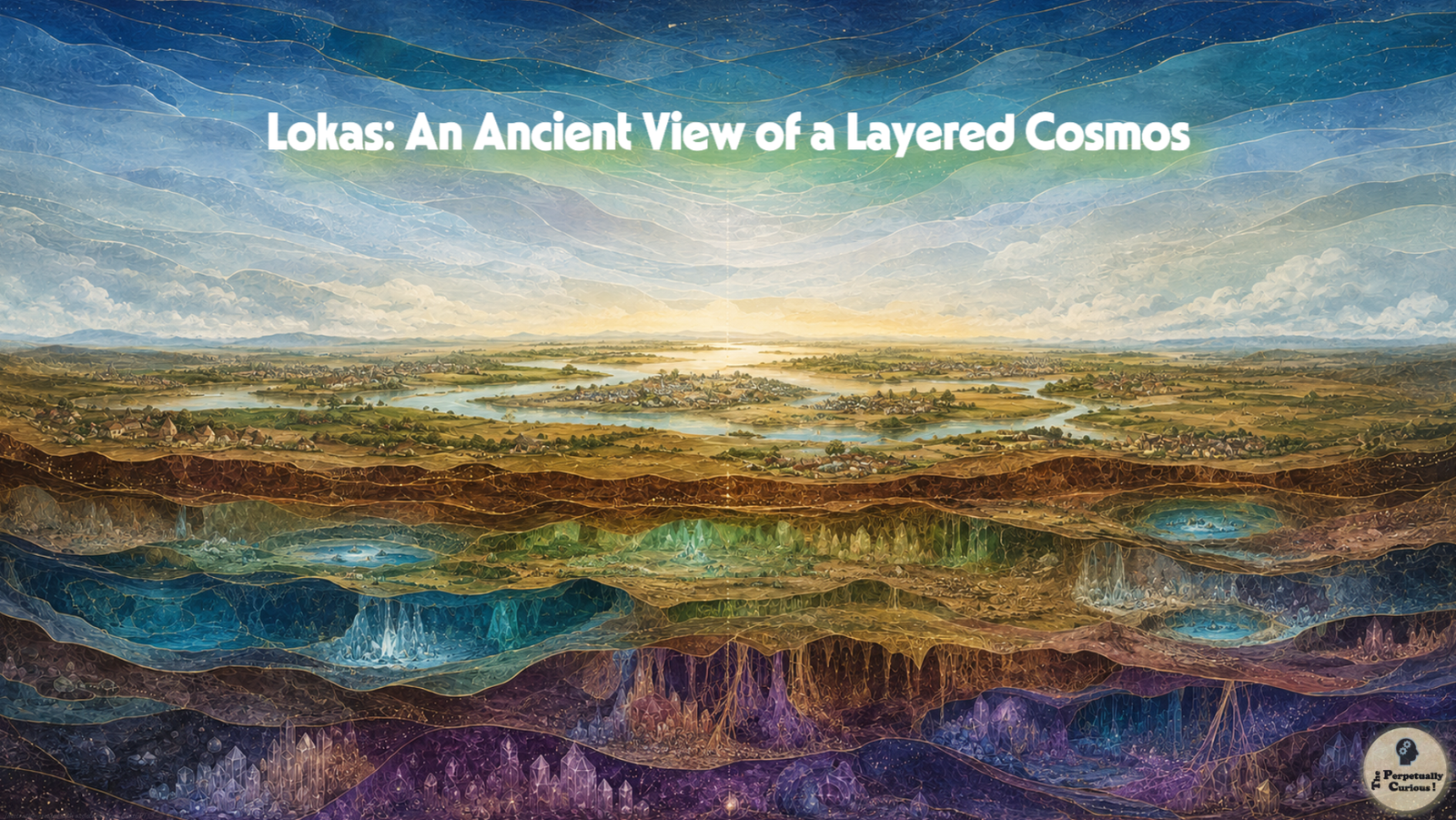
A quiet order rises through the worlds, carried by memory, intention, and return.
Each realm holds its own stillness, shaped by the paths that move through it.
In this vertical map, the universe rests like a lantern of many chambers, each lit with its own calm.
🌌 From three worlds to a layered cosmos
Early Vedic language frequently evokes a threefold cosmos: earth, the intermediate region, and heaven. These were not merely empty containers. They formed a living field in which deities, ritual action, weather, light, and human life could be related to one another.
Later texts did not simply discard that pattern. They elaborated it. Several Upanishads gave sustained attention to the relation between action, conduct, knowledge, death, and rebirth. Puranic literature then presented more expansive sacred geographies, often organizing the cosmos through nested continents, oceans, mountains, heavenly spheres, and subterranean regions.
This development should not be pictured as a neat march from a primitive three-world model to a perfected fourteen-world system. Indian textual traditions grew through commentary, retelling, regional development, philosophical disagreement, and new literary aims. Over time, the fourteen-world scheme became one influential way of expressing a memorable vertical order, even though earlier questions did not demand exactly fourteen answers.
That distinction matters. Once the map is treated as a family of textual constructions rather than a single timeless diagram, its variations become evidence instead of errors.
🗺️ Fourteen lokas, but not one fixed diagram
The most familiar fourteen-loka arrangement places seven regions above or beginning with the human world:
🌍 Bhūloka: the earthly world of embodied human life.
☁️ Bhuvarloka: the intermediate or atmospheric region between earth and heaven.
⚡ Svarloka: a heavenly sphere often associated with Indra and the devas.
🌌 Maharloka: a higher sphere associated in several accounts with great seers.
📜 Janaloka: a realm linked with elevated beings or the mind-born sons of Brahmā in Puranic descriptions.
🔥 Tapoloka: a high realm associated with tapas, or concentrated spiritual heat and discipline.
✨ Satyaloka or Brahmaloka: the highest sphere in this sequence, associated with Brahmā.
Beneath Bhūloka, a widely known list in the Bhāgavata Purāṇa names Atala, Vitala, Sutala, Talātala, Mahātala, Rasātala, and Pātāla. Other texts preserve different names or orders. The Viṣṇu Purāṇa, for example, gives a lower-world sequence that includes Nitala and Gabhastimat rather than reproducing the later familiar list exactly.
The variation is not a minor footnote. It prevents the article from presenting “the fourteen lokas” as a universally standardized chart. What remains stable is the broader architectural idea: existence can be arranged vertically, with the inhabited earth located within a much larger sacred cosmos.
Yet even that vertical language can mislead modern readers if “above” is immediately translated as morally good and “below” as morally evil. The lower regions complicate the ladder.
🏔️ Why higher and lower do not simply mean good and evil
The seven lower regions are often grouped under the name Pātāla, but they are not simply equivalents of hell. Puranic descriptions can portray them as beautiful, opulent, brightly jeweled, and inhabited by nāgas, daityas, dānavas, and other powerful beings. Sutala, for instance, is associated with the ruler Bali and is described with dignity rather than as a chamber of punishment.
Naraka belongs to a related but distinct vocabulary. Many texts use Naraka for punitive or corrective destinations connected with harmful conduct, while Pātāla names subterranean regions within sacred cosmography. The categories can appear in the same larger universe, but they should not be collapsed.
This distinction unsettles an easy modern assumption. Vertical maps often use height to suggest refinement, authority, luminosity, or distance from ordinary embodiment. They do not always make altitude a simple moral score. A splendid lower world can still be distant from liberation, just as a pleasurable heaven can remain temporary.
The map therefore contains at least two overlapping questions: where a realm is situated and what kind of existence it represents. Karma enters most clearly through the second.
⚖️ Where karma enters the map
Upanishadic and later traditions often connect action and conduct with future experience. The Chāndogya Upaniṣad links conduct with the conditions of rebirth. The Bṛhadāraṇyaka Upaniṣad relates what a person does and desires to what that person becomes. The Bhagavad Gītā later describes dispositions shaped by the three guṇas, with sattva associated with upward movement, rajas with the middle, and tamas with downward movement.
These passages helped make cosmology ethically charged, but they do not supply one universal table in which every action earns one named loka. Schools differed over how karma operates, whether divine agency has a role, how knowledge changes the process, and what liberation means. Texts also differ on whether particular heavenly attainments end in return.
One especially clear theme is impermanence. In the Bhagavad Gītā, those who reach heaven through accumulated merit return when that merit is exhausted. Even Brahmaloka is described there as lying within the cycle of return. Other texts and later traditions offer different qualifications, especially when knowledge or liberation is involved.
Karma is therefore better presented as a family of causal and moral theories than as a cosmic elevator with fixed admission rules. The vertical image gives direction to the idea, but the philosophical machinery varies from text to text.
That variety becomes visible in two early accounts of what may follow death: paths described through light and smoke, day and night, waxing and waning time.
🌗 Two paths through light and smoke
The Bṛhadāraṇyaka and Chāndogya Upaniṣads describe two post-mortem routes that later commentators call the path of the gods and the path of the ancestors. One is marked by flame, day, the bright lunar fortnight, and the Sun’s northward course. It is connected with particular forms of knowledge, contemplation, and disciplined life. The other is marked by smoke, night, the dark fortnight, and the southward course. It is connected with meritorious ritual and social works, followed by a stay associated with the Moon and eventual return through rain, food, and birth.
The imagery draws on observable cycles, including waxing and waning lunar phases. It should not be reduced to a literal flight path through the sky. The sequences bind ritual time, celestial rhythm, and ideas of return into one symbolic itinerary.
Nor should one route be paraphrased too casually as “good people” and the other as “ritualists without understanding.” The passages make more specific distinctions among knowledge, practice, merit, and destination. Their details belong to particular texts, not to a single creed shared uniformly across India.
This is where astronomy and cosmography meet most productively. They share the sky, but they do not perform the same intellectual task.
🔭 Astronomy beside cosmography
Indian scholars developed sophisticated traditions of calendrics and mathematical astronomy. A widely used system of twenty-seven lunar mansions, or nakṣatras, mapped successive segments along the Moon’s path, while later works such as the Sūrya Siddhānta supplied computational procedures for planetary motion, timekeeping, and eclipses. The wider history of nakṣatras and culturally patterned skies helps show how observation and interpretation can occupy the same heavens without becoming identical.
The recurrence of seven can make a planetary origin seem tempting. Yet numerical resemblance is not historical evidence. No dependable evidence establishes the seven visible celestial wanderers as the template for the fourteen-loka system.
The stronger comparison is methodological and restrained. Astronomical texts calculated recurring phenomena. Cosmographic texts organized a meaningful universe. Both could be systematic, and both could use celestial cycles, but one should not be treated as the concealed scientific proof of the other.
Once that boundary is restored, another question becomes easier to answer. Did traditional sources imagine the lokas as actual places, or as states of consciousness?
🧭 Spatial, symbolic, and philosophical readings
Many Puranic cosmographies describe lokas spatially. The Viṣṇu Purāṇa assigns positions and distances to upper spheres and places lower regions beneath the earth. It would therefore be inaccurate to say that the lokas were never locations and were always “dimensions” in a modern sense.
At the same time, sacred space is not identical to modern cartography. A realm can be narrated as a place while also carrying ethical, ritual, or philosophical significance. Later interpreters have read vertical cosmology symbolically, psychologically, or contemplatively. Those readings may be meaningful, but they should be labeled as interpretations rather than projected backward as the sole ancient view.
Modern physics does not clarify this distinction. Extra dimensions in mathematical theories, cosmological multiverses, dark matter, and observer effects have technical meanings supported by their own models and evidence. Pairing them with lokas creates a resemblance in vocabulary without establishing a historical or scientific equivalence.
The more illuminating question is not whether a loka can be detected by a telescope. It is how a textual culture used place, height, depth, light, duration, and return to think with. That imaginative architecture also moved beyond manuscripts and into landscape.
🏛️ When cosmic order enters landscape
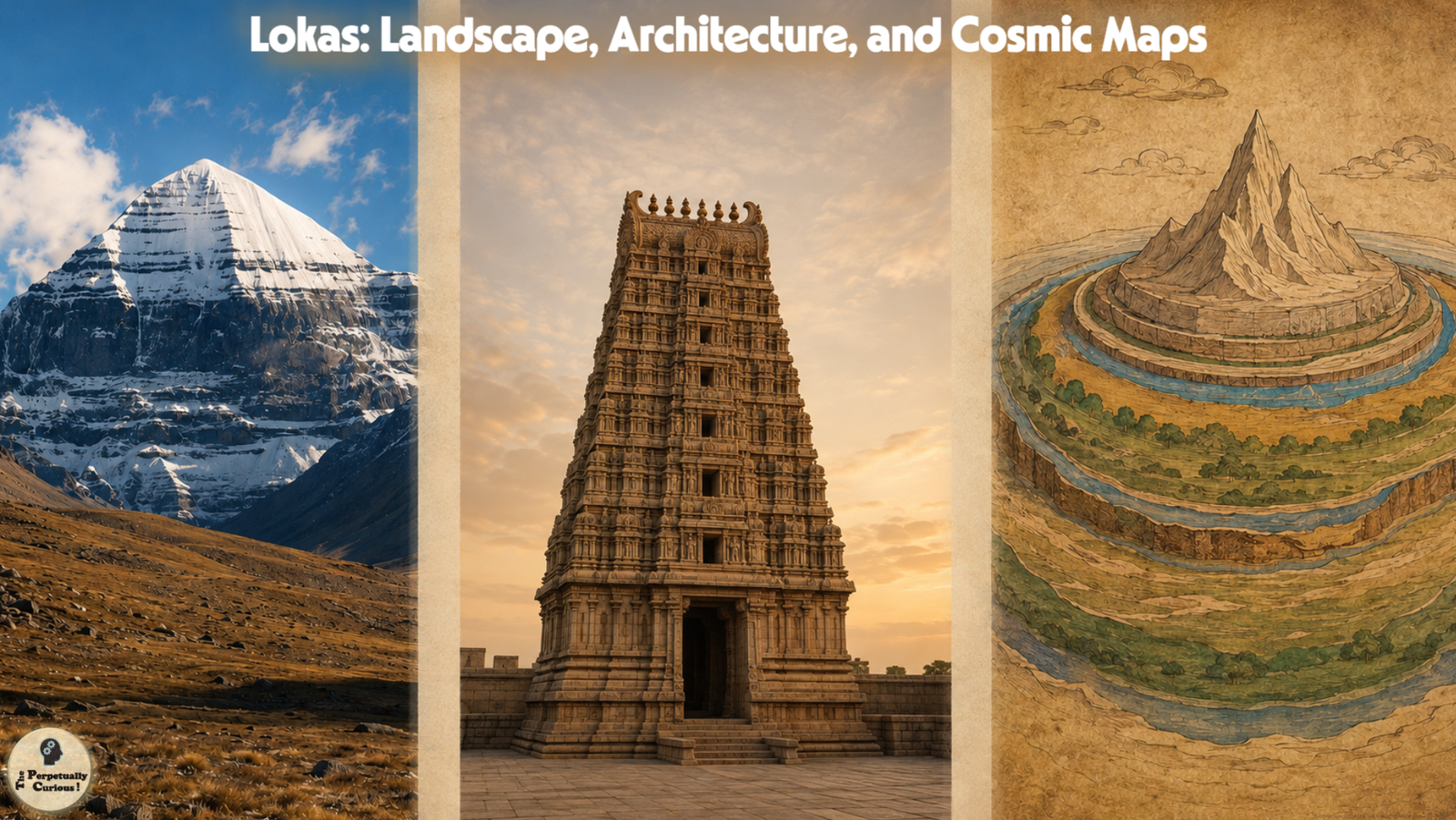
Mount Meru is a mythic cosmic mountain in Hindu, Buddhist, and Jain cosmographies. It functions as a center or axis around which regions of the world can be ordered. Mount Kailash, by contrast, is a physical mountain on the Tibetan Plateau, revered in Hindu, Buddhist, Jain, and Bon traditions. Some traditions and later representations connect Kailash with cosmic-center imagery, but the physical mountain and the mythic Meru should not be treated as automatically identical.
The broader story of Mount Kailash as geography, sacred landscape, and cultural meeting place offers a useful parallel. Stone, water, pilgrimage, and cosmological imagination gather around one visible peak, yet each tradition approaches it through its own narratives.
Temple architecture can also invite vertical readings. Towers and ascending tiers draw the eye upward, and some architectural programs express cosmological order. Still, a general claim that every gopuram or temple tower encodes all fourteen lokas would go beyond the evidence. Architectural symbolism varies by period, region, temple, and interpretive tradition.
Sacred geography does not make myth into ordinary topography. It shows how physical places can become anchors for stories about center, ascent, origin, and transcendence. The cosmic map is carried into the visible world without becoming a conventional atlas.
🌏 What the vertical imagination still reveals
The fourteen lokas remain interesting not because they secretly anticipated modern physics, but because they reveal a durable form of intellectual imagination. They place human life inside scales larger than a single lifetime. They make moral consequence spatially vivid. They allow pleasure to be temporary, lower realms to be splendid, and liberation to lie beyond the simple pursuit of a better destination.
They also remind us that traditions are internally plural. Vedic hymns, Upanishadic paths, Puranic geographies, the Bhagavad Gītā, and later philosophical readings do not speak with one voice. Their differences are part of the history, not noise to be edited away.
A vertical cosmos can look rigid at first: realm above realm, depth beneath depth. On closer view, it behaves more like a palimpsest. Earlier patterns remain visible beneath later maps. Astronomy lends the rhythm of observed skies. Ethics supplies consequence. Story gives the worlds inhabitants. Landscape gives imagination a mountain to circle.
The result is not one final chart of the universe. It is a record of people using height, light, time, and return to ask where a life fits within the whole.
Pass this article along to someone curious and let the learning travel.
💡 Did You Know
🗺️ Puranic cosmography is not only vertical. Some texts combine stacked realms with concentric continents, oceans, and Mount Meru, so the cosmic map can extend outward as well as upward.
🌳 The Bhagavad Gītā uses an inverted aśvattha, with roots above and branches below, as an image of conditioned existence. The tree is commonly identified with the sacred peepal tree, although the philosophical image should not be reduced to the botany of the species.
🌒 The same lunar cycle can function as observation and cultural timekeeping. Across societies, new and full moons became recurring cultural markers, although the meanings attached to them differed widely.
What are the 14 lokas?
A familiar Puranic scheme names seven upper worlds or spheres, beginning with Bhūloka and rising through Bhuvar, Svar, Mahar, Jana, Tapas, and Satya or Brahmaloka. Seven lower regions are often listed as Atala, Vitala, Sutala, Talātala, Mahātala, Rasātala, and Pātāla. Names and ordering vary among texts.
What does loka mean in this article?
The Sanskrit word loka has a wider semantic range than any single English equivalent. Depending on context, it can indicate a place, region, world, or division of the universe. In this article, “realm” or “world” is usually the closest shorthand. It should not automatically be treated as a planet, a modern physical dimension, or a purely psychological state; the intended sense depends on the text and interpretive setting.
Are the fourteen lokas described in the Vedas?
Early Vedic texts frequently use a three-world pattern of earth, intermediate space, and heaven. The fully articulated fourteen-world map is more characteristic of later Puranic cosmography. It is better described as a later elaboration than as a complete chart already present in the earliest hymns.
Are Pātāla and Naraka the same place?
Not usually. Pātāla refers to lower or subterranean regions, which can be portrayed as splendid. Naraka more directly refers to punitive or corrective destinations associated with harmful conduct. Texts vary, but collapsing the terms removes an important distinction.
Did ancient texts view lokas as physical places or states of consciousness?
Many Puranic texts describe them with spatial positions and distances. Symbolic, contemplative, and psychological interpretations also exist, especially in later commentary and modern thought. The safest account recognizes both while identifying which reading belongs to which source or period.
Does karma send each action to one specific loka?
There is no single cross-text chart that assigns every action to one named realm. Indian schools developed different accounts of karma, merit, knowledge, divine agency, rebirth, and liberation. Some texts describe broad upward or downward tendencies, but detailed admission rules should not be universalized.
What do light, smoke, and lunar phases have to do with the two paths after death?
The Bṛhadāraṇyaka and Chāndogya Upaniṣads describe one sequence through flame, day, the bright or waxing lunar fortnight, and the Sun’s northward course, and another through smoke, night, the dark or waning fortnight, and the southward course. These images connect ritual time and observed lunar phases with ideas of destination and return. They are best understood as text-specific symbolic itineraries, not routes described by observational astronomy.
Are heavenly lokas permanent?
Not in every framework. The Bhagavad Gītā describes heavenly reward as temporary when it depends on exhaustible merit and includes Brahmaloka within the cycle of return. Other texts and traditions qualify the issue differently, particularly when knowledge or liberation is involved.
Were the seven upper worlds based on the seven visible planets?
There is no reliable evidence for that direct derivation. Ancient Indian astronomy and sacred cosmography both organized celestial knowledge, but a shared preference for patterned systems does not prove that one list generated the other.
Is Mount Kailash the same as Mount Meru?
Mount Kailash is a physical mountain. Mount Meru is a mythic cosmic axis in several South Asian cosmologies. Some traditions and later representations associate Kailash with Meru-like symbolism, but the two should not be treated as universally identical.
Do Buddhist and Jain cosmologies use the same fourteen lokas?
No. Buddhism, Jainism, and Hindu traditions share a South Asian vocabulary of karma, rebirth, heavens, and lower realms, but they developed distinct cosmic structures and philosophical aims. Comparison is useful when it preserves those differences.
Why study the fourteen lokas today?
They offer a window into the history of ideas: how communities related ethics to place, observation to symbolism, and individual life to vast cycles of time. Their value does not depend on treating them as modern astronomy.
🌺 Share the wider map
If this article opened a new way of seeing cosmology as history, philosophy, and cultural imagination, consider sharing it with someone who enjoys following old questions into unexpected worlds. Curiosity travels well when it is carried with context.
Note: This article offers a historical and cultural exploration of ideas about a layered cosmos for general informational purposes.
“Vertical Worlds: The 14 Lokas in Ancient Indian Cosmology.” The Perpetually Curious!, August 2026.
https://www.theperpetuallycurious.org/articles/ancient-indian-cosmology-14-lokas/Continue Exploring
For what comes next
Site Updates gathers occasional notes, new additions, and ways to keep in touch. RSS brings new publications to your feed reader in chronological order.
Choose the path that speaks to you, and let the next curiosity find you wherever your wondering takes you.