
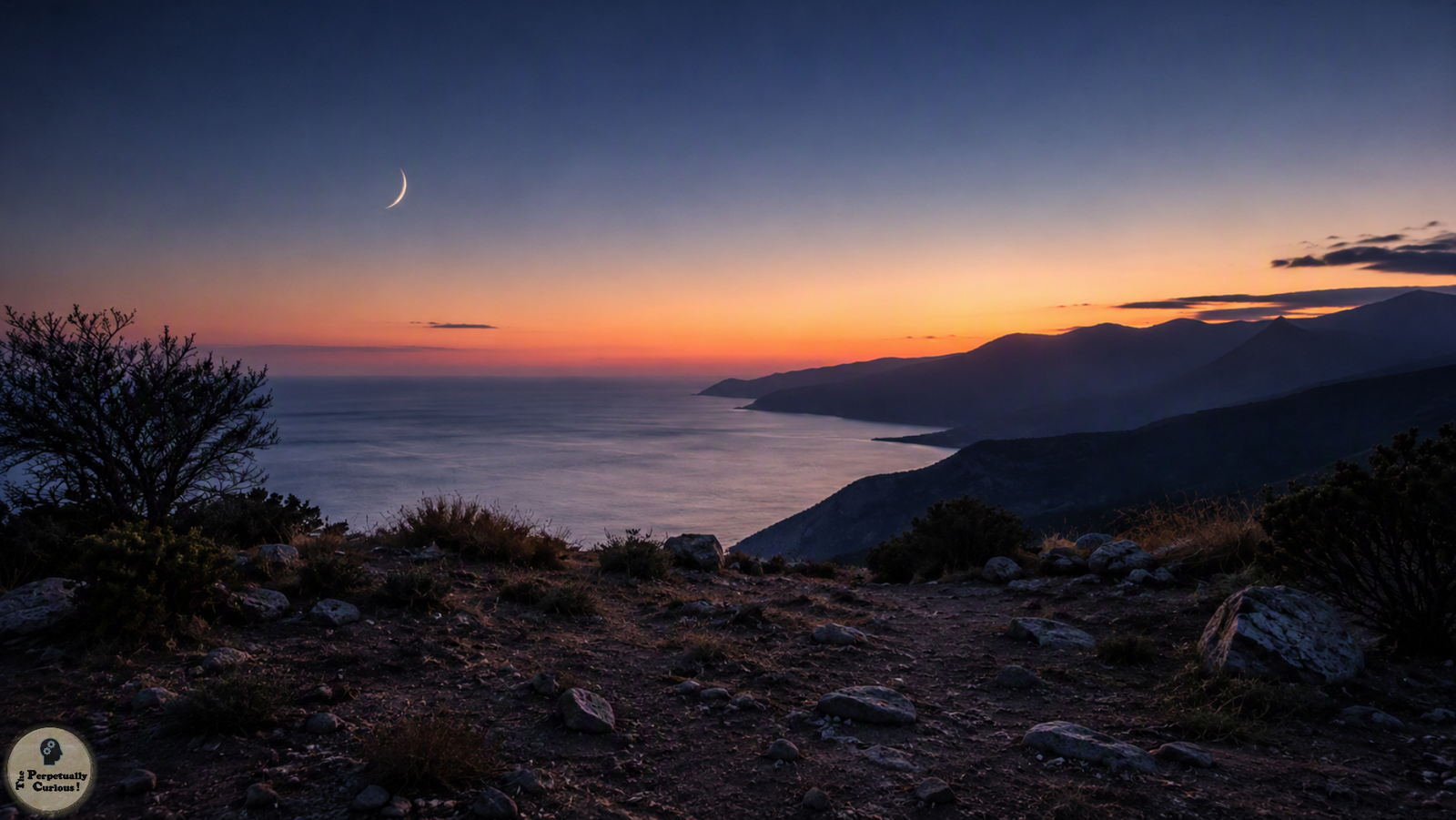
Most lunar phases pass gradually into the next, but two positions recur as clear opposites in human calendars and traditions: new Moon, when the Moon is effectively absent from the night sky, and full Moon, when its Earth-facing disk appears almost completely illuminated. Within the roughly 29.5-day lunar phase cycle, these dark and bright extremes create a repeating contrast that can help organize time.
The astronomical new Moon itself is normally invisible from Earth because the Moon lies near the Sun in our sky and its night side faces Earth. That creates an important distinction between astronomy and calendrical practice. Some lunar calendars begin not at the invisible instant of new Moon, but with the first visible crescent that follows it. In the Islamic calendar, for example, religious months traditionally begin with the sighting of that young crescent.
Other traditions give new-moon and full-moon dates their own ritual identities. Within Hindu traditions, observances may fall on amavasya, the new-moon day, or purnima, the full-moon day, although the significance of each date varies by festival, region, and community. Full Moon also forms a prominent landmark in East Asian seasonal traditions. Korea’s Chuseok falls on the 15th day of the eighth lunar month, a date traditionally associated with the full Moon, while Chinese Mid-Autumn traditions likewise connect the round Moon with gathering and reunion.
The full Moon is especially easy to recognize. It rises around sunset and remains visible through much of the night, while the exact new Moon remains invisible under ordinary circumstances. Between these extremes, the Moon waxes and wanes continuously. Different cultures have incorporated this recurring contrast between absence and fullness into calendrical boundaries and observances in different ways.
None of this means that astronomy assigns one universal meaning to a phase. Cultures build calendars, observances, and stories according to their own histories and beliefs. The sky supplies recurrence; people supply interpretation. The same human tendency to turn patterns in the night sky into shared systems of orientation and meaning helps explain why the Moon’s darkest and brightest turning points became more than astronomical events. They became ways of locating ourselves in time.