
A familiar voice calls your name. You turn, recognize the person, and feel the quiet certainty that the moment is happening to you. The brain is busy with sound, memory, attention, and emotion, yet none of those processes alone seems to contain the whole experience. Where, then, does awareness take shape?
The question invites us down to the synapse, the place where one nerve cell influences another, and outward to the networks those cells form. Neuroscience can trace much of this activity. It has not established a single address for consciousness, or fully explained why brain activity is accompanied by experience at all.
A moment of awareness rises and settles like a small light within a vast and shifting landscape.
Patterns move, signals change, yet something quiet gathers them into a single presence.
In that stillness, the mind feels its own unfolding and meets the world as if for the first time.
⚡ A message crosses a tiny gap
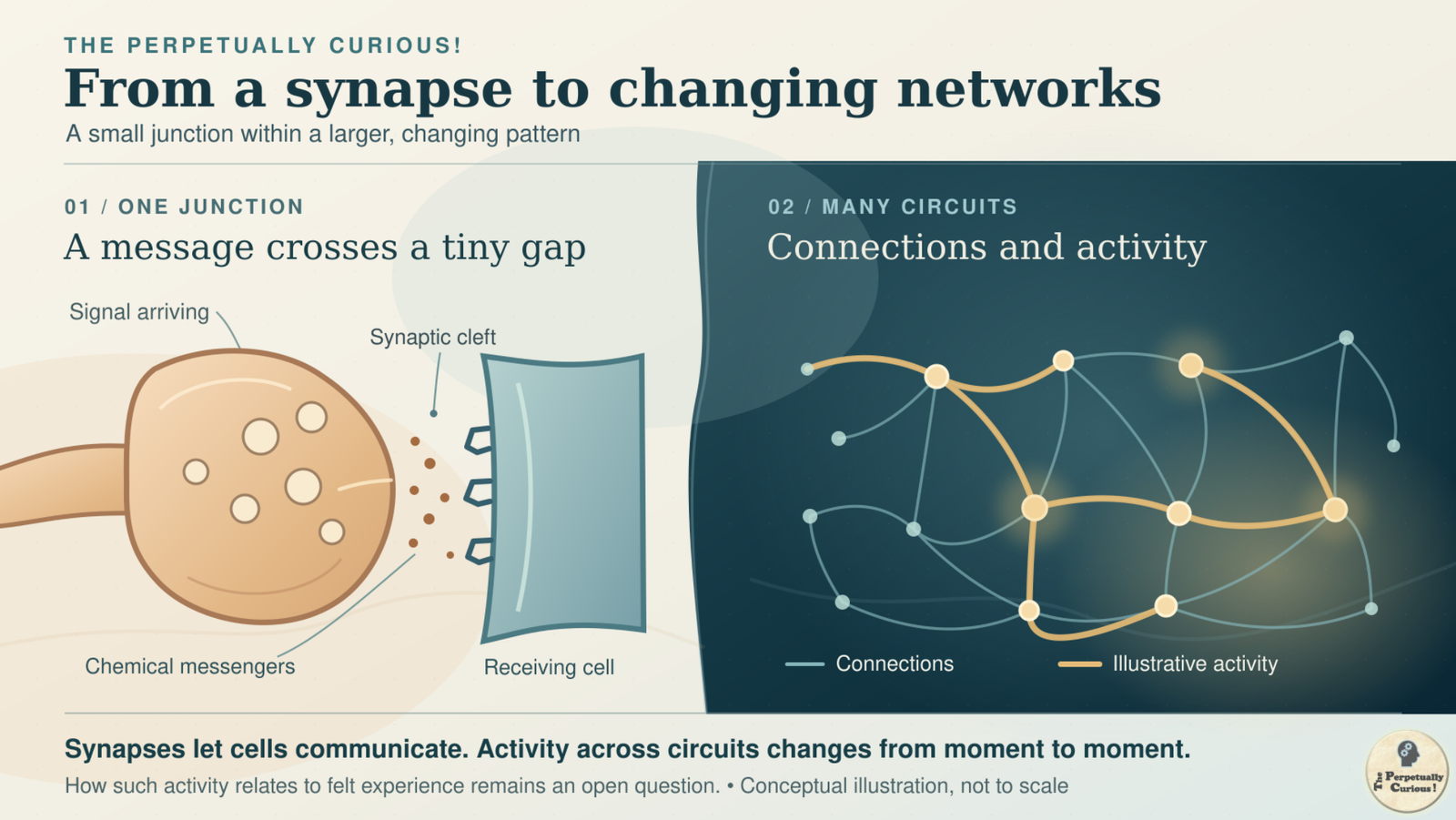
At many synapses, an electrical signal arriving at a neuron’s ending triggers the release of chemical messengers. They cross a narrow space called the synaptic cleft and bind to receptors on another cell. The receiving cell may then become more or less likely to send a signal of its own. Synapses also change with activity, one way that experience can leave a lasting mark on neural circuits.
Proteins help organize and stabilize these junctions, but their architecture is not a tiny switch that turns consciousness on. A synapse helps cells communicate; it does not, by itself, explain a thought or an inner life. That is why the question leads from one junction to changing patterns of activity across many cells.
🧩 From signals to a moment of experience
Recognizing that voice involves more than hearing it. Auditory processing, attention, memory, and a sense of relevance contribute to the encounter. Different brain systems handle different parts, while their moment-to-moment activity changes with the situation. The interplay of neurons, glial cells, and wider brain networks shapes how signals are processed. Glial cells help regulate the conditions for neural signaling and support the brain’s energy needs, although their precise relationship to conscious experience is not established.
To you, the voice, recognition, and feeling of being addressed arrive as one moment. One aspect of this puzzle, often called the binding problem, asks how separately processed features contribute to a coherent perception. It does not, by itself, explain why that perception is felt. The brain’s enduring connections provide routes for signals, but the activity along those routes changes from moment to moment. A wiring diagram alone cannot tell us what someone is experiencing now.
That difference between an available circuit and a lived moment becomes especially useful when we compare brain states. Researchers distinguish between the overall state of consciousness, such as being awake or deeply asleep, and the particular contents of experience, such as the voice you hear. A person can be awake without noticing a faint sound, while a sleeping person may have a vivid dream.
🌙 What changing states reveal
Sleep offers a natural test. As brain activity changes across the night, awareness of the surrounding room usually recedes. Experience does not simply switch off: dreams can occur during rapid eye movement sleep and during other stages as well. Reports from REM sleep are often more vivid and story-like on average, although non-REM dreams can be detailed too. The science of dreaming shows how striking an inner scene can feel even when a person is largely disconnected from the outside world.
General anesthesia offers another window, although its effects depend on the drug, the dose, and the person. Anesthetic agents act through several molecular pathways and alter activity across brain circuits. In studies of some anesthetized states, communication among distant brain regions becomes less flexible or less integrated. These are associations that vary across anesthetic conditions; they do not establish what any one person experiences. Lack of a response alone cannot settle that question either.
Brain injury poses a different and more complicated question. Tissue and pathways may be physically damaged, while other circuits may remain in place but communicate poorly as blood flow, metabolism, or signaling changes. These differences affect both behavior and the possibility of recovery, which cannot be reduced to synapses reconnecting. Taken together, changing states and injuries point toward the importance of organized brain activity without identifying a single molecular event that produces awareness.
🔎 Searching for a seat of awareness
To see how such changing activity relates to wakefulness and experience, researchers study the cortex, thalamus, brainstem, and the connections among them. The thalamus participates in circuits that regulate arousal and exchange information with the cortex; interactions between these regions change across sleep and some anesthetized states. Cortical regions contribute to what is perceived and how information is used. Their roles differ across tasks and states, and no isolated structure has been shown to house the whole of consciousness.
The claustrum, a thin and widely connected brain structure, has sometimes been proposed as a coordinator of awareness. That idea remains a hypothesis. In a small human study, stimulation within the claustrum did not abolish awareness. Its story is a reminder that being connected to many regions does not, on its own, make one region the seat of experience.
The search therefore moves from a proposed location toward a harder question about patterns: which interactions matter, and how can experiments distinguish activity that accompanies experience from activity that helps cause it?
🗺️ Competing maps of awareness
To test which patterns matter, researchers need theories that make distinct predictions. Global neuronal workspace theory emphasizes information becoming broadly available across brain networks. Integrated information theory proposes that experience corresponds to the causal structure a system generates as a whole, beyond what its parts could produce separately. In a direct, preregistered comparison, brain recordings matched some predictions of each theory but challenged central predictions of both. The findings sharpen the questions; they do not settle the field.
💭 What a neural map cannot yet explain
Even a reliable map of the circuits involved would leave another question open. Neuroscience can investigate what changes when someone sees red, hears music, or reports a dream. Why any of that activity is felt from within is a philosophical and scientific problem whose answer is still contested. We can take the biology seriously without treating one theory of subjective experience as an established fact.
The synapse is a remarkable part of this story because it lets the brain communicate and adapt. Yet awareness cannot presently be pinned to the small space between two cells. In humans, researchers investigate its biological conditions across molecules, circuits, and changing states.
Perhaps the most useful image is not a hidden chamber where the mind waits, but a conversation taking shape across many participants. That is an image, not an explanation. It leaves room for the patient work of experiments and for the ordinary astonishment of hearing a voice, turning toward it, and finding a whole world already there.
Pass this article along to someone curious and let the learning travel.
💡 Did you know?
🩺 Some people with severe brain injury show no outward response to spoken commands, yet brain recordings or imaging can reveal activity consistent with following those commands. This is evidence of covert command following, not a measure of the person’s full inner experience. Outward behavior alone cannot settle the question of awareness.
👁️ In certain cases of visual brain injury, a person can distinguish a stimulus in an affected part of the visual field better than chance while reporting no clear sight of it. Called blindsight, this phenomenon helps researchers separate processing a signal from consciously seeing it. Residual awareness can differ among people and visual tasks.
Is consciousness located in a synapse?
No individual synapse has been shown to contain consciousness. Synapses allow cells to influence one another and help shape the activity of larger circuits. How those circuits support subjective experience remains under investigation.
Have scientists found one part of the brain that produces consciousness?
No single structure has been established as its sole source. Different systems contribute to arousal, perception, and the contents of experience, and researchers continue to test how they work together.
Does a person stop experiencing anything whenever they are unresponsive?
Not necessarily. Responsiveness is an observable behavior, while experience is private. Dreams during sleep and some reports associated with anesthesia show why the two must be distinguished, although neither tells us what any particular unresponsive person is experiencing.
Are memory and consciousness the same thing?
No. Memory can shape what enters awareness, but remembering an experience and having one are different questions. Even a brief feeling of familiarity, such as déjà vu, shows how perception and memory can meet in a conscious moment without becoming identical.
If synapses change, why can a sense of self feel continuous?
Remembering one’s past involves activity across distributed brain systems, while connections can change without every learned pattern disappearing at once. Memory and personal history may contribute to a sense of continuity. This does not settle how that sense arises or why it is felt from within.
What is the “hard problem” of consciousness?
It is the question of why physical processes in the brain are accompanied by subjective experience. Describing the circuits that support perception is a vital part of the research, but many scholars hold that this description has not yet explained why perception feels like something to the person having it.
🌍 Let the question travel
If this exploration has given you a new way to think about the mind, we kindly invite you to share it with friends and colleagues. Each thoughtful conversation gives a difficult question more room to be understood.
📚 Educational context
This article explores how scientists study consciousness, brain activity, and changing states for educational purposes. It does not offer medical advice or guidance about illness, diagnosis, or treatment. The research described here explains how neural activity is investigated in general terms and cannot be used to assess any person’s health or interpret an individual’s experience. Questions about symptoms, medical conditions, or health decisions should be discussed with a qualified healthcare professional.
“Where Awareness Takes Shape: Synapses, Brain Networks, and Consciousness.” The Perpetually Curious!, September 2026.
https://www.theperpetuallycurious.org/articles/where-consciousness-arises/Continue Exploring
For the curious mind: want to explore this theme through a few questions? Visit the Classic Quiz Studio, nestled under Explorations opens in a new tab ,and see where a few well-placed questions lead: Biology & Health Quizzesopens in a new tab
For what comes next
Site Updates gathers occasional notes, new additions, and ways to keep in touch. RSS brings new publications to your feed reader in chronological order.
Choose the path that speaks to you, and let the next curiosity find you wherever your wondering takes you.