

At the mouth of a rocky crevice, an octopus can explore a place its eyes cannot see. One arm slips inside while the rest of the animal stays outside. The suckers grip the rock and detect chemicals on the surfaces they touch. Its first hints of what lies inside can come from the far end of an arm.
That small reach offers a way into octopus intelligence. What the animal senses through its body can shape what it does next. An arm can feel for a meal or carry an object that becomes shelter. The same soft body can change its appearance or slip away behind a cloud of ink.
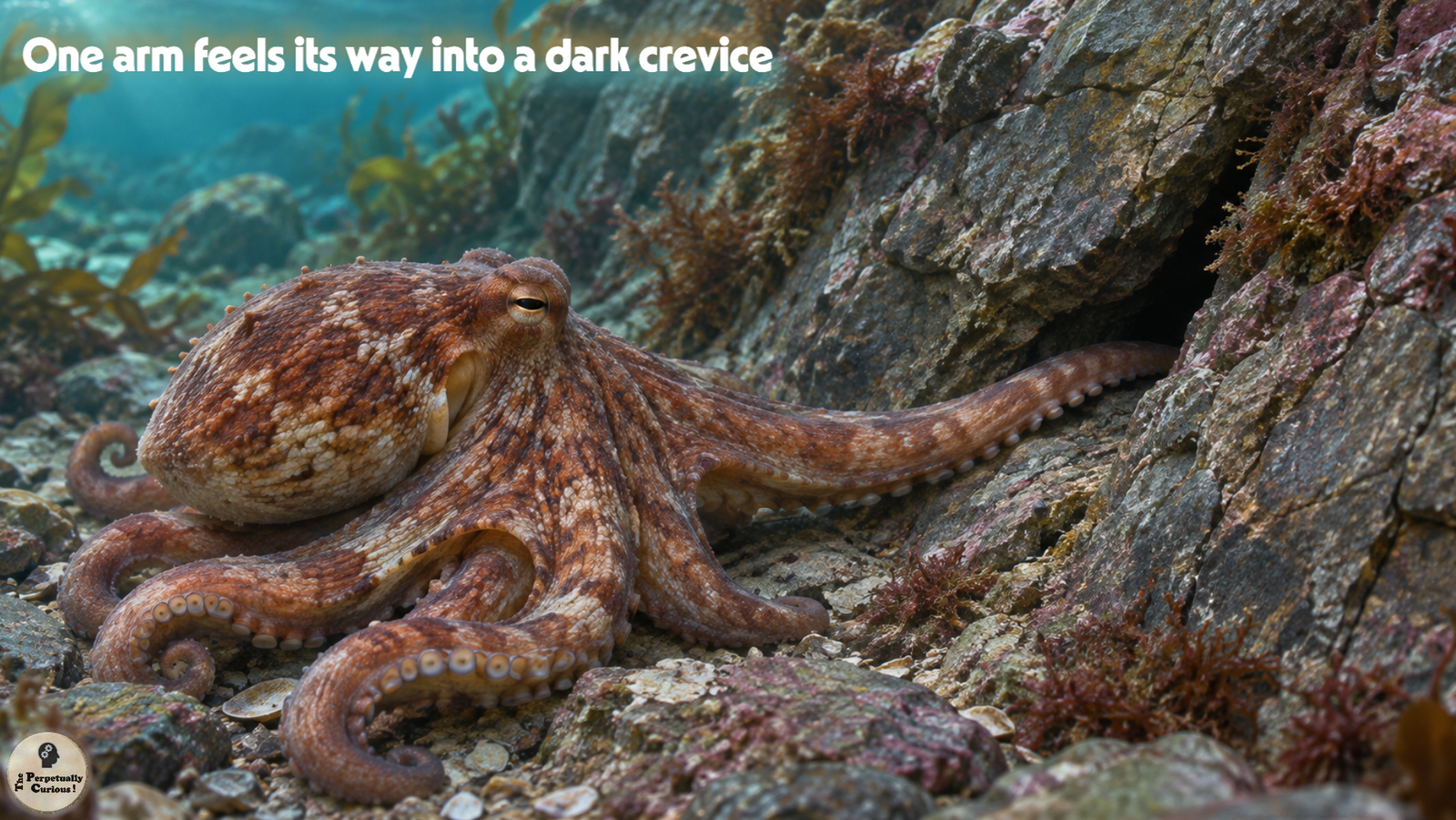
In the dim spaces between rock and water, an arm reaches where eyes cannot follow.
Beneath shifting colors, drifting ink, and silent currents, a life unfolds through touch, patience, and possibility.
The sea rarely announces its mysteries. It simply waits for them to be noticed.
🧠 How an octopus senses with its arms
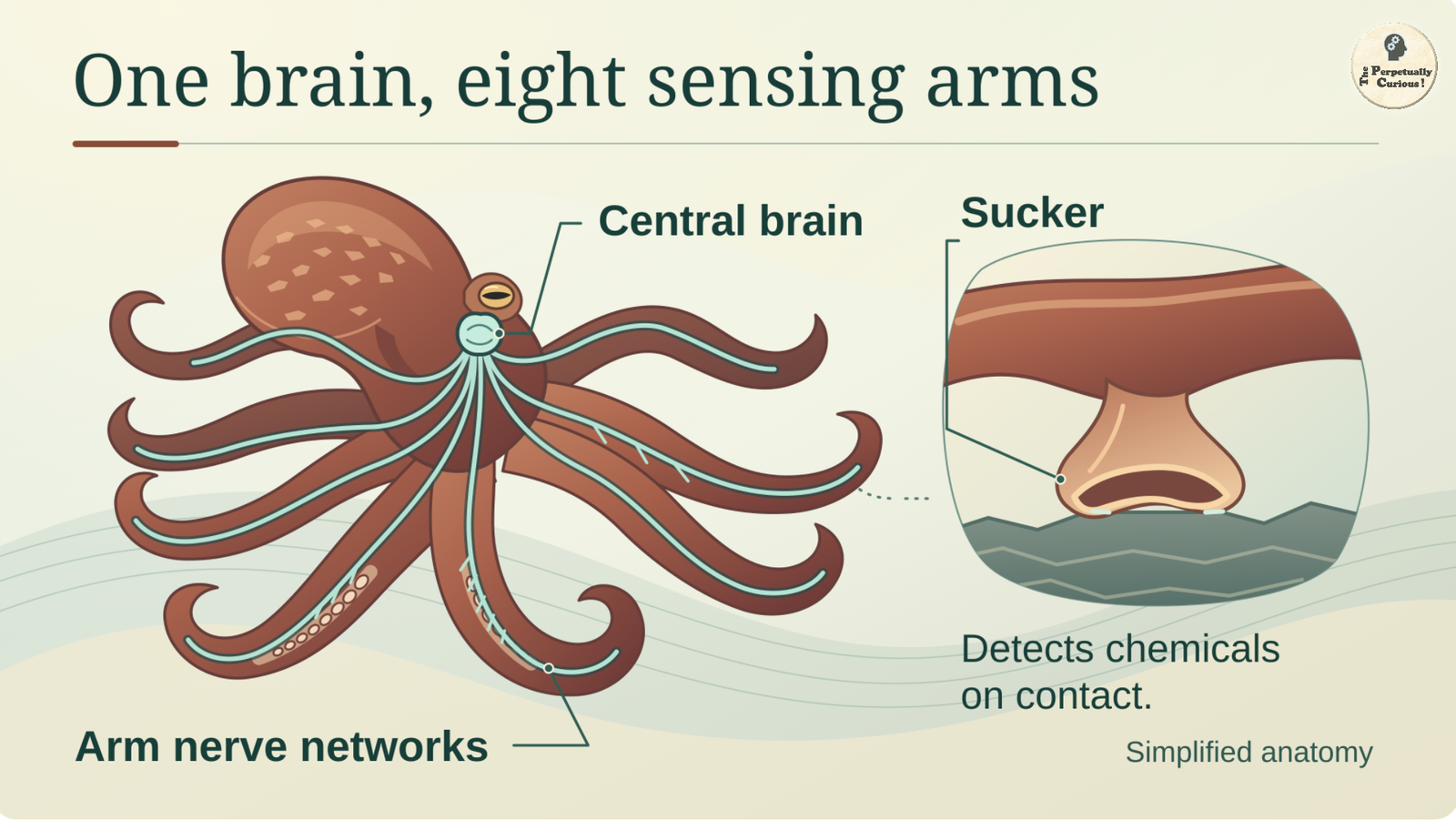
An octopus has one central brain and extensive networks of nerve cells in its eight arms. Those networks handle some sensing and movement locally, a useful arrangement when an arm can bend and twist along its length. The suckers help the animal grip a surface, and specialized receptors let them detect chemicals on contact. Researchers often describe this as tasting by touch.[1]
In one laboratory study, common octopuses (Octopus vulgaris) learned to reach through a maze with a single arm toward a visually marked compartment. A cue picked up by the eyes helped guide a limb that also gathers information of its own.[2] On the seabed, an object that an arm explores and grasps can become a shelter.
🐚 When a shell becomes shelter
In Indonesian waters, researchers watched veined octopuses (Amphioctopus marginatus) carry discarded coconut shell halves across the seabed. An octopus could collect two halves and later draw them together around its body. Carrying them made movement awkward, and their value as shelter came when the animal stopped and put them together.[3]
The researchers described carrying the shells for later use as defensive tool use. What the octopus anticipates during the journey remains an open question. A coconut shell gives it something to hide inside. For many octopuses, the skin itself offers another way to stay out of sight.
🎨 How skin changes color and texture
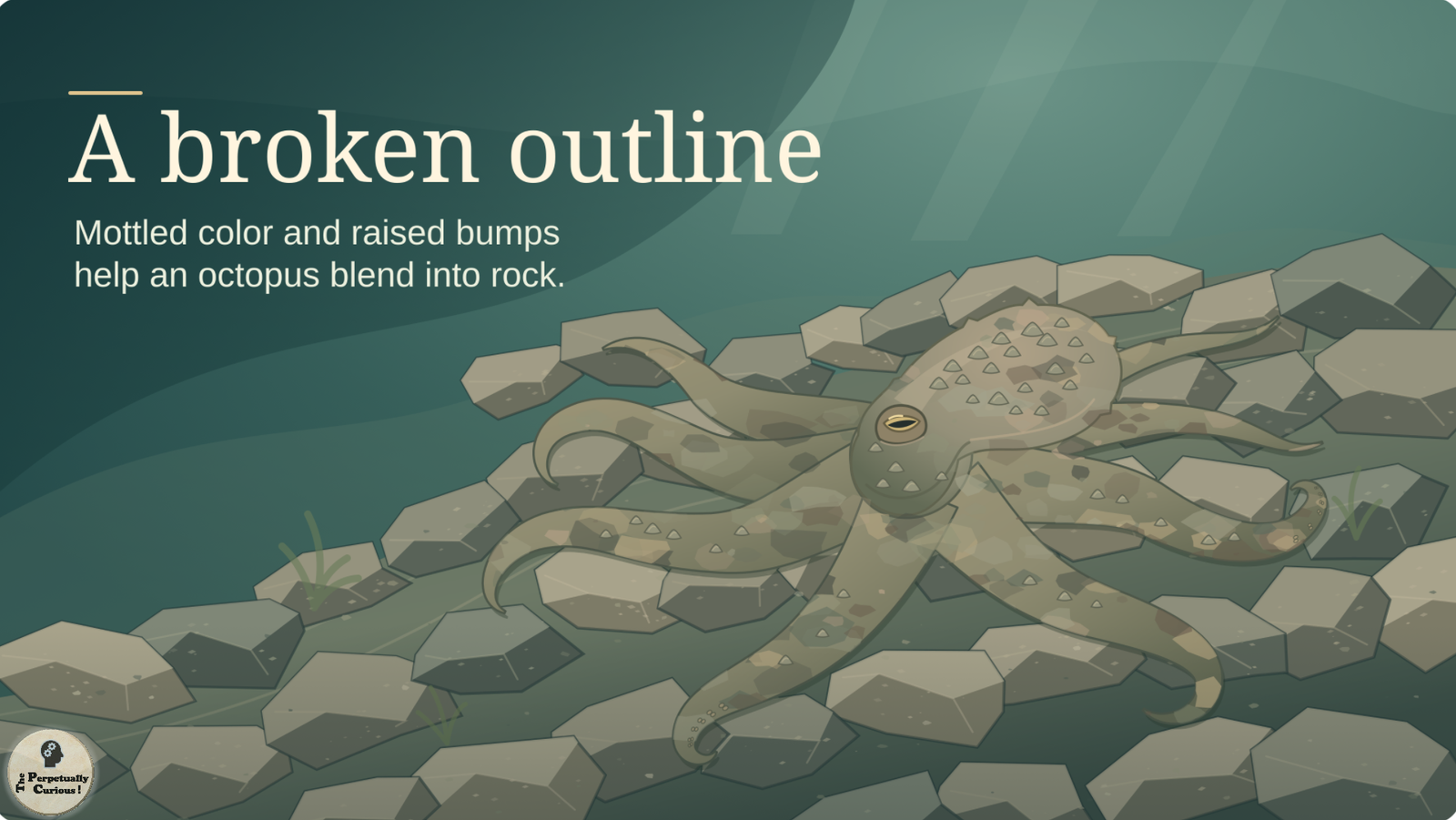
Tiny muscles stretch open pigment sacs in the skin called chromatophores. As the sacs expand, more pigment becomes visible. As the muscles relax, the spots shrink. Other structures reflect light and can give the skin an iridescent sheen. Some octopuses also raise small bumps called papillae, breaking up a smooth outline against rock or rubble.
The same skin can help an octopus stand out. Researchers watching gloomy octopuses (Octopus tetricus) recorded dark body patterns and raised postures during encounters between individuals.[4] A change in skin pattern can make an octopus harder to pick out against the seafloor. A second kind of cover can form in the water around it.
☁️ What octopus ink does
Many octopuses release dark ink through the funnel, the same opening they use to jet water for movement. Melanin gives the ink its dark color, and mucus helps shape the discharge. A diffuse cloud can obscure the octopus as it moves away. In some ink-releasing cephalopods, the discharge can hold together in a shape that resembles the animal and may briefly draw a predator’s attention.[5]
The roles change when the octopus is the one looking for a meal.
🦀 How octopuses use venom
In one field study, young octopuses used touch and chemical cues to search for prey in crevices and under rocks.[6] A hard beak sits where the arms meet, and venom from the salivary glands can help an octopus immobilize its prey.[7]
Blue-ringed octopuses (Hapalochlaena) carry tetrodotoxin in their venom. The toxin can cause paralysis, and a bite can be life-threatening to a human. Bright blue markings can appear when the animal is disturbed.[8]
Tetrodotoxin also occurs in pufferfish and other animals. The blue-ringed octopus is one example of how animals use the same toxin in different ways.
🌊 How species meet different surroundings
Across habitats, the same eight-armed body plan offers different ways to find cover and move through water. In the coastal North Pacific, a giant Pacific octopus (Enteroctopus dofleini) can blend into the rocks around its den. On sandy bottoms in Indonesian waters, a mimic octopus (Thaumoctopus mimicus) can draw its arms together and swim with a silhouette like a flatfish. In the deep sea, dumbo octopuses (Grimpoteuthis) can move with paired fins that look like small ears.
A brooding female can spend much of her time tending a single clutch.[9] At the opening of a crevice, an arm reaches into the dark. On a deep rock face, a female stays with her eggs. So much of life in a soft body depends on when to reach, when to slip away, and when to stay.
Pass this article along to someone curious and let the learning travel.
💡 Did you know?
💙 An octopus has three hearts. Two pump blood through the gills, where it picks up oxygen, and the third pumps it around the body. The blood turns blue when oxygen binds to hemocyanin, its copper-containing oxygen carrier.
🥚 In Monterey Canyon, researchers followed one female deep-sea octopus (Graneledone boreopacifica) as she brooded the same clutch for 53 months. The team recognized her by distinctive scars when they returned to the rock face.[9]
💤 The skin can change even while an octopus sleeps. Researchers studying Octopus laqueus observed brief bouts of active sleep in which skin patterns changed rapidly. Some resembled patterns seen while the animals were awake.[10]
How many brains does an octopus have?
An octopus has one central brain. The popular phrase “nine brains” counts the eight arms alongside it. Each arm contains extensive nerve networks that handle some sensing and movement close to where it happens.
What is the difference between octopus ink and venom?
Ink is released into the water, and a bite delivers venom. The bite of a blue-ringed octopus is one example of how tetrodotoxin reaches other animals.[8] Researchers have also detected tetrodotoxin in the ink of the greater blue-ringed octopus. Its role in the ink remains unclear.[5]
Can an octopus regrow a lost arm?
Yes. The common octopus can regrow lost arm tissue. The wound first closes, then new tissue grows from the injured end.
Do octopuses dream?
Researchers have recorded quiet and active sleep in some octopuses, and changes in the skin are visible during active sleep. What the animal experiences during that time remains unknown.[10] Researchers studying human dreaming have another kind of evidence. People can describe what they remember after waking.
What happens after the eggs hatch?
In many species, a female broods eggs once and dies around the time they hatch. On a later visit to the Monterey Canyon rock face, researchers found empty egg cases. The female was gone.[9]
↗️ Let the wonder travel
Share this with someone who would linger with you over a small patch of sea, watching to see what moves.
📚 Educational context
This article introduces octopus behavior and physiology. The studies described involve particular species and settings, from laboratory observations to fieldwork on the seabed.
Selected sources
- van Giesen L, Kilian PB, Allard CAH, et al. (2020). Molecular Basis of Chemotactile Sensation in Octopus. Cell, 183(3), 594-604.e14. [PMID: 33125889]
- Gutnick T, Byrne RA, Hochner B, et al. (2011). Octopus vulgaris Uses Visual Information to Determine the Location of Its Arm. Current Biology, 21(6), 460-462. [PMID: 21396818]
- Finn JK, Tregenza T, Norman MD. (2009). Defensive tool use in a coconut-carrying octopus. Current Biology, 19(23), R1069-R1070. [PMID: 20064403]
- Scheel D, Godfrey-Smith P, Lawrence M. (2016). Signal Use by Octopuses in Agonistic Interactions. Current Biology, 26(3), 377-382. [PMID: 26832440]
- Derby CD. (2014). Cephalopod ink: production, chemistry, functions and applications. Marine Drugs, 12(5), 2700-2730. [PMID: 24824020]
- Mather JA. (1991). Foraging, feeding and prey remains in middens of juvenile Octopus vulgaris (Mollusca: Cephalopoda). Journal of Zoology, 224(1), 27-39.
- Fiorito G, Affuso A, Basil J, et al. (2015). Guidelines for the Care and Welfare of Cephalopods in Research – A consensus based on an initiative by CephRes, FELASA and the Boyd Group. Laboratory Animals, 49(2 Suppl), 1-90. [PMID: 26354955]
- Australian Museum. (2021). Blue-lined Octopus. Updated September 29, 2021.
- Robison B, Seibel B, Drazen J. (2014). Deep-Sea Octopus (Graneledone boreopacifica) Conducts the Longest-Known Egg-Brooding Period of Any Animal. PLOS ONE, 9(7), e103437. [PMID: 25075745]
- Pophale A, Shimizu K, Mano T, et al. (2023). Wake-like skin patterning and neural activity during octopus sleep. Nature, 619(7968), 129-134. [PMID: 37380770]
“How Octopuses Think, Hide, and Hunt.” The Perpetually Curious!, November 2026.
https://www.theperpetuallycurious.org/articles/octopus-intelligence/Continue Exploring
For the curious mind: want to explore this theme through a few questions? Visit the Classic Quiz Studio, nestled under Explorations opens in a new tab ,and see where a few well-placed questions lead: Wilderness & Homestead Creatures Quizzesopens in a new tab
For what comes next
Site Updates gathers occasional notes, new additions, and ways to keep in touch. RSS brings new publications to your feed reader in chronological order.
Choose the path that speaks to you, and let the next curiosity find you wherever your wondering takes you.