

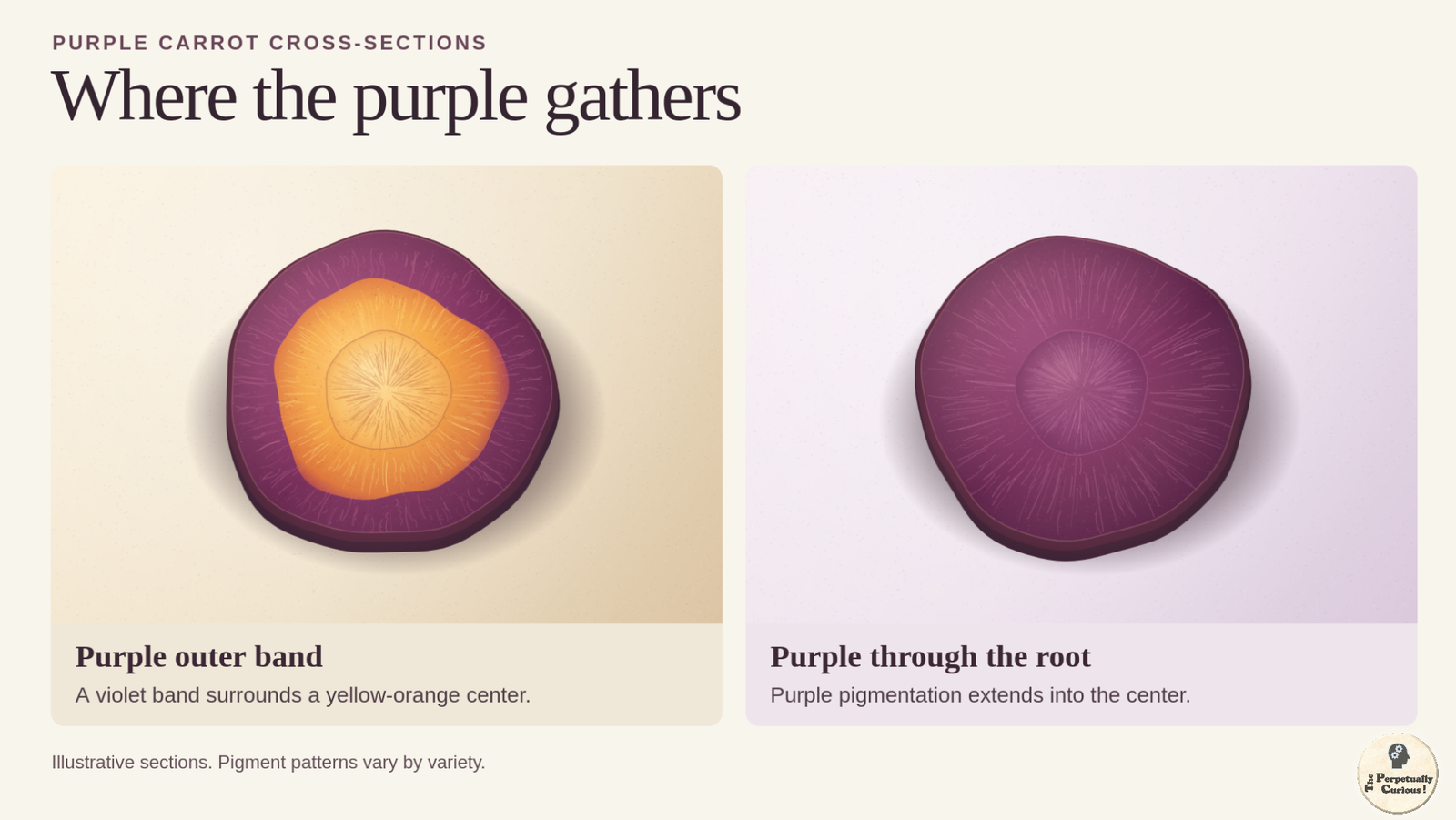
Cut a purple carrot across the middle and the color may stop before the center. One variety carries purple all the way through. Another keeps it near the outside, around a core of a different color. On the same cutting board, a red beet and a wedge of red cabbage may look like close chemical relatives. Their colors come from different families of pigments.
Vegetable color begins with the light that reaches our eyes. Pigments absorb some wavelengths more strongly than others, and the light reflected or scattered back helps determine the hue we see. What that hue can tell us depends on which pigments a plant makes, where it puts them, and what happens to them as the plant grows or the food cooks. A green tomato is a good place to watch that story unfold.
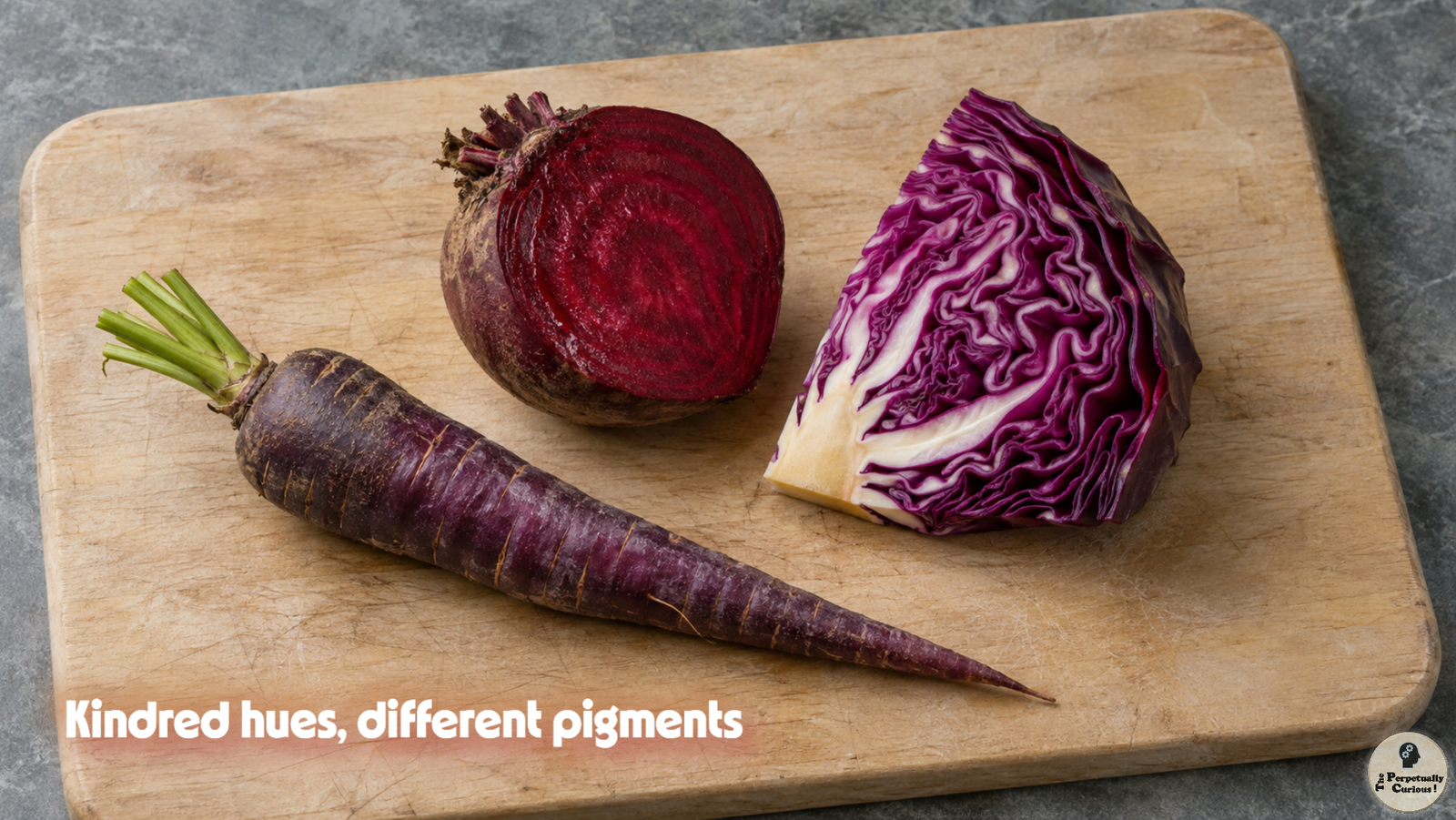
Color begins where light meets matter, and each root, leaf, and rind answers in its own quiet way.
Some shades deepen with time, some drift into water, and some wait beneath the skin.
At the kitchen table, the light finds what the knife has opened.
🍅 When a tomato leaves green behind
Chlorophyll gives spinach and broccoli much of their green. It absorbs red and blue light more strongly than green light, and the energy it captures helps drive photosynthesis. Green tissues can also contain yellow and orange carotenoids, although abundant chlorophyll can mask their colors. When chlorophyll fades in many deciduous trees, the carotenoids already present help produce the gold of autumn leaves.
In a tomato that ripens red, the change goes further. Chlorophyll breaks down, and many of the chloroplasts, the cell compartments associated with photosynthesis, turn into chromoplasts, which accumulate carotenoids. Lycopene, a red carotenoid, builds up as the tomato ripens.[1]
A carrot arrives at orange by a different route. Its edible part is a storage root, and carotenoids such as beta-carotene give familiar orange varieties much of their color.[2] A golden beet can have a similarly warm color, thanks to pigments from a different family.
🧪 Similar colors, different pigments
The violet of red cabbage and the purple skin of many eggplants come from anthocyanins. These water-soluble pigments collect in cell compartments called vacuoles. Depending on their chemical surroundings, they can appear red, purple, or blue. A familiar example beyond the vegetable patch is the red flesh of blood oranges, where anthocyanins supply a red that looks quite different from the orange of the peel.
In beets, the pigments behind these colors are called betalains. Betaxanthins give golden beets much of their yellow-orange color, while betacyanins give red beets their deep red. That red can resemble the color of red cabbage, even though cabbage gets its color from anthocyanins.
A slice of purple carrot shows how much pigment placement matters. In some varieties, anthocyanins are concentrated in outer tissues. In others, they extend through the root. Inherited differences help determine which tissues accumulate these pigments.[3] That variation is part of a wider palette that growers have shaped over generations.
🥕 How cultivation shaped the carrot’s palette
A genomic study traces early carrot domestication to a region spanning western and central Asia. It places the selection of high-carotenoid orange carrots in the Renaissance, probably in western Europe.[2] That familiar orange sits alongside the white, yellow, red, and purple varieties that are still grown.
Cultivation shapes the colors that reach the cutting board. From there, heat, water, and acidity can change what we see.
🍲 What heat, water, and acidity change
As green vegetables cook, heat and acidity can favor the conversion of chlorophyll to compounds called pheophytins. In that change, chlorophyll loses the magnesium at its center, and the green can turn olive. The timing depends on the vegetable and the cooking conditions.
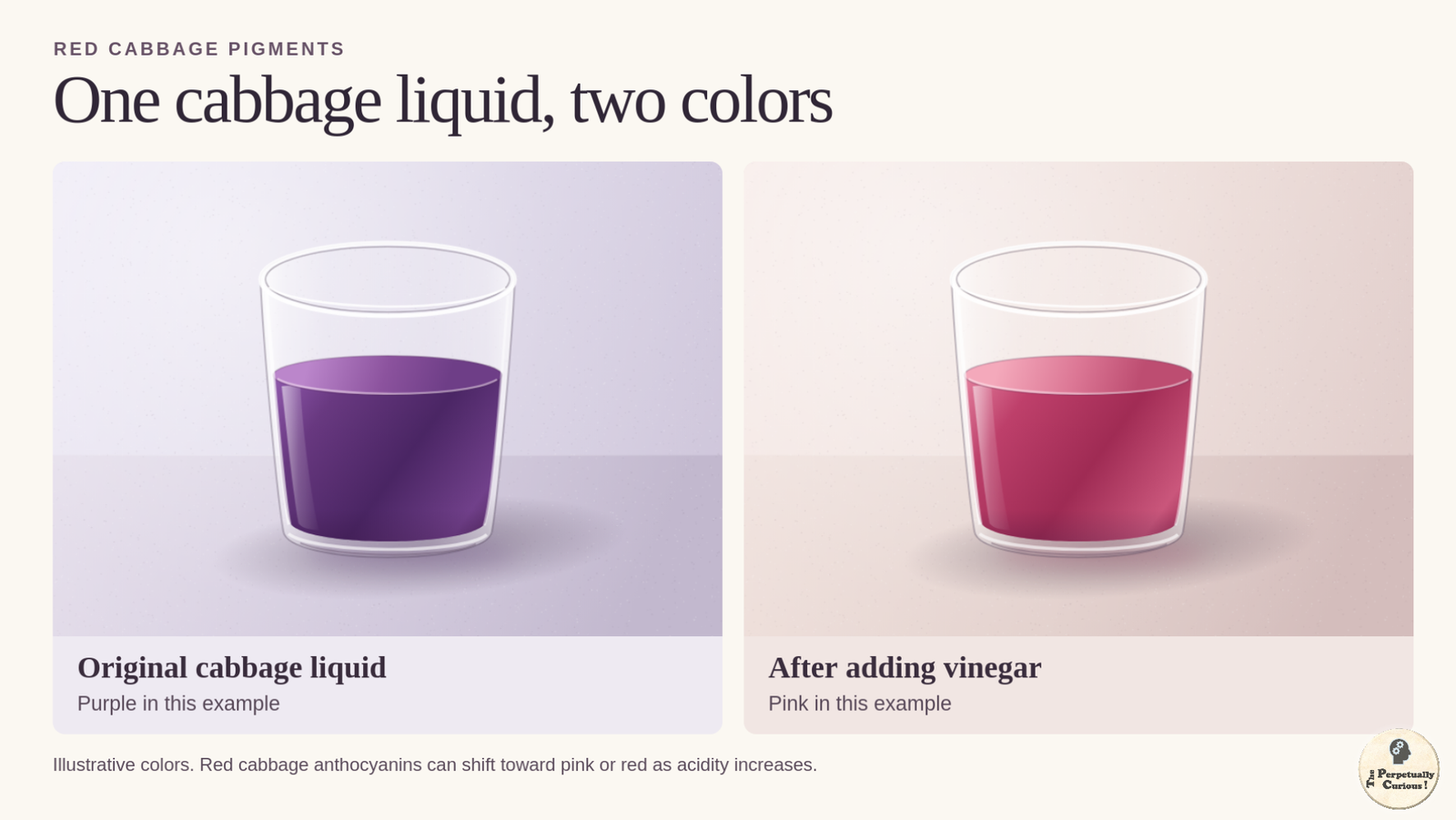
Water can carry color from one place to another. Some of the pigment in cut red cabbage can dissolve into the cooking water and tint it. If vinegar makes the liquid more acidic, its color can shift toward red or pink.
In a study of red cabbage extracts, some samples appeared red under acidic conditions and others appeared blue at neutral pH. The color depended in part on the mixture of anthocyanins in the extract.[4]
Cutting can also set reactions in motion that make new color. When a potato is sliced, cells break open, bringing enzymes and other compounds together in the presence of oxygen. One of those enzymes, polyphenol oxidase, helps start the reactions that brown the exposed surface.
🔍 What a color can tell us
Back at the cutting board, a purple ring in a carrot marks the tissues where pigment gathered. A red beet and a wedge of cabbage can look much alike, though their pigments belong to different families. A splash of vinegar can turn the purple cabbage liquid pink. Even after the knife has done its work, the colors can still change.
Pass this article along to someone curious and let the learning travel.
💡 Did you know?
🍅 Some pink tomatoes have red flesh beneath a nearly colorless outer skin. In the pink tomatoes researchers studied, the difference was the absence of a yellow flavonoid normally found in the peel. The flesh could carry much the same amount of lycopene and still look pink from the outside.
🥬 Beetroot and Swiss chard belong to the same species. In rainbow chard, different mixtures of betalains give the edible leaf stalks shades of yellow, orange, pink, and red. The pigments familiar from a beet root can show up in a different part of the plant.
🧄 Black garlic begins as ordinary pale garlic. During warm, humid aging, sugars and amino compounds undergo Maillard reactions without the help of enzymes. Those reactions help form dark compounds called melanoidins. The same family of reactions contributes to browning during coffee roasting.
How many moons does Jupiter have?
As of April 2025, astronomers have confirmed 97 moons orbiting Jupiter. The four largest are Io, Europa, Ganymede, and Callisto. These are known as the Galilean moons, discovered by Galileo Galilei in 1610.
What is a Jovian moon?
A Jovian moon is any natural satellite that orbits Jupiter. Io is one of the Galilean moons, along with Europa, Ganymede, and Callisto.
Why is Io the most volcanically active body in the Solar System?
Io’s activity is driven by tidal heating. Gravitational stretching from Jupiter and its sibling moons generates immense internal heat that fuels constant eruptions.
What makes Io’s surface so colorful?
The vivid yellows, reds, and greens come from sulfur and sulfur dioxide compounds, deposited by volcanic eruptions and frost.
Does Io have an atmosphere?
Yes, but it is extremely thin and composed mostly of sulfur dioxide. It collapses when Io passes into Jupiter’s shadow and re‑forms when sunlight returns.
What is the plasma torus?
Io’s volcanic gases escape into space and form a plasma torus around Jupiter, feeding the planet’s magnetosphere and contributing to its auroras.
↗️ Let the colors travel
Share this piece with someone who would enjoy seeing the familiar colors of a kitchen with fresh eyes.
Educational context
This article explores the plant biology and food chemistry behind the colors of familiar produce.
Selected sources
- Zita W, Bressoud S, Glauser G, et al. (2022). Chromoplast plastoglobules recruit the carotenoid biosynthetic pathway and contribute to carotenoid accumulation during tomato fruit maturation. PLoS ONE, 17(12), e0277774. [PMID: 36472971]
- Coe K, Bostan H, Rolling W, et al. (2023). Population genomics identifies genetic signatures of carrot domestication and improvement and uncovers the origin of high-carotenoid orange carrots. Nature Plants, 9(10), 1643–1658. [PMID: 37770615]
- Bannoud F, Carvajal S, Ellison S, et al. (2021). Genetic and Transcription Profile Analysis of Tissue-Specific Anthocyanin Pigmentation in Carrot Root Phloem. Genes, 12(10), 1464. [PMID: 34680859]
- Ahmadiani N, Robbins RJ, Collins TM, et al. (2014). Anthocyanins contents, profiles, and color characteristics of red cabbage extracts from different cultivars and maturity stages. Journal of Agricultural and Food Chemistry, 62(30), 7524–7531. [PMID: 24991694]
“Why Vegetables Have Different Colors: The Hidden Palette of Plant Pigments.” The Perpetually Curious!, November 2026.
https://www.theperpetuallycurious.org/articles/vegetable-colors-plant-pigments/Continue Exploring
For what comes next
Site Updates gathers occasional notes, new additions, and ways to keep in touch. RSS brings new publications to your feed reader in chronological order.
Choose the path that speaks to you, and let the next curiosity find you wherever your wondering takes you.