

Milk looks simple in a glass, yet its story reaches from mammalian biology to human ingenuity. Milk first evolved to nourish the young of each species. Dairying began when communities learned to raise particular animals, collect part of that nourishment, and transform it into foods that could endure heat, cold, distance, and season.
Across continents, those choices followed different paths. Cattle, buffaloes, goats, sheep, camels, mares, and yaks became part of distinct food systems because their bodies, landscapes, and human caretakers met in different ways. The result is not a hierarchy of better and lesser milks, but a varied record of adaptation, craft, and cultural memory.
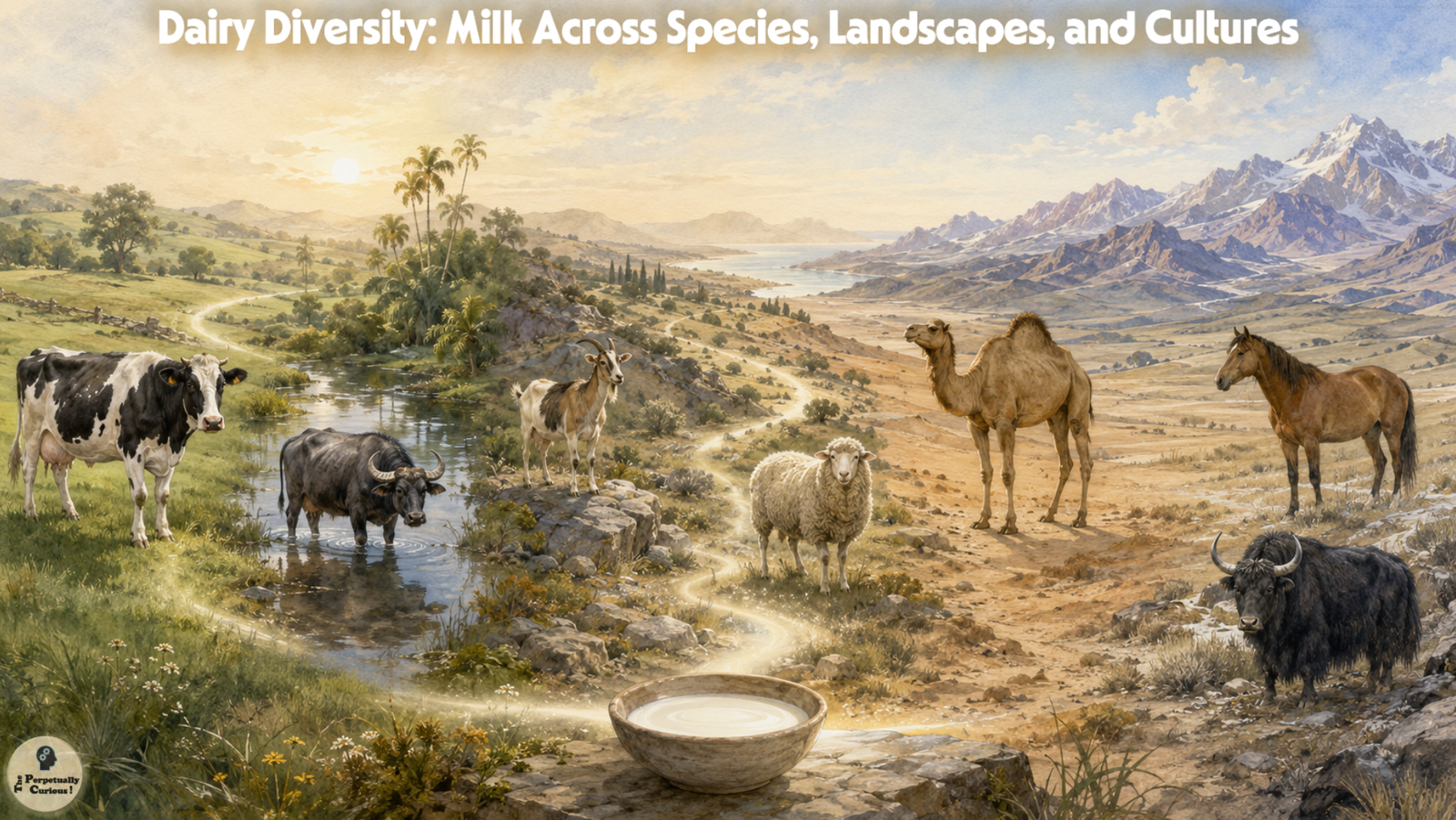
Milk carries the memory of landscapes shaped by time and care.
Every species offers a different reflection of the world it inhabits.
Across cultures and seasons, these quiet variations remind us that nourishment is also a story of place.
🌍 A global dairy landscape
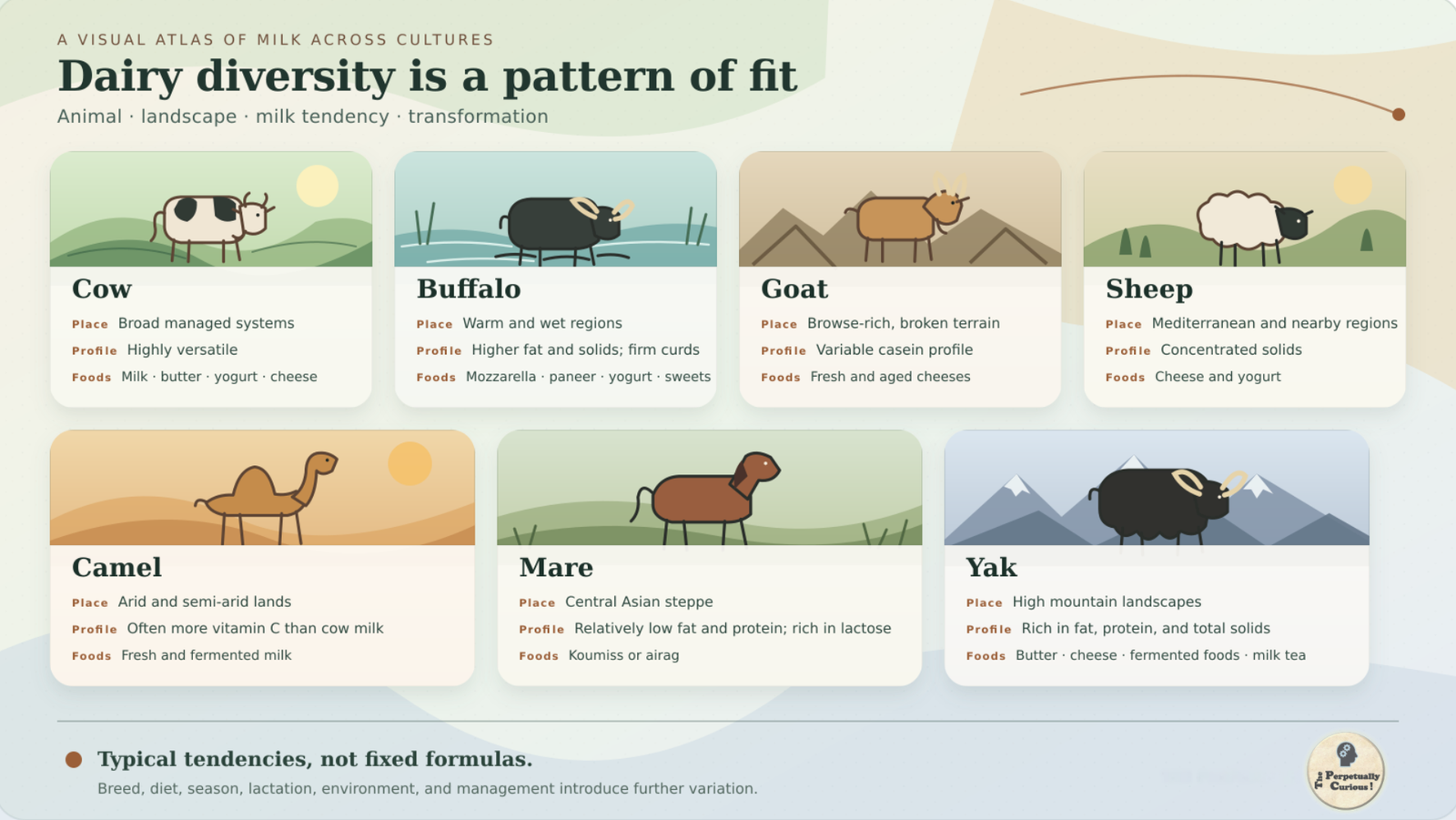
Cattle provide most of the world’s milk, while buffaloes form the second-largest source. Goats, sheep, camels, equines, and yaks account for much smaller global shares, yet their regional importance can be profound. Sheep support dairy traditions around the Mediterranean, mares across parts of the Central Asian steppe, camels in arid lands, buffaloes in wet tropical regions, and yaks across high mountain landscapes.
This distribution reflects more than the chemistry of milk. Feed, water, climate, terrain, household needs, markets, and inherited food practices all influence which animal becomes part of a dairy culture. A familiar white liquid can therefore carry an entire landscape within it.
🐄🐃 Cow and buffalo milk: scale and richness
Cow milk sits at the center of modern dairy systems because cattle are widely raised and their milk can be processed into an unusually broad range of products. Its composition varies by breed, feed, season, and stage of lactation, but it commonly contains about 3 to 4 percent fat, about 3.5 percent protein, and close to 5 percent lactose.
Buffalo milk is generally richer in fat, calcium, and casein, the main family of milk proteins that gathers into curds under acid or rennet. It also contains more total solids, meaning the fat, proteins, lactose, and minerals left when water is excluded. Those qualities support creamy textures and strong curd formation, helping explain its importance in products such as mozzarella, paneer, yogurt, and concentrated sweets. The difference is not simply that one milk is heavy and the other light. Each offers a different balance of water, fat, protein, minerals, and processing behavior.
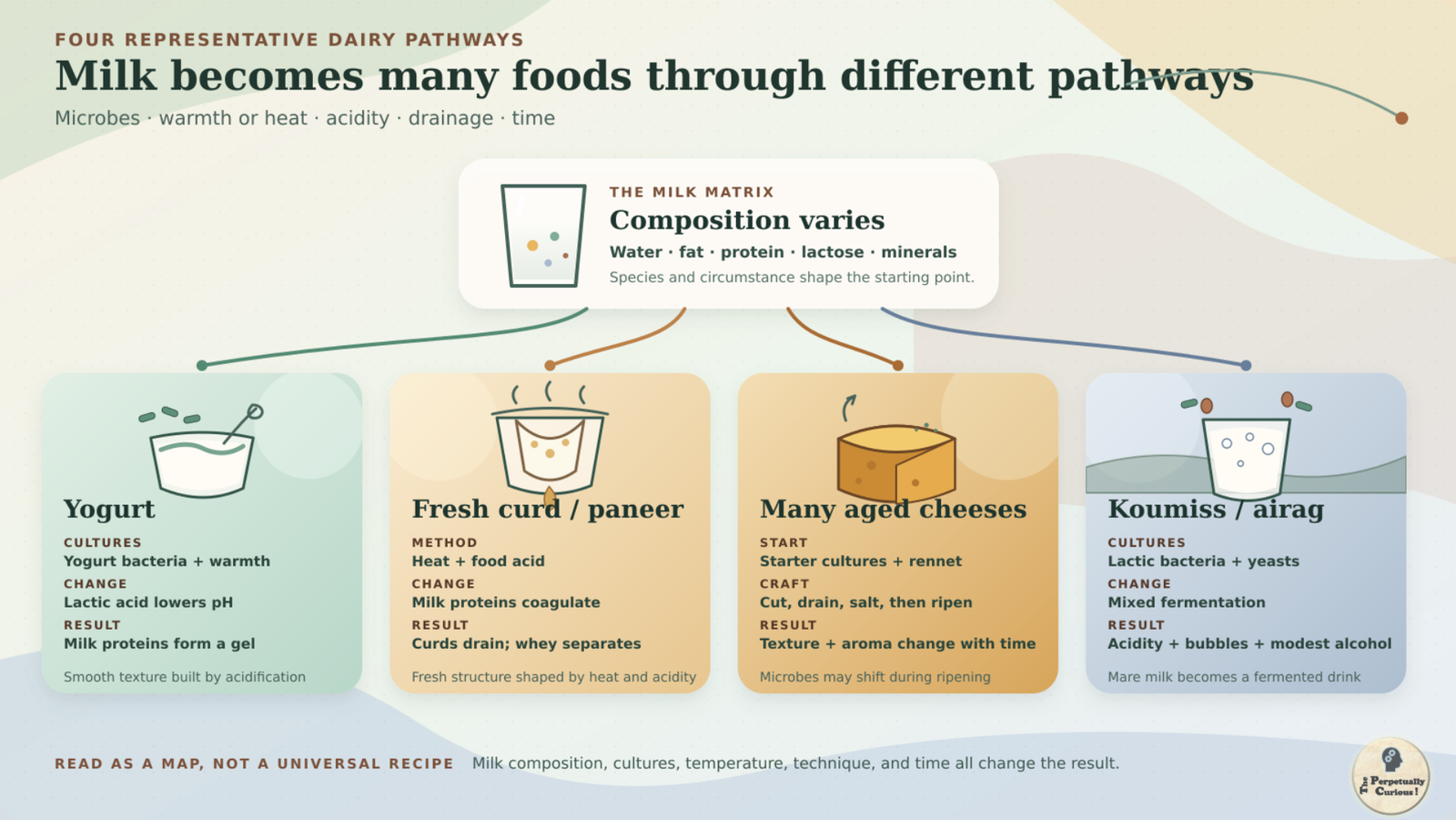
That chemistry becomes craft in paneer-making, where heat and acid gather milk proteins into a fresh cheese whose simplicity conceals careful control of temperature, acidity, and drainage.
🐐 Goat milk: variation within an ancient partnership
Goats can browse shrubs and other plants on terrain where cattle may be difficult to maintain, which has made them valuable to many smallholder and pastoral communities. Their milk is broadly similar to cow milk in its major components, but the size and behavior of its fat globules, as well as the balance of its casein proteins, can differ.
One important caution is that goat milk is not chemically uniform. The amount of alpha-S1-casein can vary substantially among breeds and individual animals. Some people describe goat milk as more comfortable to digest, but that experience should not be treated as universal. Goat milk still contains lactose, and its proteins can cross-react in people with cow milk protein allergy. A different species does not automatically mean a safe dietary substitute.
🐑 Sheep milk: concentrated solids and enduring cheeses
Sheep milk generally contains more fat, protein, and total solids than cow or goat milk. This concentrated composition allows a given volume to produce comparatively more curd, making sheep milk especially well suited to cheese and yogurt.
Across the Mediterranean and neighboring regions, that chemistry has become part of long-lived traditions associated with cheeses such as feta, Manchego, Pecorino Romano, and Roquefort. Their differences do not come from milk alone. Breed, pasture, salt, starter cultures, rennet, ripening conditions, and local technique all shape the finished cheese. Composition opens a possibility, while craft gives it form.
🐪 Camel milk: nourishment in arid lands
Camel milk has a gross composition broadly comparable to cow milk, although it often tastes slightly saltier and usually contains more vitamin C. The amount is not fixed and can vary with season, diet, and other conditions. For pastoral communities in arid and semi-arid regions, the milk’s importance arises not from a single nutrient but from the camel’s capacity to remain productive where heat, limited water, and sparse forage constrain other dairy animals.
Camel milk also contains lactoferrin, immunoglobulins, lysozyme, and other biologically active components. These compounds are scientifically interesting, but their presence does not by itself establish a medical effect in people. Research into camel milk and human health remains active, and nutritional description should not be turned into a treatment claim.
Its flavor also resists a single explanation. Breed, diet, water, season, stage of lactation, and handling can all influence the final milk. The desert leaves a signature, but not through one cause alone.
🐎🏔️ Mare and yak milk: specialized traditions
Mare milk contains relatively little fat and protein but more lactose than most ruminant milks. Across parts of Central Asia, communities ferment it into koumiss or airag. Lactic acid bacteria and yeasts work together, producing acidity, aroma, carbonation, and a modest amount of alcohol. Fermentation makes the milk not merely longer-lasting, but culturally and sensorially distinct.
Donkey milk traditions persist on a much smaller scale. Like mare milk, it contains relatively little casein and does not readily form the firm curds expected in conventional cheese-making.
Yak milk follows a very different pattern. Rich in fat, protein, and total solids, it supports butter, cheese, fermented products, and milk tea across high-altitude communities. The yak’s success at elevation belongs first to the animal’s physiology, including adaptations to cold and low oxygen. The richness of its milk then gives people a dense and versatile food within that demanding environment.
Placed side by side, mare and yak milk reveal the breadth of the species pattern. Yet even within that pattern, milk refuses to become a fixed formula.
🔬 Composition is a range, not a fixed label
Species matters, but it is only the first layer. Breed, diet, age, stage of lactation, season, environment, and farming system can shift flavor and composition, so milk from two animals of the same species need not behave identically.
Those components also behave differently during processing. Casein helps form curds. Fat shapes richness and aroma. Lactose feeds fermentation. Minerals influence protein structure, while water determines concentration. The practical character of a milk emerges from these components acting together, not from one nutrient standing alone.
Variation also exists within individual proteins. In cow milk, the A1 and A2 milk distinction describes variants of beta-casein rather than two entirely different kinds of milk. It is one molecular difference within a much larger and more variable food matrix.
Milk evolved to serve the young of each species. Human communities later learned to work with those biological differences, turning them into textures, flavors, and traditions that evolution itself did not design for the kitchen.
🧀 When milk meets microbes, heat, and time
Once milk leaves the animal, composition meets technique. Acid or rennet can draw casein into curds. Churning concentrates fat. Heating changes proteins and flavor. Salt, drainage, and ripening reshape moisture and texture. Microorganisms convert lactose and other compounds into acids, gases, alcohols, and aromas.
Across fermented-food traditions, bacteria, yeasts, and molds do not perform one universal transformation. Yogurt cultures acidify milk and form a gel. Some cheeses depend mainly on starter bacteria and rennet at first, then acquire new organisms during ripening. Koumiss combines bacterial and yeast activity. The milk creates an ecological setting, while process and culture determine which microorganisms flourish within it.
Processing knowledge must also remain connected to food safety. Flavor-sensitive heating choices do not replace validated pasteurization standards, hygienic handling, or an appropriate cold chain. Tradition and safety are strongest when they inform rather than exclude one another.
🎭 Dairy as cultural memory
Milk becomes meaningful through repetition. Buffalo milk thickens into sweets such as rasmalai and kulfi. Sheep and goat milk enter brined and aged cheeses. Mare milk is fermented, stirred, shared, and renewed. Yak milk enriches tea and butter in high mountain homes. These foods carry sensory memories, seasonal rhythms, and inherited techniques alongside their nutrients.
Such traditions should not be treated as static relics. Refrigeration, regulation, migration, markets, and changing landscapes continually reshape how dairy foods are made and understood. Yet the older relationship remains visible: people learn the possibilities of a local milk, then teach those possibilities forward.
Because these traditions arise from living landscapes, their continuity also depends on the animals, water, forage, and land that sustain them.
🌱 Animals, landscapes, and environmental tradeoffs
Different dairy animals make food production possible in very different environments. Goats can use browse and broken terrain. Buffaloes are well suited to warm, wet regions. Camels conserve water efficiently in arid climates. Yaks tolerate cold, high-altitude conditions that challenge most livestock.
Local adaptation, however, is not the same as automatic sustainability. Environmental outcomes also depend on stocking density, feed sources, land condition, water use, manure management, methane emissions, animal health, and the surrounding ecosystem. A species can be well matched to a landscape and still be managed poorly, just as careful husbandry can reduce pressures within a demanding system.
The more accurate lesson is one of fit rather than innocence. Sustainable dairying depends on how an animal, a place, and a human system are brought into relationship.
🌟 What dairy diversity teaches us
There is no universal best milk. Nutritional needs differ among people, and milk composition differs among species, breeds, seasons, and products. A rich milk may be ideal for cheese yield, a high-lactose milk for a particular fermentation, and a locally adapted animal for a landscape where another species would struggle.
The deeper value of dairy diversity lies in what it reveals. Milk begins as nourishment for a young mammal. In human hands, it can become yogurt, cheese, a fermented drink, a festival sweet, a livelihood, or a memory. Between biology and culture, one familiar liquid becomes many worlds.
Pass this article along to someone curious and let the learning travel.
💡 Did you know?
🥛 Milk from the same species does not have one permanent composition. Breed, feed, season, stage of lactation, and farming system can all shift its fat, protein, mineral, and flavor profile.
🧀 Buffalo and sheep milk generally contain more total solids than cow milk. More solids often mean more material available to form curd, which helps explain their importance in cheese and yogurt traditions.
🧫 Koumiss and airag are not produced by lactic acid bacteria alone. Yeasts also participate, allowing fermented mare milk to develop gentle carbonation and a modest alcohol content alongside its acidity.
🏺 Perforated pottery vessels from sixth-millennium BCE sites in Kuyavia, present-day Poland, have yielded dairy-fat residues consistent with separating curds from whey. The evidence offers a chemical trace of cheese-making more than 7,000 years ago.
🧬 Dairy use is older than the high frequency of lactase-persistence variants in many populations. Fermentation and curd separation reduced lactose, allowing milk to become culturally useful even where most adults could not comfortably drink large amounts fresh.
🥚 Monotremes such as platypuses and echidnas produce milk without nipples. Milk is released through openings onto specialized skin and surrounding fur, where the young take it up, offering a living reminder that lactation predates the nipple-based anatomy of most mammals.
Why can some adults digest fresh milk while others cannot?
Most mammals reduce production of the enzyme lactase after weaning. In several human populations with long dairying histories, genetic variants that maintain lactase production into adulthood rose in frequency through strong natural selection. Lactase non-persistence remains common worldwide, and symptoms can vary with the amount consumed, the food matrix, and individual physiology.
Is goat milk always easier to digest than cow milk?
No. Differences in fat-globule behavior and protein composition may affect texture and digestion for some people, but goat milk still contains lactose and many proteins similar to those in cow milk. It is not a dependable substitute for lactose intolerance or cow milk protein allergy without appropriate clinical guidance.
What do A1 and A2 mean in milk?
They refer to variants of beta-casein found in cattle. The A1 and A2 beta-casein variants differ by one amino acid, but that distinction does not describe goat, sheep, buffalo, camel, mare, or yak milk in the same way. It is also only one feature within the broader composition of cow milk.
What determines whether a milk makes firm cheese?
Casein content and structure, calcium balance, total solids, acidity, rennet response, and processing conditions all matter. Buffalo and sheep milk often yield more curd because they contain more casein and total solids, while mare and donkey milk contain less casein and form much weaker curds.
How does fermentation transform milk?
Microorganisms consume available nutrients and produce acids, gases, alcohols, and aroma compounds. In yogurt, lactic acid causes proteins to form a gel. In many cheeses, starter bacteria begin acidification, while other bacteria, yeasts, or molds may shape texture and aroma during ripening. The microbial transformation of yogurt and cheese shows why different foods require different organisms and conditions.
Why can milk taste different across seasons?
Season can change the plants animals eat, the amount and quality of available forage, water intake, temperature exposure, and the distribution of lactation stages across a herd. Those shifts can alter fat, protein, and aroma compounds, while storage and handling add further variation. A seasonal flavor difference therefore reflects a chain of influences rather than the calendar alone.
Does camel milk have proven medicinal effects?
Camel milk contains nutrients and bioactive proteins that merit scientific study, but the presence of those compounds does not establish that the milk prevents or treats disease. Clinical evidence depends on the specific condition, product, dose, and study design. Camel milk should be discussed as a culturally important food unless a well-supported medical claim is being evaluated separately.
🌸 Share the wonder
Knowledge travels much as food traditions do, through hands, homes, and conversations. If this journey offered a new way to see a familiar glass, pass it along and let another curiosity begin.
📚 Educational context
This article presents scientific and anthropological observations about dairy diversity for educational purposes. It does not provide nutritional or medical guidance. Individual responses to milk vary with lactose digestion, allergy, health conditions, age, and personal circumstances. Questions about dairy consumption or dietary change should be discussed with a qualified healthcare professional.
🍽️ Continue exploring this theme
More connected pieces on food traditions, culinary science, nourishment, and the rituals of everyday life are gathered among the Food & Lifestyle articles on The Perpetually Curious! website.
“Milk Across Cultures: A Journey Through Nature’s Dairy Diversity.” The Perpetually Curious!, September 2026.
https://www.theperpetuallycurious.org/articles/types-of-animal-milk/Continue Exploring
For what comes next
Site Updates gathers occasional notes, new additions, and ways to keep in touch. RSS brings new publications to your feed reader in chronological order.
Choose the path that speaks to you, and let the next curiosity find you wherever your wondering takes you.