

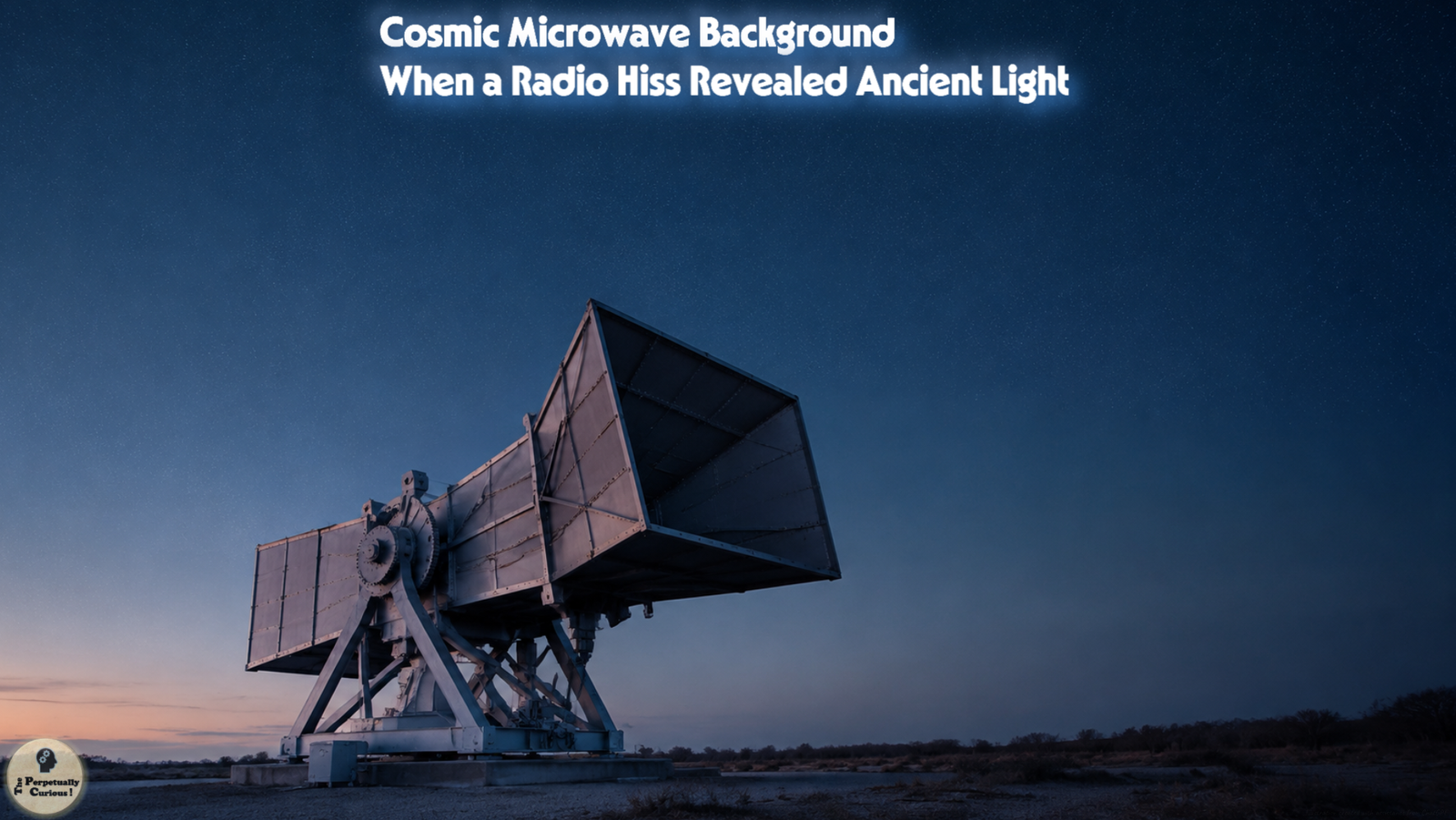
In 1964, radio astronomers Arno Penzias and Robert Wilson were troubled by a faint hiss in the Holmdel Horn Antenna at Bell Labs. The noise came from every direction. They checked the receiver, considered interference, and cleaned contamination from the antenna, including residue left by nesting pigeons. Still, the hiss remained.
What sounded like an instrumental nuisance was a signal from deep time. After Penzias and Wilson connected with a Princeton group preparing to search for predicted relic radiation, the meaning of the noise became clear. They had encountered the cosmic microwave background, or CMB, the oldest light that can travel freely to us.
That light did not emerge at the first instant of the Big Bang. It began its free journey when the universe was about 380,000 years old, then crossed expanding space for almost 13.8 billion years. In its faint variations lies a record of the conditions from which galaxies, stars, planets, and eventually curious observers could arise. A stubborn hiss had opened a window onto creation.
A gentle shimmer still moves across the sky, carrying the memory of a young universe finding its first calm.
The same ancient light drifts through every quiet night, patient and unchanged.
In its faint warmth, the earliest story continues to pass over us, steady and unhurried.
✨ The afterglow of everything
To understand the CMB, we must return to a universe that was hot, dense, and opaque. During its early history, ordinary matter existed as an ionized plasma of nuclei and free electrons. Photons repeatedly scattered from those charged particles, so light could not travel far in a straight line.
The scene can be compared, cautiously, with the interior of a star extended across all observable space. The young universe was filled with radiation, yet that brilliance could not move freely through the surrounding plasma. It was light everywhere, trapped by matter everywhere.
As the universe expanded, it cooled. By about 380,000 years after the Big Bang, the temperature had fallen to roughly 4,940°F (about 3,000 K or 2,727°C). Electrons could combine with protons to form neutral hydrogen without being immediately torn apart by energetic photons. Cosmologists call this transition recombination, even though these neutral atoms were forming for the first time.
With far fewer free electrons available to scatter light, the universe became transparent. The transition was rapid on cosmic scales, but it was not instantaneous. The light reaching us last scattered across a finite interval, so the surface of last scattering is better understood as a thin shell with depth than as a perfectly sharp boundary.
Photons decoupled from matter and began traveling through space. Expansion has stretched their wavelengths ever since, shifting what was once hot thermal radiation into the microwave part of the spectrum. The CMB is therefore not a view of the Big Bang’s first moment. It is the luminous boundary beyond which ordinary light cannot show us an earlier scene.
🔍 A discovery hidden in plain sight
The relic glow had been anticipated before it was recognized in the Bell Labs antenna. In 1948, physicists Ralph Alpher and Robert Herman estimated that radiation left from a hot early universe should now have cooled to about 5 K. George Gamow and other theorists also developed early-universe ideas, but the predictions did not become a widely coordinated observational search.
Penzias and Wilson were studying radio signals, not setting out to test the Big Bang model. Their persistent excess antenna temperature, however, matched the kind of all-sky background that Robert Dicke, Jim Peebles, Peter Roll, and David Wilkinson at Princeton were preparing to investigate. The two groups published companion papers in 1965. Penzias and Wilson later shared the 1978 Nobel Prize in Physics for the discovery.
Today the CMB is measured as an almost perfect blackbody at about minus 454.76°F (2.725 K or minus 270.43°C). When its spectrum is expressed per unit frequency, it peaks near 160 gigahertz. Each cubic inch of space contains about 6,700 CMB photons (about 410 per cubic centimeter), so ancient light is extraordinarily abundant even though each photon carries very little energy.
The background is also astonishingly uniform. After the much larger dipole pattern caused by our motion is removed, its primordial temperature variations are only about one part in 100,000. Those tiny departures from sameness are where the story becomes richer: the hiss can be mapped, and the map can be read.
🌡️ Reading the universe’s baby picture
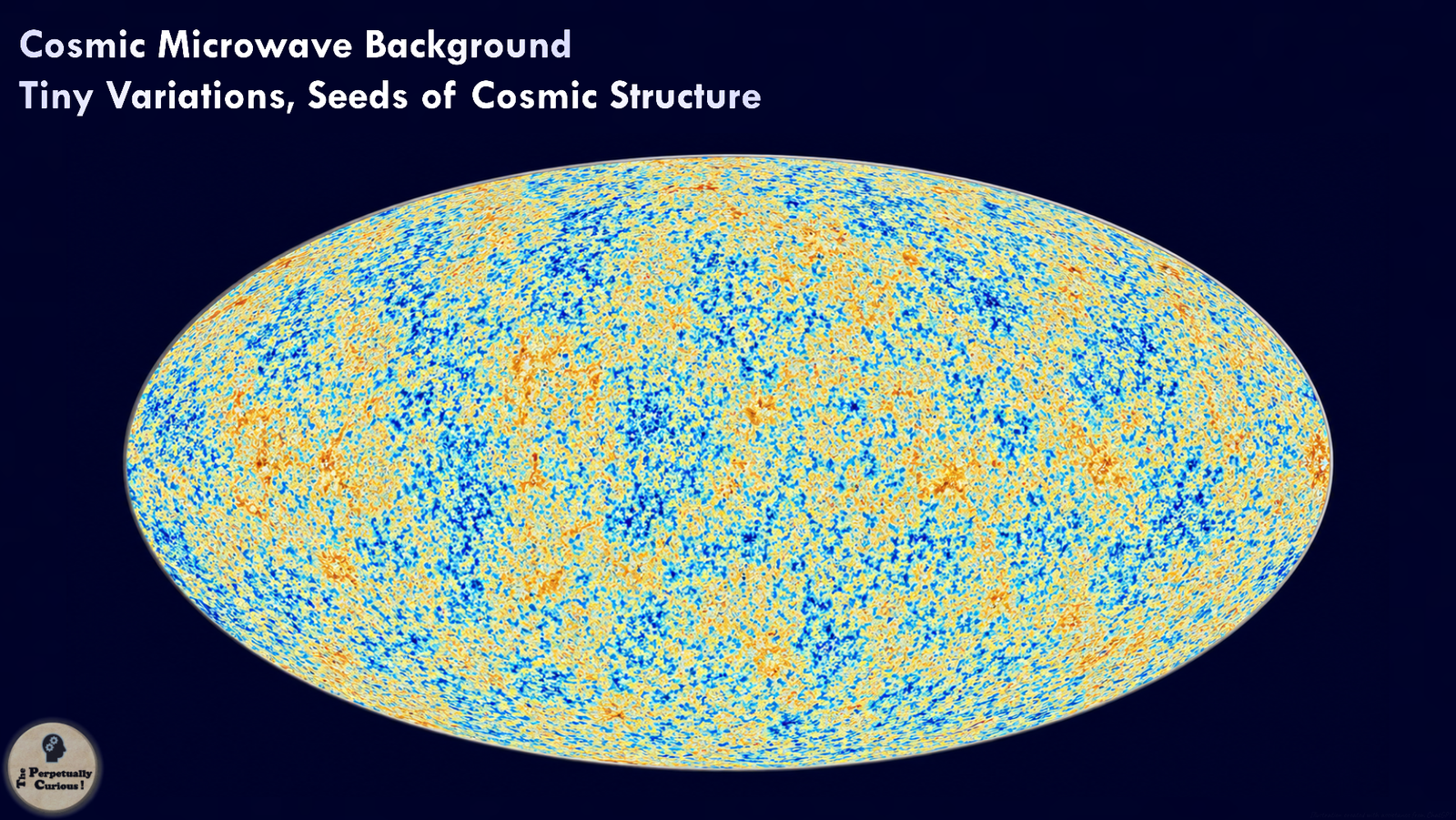
NASA’s Cosmic Background Explorer, or COBE, detected primordial CMB temperature variations in 1992. The Wilkinson Microwave Anisotropy Probe, or WMAP, and the European Space Agency’s Planck mission later mapped them across the sky with far greater precision.
The familiar blue, orange, and red maps are not literal photographs and do not show colors that human eyes could see. They are scientific visualizations of extremely small microwave temperature differences. Researchers must also separate the cosmological signal from emission by dust, gas, radio sources, and other foregrounds within our own galaxy and beyond it.
Once those layers are modeled, the remaining pattern preserves an imprint of density, velocity, and gravitational conditions in the early universe. Slight differences in those conditions helped gravity gather matter over billions of years. The relationship is not a simple one-pixel prediction of a future galaxy, but the statistical pattern contains the seeds from which the cosmic web could grow.
This is why the CMB is often called the universe’s baby picture. It does not show stars or galaxies. It shows the subtle conditions that made their later formation possible. The next step is to move from the picture itself to the physical information encoded in its scales.
🔬 Physics written in ancient light
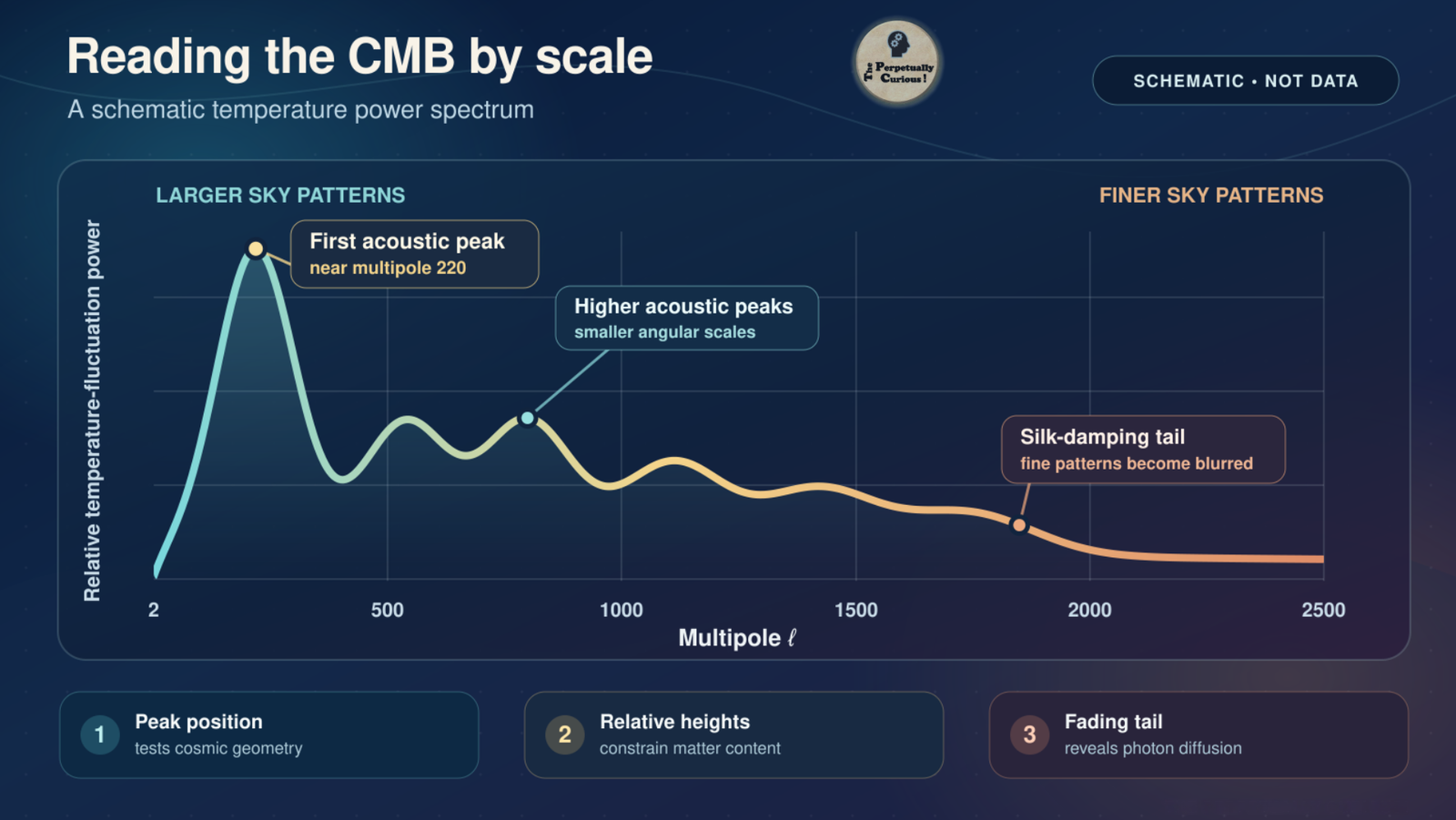
Before recombination, photons and ordinary matter behaved as a coupled photon-baryon fluid. Gravity drew the fluid into potential wells, many of them shaped by dark matter, while photon pressure resisted compression. The resulting acoustic oscillations were not sound in air, but pressure waves moving through the primordial plasma.
Recombination froze a statistical record of those oscillations into the CMB. When scientists arrange the temperature variations by angular scale, they obtain a power spectrum with a sequence of peaks and valleys. The positions and relative heights of those peaks constrain the geometry of space, the amount of ordinary matter, the amount of dark matter, and other cosmological parameters.
At smaller scales, photons diffused through the plasma and blurred some of the finest fluctuations, a process called Silk damping that helps make the smallest patterns fade from the power spectrum.
Within the standard Lambda-CDM model and in combination with other observations, the results describe a universe whose energy density is roughly 5 percent ordinary matter, 27 percent dark matter, and 68 percent dark energy. The angular pattern is also consistent with spatial geometry that is very close to flat within measurement uncertainty. This does not prove that every feature of the standard model is final, but it shows how a microwave map can test the architecture of the cosmos.
The CMB also supports major predictions of cosmic inflation, the leading framework in which the early universe underwent an extremely rapid expansion. Inflation offers an explanation for the CMB’s broad uniformity and for the nearly scale-invariant pattern of primordial fluctuations. The evidence is strong, but it is not a direct photograph of inflation or proof of one unique inflationary mechanism.
Temperature is only part of the message. The CMB is faintly polarized, and that polarization forms characteristic patterns. E-mode polarization has been measured and sharpens constraints on cosmic history. B-mode polarization produced by gravitational lensing has also been detected. A different primordial B-mode pattern could provide evidence for gravitational waves generated during inflation, but no such primordial signal has yet been confirmed.
🌍 Living within the afterglow
The CMB fills the space around us, but its presence does not mean that it noticeably heats a room or shines in our eyes. Human vision responds to a narrow band of visible wavelengths, while the background now lies in the microwave range and carries very little energy per photon.
The contrast between our warmth and the cosmic cold puts that faintness into perspective. At about 98.6°F (37°C), a human body is roughly 114 times warmer than the CMB on an absolute temperature scale and radiates vastly more power per unit area. Both emissions nevertheless follow the same broad blackbody physics. The difference is a reminder that temperature, wavelength, and detectability can transform how the same physical principles appear.
The CMB also offers a clean example of why space can look dark even in a universe filled with light. An optically dark sky can still contain radiation at radio, microwave, infrared, ultraviolet, X-ray, and gamma-ray wavelengths. Instruments extend perception beyond the limits of the eye, turning apparent emptiness into a layered electromagnetic landscape.
That connection brings the article from distant cosmology back to lived experience. We do not see the ancient afterglow when we look upward, but every observation is made from within it. The next question is where this precise picture remains incomplete.
🧩 What the CMB still leaves unresolved
Under the standard cosmological model, CMB measurements help place the universe’s age near 13.8 billion years. The precision of that estimate depends on the model used to interpret the data, so it is better understood as a tightly constrained inference than as a direct clock reading.
CMB polarization also helps constrain the broad history of reionization, the era when the first luminous objects transformed neutral gas across the universe. It does not directly identify the first individual star or give a single model-free ignition date. Observations of early galaxies, stellar populations, and the conditions that allow stars to form complete that later part of the story. Together, the evidence places the rise of the first stars within the first few hundred million years after the Big Bang.
The observable universe is now about 93 billion light-years across when measured as present-day comoving distance, even though the universe is about 13.8 billion years old. There is no contradiction. While CMB photons traveled toward us, the space between distant regions expanded, so the matter that emitted those photons is now much farther away than 13.8 billion light-years.
The maps also contain large-scale features that continue to attract attention. The CMB cold spot and a possible hemispheric asymmetry have inspired explanations involving chance fluctuations, foreground effects, systematic errors, unusual cosmic structures, and new physics. At the largest angular scales, interpretation also meets an unavoidable limit called cosmic variance: scientists have only one observable universe to sample, so chance structure can be difficult to distinguish from genuinely unusual physics.
The statistical significance and interpretation of these features remain debated. They are valuable precisely because they test how far the standard model can account for the sky, not because they have already overturned it.
These limits lead naturally to the present observing effort. Once a baby picture becomes precise, progress depends on finding fainter patterns within it and distinguishing primordial information from everything the light encountered on its way to us.
🔭 The continuing quest
CMB research now combines space missions with observatories in exceptionally cold, dry places. The South Pole Telescope takes advantage of Antarctica’s cold, dry observing conditions to study small angular scales. BICEP/Keck instruments at the South Pole continue the search for polarization patterns associated with primordial gravitational waves.
The Atacama Cosmology Telescope, located about 17,000 feet (5,200 meters) above sea level in Chile, finished observing in 2022 and has been decommissioned, but its data continue to support precision cosmology. The Simons Observatory in Chile has moved through commissioning and initial observations with instruments designed to measure CMB temperature and polarization across large areas of sky.
The field’s plans also change as funding and scientific priorities evolve. CMB-S4 was developed as a major next-generation ground-based project, but the United States Department of Energy and National Science Foundation ended project support in July 2025, leading to an orderly shutdown. Its design work still informs the broader technical path of CMB science.
In space, the JAXA-led LiteBIRD mission is being developed to survey CMB polarization across the full sky, with a current target in Japan’s fiscal year 2036. Its central goal is to search for the primordial polarization signature that could illuminate inflation.
The instruments are now deliberate, sensitive, and global, far removed from the accidental discovery at Bell Labs. Yet the essential act has not changed. Cosmology is still listening to a faint background and asking what ancient light remembers.
Pass this article along to someone curious and let the learning travel.
💡 Did You Know
📡 Ancient photons are abundant. Each cubic inch of space contains about 6,700 CMB photons (about 410 per cubic centimeter), even though the background is extremely cold and faint.
🔬 Light greatly outnumbers ordinary matter particles. In standard cosmology, there are roughly one to two billion CMB photons for every baryon, the family of particles that includes protons and neutrons.
🧭 CMB lensing reveals intervening structure. Galaxies, galaxy clusters, and the wider matter distribution bend CMB photons through gravitational lensing, allowing researchers to reconstruct maps of matter between the last-scattering surface and Earth.
🎯 Galaxy clusters leave a spectral fingerprint. Hot electrons in cluster gas transfer energy to some CMB photons through the thermal Sunyaev-Zeldovich effect. The distortion helps astronomers find and characterize distant clusters, while precise mass estimates still require calibration and complementary observations.
🛰️ The CMB is part of a much larger invisible universe. Microwave detectors, radio observatories, and orbiting instruments show how space telescopes reveal hidden cosmic realms beyond the narrow colors detected by human eyes.
🌫️ A promising signal became a lesson in foregrounds. In 2014, BICEP2 reported a B-mode excess that raised hopes of detecting primordial gravitational waves. A joint analysis with the Keck Array and Planck later found no statistically significant primordial signal and showed that dust in the Milky Way could account for the observed excess, underscoring why foreground separation is central to CMB science.
What is radiation in simple terms?
Radiation is energy that travels through space as waves or particles. Visible light, infrared warmth, radio signals, X-rays, and the CMB are all forms of electromagnetic radiation at different wavelengths.
What exactly is the cosmic microwave background?
The CMB is thermal radiation released when the universe became transparent, about 380,000 years after the Big Bang. It fills observable space and provides the oldest light that can travel freely to our instruments.
Why is the CMB so uniform across the sky?
The broad uniformity creates what cosmologists call the horizon problem. Regions now separated by enormous distances appear to have nearly the same temperature even though, without an earlier connection, ordinary expansion would not have allowed them to exchange enough information to become so similar. Inflation is the leading framework for explaining this pattern because it could have stretched a once-connected region across the observable universe. The CMB supports important predictions of inflation, but it does not prove one unique inflationary model.
How was the cosmic microwave background discovered?
Arno Penzias and Robert Wilson detected a persistent microwave excess in 1964 while working with the Holmdel Horn Antenna at Bell Labs. The signal matched relic radiation predicted from a hot early universe.
Why could a radio antenna detect the universe’s oldest light?
Cosmic expansion stretched the radiation to microwave wavelengths. Radio and microwave instruments can detect those wavelengths, which connects the discovery to how astronomers use long wavelengths to study hidden cosmic signals.
What can the CMB tell us about dark matter and dark energy?
The pattern of acoustic peaks constrains how much ordinary matter and dark matter influenced the early plasma. Within the standard Lambda-CDM model and with other observations, CMB data also help constrain the cosmic geometry and the dark-energy component that affects later expansion.
Did the CMB come directly from the first instant of the Big Bang?
No. The early universe was opaque, so ordinary light from earlier times could not travel freely. The CMB was released about 380,000 years later. It also does not sit at a physical edge, and the Big Bang was not an explosion from one point into preexisting empty space. Cosmic expansion occurred throughout the observable region.
Can the CMB reveal anything from before recombination?
Yes, indirectly. Its temperature, polarization, and statistical patterns preserve effects of physical conditions that existed earlier than the release of the photons. Scientists use those patterns to test inflation and particle physics, but no confirmed CMB feature currently demonstrates a previous universe or a time before the Big Bang.
What will happen to the CMB in the future?
If cosmic expansion continues as described by the standard model, CMB wavelengths will keep stretching and the background temperature will keep falling. It will become progressively more difficult for future observers to distinguish, although absolute claims about all conceivable technology or the universe’s remote future would go beyond present evidence.
Could the CMB contain information that scientists have not yet extracted?
Yes. Researchers continue to improve foreground removal, polarization measurements, gravitational-lensing reconstruction, and searches for subtle spectral distortions. Those advances may sharpen constraints on neutrino properties, inflation, reionization, and the growth of cosmic structure.
📣 Share the cosmic story
Ancient light gained scientific meaning when patient observation connected one faint signal to a much larger story. Sharing that story can offer another curious mind the same doorway.
Pass this article to someone who may enjoy hearing what the universe’s oldest light still has to say.
“The Universe’s Ancient Whisper: Decoding the Cosmic Microwave Background.” The Perpetually Curious!, August 2026.
https://www.theperpetuallycurious.org/articles/cosmic-microwave-background/Continue Exploring
For the curious mind: want to explore this theme through a few questions? Visit the Classic Quiz Studio, nestled under Explorations opens in a new tab ,and see where a few well-placed questions lead: Cosmic Exploration Quizzesopens in a new tab
For what comes next
Site Updates gathers occasional notes, new additions, and ways to keep in touch. RSS brings new publications to your feed reader in chronological order.
Choose the path that speaks to you, and let the next curiosity find you wherever your wondering takes you.