

The universe is keeping a secret from us. About 85 percent of all matter by mass appears to be dark matter, a component that does not emit, absorb, or reflect enough electromagnetic radiation for us to detect it directly. Yet its gravity helps shape galaxies, galaxy clusters, and the large-scale structure of the cosmos. The mystery is therefore unusual: scientists can map many of its effects with extraordinary precision while the physical identity of the substance itself remains unknown.
That tension gives dark matter its detective-story quality. The clues did not arrive from one instrument or one generation. They accumulated across galaxy motions, colliding clusters, gravitational lensing, the cosmic microwave background, and increasingly sensitive underground experiments. Each line of evidence answers part of the question, while leaving the central suspect just beyond direct reach.
In the quiet architecture of the cosmos, unseen matter shapes the paths of galaxies and the stories they tell.
Its presence is felt in every curve of starlight, a patient influence woven through the structure of space.
We stand within this vast design, aware of only a fraction of what holds the universe together.
🔍 The first clues: when galaxies refused to make sense
The modern story began in 1933, when Swiss astronomer Fritz Zwicky studied the Coma Cluster, a vast collection of more than a thousand galaxies roughly 320 million light-years away. The galaxies were moving so rapidly that the visible matter in the cluster did not appear sufficient to keep the system gravitationally bound. Applying the virial theorem, which connects the motions within a system to the mass required to hold it together, Zwicky inferred that much more mass must be present than astronomers could see.
He called this missing component dunkle Materie, or dark matter. The idea was striking, but at the time it remained one clue among many unresolved questions about galaxies.
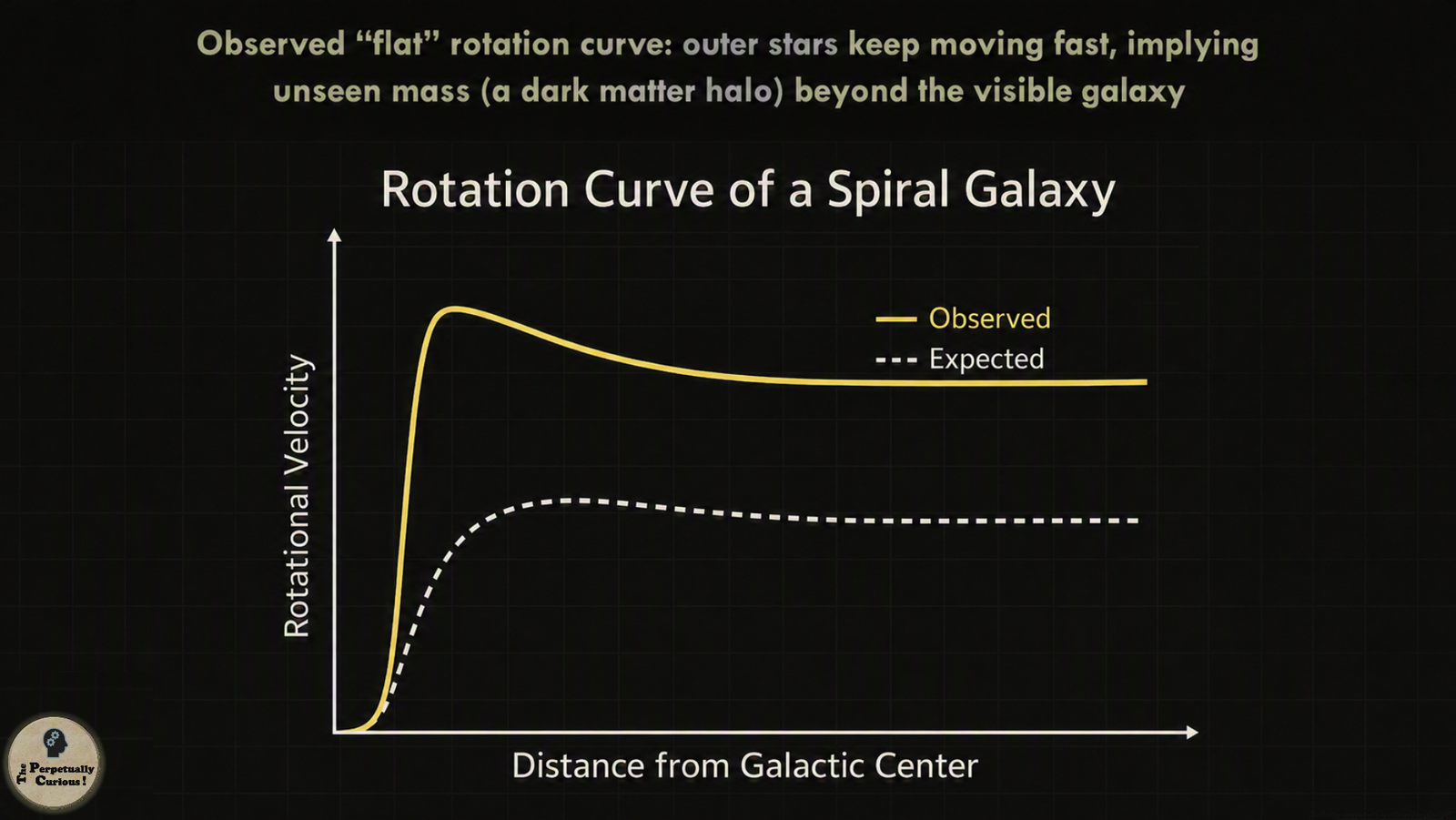
The case strengthened dramatically decades later. In the 1970s, astronomer Vera Rubin, working with Kent Ford and building on earlier rotation studies, measured how stars and gas moved through spiral galaxies. If most of a galaxy’s mass were concentrated where its visible stars shine, orbital speeds should decline substantially toward the outer regions. Instead, many galaxies showed nearly flat rotation curves: material far from the bright center continued moving at unexpectedly high speeds.
The pattern repeated from galaxy to galaxy. The simplest interpretation was that luminous disks sit inside much larger halos of unseen gravitating matter. That same extended mass distribution also contributes to our wider galactic orbit, where the Sun moves around the Milky Way under the combined gravity of stars, gas, the central regions, and the galaxy’s dark matter halo.
Rotation curves made the missing-mass problem difficult to dismiss. These measurements were not limited to one galaxy or one survey, but revealed similar patterns across many spiral galaxies. Yet galaxy motions alone could still leave room for questions about how gravity was being interpreted. A collision between entire galaxy clusters would offer a very different kind of test.
⚖️ Cosmic collisions reveal the separation
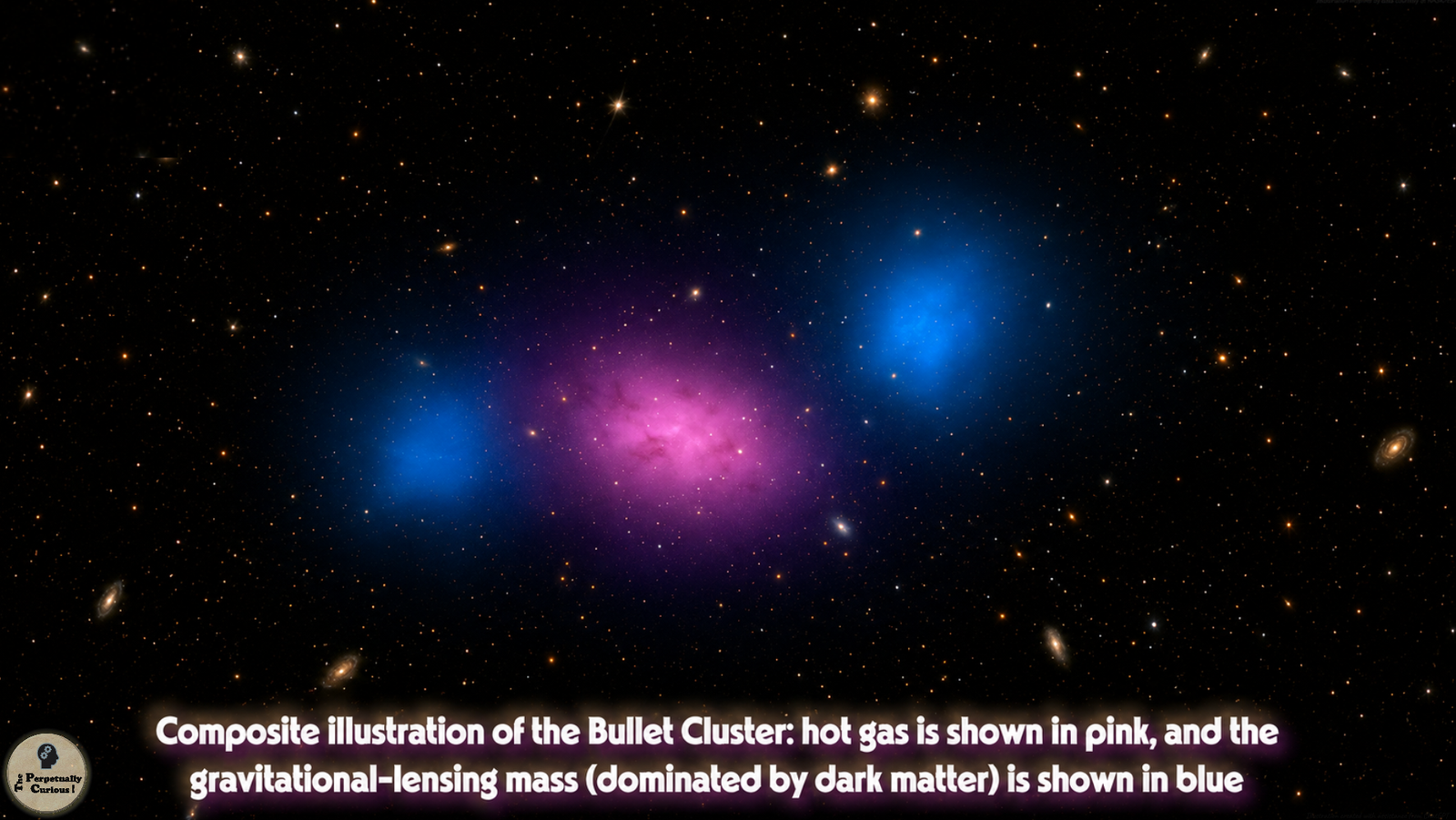
The Bullet Cluster, about 3.8 billion light-years away, formed through the collision of two massive galaxy clusters. It provides one of the clearest visual demonstrations that ordinary matter and the dominant gravitating mass do not always occupy the same place.
X-ray observations reveal extremely hot gas, shown in pink in widely reproduced composite images. That gas contains most of the clusters’ ordinary baryonic matter. During the collision, the gas clouds interacted, slowed, and became displaced from the galaxies.
Gravitational lensing tells another part of the story. Mass bends spacetime, deflecting light from more distant galaxies. By measuring the resulting distortions, astronomers can reconstruct the distribution of total mass, whether luminous or unseen. Comparing that lensing map with the locations of galaxies and X-ray-emitting gas helps reveal where an additional unseen mass component is required.
In the Bullet Cluster, the lensing-derived mass distribution is offset from much of the X-ray-emitting gas and remains more closely associated with the collisionless galaxy populations. This separation provides some of the strongest observational evidence that most of the gravitating matter in the system is not simply the hot ordinary gas. Similar offsets in other colliding clusters reinforce the broader interpretation.
The importance of this result reaches beyond one dramatic collision. The Bullet Cluster is one of several colliding systems where mass and visible gas become separated in ways that can be studied through lensing. Once gravity can be used as a map, dark matter becomes not merely a missing number in an equation but an inferred structure that can be traced across the cosmos.
🌀 Mapping the invisible architecture
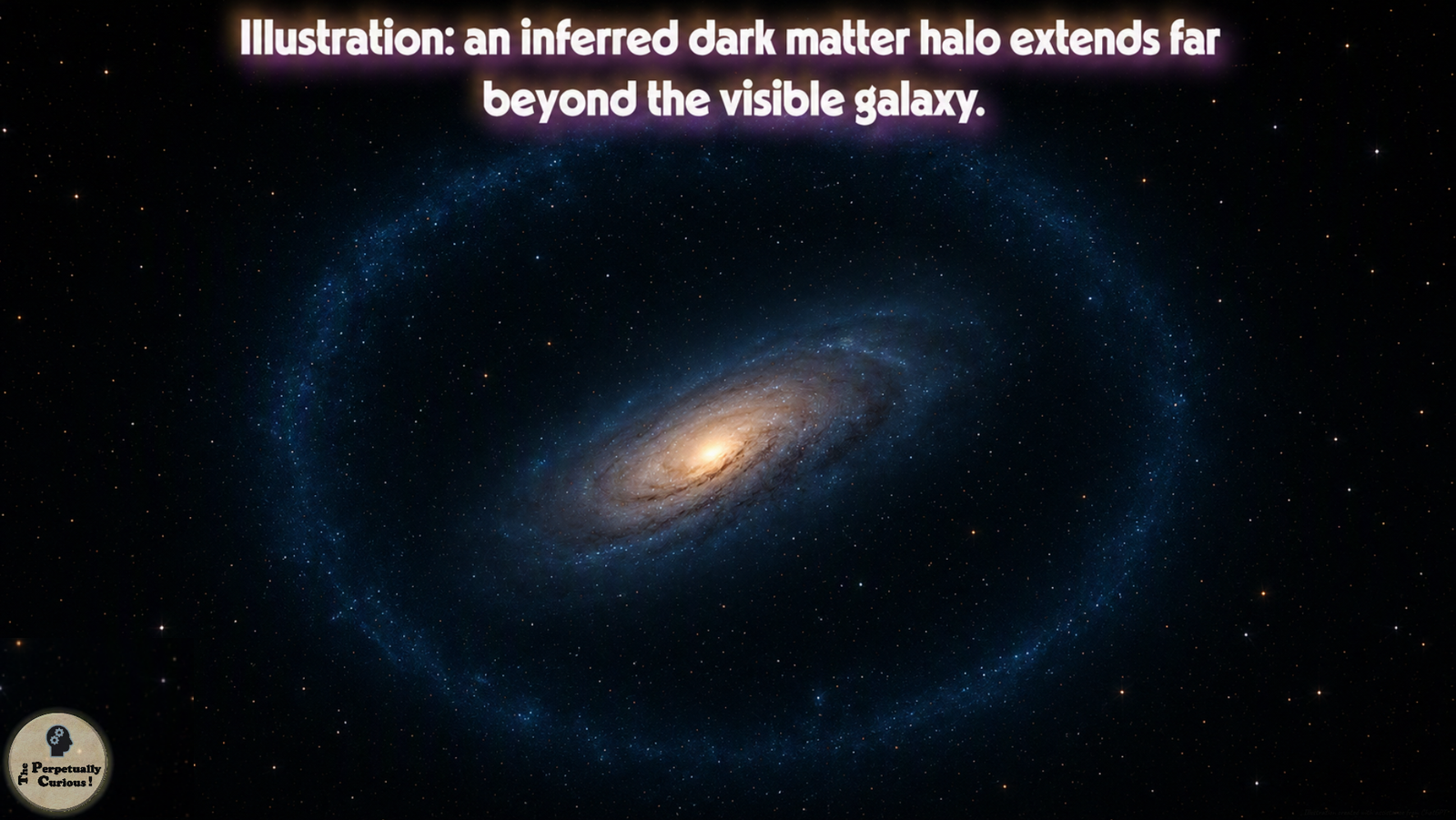
Dark matter appears to form extended halos around galaxies, reaching far beyond their luminous disks. The Milky Way’s halo extends hundreds of thousands of light-years from the galactic center. Estimates of the Galaxy’s total mass vary with method, but values around one to one and a half trillion solar masses are commonly inferred, with dark matter contributing most of that total.
Our solar system moves through this halo as it orbits the Milky Way at roughly 490,000 miles per hour (790,000 kilometers per hour). In leading particle models, dark matter interacts so weakly with ordinary matter that this motion produces no sensation and no familiar friction. The halo is dynamically important on enormous scales while remaining almost completely imperceptible in everyday life.
Dwarf spheroidal galaxies make the contrast even sharper. Systems such as Draco contain relatively little luminous material, yet the motions of their stars imply far more gravitating mass than the stars alone can provide. Their inferred mass-to-light ratios can be extremely high, making some dwarf galaxies among the most dark-matter-dominated systems known.
Individual galaxies and clusters reveal where unseen mass appears to gather. The next question is deeper: was dark matter already shaping the universe before galaxies existed at all? For that evidence, astronomers turn to the oldest light we can observe.
📡 The echo of creation
The cosmic microwave background (CMB) provides an independent line of evidence for dark matter from the universe’s infancy. This faint radiation was released when the universe became transparent about 380,000 years after the Big Bang. Tiny temperature variations across the CMB preserve a record of density differences and acoustic oscillations in the early cosmos.
The locations and relative heights of peaks in the CMB power spectrum help constrain the amounts of ordinary matter and total matter in the standard cosmological model. These acoustic peaks preserve the signature of oscillations within the early photon-baryon plasma before recombination. Those measurements cannot be reproduced by ordinary baryonic matter alone. They require a substantial nonbaryonic matter component consistent with the dark matter inferred from galaxies and clusters.
The reason is rooted in early-universe physics. Before recombination, ordinary matter was tightly coupled to radiation and could not collapse freely into growing structures. A nonbaryonic dark matter component was not subject to the same radiation pressure and could begin building gravitational potential wells earlier. After the universe became transparent and ordinary gas decoupled from radiation, that gas could fall into the pre-existing wells and participate in the growth of stars, galaxies, clusters, and the cosmic web.
This agreement across radically different observations is one of dark matter’s strongest features as a scientific explanation. Galaxy motions, gravitational lensing, cluster collisions, and the CMB all point toward a universe containing far more gravitating matter than atoms alone can supply.
Cosmology, however, tells scientists that such a component is needed. It does not reveal what the component is made of. If dark matter consists of particles that persist to the present day, those particles should still populate galactic halos. That possibility moves the investigation from the sky to detectors buried deep underground.
🔬 The underground hunt
Nearly a mile beneath the Black Hills of South Dakota, the LUX-ZEPLIN experiment searches for extremely rare interactions that could reveal a dark matter particle. LZ operates 4,850 feet (1,480 meters) underground at the Sanford Underground Research Facility, where the surrounding rock suppresses much of the cosmic-ray background that would otherwise overwhelm such a sensitive detector.
The experiment contains about 22,000 pounds (10 tonnes) of ultrapure liquid xenon, with about 7 tonnes serving as the active target in its central time-projection chamber. If a dark matter particle were to strike a xenon nucleus in the right way, the recoil could produce a tiny combination of light and liberated electrons for the detector to record.
In December 2025, the LZ collaboration reported results from its largest low-mass dark matter search dataset, based on 417 live days of analyzed data collected between March 2023 and April 2025. No significant excess attributable to dark matter interactions was found in the searched mass range. Instead, the experiment detected a signal from boron-8 solar neutrinos interacting through coherent elastic neutrino-nucleus scattering, or CEvNS, with a statistical significance of 4.5 sigma.
That result marked an important threshold. The same extraordinary sensitivity needed to search for low-mass dark matter is now sufficient to detect neutrino events that can resemble the signals researchers hope to find. Boron-8 solar neutrinos can scatter coherently from xenon nuclei, producing nuclear recoils that overlap with part of the signal space being examined for low-mass dark matter. In this low-mass search regime, LZ has entered what physicists often call the “neutrino fog.”
The milestone is both scientific success and experimental complication. It confirms that the detector can see extraordinarily faint nuclear-recoil signals while showing how carefully future searches must distinguish neutrino backgrounds from any possible dark matter
interaction.
Direct detection therefore advances even when the sought-for particle remains unseen. Every well-calibrated non-detection narrows the range of possible properties, while every newly resolved background sharpens the next search. Each result helps investigators eliminate possibilities and refine the search landscape.
🌟 The process of elimination
Dark matter research does not depend on one favored particle. It also advances by testing and excluding explanations that cannot account for the full body of evidence.
Hidden ordinary matter: Could the missing mass simply consist of dim ordinary objects? Astronomers have considered faint stars, brown dwarfs, stellar remnants, and black holes. Gravitational microlensing surveys place strong limits on how much of the Galactic halo can be made of compact ordinary objects across broad mass ranges. These objects can contribute some unseen mass, but they cannot account for the dominant dark matter component required by cosmology. Primordial black holes, which are not ordinary stellar remnants, remain possible dark matter candidates only within constrained mass windows.
Fundamental constraints: Big Bang nucleosynthesis provides another powerful limit. The observed abundances of light elements such as hydrogen, deuterium, and helium constrain how much ordinary baryonic matter existed in the early universe. Those constraints are consistent with CMB measurements and fall far short of the total matter density inferred from cosmology. Most dark matter therefore cannot simply be hidden atoms.
Leading candidates: WIMPs remain an important class of hypothetical particles, although increasingly sensitive experiments have excluded large regions of previously plausible parameter space. The axion was originally proposed through the Peccei-Quinn mechanism as a possible solution to the strong CP problem in particle physics and later became a dark matter candidate. Axions and axion-like particles offer a very different possibility from WIMPs, with sufficiently light candidates behaving collectively in ways that can resemble waves on astronomical scales. Other models invoke hidden-sector particles with their own interactions.
Primordial black holes occupy another category entirely. They would not be new elementary particles, but black holes formed in the early universe rather than through stellar collapse. Observations strongly constrain how much dark matter they could supply across many masses, yet some windows remain scientifically interesting.
The candidate list has therefore become broader even as individual possibilities are squeezed more tightly. The search is not a march toward one predetermined answer. It is a narrowing landscape shaped by observation, experiment, and theory. Together, these investigations reveal a universe where most mass remains hidden, while the small fraction that shines allows us to uncover its presence.
🎭 Living within the visible minority
Dark matter also changes the scale of what “ordinary” means. Atoms, stars, planets, gas, dust, and living bodies account for only about 5 percent of the universe’s total energy density. Dark matter contributes about 27 percent, while dark energy accounts for roughly 68 percent.
Those numbers do not mean that most of the universe is a single mysterious substance. Dark matter and dark energy describe very different phenomena. Dark matter gravitates and clusters, helping organize cosmic structure. Dark energy is the name given to the component associated with the observed acceleration of cosmic expansion.
Within the standard cold dark matter picture, dark matter does not efficiently radiate electromagnetic energy. It therefore does not cool and collapse into thin disks, stars, and planets the way ordinary gas can. Instead, it remains distributed in extended halos and filaments that provide the gravitational framework within which ordinary matter gathers.
That framework matters especially for the early growth of structure. After recombination, gas could fall into dark matter potential wells, cool, and eventually meet the conditions for star formation. Without the nonbaryonic matter component represented in the standard cosmological model, the observed pattern and timing of galaxies and the cosmic web would be very difficult to reproduce.
The mystery therefore ends where it began, with a distinction between evidence and identity. Scientists can measure dark matter’s gravitational influence, map where it appears to gather, estimate how much of it exists, and rule out many proposed explanations. What they still cannot do is point to a confirmed dark matter particle and say, with certainty, “this is what the unseen mass is.”
Perhaps that is what makes the subject so enduring. Dark matter is not merely something hidden in a distant corner of space. It is a reminder that the universe can reveal the shape of an answer long before it yields the thing itself.
Pass this article along to someone curious and let the learning travel.
Did You Know
🌠 Dark matter accounts for about 85 percent of all matter by mass, while contributing roughly 27 percent of the universe’s total energy density.
🌌 Estimates of the Milky Way’s total mass commonly fall around one to one and a half trillion solar masses, with dark matter contributing most of that mass even though the Galaxy’s stars provide nearly all of its visible light.
🧭 Astronomers do not photograph dark matter directly. They infer its distribution through effects such as stellar and galaxy motions, gravitational lensing, and the relationship between ordinary matter and total gravitational mass.
🔭 Space-based and ground-based observatories often work together when mapping dark matter. Optical and infrared images trace galaxies, X-ray observations reveal hot gas, and lensing measurements reconstruct total mass. This multi-instrument approach connects naturally with how space telescopes reveal hidden cosmic realms.
🌌 The CMB contains tiny temperature variations at roughly the level of one part in 100,000. Those patterns preserve information about the density fluctuations from which later cosmic structure grew.
❄️ In the standard cold dark matter picture, the dominant dark component does not cool efficiently by emitting light, which helps explain why it remains in broad halos instead of collapsing into luminous disks and stars.
🌀 Some dwarf spheroidal galaxies are inferred to be overwhelmingly dominated by dark matter, making them valuable laboratories for studying gravity where relatively little luminous matter is present.
🌌 Evidence for dark matter spans extraordinary cosmic timescales, from the universe’s earliest light preserved in the cosmic microwave background to the motions of galaxies and galaxy clusters observed today.
What exactly is dark matter?
Dark matter is the name given to a gravitating component that does not emit, absorb, or reflect enough electromagnetic radiation for direct astronomical detection. Its presence is inferred from several independent observations, but its fundamental physical identity remains unknown.
How do we know dark matter exists if we cannot see it?
Galaxy rotation curves, motions within galaxy clusters, gravitational lensing, colliding-cluster observations, the cosmic microwave background, and large-scale structure all indicate more gravitating matter than ordinary atoms can provide. The strength of the dark matter interpretation comes from the agreement among these different lines of evidence.
How does gravitational lensing help reveal dark matter?
Mass bends the path of light from more distant objects. By measuring how background galaxies are stretched, magnified, or distorted, astronomers can reconstruct the distribution of total mass in a foreground galaxy or cluster. Comparing that map with visible stars and X-ray-emitting gas reveals where additional unseen mass is required.
Could dark matter just be ordinary matter that has not been detected?
Not in sufficient quantity to explain the observations. Big Bang nucleosynthesis and CMB measurements tightly constrain the amount of ordinary baryonic matter, while microlensing and other surveys limit how much hidden mass can exist in faint stars, brown dwarfs, stellar remnants, and compact objects.
Is dark matter the same as antimatter?
No. Antimatter has well-established particle properties and interacts electromagnetically. When antimatter meets ordinary matter, the two can annihilate and produce detectable radiation. Dark matter, by contrast, is inferred primarily through gravity and has not been identified as a known form of antimatter.
Has anyone detected a dark matter particle?
No confirmed direct detection of a dark matter particle has been established. Experiments such as LUX-ZEPLIN continue to set increasingly stringent limits on possible interactions while also revealing rare backgrounds, including solar-neutrino signals.
Why do scientists keep searching if no particle has been found?
The gravitational evidence does not disappear when a particular detector sees no signal. Instead, each null result excludes part of the possible parameter space and helps distinguish among competing particle models, compact-object scenarios, and alternative explanations.
Where is dark matter located?
Dark matter is inferred to occupy extended halos around galaxies, larger halos around galaxy clusters, and filaments throughout the cosmic web. The Solar System is embedded within the Milky Way’s dark matter halo.
Can dark matter interact with itself?
Observations of colliding galaxy clusters indicate that any dark matter self-interaction must be weak enough to preserve the observed mass distributions in those systems. Some theoretical models nevertheless allow limited self-interactions, and astronomers continue to test those possibilities.
How is dark matter different from dark energy?
Dark matter gravitates, clusters, and helps build structure. Dark energy is associated with the accelerated expansion of the universe and does not behave like matter concentrated in galactic halos. Their similar names reflect what remains unexplained, not a shared physical identity.
Why cannot telescopes simply see dark matter?
Telescopes detect electromagnetic radiation or its interaction with matter. Dark matter does not appear to emit, absorb, or reflect enough light for direct imaging. Astronomers therefore map its gravitational effects on luminous objects and background light rather than photographing the substance itself.
Does dark matter make black holes?
Standard particle dark matter does not efficiently radiate energy and collapse the way ordinary gas does, so it is not expected to form stars or conventional black holes readily. Primordial black holes are a separate possibility: if some formed in the early universe, they could themselves contribute a fraction of dark matter within observationally allowed mass ranges.
✨ Share the wonder
If this cosmic mystery stirred your curiosity, sharing it can help another reader follow the clues from visible galaxies to the unseen architecture that helps shape them.
“The Hunt for the Invisible: Understanding Dark Matter Through Science’s Greatest Detective Story.” The Perpetually Curious!, August 2026.
https://www.theperpetuallycurious.org/articles/evidence-for-dark-matter/Continue Exploring
For the curious mind: want to explore this theme through a few questions? Visit the Classic Quiz Studio, nestled under Explorations opens in a new tab ,and see where a few well-placed questions lead: Cosmic Exploration Quizzesopens in a new tab
For what comes next
Site Updates gathers occasional notes, new additions, and ways to keep in touch. RSS brings new publications to your feed reader in chronological order.
Choose the path that speaks to you, and let the next curiosity find you wherever your wondering takes you.