Explore by topic, question, or idea. Find articles, reflections, videos, puzzles, and curiosity pathways gathered across the site.
Press Enter or select Search. A newly typed query starts globally; filters are applied only through the visible rail.
119 results for “space”
- The Perpetually Curious! › Canonical › Cosmic ExplorationArticle
🌌 Why Space Feels Cold Among So Many Suns: The Quiet Physics of Cosmic Warmth
From section: 🌌 The vacuum of space and the scarcity of particlesSpace is often described as a vacuum, but a vacuum is a region of extremely low matter density, not necessarily perfect emptiness. Under typical near-surface conditions, Earth’s atmosphere contains roughly 410 quintillion molecules per cubic inch (2.5 × 10¹⁹ per cubic centimeter).
- The Perpetually Curious! › Canonical › Cosmic ExplorationArticle
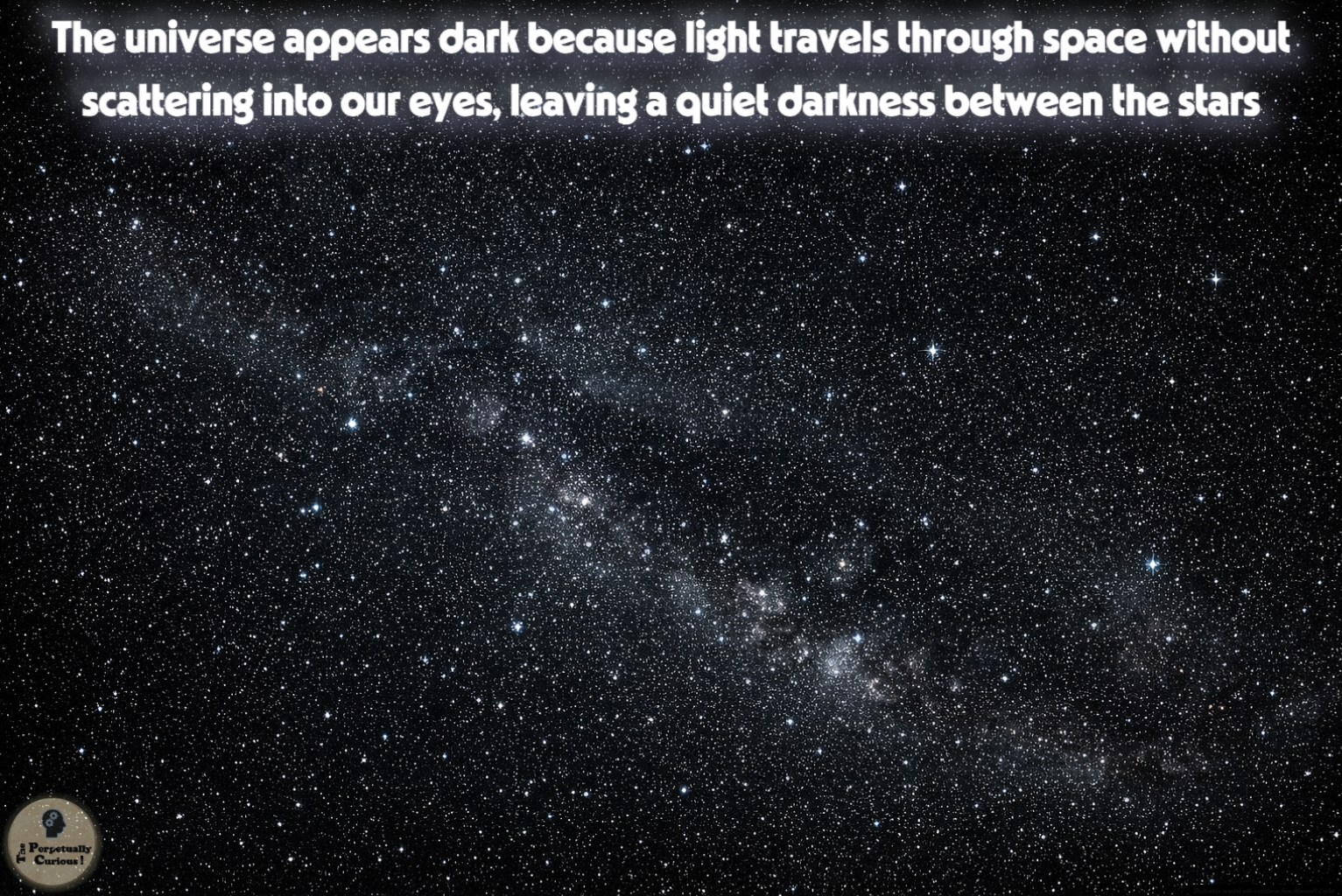
🌌 Why Space Looks Dark in a Universe Filled with Light: Understanding the Quiet Cosmos
Light moves through the quiet of space and waits for a surface to answer it. The rest remains open and unlit, a depth that holds its silence.
- The Perpetually Curious! › Archives › PhysicsArticle
🌌 Why Space Looks Dark: Light, Matter, and the Quiet Cosmos
Space can look surprisingly dark, even in a universe filled with stars. That darkness is not simply the absence of light. It is often the result of how light travels, what it meets, and what it does not meet. On Earth, daylight becomes a bright blue sky because sunlight…
- The Perpetually Curious! › Archives › Cosmic ExplorationArticle
Cosmic Eyes: How Humanity's Space Telescopes Unveil the Universe's Hidden Realms 🔭
Space telescopes changed everything, granting us new senses to perceive the invisible universe.
- The Perpetually Curious! › Archives › Cosmic ExplorationArticle
🌞 The Solar Wind: When the Sun Breathes Across Space
Though invisible to our eyes, this cosmic current shapes Earth’s environment, drives space weather, and even fuels storms that can disrupt technology on Earth, and it is why space‑weather forecasters watch the Sun every day.
- The Perpetually Curious! › Archives › PhysicsArticle
🚀⚡ Pioneering Power in Deep Space: The Essential Role of Radioisotope Thermoelectric Generators (RTGs)
This article also belongs naturally within the wider cosmic exploration collection, where deep-space power, spacecraft motion, distant signals, and observation technologies come together as parts of the same larger story.
- The Perpetually Curious! › Canonical › Cosmic ExplorationArticle
🌌 Silent Crossings: Why Starlight Does Not Mix in Space
On a clear night, light arrives from stars scattered across an immense depth of space. Radiation from different stars can overlap in space. Yet the sky still offers points of light, recognizable patterns, and spectra that astronomers can study.
- The Perpetually Curious! › ArchivesGateway
TPC8‑QH‑CE‑003 🌌 Cosmic Exploration | ✨ Deep Space Phenomena
🌌 Cosmic Exploration Quiz: CE‑003 | Deep Space Phenomena 👉 Answer all 5 questions by clicking the option you believe is correct. Each choice you make will be highlighted. Once you have completed the quiz, select “Finish Quiz” to view your results and explanations.
- The Perpetually Curious! › ArchivesGateway
TPC8‑QH‑CE‑001 🌌 Cosmic Exploration | 🚀 First Steps into Space
🌌 Cosmic Exploration Quiz: CE‑001 | First Steps into Space 👉 Answer all 5 questions by clicking the option you believe is correct. Each choice you make will be highlighted. Once you have completed the quiz, select “Finish Quiz” to view your results and explanations.
- The Perpetually Curious! › Canonical › Cosmic ExplorationArticle
🛰️ What Tardigrades and Extremophiles Teach Us About Life Beyond Earth
During the 12-day Foton-M3 mission, researchers exposed dried tardigrades to space for ten days. Back on Earth, they rehydrated the animals and checked for coordinated leg movement as a sign of recovery.