
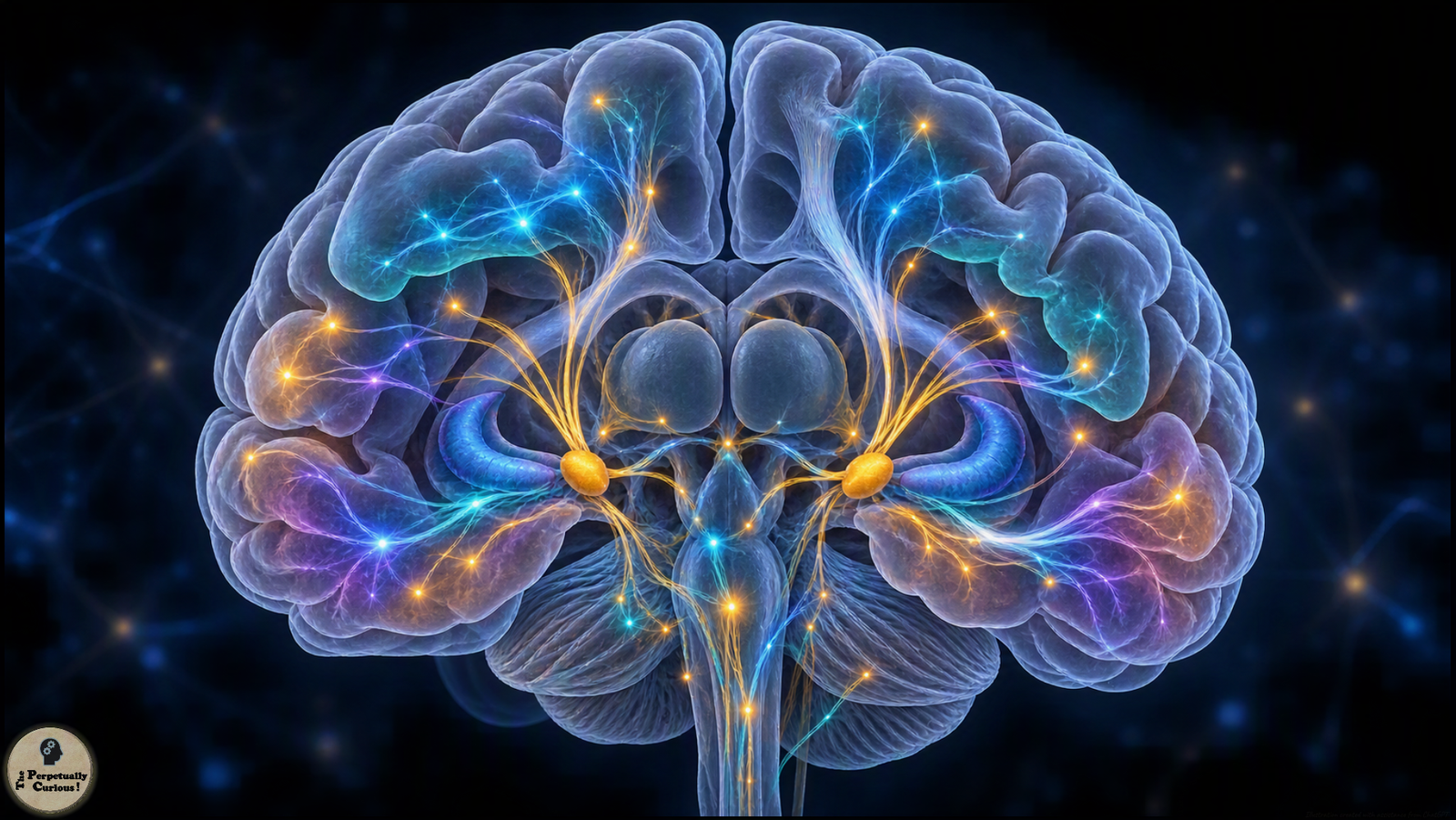
The amygdala is often introduced as the brain’s “fear center,” as though a small switch deep in the temporal lobes turns fear on. The label points toward important biology, but it compresses several distinct processes into one place. Each amygdala is a cluster of nuclei, and its cells participate in circuits that help the brain learn which events predict danger, reward, or other biological significance.
When a threatening cue appears, amygdala circuits can help connect that cue with its consequences. Through wider connections, they contribute to how neurons, glia, and networks shape human experience by influencing attention, memory, bodily regulation, and defensive action. These contributions are important, but detecting a threat, preparing a response, and consciously feeling afraid are not the same process.
The amygdala is not limited to danger. Studies of primates have found distinct neuronal populations that represent learned positive and negative value, while circuit research shows that different pathways within the amygdala can support different forms of approach, avoidance, attention, and memory. Activity in these circuits therefore does not translate automatically to “fear.” Its meaning depends on the cells involved, their connections, the stimulus, prior learning, and the state of the wider brain.
Rare lesion evidence makes the limit of the fear-center metaphor especially clear. In one small study, three people with bilateral amygdala damage experienced intense fear and panic while inhaling carbon dioxide. Such damage can nevertheless disrupt several responses to external threats. The finding did not make the amygdala unimportant. It showed that internal bodily threat signals can reach fear and panic through other routes.
An emotional episode draws together perception, memory, learning, bodily state, attention, and interpretation. A similar convergence becomes visible in emotional tears, where grief, relief, joy, or awe can reach a shared physical response through overlapping brain and body pathways.
The “fear center” label is therefore useful only as a first approximation. The amygdala matters because it helps the brain learn significance and organize responses, not because fear resides inside it. Fear feels like one experience, but its biology is a coordinated event without a single switch.