
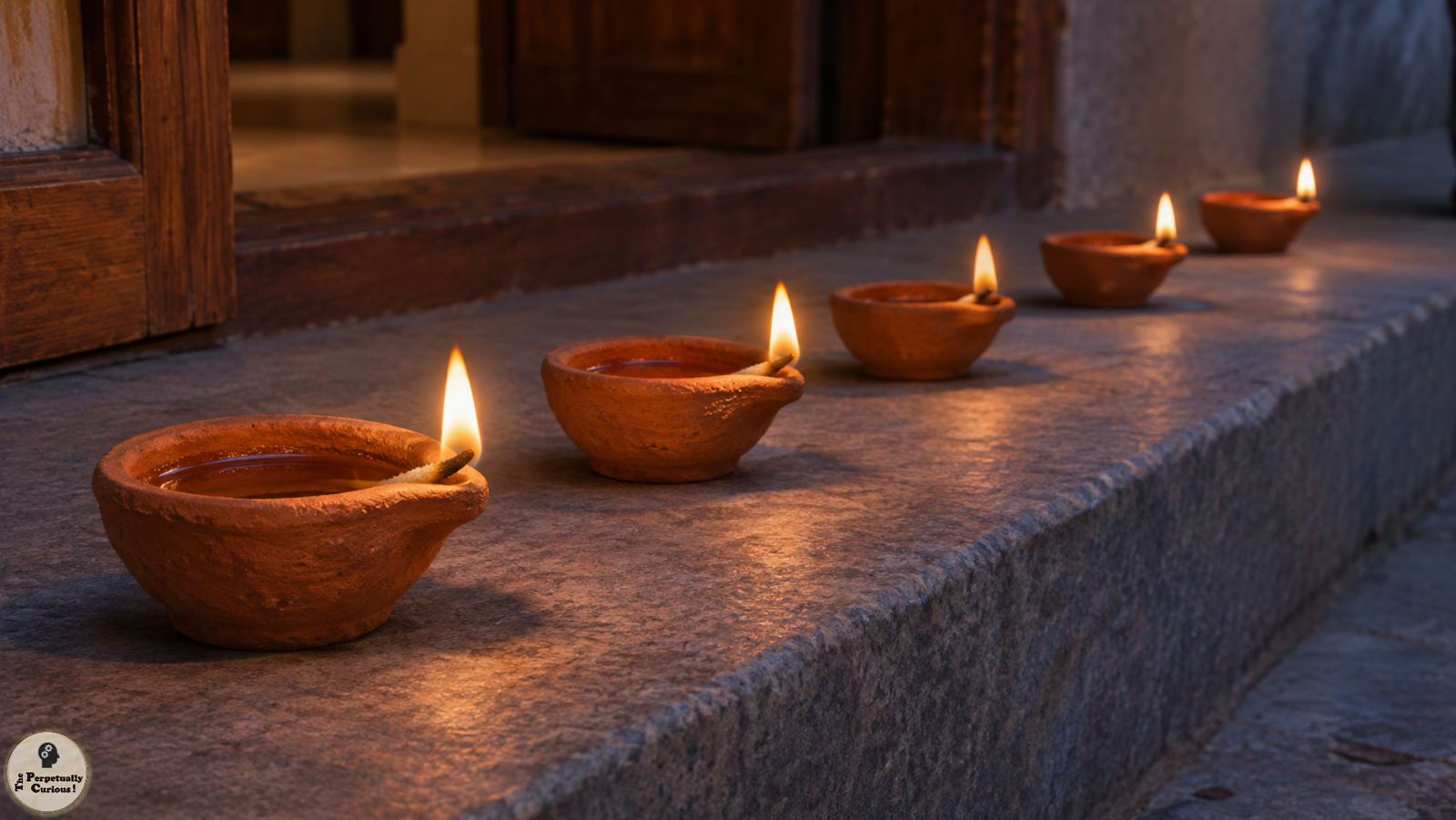
A row of small oil lamps can make a doorway recognizable as part of Deepavali before anyone explains the celebration. Yet the lights do not tell every household’s story. In one setting, they recall a homecoming; elsewhere, they welcome prosperity, honor spiritual liberation, or accompany remembrance of release from imprisonment. The familiar description “festival of lights” captures what people can see. Understanding the festival means looking more closely at what those lights are there to express.
The name offers a starting point. Deepavali, also commonly called Diwali, comes from Sanskrit words meaning a row of lights. Small oil lamps, often called diyas, give that name a visible form along doorways and around homes. The arrangement matters to the image: several separate flames turn an entrance or courtyard into an illuminated space. A lamp is both an everyday object that supplies light and, within the celebration, an object given religious and cultural meaning.[1]
In many Hindu interpretations, that brightness expresses the overcoming of darkness, evil, or ignorance. The contrast gives physical light a moral and spiritual meaning: what is illuminated can represent knowledge, while darkness can stand for what obscures it. Within the celebration, the lamps make these ideas visible through a familiar object. Their significance comes from the stories and observances around them, not simply from the fact that they burn.[1]
One widely recognized Hindu tradition connects the celebration with Rama’s return to Ayodhya alongside Sita and Lakshmana after exile and the defeat of Ravana. In this telling, people illuminate the city to welcome them home. The lamps make a public act of recognition out of a return: a community lights the place to which its central figures belong. Homecoming gives the brightness a particular meaning, more specific than the general contrast between light and darkness.[2]
Other Hindu traditions emphasize Krishna’s defeat of Narakasura, especially in southern Indian celebrations. Here, the emphasis falls on the ending of a destructive power.[2] Many households also worship Lakshmi, the goddess associated with wealth and prosperity, and illuminate their homes as part of welcoming her.[3] Homecoming, victory, and auspicious welcome are related themes, but they are not interchangeable stories. A family’s observance may bring several associations together rather than fit neatly into one regional account.
For Jains, Diwali has a distinct center: it commemorates Mahavira’s final liberation, or nirvana. The Pluralism Project describes the lamps as honoring his spiritual illumination. It also records gatherings in which Jains light lamps, chant mantras, and sing together. In this context, brightness is associated with spiritual freedom. The outward similarity to a neighboring celebration does not make its religious meaning the same. The remembered event and the understanding of liberation belong to the Jain tradition.[3]
Sikhs observe Bandi Chhor Divas during the same festival period, commemorating Guru Hargobind’s release from imprisonment. Sikh accounts associate his return to Amritsar with illuminated celebrations. Light thus accompanies a remembrance of freedom with its own place in Sikh history and religious life. Although a photograph of lamps might look familiar across these settings, it cannot by itself explain whom a community remembers or why. The name of the observance and the account told around it supply that context.[4]
A shared visual practice therefore need not express identical beliefs. The Hindu, Jain, and Sikh examples here show some of that variation; they do not form an exhaustive account. Naming a tradition also does not mean every household follows one pattern. Stories, prayers, family visits, and the sharing of food give the occasion a fuller setting than its most recognizable decoration.[2] The lamps offer an entry into that setting, while household customs and community accounts supply the detail.
Even the language of renewal needs context. For some business communities, the Diwali period is associated with closing accounts and beginning new ledgers.[2] In the observance called Chopda Pujan, new account books are blessed for the year ahead.[5] This is one example within the wider range of new-year traditions across cultures. It does not mean that Deepavali begins the year for everyone who celebrates it. A household can welcome prosperity, gather with relatives, or remember a sacred event without treating the occasion as its calendar’s first day.
The lights are recognizable beyond India as well. Singapore’s Little India has featured a Deepavali street light-up.[2] Leicester in Britain has hosted public Diwali celebrations. The Smithsonian’s National Museum of Asian Art in Washington, D.C., has hosted a Diwali festival. These public settings also give visitors ways to encounter the traditions behind the illumination. The surrounding stories, performances, and activities can explain an occasion that might otherwise be known mainly through its lights.
A row of lamps therefore connects these observances through a recognizable form, while leaving room for distinct meanings. Following the light back to a particular story, prayer, or act of remembrance reveals why it matters there. At the doorway, the flames make the occasion visible. The people who light them give that brightness its meaning.
Selected sources
- National Heritage Board. (n.d.). Everything Is Illuminated. Section: The Lights of Deepavali.
- Ho, S. (n.d.). Deepavali. Singapore Infopedia, National Library Board.
- The Pluralism Project, Harvard University. (n.d.). Celebrating Mahavira: Mahavira Jayanti and Divali.
- Singh, G. (n.d.). Bandi Chhor Divas – Sikh Divali: The harbinger of Enlightenment and Freedom. Sikh Missionary Society (U.K.).
- BAPS Swaminarayan Sanstha. (2002). Diwali Celebration 2002, Gondal.