
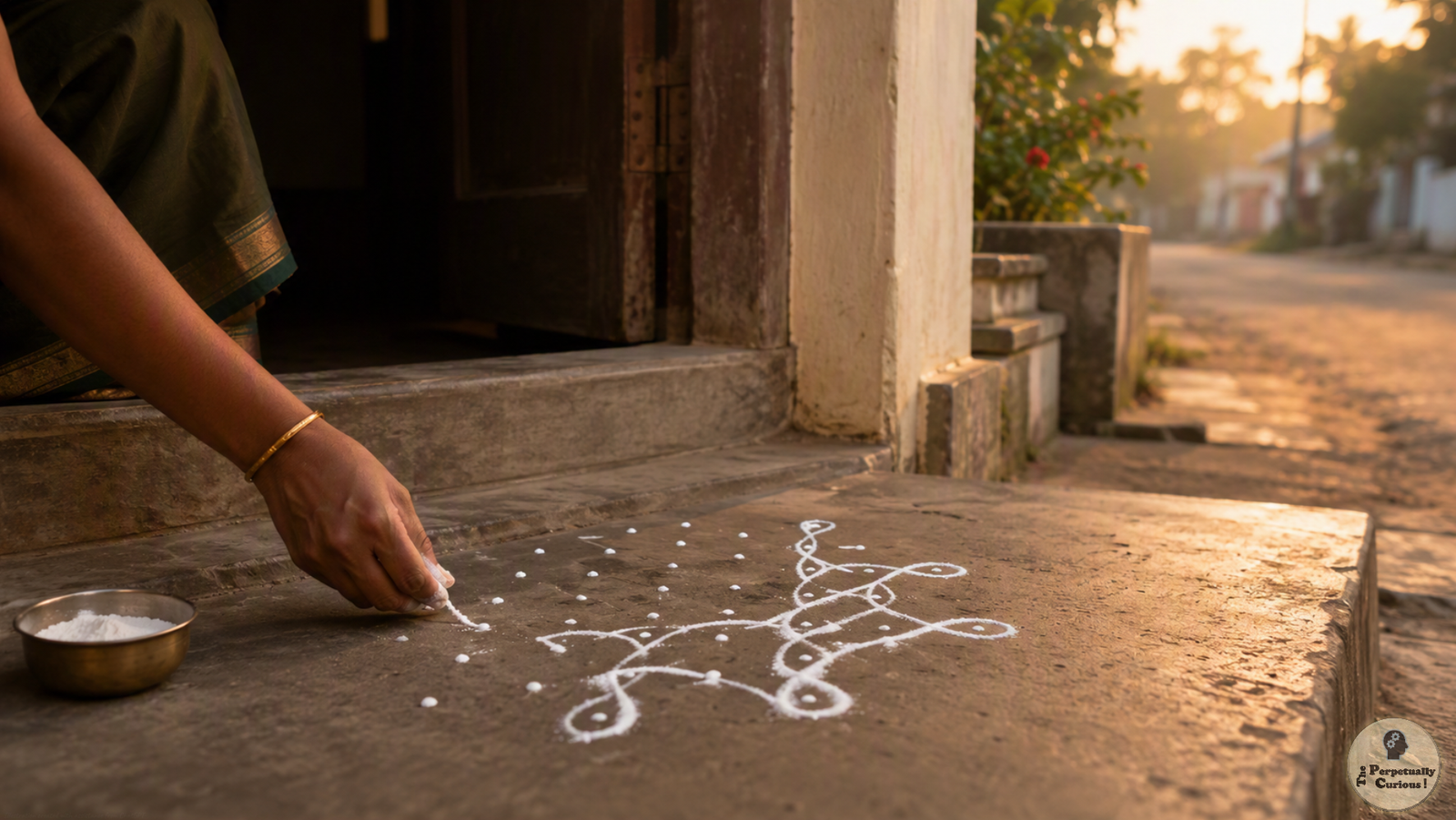
At many doorways in Tamil Nadu, the day begins with a surface being cleared and a pattern placed upon it. Fine rice flour or, in many modern settings, white stone or chalk powder is released between the fingers as dots, curves, and loops. The result is a kolam, a threshold drawing whose beauty is not secured by permanence.
Kolam is closely associated with Tamil culture, although related floor-drawing traditions across India have their own names, materials, designs, and occasions. In many Tamil households, kolam has traditionally been made by women, often in the morning, though practitioners and routines vary. Some designs are drawn freehand. Others begin with a grid of dots, a form commonly known as pulli kolam. In sikku kolam, a particular kind of dot-grid design, one or more closed looping lines wind around the dots. These structured forms have attracted mathematical study, but kolam is not mathematics alone. It is also an embodied practice learned through observation, memory, and repeated movement.
The threshold gives the drawing much of its meaning. It marks a boundary between household and street, interior and exterior, private routine and public view. Depending on the family and community, making a kolam may express auspiciousness, welcome, devotion, generosity, attentiveness, or continuity. Rice flour may also be understood as food offered to ants, birds, and other small creatures. Yet not every contemporary kolam uses edible material, and no single explanation represents every practitioner.
Unlike printing ink designed to hold a mark, kolam is placed where daily life will disturb it. Feet interrupt the lines. Wind scatters the powder. Rain softens the edges. By the next morning, the surface may be swept and drawn again. Its disappearance is not necessarily a failure of the work. It belongs to the work’s temporal setting.
A similar distinction appears in henna stains that fade while the practice continues. The lifespan of a material mark need not match the lifespan of a cultural tradition. The individual design may vanish, but the knowledge remains in hands, memories, and shared routines.
Kolam therefore holds a precise geometry for only a short time. What endures is the returning gesture: dots placed, lines guided, and a familiar entrance made newly visible.