
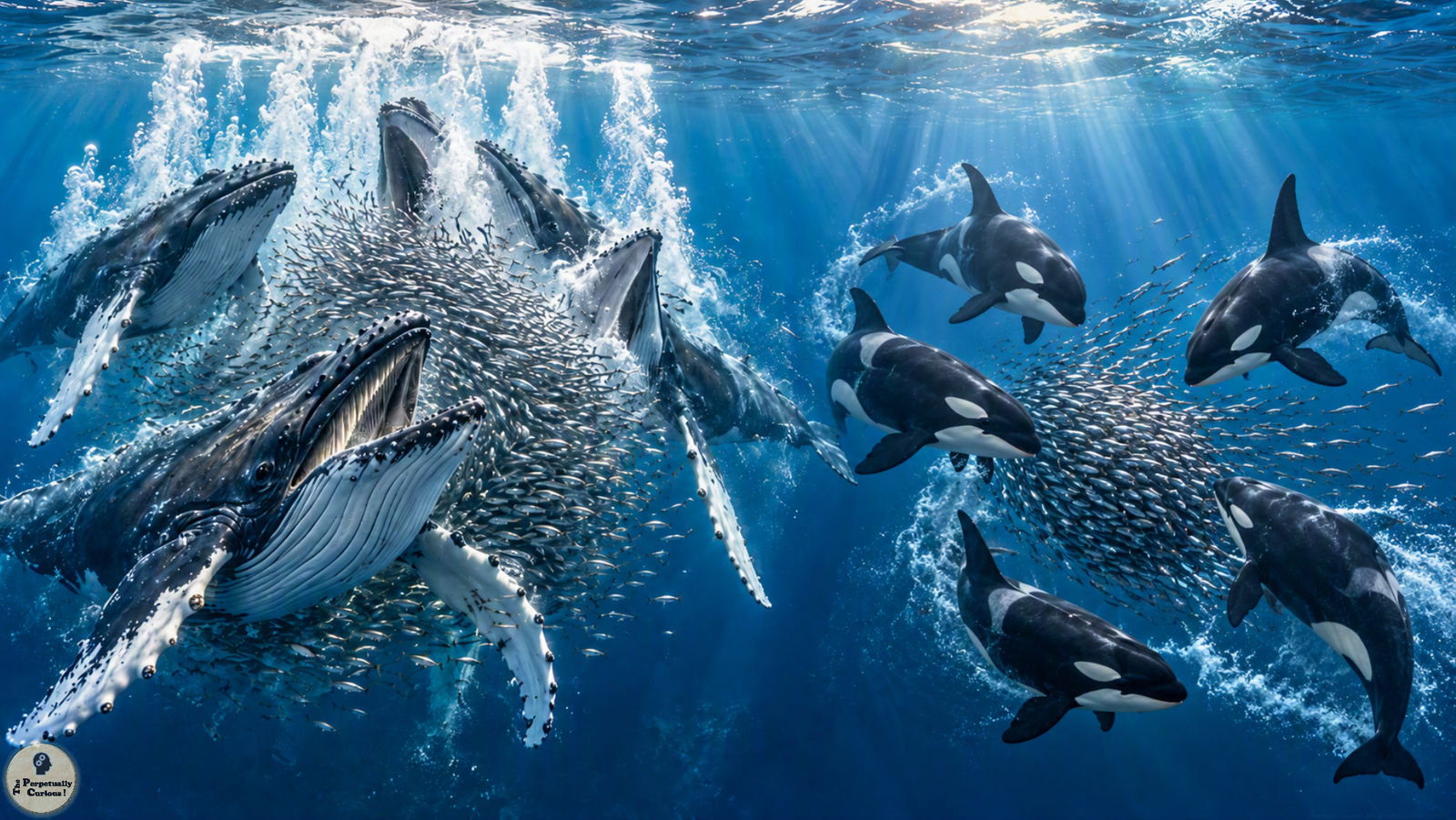
On feeding grounds such as Stellwagen Bank, several humpback whales may converge on the same dense patch of fish. They can herd prey, dive together, and surface in coordinated lunges. Orcas can also cooperate closely while feeding. From the surface, the two scenes can look like versions of the same social behavior.
They are not quite the same kind of society.
Humpbacks are baleen whales. They engulf prey-rich seawater and filter small schooling fish and krill through baleen, sometimes after concentrating prey with bubbles, sounds, their fins, or movements along the seafloor. Humpbacks have also been documented coordinating over dense schools of fish during feeding. Yet feeding associations can be fluid, and several whales may gather because the same rich prey patch has drawn them together.
Fluid does not mean socially simple. Long-term studies have documented recurring associations, persistent pair bonds, structured feeding networks, and socially learned feeding techniques in some humpback populations. A humpback feeding group may therefore reflect both immediate opportunity and meaningful social relationships without necessarily representing a permanent family unit.
Orcas are toothed cetaceans and members of the dolphin family. In many populations, individuals remain closely associated with maternally related social groups. Feeding traditions can also be strongly learned. Different orca populations specialize on very different prey, including salmon, herring, marine mammals, sharks, rays, and other animals, and coordinated hunting techniques can be transmitted socially within populations.
The contrast is therefore not simply solitary humpback versus social orca. Humpback social life can be more structured than that shorthand suggests, while orca societies also vary among populations. The more useful distinction is that cooperative feeding among humpbacks often occurs within comparatively flexible associations, whereas many orca hunts unfold inside more persistent kin-based social networks.
Nor is this an Arctic-versus-Atlantic divide. Orcas occur in every ocean, including temperate, tropical, and subtropical waters, while humpbacks also occur worldwide across all major oceans. Geography is a separate ecological question.
What looks like teamwork at the surface can therefore arise from different social worlds. For humpbacks, feeding partners may be temporary, recurring, or surprisingly persistent. For many orcas, the hunt can be woven more tightly into family relationships, communication, learned traditions, and life within the group.