
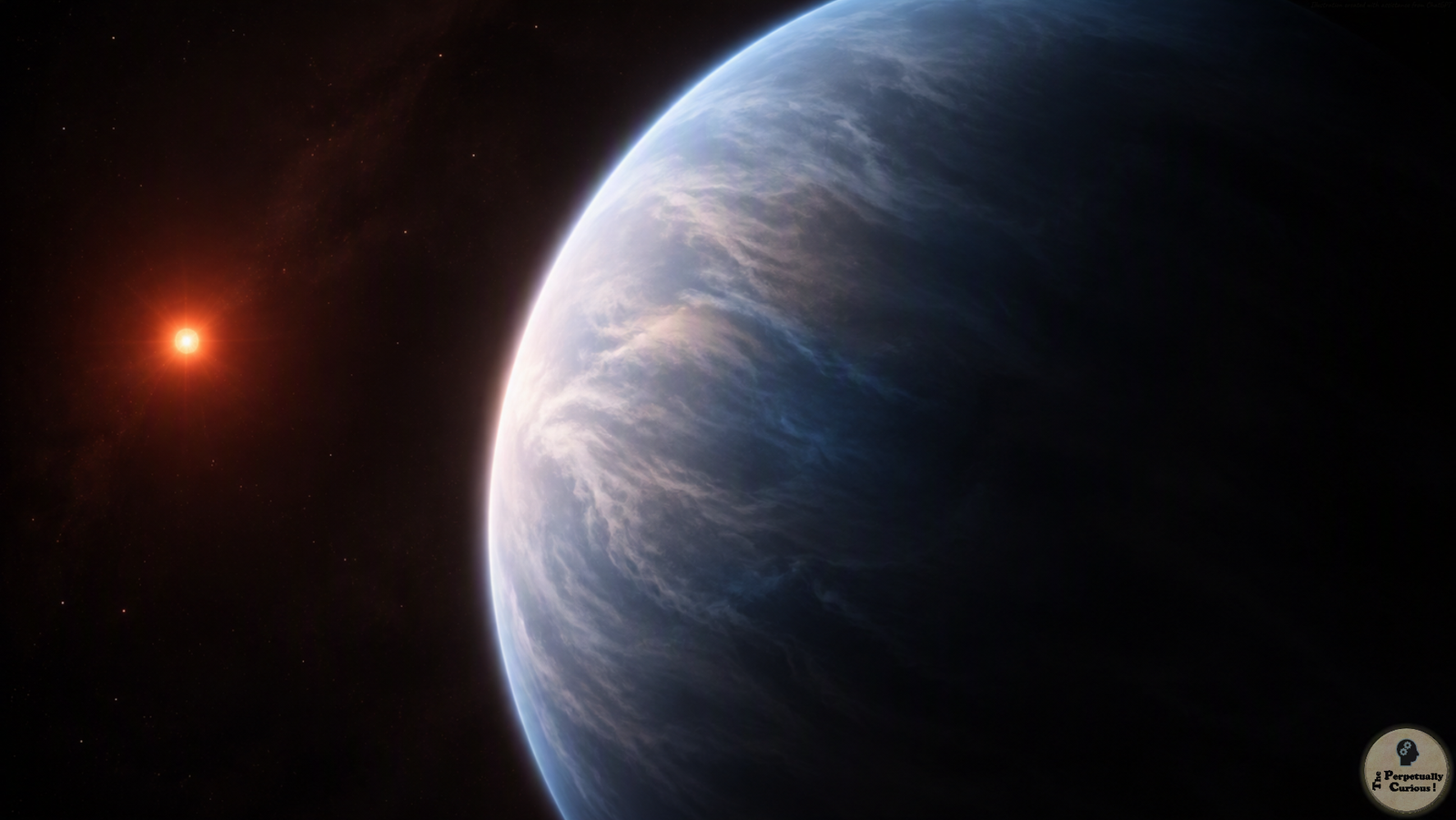
A widely circulated illustration of K2-18 b shows a blue planet wrapped in pale clouds. The scene is not a telescope photograph. It is an artist’s concept built around evidence from one of the many worlds beyond our solar system, not a portrait of a known surface.
K2-18 b lies roughly 120 light-years away in the constellation Leo and circles a cool red-dwarf star every 33 days. Current NASA catalog values place it at about 2.4 times Earth’s radius and nearly nine times Earth’s mass. It is therefore not simply a larger Earth. Its size places it among sub-Neptunes, a class of planets with no close counterpart in our solar system.
Astronomers study the planet when it passes in front of its star. A fraction of the starlight filters through the atmosphere, where different gases absorb particular wavelengths. The resulting spectrum supports the presence of methane and carbon dioxide in a hydrogen-rich atmosphere. It does not reveal a mapped landscape of continents, seas, or a visible solid surface.
The planet also orbits within its star’s habitable zone. That term describes a range of distances where liquid water could exist at a planet’s surface under suitable conditions. It does not establish that water is present, that the surface is accessible beneath the atmosphere, or that the planet can support life.
One interpretation describes K2-18 b as a possible Hycean world, with a hydrogen-rich atmosphere above a global ocean. Other research finds that the same observations can be explained by a gas-rich mini-Neptune with no habitable surface. Even the proposed ocean therefore remains a model-dependent possibility rather than an observation.
The blue planet in the illustration is best understood as a map of one scientific hypothesis. What telescopes have actually detected is subtler and more valuable: a distant atmosphere leaving patterns in starlight, enough to reveal some of its chemistry, but not yet an Earth-like world, an ocean, or life.