

Mud often appears simple at first glance, a dark smear on a boot or a soft bed beneath still water. Yet its color, especially the deep browns and blacks that settle into riverbanks, marshes, and lake bottoms, carries a quiet record of oxygen, water, and life. When soil meets water and lingers there, minerals, microbes, and organic matter begin to rearrange themselves. The result is written in color, a subtle palette shaped by the presence or absence of air, the slow work of decomposition, and the chemistry of iron.
Mud is not simply wet soil. It is a quiet archive of environmental conditions, a place where the Earth writes slowly beneath our feet. This article follows that color story from the familiar brown of a riverbank to the almost ink‑black mud of tidal flats, tracing the processes that shape these tones and the landscapes they reveal.
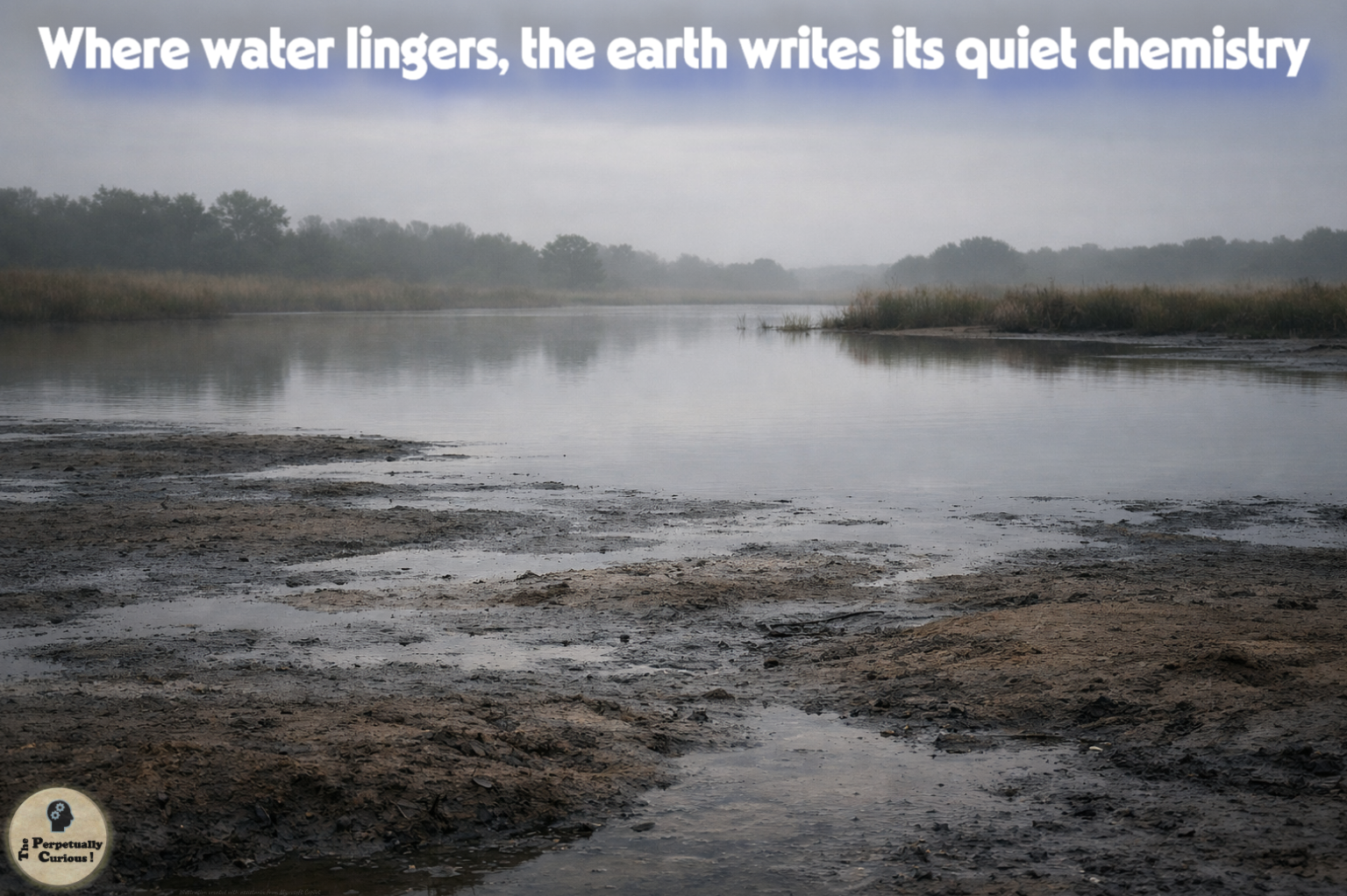
🌍 When soil becomes waterlogged, it turns into mud
Mud begins as soil that has taken on more water than it can easily drain. In a field after rain, in a rice paddy, or along a tidal flat, the pores between grains fill with water and air is displaced. The same mixture of minerals and organic fragments that formed the original soil remains present, but the balance between air and water has shifted.
This shift is not only about texture. It determines how much oxygen can reach the tiny spaces between particles. Oxygen moves slowly through water, and once the pores are saturated, the supply becomes limited. Within hours to days of saturation, aerobic microorganisms consume the remaining dissolved oxygen, and the environment begins to change. This change sets the stage for the colors that follow.
Different soil types can influence the minerals and organic matter that eventually form mud, but the color of mud itself is governed mainly by oxygen availability, iron chemistry, and organic accumulation.
🧱 Minerals, organic matter, and the palette of mud
Mud is usually made of three main components: mineral particles, organic matter, and water. Each contributes to color in a different way, and together they create the familiar spectrum from light brown to nearly black.
Mineral particles in mud are often very fine, especially clays and silts. Many of these minerals contain iron, an element abundant in the Earth’s crust. Iron makes up roughly 5 percent of Earth’s continental crust by mass, making it one of the most common color-influencing elements in soil and sediment worldwide. A broader view of these elemental patterns begins with the periodic table, which places iron among the elements that help shape soil and sediment color. When iron is exposed to oxygen and moisture, it can form iron oxides, which are natural pigments. These oxides often appear red, yellow, or brown, and even a small amount can tint a large volume of sediment.
Organic matter tends to darken mud. Leaves, roots, algae, and microscopic organisms break down over time into complex carbon‑rich substances. As this material accumulates and becomes more decomposed, it forms humus, which is usually dark brown to black. Humus coats mineral grains and can easily mask their lighter colors, especially near the surface where biological activity is strongest.
Water deepens the appearance of whatever it saturates. A soil that looks light brown when dry may appear much darker when wet because water reduces scattering of light and allows dark pigments to dominate.
🔥 Iron, oxygen, and the chemistry of brown
In many well‑drained environments, mud and soil appear brown because iron is present in an oxidized form and organic matter is present in moderate amounts. When oxygen is plentiful, iron tends to exist as ferric iron, which forms minerals such as hematite and goethite. Hematite often imparts red tones, while goethite ranges from yellow to reddish brown depending on its crystal form and particle size. When these pigments mix with darker organic coatings, the result is a range of browns that most people associate with ordinary mud.
The availability of atmospheric oxygen plays a central role in determining whether iron forms bright oxides or shifts toward darker reduced states.
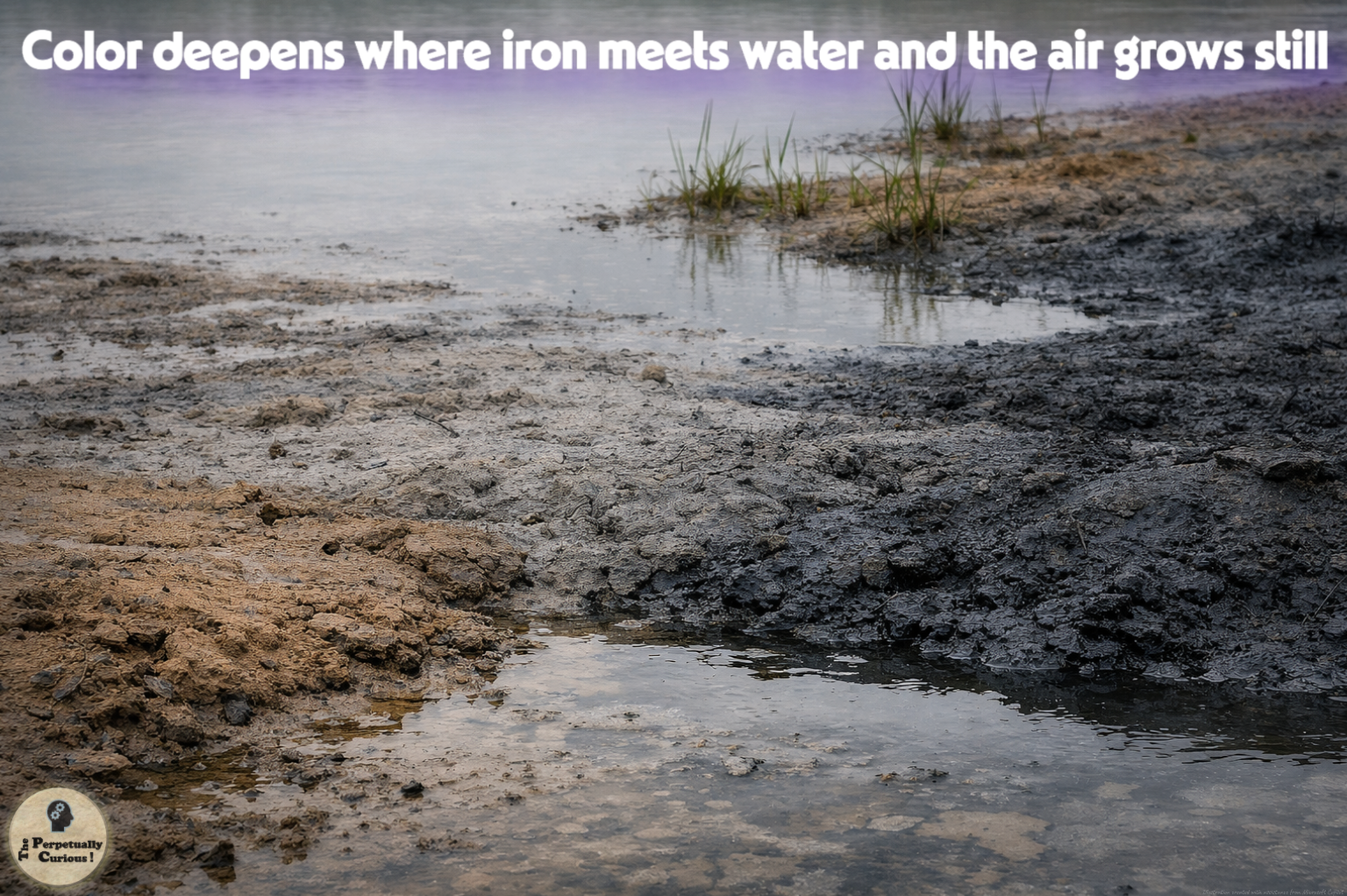
🌑 When oxygen disappears, mud turns black
Black mud usually forms where water remains for long periods and oxygen is scarce. In such waterlogged environments, the pores between particles are filled almost entirely with water, and oxygen from the atmosphere diffuses very slowly. Microorganisms that use oxygen consume what little is available, and then other microbes that can live without oxygen begin to dominate.
These anaerobic microbes often use alternative chemical pathways to obtain energy. In seawater and some sulfate‑rich freshwater settings, sulfate‑reducing microbes can produce sulfide, which combines with dissolved iron to form black iron sulfides. Some of these iron sulfides may later transform into pyrite. The earliest of these iron sulfide phases are often amorphous and intensely black, contributing more directly to the dark color of fresh anoxic mud than the crystalline pyrite that may develop over longer timescales.
At the same time, organic matter in these low‑oxygen settings tends to decompose more slowly. Instead of being fully broken down, it can accumulate and become very dark. The combination of partially decomposed organic material and black iron sulfides can produce mud that appears almost ink‑like.
🌿 Organic matter, humus, and the deepening of color
Even without strong contributions from iron sulfides, organic matter alone can make mud appear very dark. In wetlands, peatlands, and forested depressions, plant material may accumulate faster than it decomposes. Over time, this material becomes well-decomposed organic matter and mineral-associated organic material, often grouped under the familiar term humus, which is usually dark brown to black.
Humus tends to coat mineral grains and fill spaces between them, which reduces the visibility of lighter minerals such as quartz or feldspar. As the proportion of humus increases, the overall color of the mud shifts toward darker shades.
The gradual transformation of plant material into humus is supported by the steady decomposition work of fungi and other soil organisms, which influence how organic matter accumulates in many environments.
In some waterlogged settings, organic matter accumulates as peat rather than decomposing fully into humus. If that peat is later buried and heated over geological time, it can enter the much longer process through which coal is formed.
💧 Water, depth, and the subtle shifts in shade
Water content does not only control oxygen availability. It also influences how we perceive color. A patch of mud that appears nearly black when saturated may look more brown or even gray when it dries. As water evaporates, the surface becomes more reflective and fine cracks may form, changing the way light interacts with the pigments.
A similar principle appears in the way light scattering shapes the brightness of snow, where the interaction of water and light determines the color we perceive.
🧭 Reading landscapes through the colors of mud
Once the roles of iron, organic matter, and water are understood, the colors of mud begin to act like a quiet map of environmental conditions. Brown mud along a well‑drained riverbank may suggest regular flushing with oxygenated water and moderate organic inputs. Dark brown or black mud in a marsh may indicate long periods of saturation, slow decomposition, and active anaerobic processes.
A similar way of interpreting quiet geological records appears in seafloor mapping, where layers of sediment reveal long histories of underwater change.
🧪 Mud, sand, and why their colors diverge
Mud and sand often coexist along coasts and rivers, yet they frequently differ in color. Sandy beaches are commonly light beige or pale yellow, while nearby mudflats may appear dark brown or black. This contrast arises from differences in grain size, composition, and the ability to hold water and organic matter.
A broader view of how waves shape lighter sediments can be found in the movement of coastal sand, which offers a useful contrast to the darker and more waterbound character of mud.
Sudden coastal disturbances can also reshape mud layers, leaving sediment records that reflect the force and reach of rare but powerful tsunamis.
Pass this article along to someone curious and let the learning travel.
💡 Did You Know
🔍 In some lakes, varves form as seasonal sediment layers, creating fine bands that can preserve environmental change year by year. A broader example of how large lake systems record environmental history can be seen in the great lakes, which hold long archives of shifting water, climate, and sediment.
🌫️ Blue gray mud in wetlands often indicates gleying, a process in which iron is chemically reduced under prolonged saturation.
🌋 Volcanic ash and local minerals can tint mud unusual colors, including gray, greenish, reddish, or purplish tones.
🧭 Ancient soils, known as paleosols, can preserve evidence of long‑vanished landscapes, while ancient mud itself may harden into rocks such as mudstone or shale.
🟤 In some wetlands, dissolved organic compounds called humic substances can stain mud dark brown or nearly black, even when iron levels are low. These natural pigments come from the slow breakdown of plant material.
🟧 In certain soils, sharp color boundaries form where oxygen penetrates only partway into waterlogged layers, causing iron to oxidize and precipitate, creating visible red‑brown bands directly above the gray or black zones below.
⏳ In coastal marshes and estuaries, accumulating mud layers can preserve records of storm surges, sea‑level shifts, and ecological change spanning thousands of years.
🧫 Certain microbial mats can tint surface mud green, purple, or even orange, depending on the photosynthetic or metabolic pigments of the organisms forming the mat.
Why does mud sometimes appear gray instead of brown or black?
Gray mud often forms where iron has been chemically reduced but has not yet combined with sulfur to form black iron sulfides. This gray color is common in waterlogged soils that experience limited oxygen but do not contain high levels of sulfate.
What is gleying, and why does it produce blue‑gray mud?
Gleying occurs when prolonged waterlogging causes iron to shift into a chemically reduced state. In this form, iron compounds can produce gray, blue‑gray, or greenish hues rather than the reddish browns associated with oxidized iron. The term traces to Slavic and Ukrainian or Russian dialect words related to clayey earth or clay.
Can mud color change durably after environmental shifts?
Yes, though these changes are gradual and can shift again if environmental conditions change once more. If drainage improves or water levels drop, oxygen may return to the soil, allowing iron to oxidize and organic matter to decompose more fully. Over time, this can shift mud from gray or black toward brown or yellowish tones.
Why is mud usually darker than dry soil in the same place?
Water reduces the scattering of light and deepens the appearance of pigments. When the same material dries, the surface reflects more light and may appear lighter in color.
What makes some mud smell strongly, especially in wetlands or marshes?
In oxygen‑poor environments, certain microorganisms use sulfate and other compounds instead of oxygen. During these processes, gases such as hydrogen sulfide may form. This gas produces a sharp, recognizable odor characteristic of reduced sulfur compounds.
Can mud be other colors besides brown or black?
Yes. Mud can display a range of colors depending on its mineral content and environmental conditions. Red or yellow mud often indicates oxidized iron minerals. Gray or bluish mud may form where iron has been reduced. Local geology can also introduce unusual hues.
Does darker mud always mean that the soil is more fertile?
Darker mud often contains more organic matter, which can be associated with favorable physical properties. However, fertility depends on many factors, including nutrient balance, pH, and drainage. Very dark, highly waterlogged mud may not provide ideal conditions for all types of plants.
Why does mud at the bottom of lakes or ponds often look black?
Mud at the bottom of lakes or ponds is frequently saturated and receives limited oxygen from the overlying water. Organic matter settles there and decomposes slowly. Under these low‑oxygen conditions, reduced iron compounds and accumulated organic matter can make the mud appear black.
How long does it take for mud to turn black in waterlogged conditions?
Microbial depletion of dissolved oxygen in saturated sediments can begin within hours to days. If sulfate, sulfide, and dissolved iron are available, dark amorphous iron sulfide phases can begin forming soon after anoxic conditions develop, though visible blackening varies with chemistry, temperature, organic matter, and sediment mixing. More crystalline pyrite usually develops over longer diagenetic timescales.
How do scientists study mud layers in underwater environments?
Researchers often examine cores taken from lake beds or coastal zones to understand how sediments have changed over time. Similar methods are used in seafloor mapping, where patterns in sediment thickness and composition reveal long histories of underwater change.
What role do fungi play in shaping the color of mud?
Fungi help break down plant material and contribute to the formation of humus, which can darken mud. Their steady decomposition work is part of the broader activity of soil organisms that influence how organic matter accumulates in many environments.
How does oxygen from the atmosphere influence mud color?
Oxygen that diffuses into soil or waterlogged environments determines whether iron becomes oxidized or reduced. This process is tied to the presence of atmospheric oxygen, which shapes many of the chemical pathways that influence mud color.
The earth settles into its darker tones where water lingers and light moves slowly through the quiet layers below. In these shaded places, iron, clay, and time leave their soft record of change. The surface holds the moment, while the depths keep their patient ink.
🌺 A Gentle Invitation to Share
We kindly invite you to share and spread the word. Under this gentle request, we encourage you to help this piece travel a little farther by sharing it with friends, colleagues, or anyone who may enjoy looking at the ground beneath their feet with new curiosity. Your support in spreading this quiet story of mud, water, and color is deeply appreciated.
“Why Mud Is Brown or Black: Where Earth Turns to Quiet Ink.” The Perpetually Curious!, May 2026.
https://www.theperpetuallycurious.org/articles/why-mud-is-brown-or-black/Continue Exploring
Site Updates
Begin with the Updates page for new articles, site notes, and recently added pieces across The Perpetually Curious!