Explore by topic, question, or idea. Find articles, reflections, videos, puzzles, and curiosity pathways gathered across the site.
Press Enter or select Search. A newly typed query starts globally; filters are applied only through the visible rail.
6 results for “from plant fibers to human memory”
- The Perpetually Curious! › Canonical › Environment & SustainabilityArticle
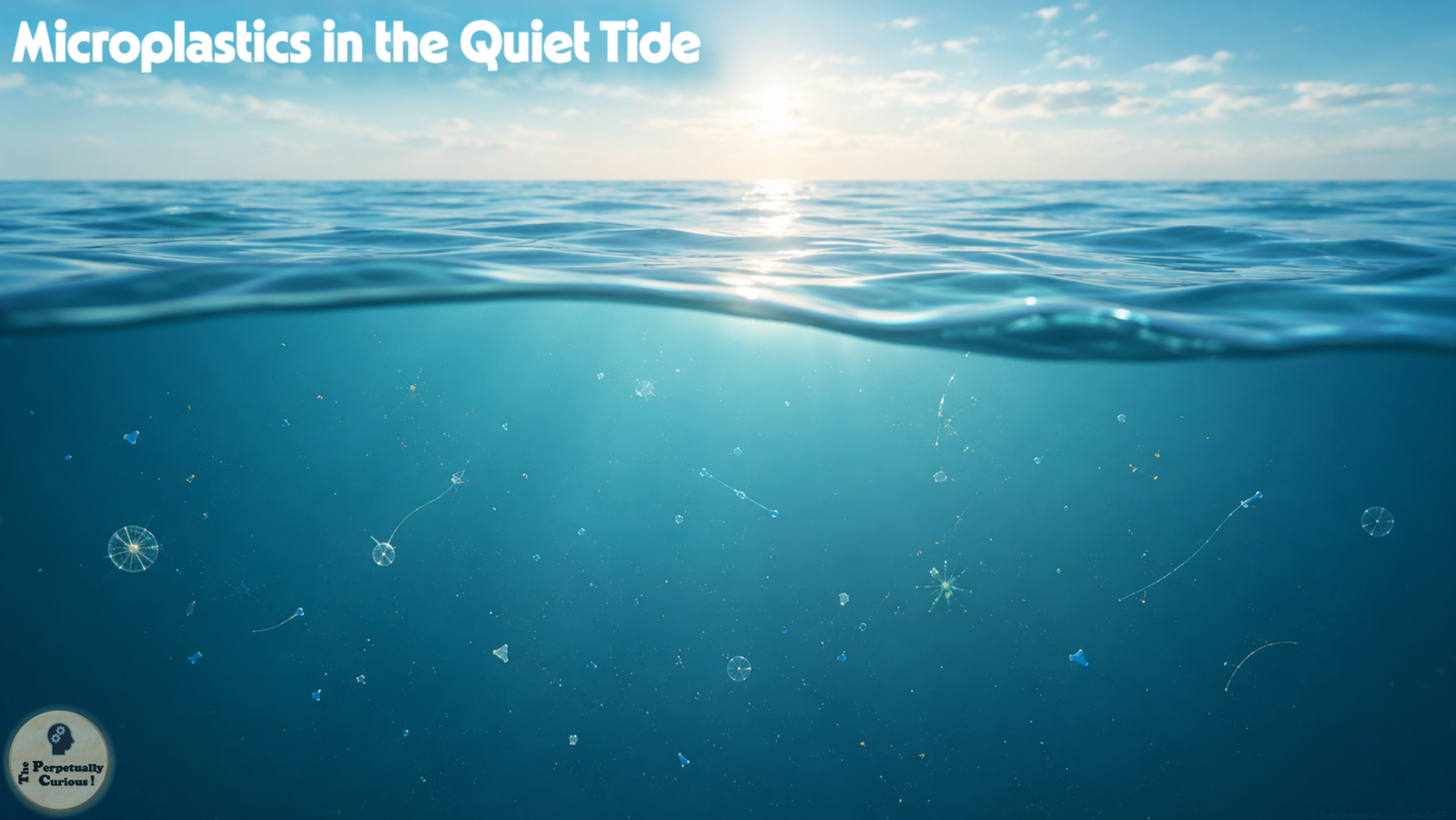
🔄 Tides of Plastic: Microplastic Pollution in the Oceans and Its Journey Back to Us
… Some form when larger plastic items break apart through sunlight, abrasion, waves, and time. Others begin as intentionally manufactured particles, or as synthetic fibers released when fabrics are washed, worn, and weathered. …
- The Perpetually Curious! › Canonical › Environment & SustainabilityArticle
🕸️ Ghost Nets, Silent Drifters: How Lost Fishing Gear Haunts the Ocean
From section: 🌌 A quiet reflection: ghost nets as part of the ocean’s memoryWhen we imagine the ocean, we may picture waves, shorelines, and the play of light on the surface. Ghost nets remind us that another kind of memory can also be carried beneath that surface, formed by the tools, materials, and traces of human presence. …
- The Perpetually Curious! › Canonical › Environment & SustainabilityArticle
🌿 Liquid Trees: Microalgae Photobioreactors and the Quiet Art of Urban Breathing
Cities often carry a subtle heaviness in their air, shaped by traffic, heating, industry, construction, and the density of human activity. Into a small number of public spaces, designers have introduced an unfamiliar form of living technology: transparent vessels filled with…
- The Perpetually Curious! › Canonical › Environment & SustainabilityArticle
🍄 From Rainforest Floor to Landfill Core: How Nature’s Decomposers Are Learning to Eat Our Plastic Problem
A plant stem can look ordinary while fungi live quietly inside it. Researchers isolated such fungi, called endophytes, from stems collected in the Ecuadorian Amazon. Their unexpected ability came to light in the laboratory, when the researchers tested them on a plastic called polyester polyurethane.
- The Perpetually Curious! › Archives › Environment & SustainabilityArticle
🌊 Microplastics in the Ocean: How Tiny Fragments Travel
Other particles begin even smaller, including synthetic fibers shed from fabrics or tiny material released from human activity on land and at sea.
- The Perpetually Curious! › Archives › Environment & SustainabilityArticle
From Rainforest Floor to Landfill Core: How Nature's Decomposers Are Learning to Eat Our Plastic Problem 🍄
In 2011, undergraduate students trudging through Ecuador's rainforest made an accidental discovery that would reshape our approach to plastic waste. Their equipment bag, supposedly sealed against moisture, had become lunch for an unexpected guest.