

Cities often carry a subtle heaviness in their air, shaped by traffic, heating, industry, construction, and the density of human activity. Into a small number of public spaces, designers have introduced an unfamiliar form of living technology: transparent vessels filled with green microalgal cultures. Some rise vertically, while others are integrated into benches or compact street furniture. Often described as liquid trees, they invite a question that is both simple and scientifically demanding: how much can a vessel of living water contribute to the air around it?
The answer begins with photosynthesis, but it extends into engineering, maintenance, measurement, and the limits of comparison. Public examples such as LIQUID3 in Belgrade and the later AlgaeTree installation in Bhopal show how one biological principle can take different urban forms rather than belonging to a single standardized machine. This journey therefore moves from the organisms inside the vessel to the systems that keep them alive, then outward to the evidence needed to judge whether liquid trees can complement, without replacing, the living trees and broader environmental measures on which cities depend.
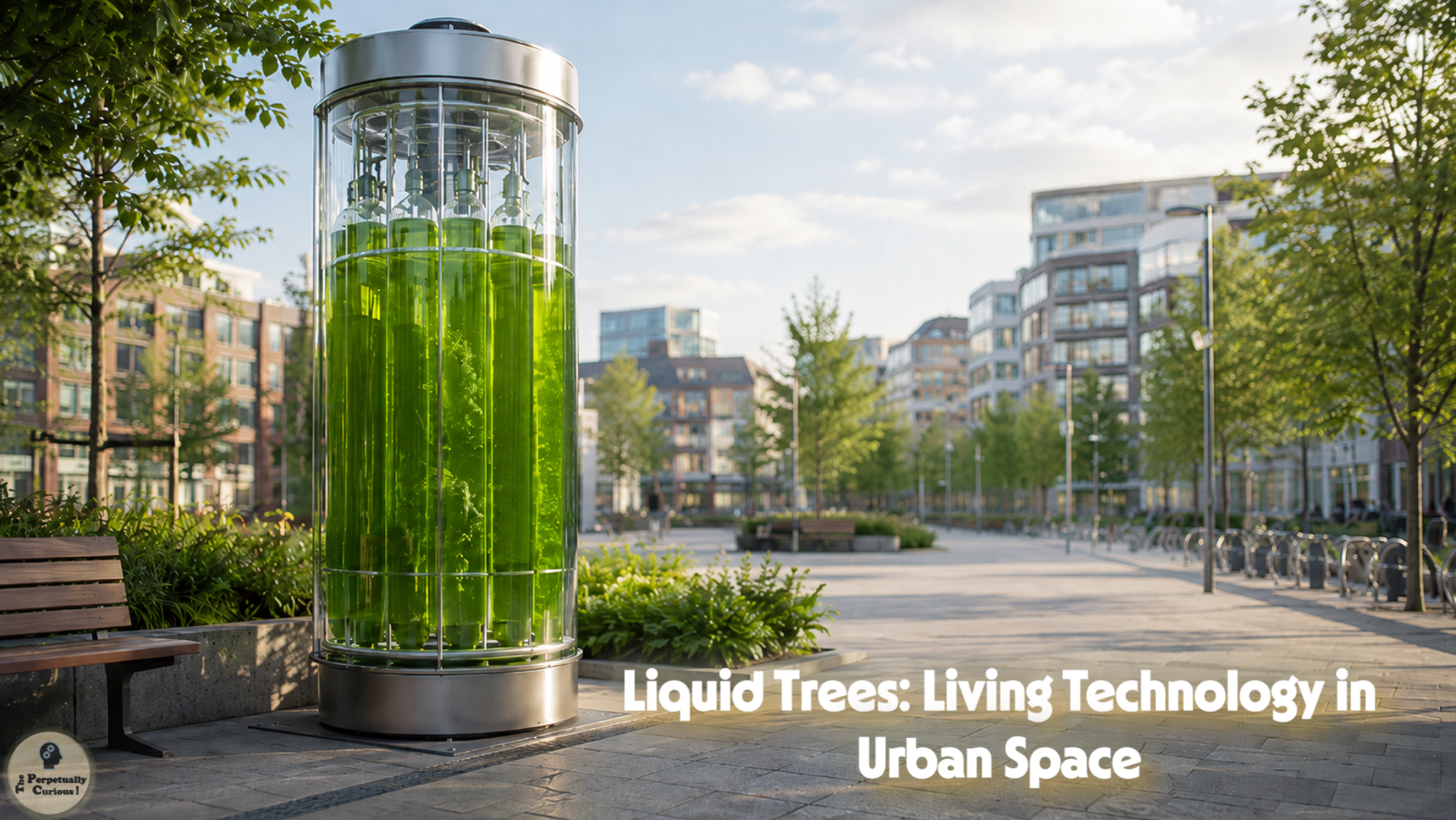
A quiet green patience rises inside the glass as the city moves around it.
Light settles into the water and becomes a small gesture of renewal.
In this stillness the algae keep their gentle rhythm and offer the air a moment of calm.
🌱 A new kind of urban presence: what a liquid tree is
A liquid tree is an informal name for a public-space photobioreactor that cultivates microalgae inside a transparent, water-filled vessel. It is not one standardized machine. Some designs resemble bench-like glass tanks, while others use taller vertical enclosures. Their dimensions and supporting equipment vary, but the underlying principle is similar: a compact system maintains a photosynthetic culture by managing light, nutrients, circulation, temperature, and gas exchange.
The vivid green color comes from microalgae suspended throughout the culture medium. Microalgae are microscopic photosynthetic organisms that are commonly unicellular, although some occur in colonies or form simple multicellular structures. Through photosynthesis, they use light energy to incorporate inorganic carbon into new cellular material while releasing oxygen. Their growth depends on the species or strain being cultivated and on conditions such as illumination, temperature, nutrient availability, mixing, pH, culture density, and carbon dioxide availability. Photobioreactors take many forms because these conditions interact differently across vessel shapes and scales.
The algae are living organisms rather than a synthetic green substance manufactured inside the unit. Operators begin with a small starter culture, known as an inoculum, and allow the cells to reproduce until they form the larger working culture. Strains may be selected for stable growth, tolerance of local temperatures and water chemistry, resistance to contamination, ease of harvesting, or other traits suited to the intended reactor. Genetic engineering is possible in microalgal research, but it is not an inherent requirement of a liquid tree. A project should not be assumed to use genetically modified organisms unless that is specifically documented.
The origin of the culture is also installation-specific. The LIQUID3 project in Belgrade reported using single-celled freshwater algae found in Serbian ponds and lakes that could grow in tap water and tolerate local temperature variation. Other projects do not always publish the exact organism or confirm that it is native to the installation area, so locally sourced algae should not be treated as a universal feature of the technology.
Transparency serves a biological purpose before it serves an aesthetic one. Light must reach the culture, although dense growth can shade cells deeper inside the vessel, while excessive illumination can also reduce productivity. The visible green water makes an otherwise hidden cultivation process understandable in public space. A compact installation may also fit where limited soil, rooting space, or street infrastructure makes conventional tree planting difficult, while remaining fundamentally different from a living tree.
The vessel therefore contains both a living population and a managed habitat. Once the culture is established, its performance depends on how effectively air, light, nutrients, and water are brought together inside the reactor. That leads to the next question: what actually happens when urban air moves through the system?
🌞 Inside the green vessel: how air and microalgae meet
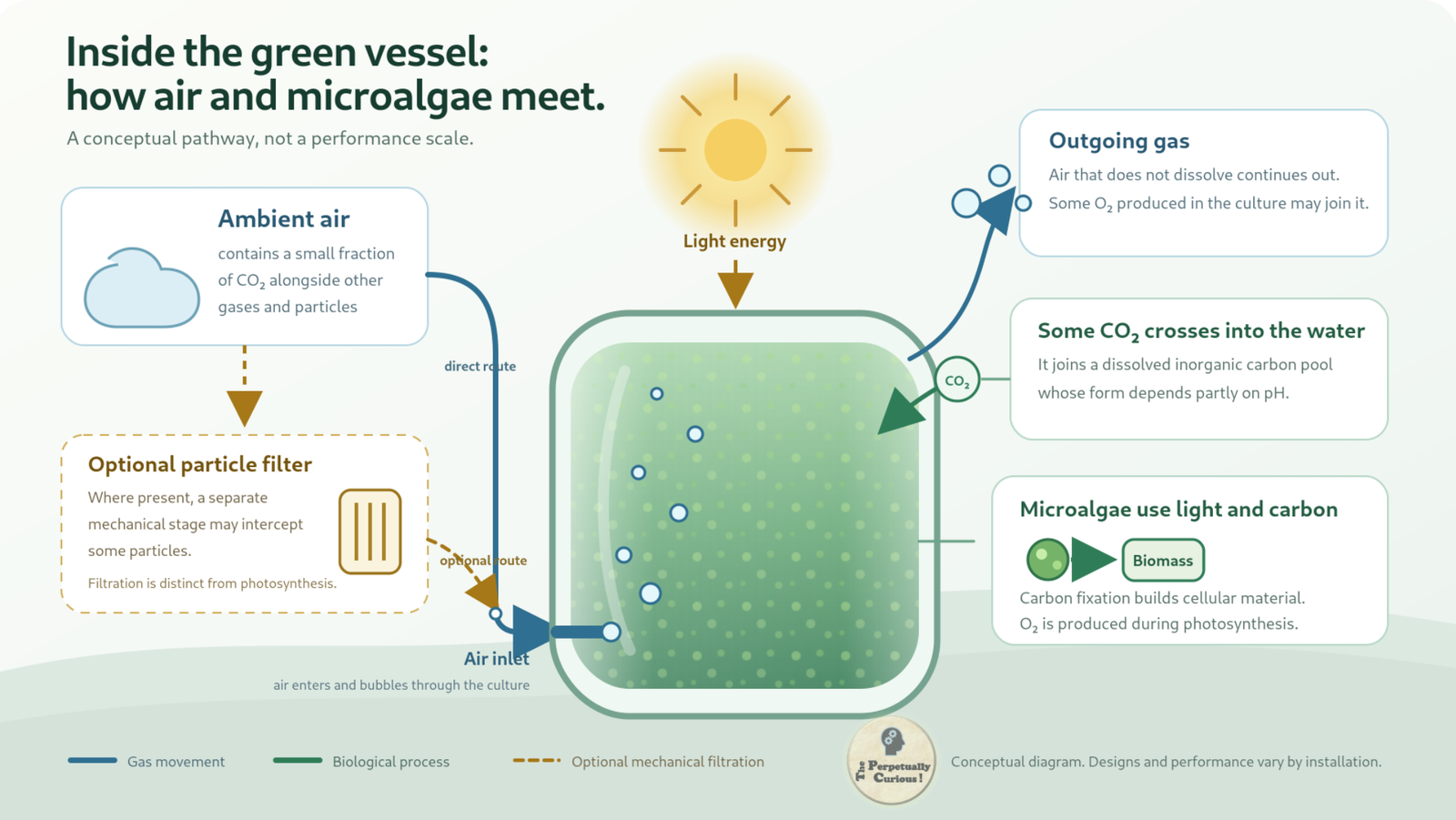
To understand how a liquid tree functions, it helps to follow both the air and the carbon moving through a particular design. In some systems, a pump releases ambient air through small openings near the bottom of the culture, producing bubbles that increase contact between the gas and the surrounding water. Other systems place a mechanical filtration stage before or alongside the biological chamber. These functions should remain distinct: a filter may intercept particulate matter, while the microalgae primarily exchange gases and build biomass through photosynthesis.
As a bubble rises, some of its carbon dioxide crosses the gas-water boundary and dissolves in the culture medium. Depending partly on pH, that inorganic carbon may occur as dissolved carbon dioxide, bicarbonate, or carbonate. Many microalgae use carbon-concentrating mechanisms that increase the supply of carbon dioxide near Rubisco, a key enzyme in carbon fixation. Light-driven reactions provide the energy needed to build sugars and other cellular material, while oxygen is released and may subsequently pass from the water into the surrounding air. This is a compact, engineered expression of the wider carbon and oxygen cycles that connect living organisms with the atmosphere.
Gas transfer and biological fixation are related, but they are not the same process. Not every carbon dioxide molecule carried into the vessel dissolves, and not all dissolved carbon is immediately converted into biomass. Bubble size, airflow, contact time, water depth, circulation, temperature, pH, culture density, and reactor geometry all influence how much carbon enters the liquid. Light, nutrients, cellular health, and the selected strain then determine how much of that available carbon the microalgae can use. Carbon availability and gas-liquid transfer can therefore limit productivity even when the organisms themselves are capable of rapid photosynthesis.
This distinction becomes especially important when a liquid tree draws ordinary street air. Laboratory cultures are often supplied with carbon dioxide-enriched gas, while ambient air contains a much lower concentration. A public unit must therefore move and contact a considerable volume of air to deliver comparatively small amounts of carbon dioxide to the culture. Biological activity inside the vessel does not, by itself, establish that the surrounding outdoor air has improved by a measurable amount.
Particulate pollution requires a separate explanation. PM10 includes inhalable particles no larger than about 10 micrometers, while the finer PM2.5 fraction can penetrate more deeply into the respiratory system. A purpose-built filter may intercept some of these particles before the air reaches the culture. Particles may also enter or settle within the water under certain conditions, but water contact alone does not guarantee effective removal. Performance depends on particle size and composition, airflow, residence time, filter media, maintenance, and reactor design. It must therefore be measured for the specific installation.
Efficiency can also mean several different things. Gas-transfer efficiency describes how much incoming carbon dioxide enters the water. Biological efficiency concerns how much dissolved carbon becomes new biomass. Particle-removal efficiency applies only where an appropriate filtration or capture process exists. Overall environmental efficiency must also include the electricity, materials, maintenance, water, nutrients, and biomass handling required to operate the unit.
The final fate of the biomass matters as well. Photosynthesis fixes carbon into living material, but this does not automatically create permanent storage. If harvested algae decompose or are burned, much of that carbon may return to the atmosphere. Any claim of lasting carbon removal must therefore consider what happens after harvesting as well as what occurs inside the vessel.
Liquid trees consequently share a biological principle without sharing one universal level of performance. Carbon-capture estimates, oxygen-output figures, particle-removal rates, and tree-equivalent comparisons must be tied to a named installation, a defined operating period, and a transparent measurement method. That need for system-specific evidence leads naturally from the processes inside the green vessel to the different forms now appearing in public spaces.
🏙️ Public liquid trees: one biological idea, different urban forms
The liquid tree did not begin with the invention of a new organism or a wholly new biological process. It emerged from the longer development of photobioreactors, which cultivate photosynthetic microorganisms under managed conditions. The newer step was to move that technology into public space and combine it with elements such as seating, renewable power, filtration, sensors, or environmental displays. One practical motivation was to introduce a compact photosynthetic system into paved urban locations where limited soil, underground utilities, or surrounding infrastructure can make conventional tree planting difficult.
Public placement changes how the technology is encountered. Instead of operating behind laboratory or industrial walls, the green culture becomes part of an ordinary street, park, or plaza. Passersby can see changes in the density and color of the culture, observe some of the equipment that supports it, and encounter photosynthesis as an active urban process rather than an invisible scientific abstraction.
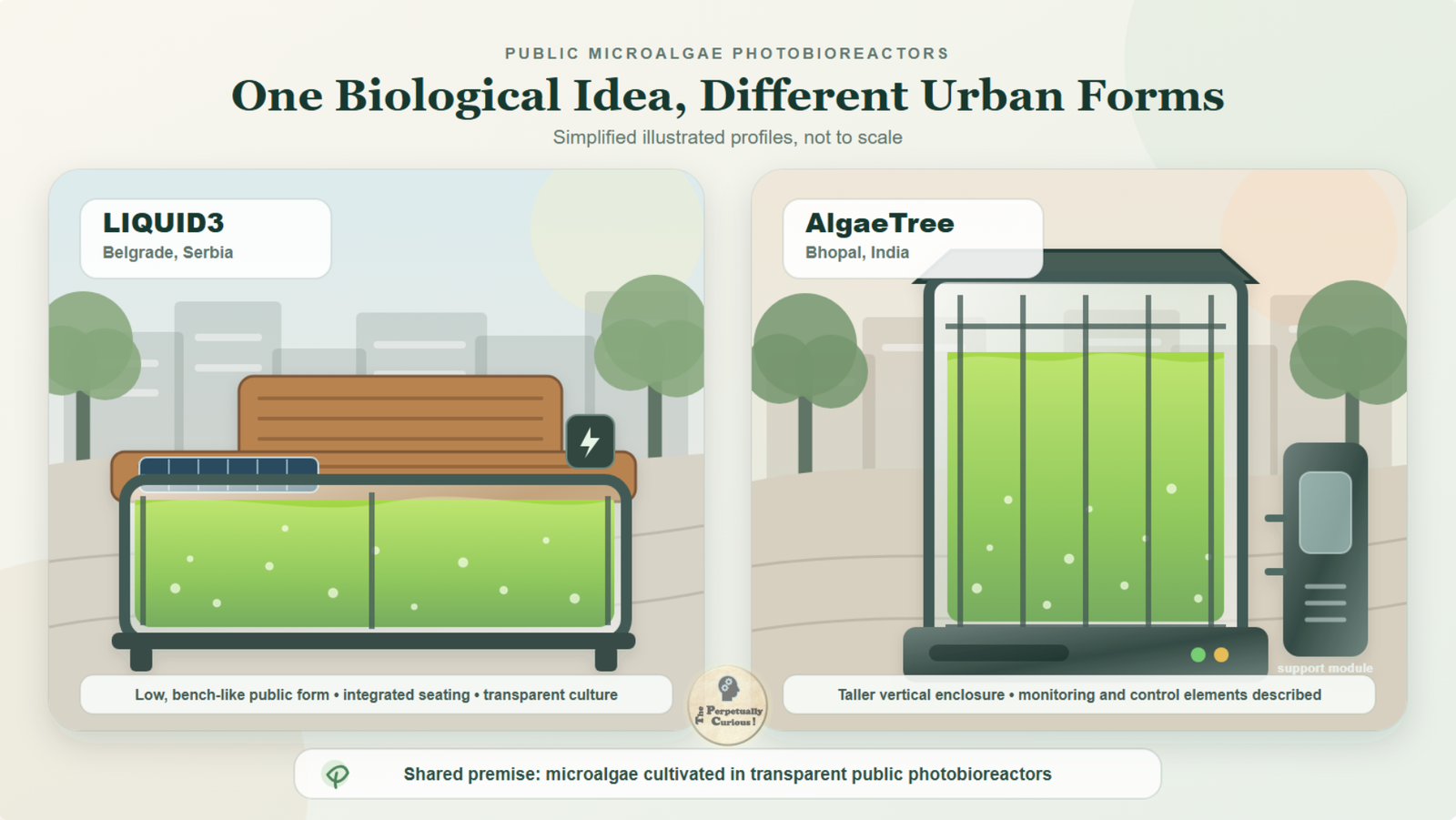
One of the best-documented examples is LIQUID3 in Belgrade, Serbia. Installed outside the Municipality of Stari Grad in 2021, it contains about 159 gallons (600 liters) of water and microalgae. Its low, bench-like form incorporates photovoltaic power and a charging point for mobile devices, making the installation part photobioreactor and part street furniture. Its shape differs markedly from the tall cylinder often associated with the phrase “liquid tree,” illustrating why the term describes a family of public installations rather than one standardized machine.
A later expression of the idea appeared at Swami Vivekananda Park in Bhopal, India. Developed by Mushroom World Group, the AlgaeTree uses a taller transparent enclosure and is described as drawing air through a controlled intake before passing it through a separate particulate-filtration stage. The filtered air then enters the biological chamber, where microalgae use carbon dioxide during photosynthesis. The developer also describes solar power, battery support, sensors, connected monitoring, and automated control of variables such as airflow, lighting, and nutrient delivery.
The Bhopal design includes more described filtration, monitoring, and control components than the earlier Belgrade installation, but its performance claims remain difficult to generalize. The developer reports a design target of about 4.0 to 4.4 pounds (1.8 to 2 kilograms) of carbon dioxide per day and separately summarizes annual capture as approximately 1,430 to 1,540 pounds (650 to 700 kilograms). Another graphic on the same technical page states approximately 1.5 tons per year without defining whether “ton” refers to a metric or U.S. ton. Because these figures are not reconciled, associated claims about carbon capture, oxygen production, particulate removal, and local air quality should be treated as project-reported estimates awaiting clearly documented and independently evaluated field evidence.
The contrast between Belgrade and Bhopal reveals both what sparked the public liquid-tree concept and why it continues to evolve. Belgrade emphasizes compact biological street furniture in places with little room for planting. Bhopal adds mechanical filtration, monitoring, and more active system control. Both make photosynthesis visible, but neither establishes a universal blueprint or performance standard.
Public photobioreactors may therefore offer several distinct forms of value. They can test biological engineering under real urban conditions, occupy otherwise difficult sites, collect operational data, and invite public engagement with environmental science. Whether they also produce a meaningful improvement in surrounding air depends on independently measured performance, sustained maintenance, energy use, local climate, airflow, and the distance over which any change can be detected. With those limits established, the next comparison becomes clearer: what can a liquid tree contribute, and what can only a living tree provide?
🌳 Liquid trees and living trees: different roles in the same landscape
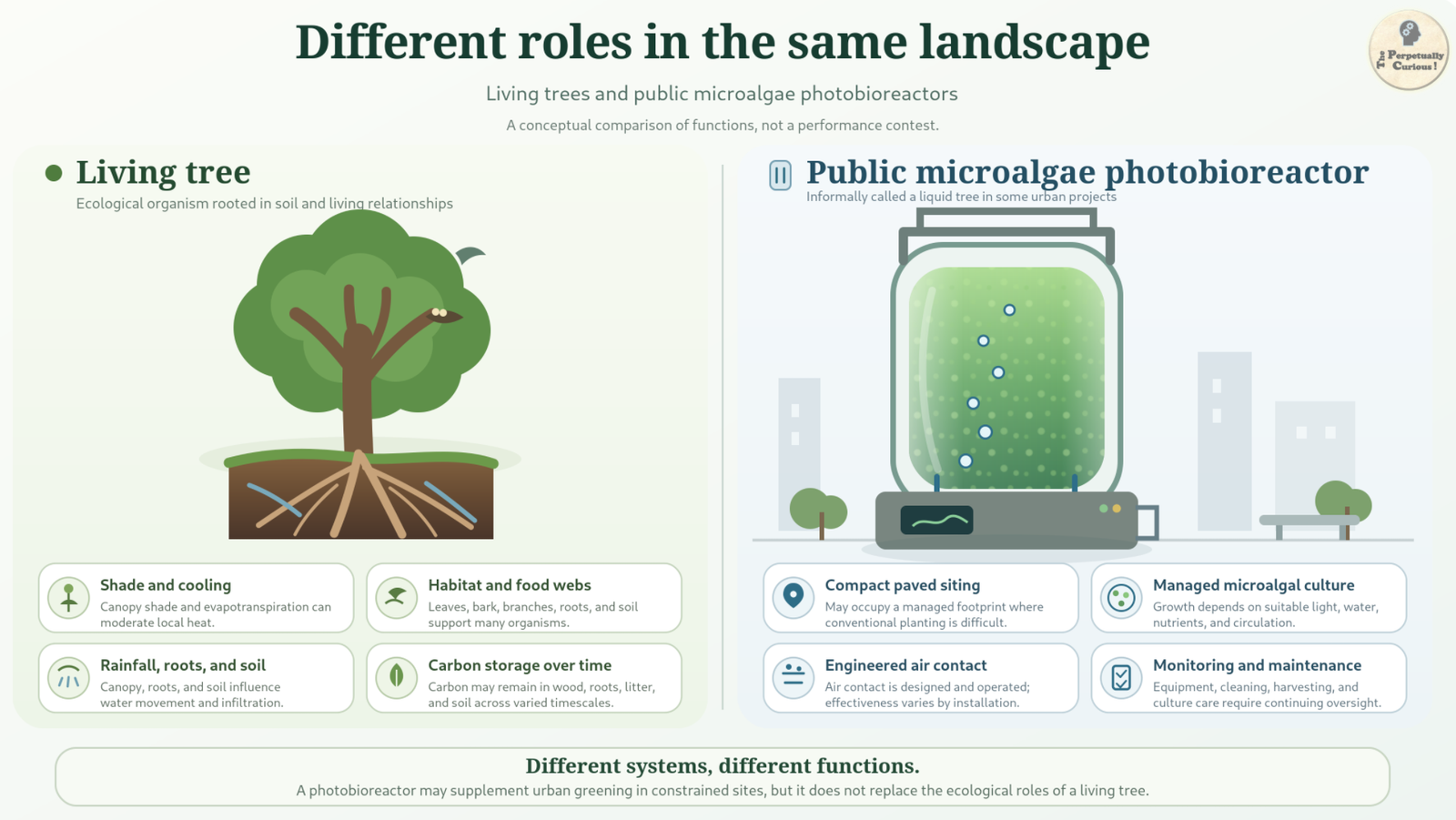
A liquid tree does not replace a living tree because the two operate at fundamentally different scales. A mature tree is not merely a photosynthetic surface. It is a long-lived organism embedded within soil, water, climate, and ecological communities. Its canopy casts shade, intercepts rainfall, slows wind, provides habitat, and cools the surrounding air through evapotranspiration. Its trunk and roots can retain carbon for years or decades, stabilize soil, and influence local hydrology through relationships among roots, water, and landscape.
Below ground, many trees form mycorrhizal associations with fungi and participate in mycorrhizal networks. These relationships can influence nutrient acquisition, water access, soil structure, and the wider biological community around the roots. Above ground, leaves contribute to photosynthesis, cooling, rainfall interception, and habitat while responding continuously to seasons, water availability, pests, and weather. A liquid tree performs a much narrower set of managed biological and mechanical functions within an engineered enclosure.
Its potential advantage lies in compact and controlled placement. A photobioreactor may fit into paved or highly constrained sites where shallow soil, underground utilities, narrow walkways, contaminated ground, or surrounding infrastructure make successful tree establishment difficult. It may also allow operators to monitor airflow, culture conditions, and biomass production more directly than they could assess the biological activity of an entire tree.
That control comes with trade-offs. A living tree, once successfully established, can continue functioning through natural cycles without pumps or electronic controls. A liquid tree depends on circulation, energy, nutrients, cleaning, monitoring, and periodic harvesting. A tree may suffer from drought, disease, or poor soil, while a photobioreactor may lose performance if its culture becomes contaminated, overheated, nutrient-limited, excessively dense, or affected by equipment failure. Compactness should therefore not be confused with independence from infrastructure.
Even at a suitable site, any local air-quality effect depends on the reactor’s airflow, filtration, biological productivity, operating schedule, maintenance, and surrounding weather conditions. Its influence may remain close to the installation, while the benefits of a mature tree can extend through shade, cooling, habitat, stormwater management, and soil processes. A photobioreactor is therefore better understood as a possible supplement to urban greening rather than an alternative to it.
Some project descriptions compare a liquid tree’s carbon uptake with that of a certain number of mature trees, sometimes citing figures such as 20 to 25. These analogies are not standardized measurements. They depend on the reactor design, culture conditions, operating period, carbon source, maintenance, and measurement method, as well as the species, age, health, climate, and growth rate of the trees used for comparison.
Such comparisons may also place unlike forms of carbon storage beside one another. A photobioreactor can fix carbon rapidly into harvestable algal biomass, but that carbon may return to the atmosphere if the biomass decomposes or is burned. A tree generally fixes carbon more slowly while storing part of it in wood, roots, litter, and soil over longer periods. Neither comparison is meaningful unless the time frame, system boundary, and fate of the captured carbon are clearly stated.
Cities generally need layered responses to air pollution and heat. Emission reduction, cleaner transport, energy transitions, street trees, parks, green infrastructure, and carefully evaluated biological technologies serve different functions. A liquid tree may have a useful role within that mixture, particularly where conventional planting is difficult, but its contribution must be judged by evidence rather than symbolism. That limited but potentially valuable role leads to the engineering question beneath the green surface: what keeps a liquid tree functioning from day to day?
⚙️ The engineering beneath the surface: control, energy, and maintenance
A liquid tree depends on far more than the green culture visible through its walls. Pumps or aeration systems move air into the vessel, while circulation helps distribute dissolved gases, nutrients, heat, and light exposure throughout the culture. Depending on the design, sensors may track temperature, pH, dissolved oxygen, culture density, airflow, water level, or surrounding air conditions. These measurements can help operators recognize declining culture health or mechanical problems, but monitoring alone does not make a system self-adjusting. Automated control requires additional software and equipment capable of modifying airflow, nutrient delivery, lighting, or temperature in response to sensor readings.
Energy requirements also vary substantially among installations. Solar panels may support pumps, sensors, charging points, or communications equipment, but they do not necessarily make a unit fully self-sufficient. Aeration, circulation, mechanical filtration, artificial lighting, heating, cooling, and data transmission can all add to the operating load. Batteries or grid electricity may therefore be needed during nighttime operation, prolonged cloud cover, or extreme temperatures. Rather than assigning one universal daily energy figure, each installation should report which components are powered, how long they operate, and where their energy comes from.
The microalgal culture is a renewable living population rather than a disposable filter cartridge. Once established from a starter culture, it can continue reproducing while conditions remain suitable. Operators usually remove part of the growing biomass before the culture becomes so dense that cells shade one another and light penetration declines. A healthy portion can remain inside the reactor and regrow after water and nutrients are replenished. If contamination, temperature stress, nutrient imbalance, or another serious disruption occurs, part or all of the culture may need to be replaced from a clean backup culture.
Routine maintenance is therefore both biological and mechanical. Transparent surfaces must be cleaned because mineral deposits, dust, and biological films can block light. Water chemistry, nutrient levels, temperature, circulation, and culture density require continued attention. Pumps, filters, air lines, seals, batteries, sensors, and electrical connections also need inspection, while monitoring instruments may require cleaning and calibration. Maintenance frequency depends on climate, air quality, reactor geometry, microalgal strain, and operating intensity, so a schedule reported for one project should not be generalized to every liquid tree.
Harvested biomass may have potential value, but it is not automatically suitable for reuse. Microalgae cultivated in controlled facilities can be investigated for fuels, materials, pigments, soil products, feed, and other applications. Biomass from an urban installation exposed to ambient air may also contain trapped particulate matter, metals, or other contaminants introduced through the air or water. Its composition must therefore be tested, and any reuse must follow appropriate processing, safety, and regulatory requirements.
The destination of the harvested biomass also affects the system’s carbon balance. Photosynthesis transfers carbon into living material, but that carbon may return to the atmosphere if the biomass decomposes or is burned. Longer retention may be possible if the material enters a durable product or another appropriately managed pathway, but such outcomes must be demonstrated rather than assumed.
Efficiency is similarly multidimensional. Biological efficiency concerns how effectively the algae grow and fix carbon. Gas-transfer efficiency measures how much carbon dioxide enters the water. Filtration efficiency applies where particulate-removal equipment is present. Operational efficiency includes energy, water, nutrients, replacement parts, labor, maintenance, and system uptime. The most meaningful assessment combines these factors with any verified environmental effect outside the vessel.
The environmental balance therefore extends beyond visible photosynthesis. Glass, steel, electronics, batteries, solar equipment, nutrient production, replacement materials, maintenance operations, and temperature control all carry material and energy costs. The environmental case for a liquid tree can be judged only when its measured benefits are evaluated alongside those lifecycle demands. This engineering foundation leads to a wider question: where could such living technology realistically fit among the many systems that shape an urban environment?
🌍 A wider view: where liquid trees may fit in future cities
Liquid trees belong to a broader set of approaches intended to improve urban environmental conditions. Their possible role is narrow and localized. They do not replace emission controls, cleaner transport, energy transitions, street trees, parks, or other forms of green infrastructure. Instead, a carefully maintained photobioreactor may serve as a supplementary system in paved or highly constrained places where limited soil, underground utilities, contamination, or surrounding structures make conventional planting difficult.
The most suitable location is not necessarily the most visible one. A useful deployment would need adequate sunlight, safe pedestrian access, reliable power and water, room for maintenance, and airflow that allows the system to interact with its surroundings. Local climate also matters. Excessive heat, freezing conditions, prolonged shade, or large seasonal changes may reduce biological performance or increase the energy needed to keep the culture within a workable range.
Its long-term value remains a question for measurement rather than assumption. Researchers and planners need independently collected data on airflow, carbon uptake, particulate handling, oxygen transfer, energy and water demand, maintenance frequency, culture stability, system uptime, lifecycle emissions, and the distance over which any change in surrounding air can be detected. Measurements must distinguish activity inside the vessel from effects outside it. A healthy, productive culture does not automatically demonstrate a meaningful improvement across a street, park, or neighborhood.
Public reporting is therefore as important as public visibility. A credible project should explain which pollutants or gases are measured, where sensors are placed, how background conditions are accounted for, how often the unit operates, and whether the results have been independently evaluated. Transparent records of maintenance, energy consumption, culture replacement, and biomass handling would allow communities to judge whether the installation is delivering more than an attractive symbol.
Public installations may nevertheless have value even when their direct atmospheric effect remains confined to the immediate area. They can make photosynthesis, air monitoring, microbial cultivation, and environmental engineering visible to people who might never encounter a working photobioreactor elsewhere. Schools, universities, planners, and community groups may use them as platforms for observation and discussion, provided their educational framing clearly distinguishes demonstrated performance from experimental promise.
The biology inside these systems belongs to a much older planetary story. Long before cities existed, oxygenic microorganisms, especially cyanobacteria, contributed to the gradual transformation of Earth’s living atmosphere over geological time. Modern microalgae are not unchanged representatives of those earliest organisms, but they continue the broader photosynthetic process of using light energy to build living matter from inorganic carbon.
By placing that ancient process inside an engineered urban structure, liquid trees offer one example of living technology. Their future will depend less on whether they resemble trees than on whether they perform a clearly defined function at a reasonable environmental and economic cost. Careful design, transparent evidence, dependable maintenance, appropriate siting, and integration with larger pollution-reduction strategies will determine whether they become useful urban tools, temporary demonstrations, or something between the two.
Beyond those practical judgments lies a more human question: what does it mean to encounter a living process glowing within the built city?
🌌 A gentle reflection: the quiet glow of living water
At dusk, when the last light settles across a city, a liquid tree may appear almost luminous. The green culture behind its transparent walls catches the fading light, briefly revealing countless microscopic organisms growing within the circulating water and responding to a carefully maintained environment. What appears from a distance as a column or vessel of green water is, on closer inspection, a living population sustained by biology, engineering, and continued human care.
The installation does not breathe as a tree does, nor does it recreate the ecological world of roots, leaves, soil, fungi, and habitat. Its photosynthesis is real, but so are its pumps, power demands, maintenance needs, and limits of scale. That tension is part of what makes the liquid tree compelling. It places an ancient biological process inside a distinctly modern structure, allowing the living and the engineered to remain visible at the same time.
Liquid trees will not solve urban air pollution. Their future depends on evidence, reliable operation, responsible biomass handling, and integration with measures that reduce pollution at its source. Yet they offer a meaningful experiment in designing with living organisms rather than merely imitating their appearance. Their broader value may lie not only in what a particular installation can measurably contribute, but also in the questions it makes difficult to ignore: what should a living technology accomplish, how should its benefits be measured, and where does it genuinely belong within a city?
Pass this article along to someone curious and let the learning travel.
💡 Did You Know
🧬 Microalgae do not belong to one single branch of life. The term describes a diverse range of microscopic photosynthetic organisms whose pigments, cell structures, growth patterns, and environmental tolerances can differ substantially.
🔬 Microalgal growth rates vary widely among species, strains, and cultivation conditions. Under favorable controlled conditions, some fast-growing cultures may double their biomass in roughly one to two days, while others grow considerably more slowly.
🌗 Mixing does more than keep the culture from settling. It moves cells repeatedly between brighter and darker regions of the vessel, creating short light-dark cycles that can influence photosynthetic performance.
🧪 Photosynthesis can alter the chemistry of the culture medium as microalgae consume dissolved inorganic carbon. Operators may therefore track pH alongside dissolved oxygen, temperature, and culture density to understand how conditions inside the living culture are changing.
🍃 The transparent surface of a photobioreactor performs a much narrower role than the varied leaf shapes of living plants, which reflect trade-offs involving light capture, gas exchange, cooling, water loss, rainfall interception, and structural stress.
🌍 Space agencies and research institutions have studied microalgae as possible components of bioregenerative life-support systems. Their potential roles include using carbon dioxide, producing oxygen and biomass, and contributing to food production or resource recycling during long-duration missions.
💧 Harvested microalgal biomass usually contains a large amount of water. Separating, concentrating, and drying it can require substantial energy, so downstream processing may strongly influence the environmental balance of the overall system.
What is a liquid tree?
A liquid tree is an informal name for a public-space photobioreactor that cultivates microalgae inside a transparent, water-filled vessel. The term does not describe one standardized product. Installations can differ in shape, culture volume, airflow, filtration, power supply, monitoring, and intended function. LIQUID3 in Belgrade, for example, uses a bench-like 159-gallon (600-liter) tank, while other projects use taller enclosures.
What inspired the idea of placing microalgae in public spaces?
Photobioreactors have long been used for scientific research, biomass cultivation, wastewater treatment, and carbon-management studies. The newer urban concept brought this established technology into visible public locations, particularly paved areas where limited soil, underground utilities, or dense infrastructure may make successful tree planting difficult. The aim was not to invent photosynthesis, but to adapt a managed photosynthetic culture to constrained city spaces.
How does a liquid tree work?
In some designs, a pump releases ambient air into the water as small bubbles. Part of the carbon dioxide in that air dissolves into the culture medium, where microalgae can use it during photosynthesis to build sugars and other cellular material. Oxygen is produced, and some of it may transfer from the water into the surrounding air.
Mixing helps distribute gases, nutrients, heat, and light exposure. Systems intended to address particulate matter may also include a separate mechanical filtration stage. The biological culture and the particle filter should therefore be understood as related but distinct parts of the installation.
Are the algae natural, laboratory-grown, or artificially synthesized?
They are living microorganisms, not a synthetic green material. Operators begin with a small starter population, called an inoculum, and cultivate it under controlled conditions until the cells reproduce into a larger working culture. Laboratory cultivation describes where and how the organisms are multiplied. It does not mean that the organisms themselves have been chemically manufactured.
Genetic modification is possible in some areas of microalgal research, but it is not an inherent requirement of a liquid tree. A public installation should not be assumed to contain genetically modified organisms unless its developers specifically document that fact.
What kinds of microalgae are used, and are they locally native?
Projects generally select species or strains suited to their operating conditions. Useful traits may include stable growth, tolerance of temperature changes, compatibility with the available water, resistance to contamination, efficient use of light and inorganic carbon, and ease of harvesting. Rapid growth may be helpful, but it is only one consideration.
The organisms are not necessarily native to the installation area. The LIQUID3 team reported using unicellular freshwater algae found in Serbian ponds and lakes that could grow in tap water and tolerate local temperature variation. Other projects do not always identify the exact strain or establish whether it is locally native. Nativity should therefore be treated as an installation-specific choice rather than a defining feature of all liquid trees.
How is the culture started and kept alive?
A healthy inoculum is introduced into water containing suitable nutrients. The microalgae reproduce when light, temperature, pH, carbon availability, and nutrient conditions remain within a workable range. Aeration or circulation helps prevent stagnation and moves cells through brighter and darker regions of the vessel.
Operators must also prevent the culture from becoming excessively dense because cells near the surface can shade those deeper inside. Contamination, nutrient imbalance, overheating, freezing, poor circulation, or equipment failure can weaken the culture. Monitoring and periodic harvesting help keep it productive.
Are the algae reusable, and what happens to the harvested biomass?
The living culture is renewable rather than reusable like a removable filter. Operators can harvest part of the growing biomass while leaving a healthy population inside the reactor. The remaining cells continue reproducing after water and nutrients are replenished. If the culture becomes severely contaminated or unhealthy, however, part or all of it may need to be replaced from a clean backup culture.
Harvested microalgal biomass has been investigated for fuels, materials, pigments, soil products, animal feed, and other applications. Biomass from an urban installation exposed to ambient air may contain particles, metals, or other contaminants introduced through the air or water. It should therefore be characterized and tested before reuse, and any application must meet relevant safety, processing, and regulatory requirements.
What maintenance does a liquid tree require?
Maintenance can include cleaning transparent surfaces, inspecting pumps and air lines, servicing particulate filters, checking seals and electrical components, calibrating sensors, replenishing water and nutrients, controlling culture density, and harvesting excess biomass. Temperature management may also be necessary during very hot or cold conditions.
The schedule depends on the reactor, climate, microalgal strain, local pollution, and operating intensity. A maintenance interval reported for one installation should not be presented as a universal standard. Biological performance is inseparable from the reliability of the surrounding equipment.
How efficient is a liquid tree?
Efficiency can describe several different processes:
• Gas-transfer efficiency: how much carbon dioxide moves from the air into the water.
• Biological efficiency: how much dissolved carbon becomes new biomass.
• Optical efficiency: how effectively light reaches productive cells.
• Filtration efficiency: how much particulate matter is intercepted where filtration is present.
• Operational efficiency: how much energy, water, nutrients, labor, and maintenance the system requires.
• Urban effectiveness: whether the installation produces a detectable improvement in the surrounding outdoor air.
A reactor can grow algae efficiently without producing a large neighborhood-scale air-quality effect. One percentage or tree-equivalent figure cannot represent all these dimensions.
How much carbon dioxide can one liquid tree remove?
There is no universal verified annual figure. Carbon fixation depends on culture volume, airflow, carbon dioxide concentration, gas-transfer efficiency, available light, temperature, nutrient supply, culture health, operating time, and the handling of harvested biomass. Laboratory systems supplied with concentrated carbon dioxide are also not directly comparable with public units drawing ordinary ambient air.
Any annual estimate should identify the installation, measurement period, operating conditions, system boundary, and method used. Project publicity figures should not be generalized across different designs.
Does a liquid tree permanently remove carbon dioxide?
Not automatically. Photosynthesis transfers carbon into living algal biomass, but that carbon may return to the atmosphere if the harvested material decomposes or is burned. Longer retention may be possible if the biomass enters a durable and appropriately managed product or storage pathway.
A full assessment must also consider electricity, equipment, nutrients, harvesting, processing, transport, and replacement materials. Carbon fixation inside the vessel is therefore only one part of the system’s net climate balance.
Do liquid trees release meaningful amounts of oxygen?
Microalgae release oxygen during photosynthesis, but the amount that leaves the water depends on culture productivity, mixing, temperature, dissolved-gas conditions, and reactor geometry. Oxygen production demonstrates biological activity, but it does not by itself establish a measurable improvement in neighborhood-scale air quality.
Outdoor air already contains a large reservoir of oxygen, so the more relevant question is usually whether the installation measurably affects targeted pollutants or carbon dioxide under real operating conditions.
What happens inside a liquid tree at night?
When natural light falls below the level required for photosynthesis, carbon fixation and photosynthetic oxygen production slow greatly or stop. The living cells continue respiration, using stored organic material to support cellular activity. Pumps, filters, sensors, or circulation equipment may continue operating if power is available.
Daily performance therefore varies with the light-dark cycle unless the system uses supplemental lighting, which introduces an additional energy demand.
Do liquid trees require freshwater and added nutrients?
Microalgae require water and nutrients, particularly sources of nitrogen, phosphorus, and essential minerals. Closed systems can recirculate much of their culture medium, but water may still be lost or removed through evaporation, harvesting, cleaning, leakage, and culture replacement.
Reclaimed water or recovered nutrients may reduce demand for new resources in some applications, but they can also introduce contaminants or competing organisms. The appropriate inputs depend on the selected organism, intended biomass use, and available monitoring.
Can liquid trees remove PM2.5 and PM10, and are all airborne particles alike?
Some systems include filters or other stages intended to intercept particulate matter. Particles may also enter the culture water under certain conditions, but a water-filled chamber does not automatically function as an efficient particle filter. Performance depends on particle size and composition, airflow, filter media, residence time, maintenance, and reactor geometry.
Particulate matter also varies in chemistry, origin, atmospheric behavior, and health significance. Natural organic aerosols in the Great Smoky Mountains help create the region’s characteristic blue haze, while urban particles may include soot, road and construction dust, metals, salts, secondary chemicals, and biological material. A reported removal rate should therefore identify the particle fraction measured rather than referring vaguely to pollution.
How can researchers determine whether a liquid tree improves nearby air?
A credible field study must measure conditions outside the vessel, not merely confirm that algae are growing inside it. Researchers may compare readings taken while the unit is operating and inactive, use suitable control locations, examine upwind and downwind conditions, and measure at several distances.
The analysis must also account for traffic, wind, temperature, humidity, sunlight, background pollution, operating time, filter condition, and maintenance. Carbon accumulated in the biomass does not by itself prove that pedestrians or nearby neighborhoods experience a measurable air-quality improvement. These controls help distinguish a genuine local effect from ordinary changes in weather, traffic, and background pollution.
Can liquid trees replace living trees?
No. A photobioreactor cannot reproduce the shade, cooling, habitat, stormwater interception, soil stabilization, long-term carbon storage, and ecological relationships provided by living trees. It may occupy a compact paved site, but that engineering advantage does not make it ecologically equivalent to a mature tree.
Its most defensible role is supplementary, particularly where conventional planting is physically difficult.
What does it mean when one liquid tree is compared with several living trees?
Tree-equivalent figures are project publicity analogies rather than standardized scientific conversions. Their meaning changes with the photobioreactor’s size, operating period, culture conditions, carbon source, energy demand, and measurement method. The comparison also depends on the species, age, health, growth rate, and climate of the living trees.
Rapid carbon fixation into short-lived algal biomass is not equivalent to carbon retained for years in wood, roots, litter, and soil. A comparison is informative only when it states what was measured, over what period, and what happened to the captured carbon. Public descriptions of LIQUID3 compare the unit with both a small number of trees and an area of lawn, illustrating how strongly such analogies depend on the chosen comparator.
Where have public liquid trees been installed?
Two publicly documented examples discussed in this article are LIQUID3 in Belgrade, Serbia, and the AlgaeTree at Swami Vivekananda Park in Bhopal, India. They differ in physical form and supporting equipment, so their dimensions, power systems, filtration, maintenance, and performance claims should not be combined as though they describe the same machine.
How are liquid trees powered, and can they operate in cold climates?
Power arrangements vary by installation. Solar panels may support small pumps, sensors, lighting, communications equipment, or charging points. Batteries or grid electricity may be needed for nighttime operation, mechanical filtration, artificial illumination, or temperature control.
Some microalgal strains tolerate substantial temperature variation, but biological tolerance does not guarantee year-round reactor performance. Freezing water, overheating, reduced winter sunlight, batteries, pumps, and electronics all create engineering constraints. Cold-climate suitability must therefore be demonstrated for the complete system, not inferred only from the organism. LIQUID3’s solar panel, for example, is documented as powering a small pump rather than every conceivable operating requirement.
How do liquid trees fit into broader air-quality strategies?
Liquid trees are experimental, localized systems rather than substitutes for reducing pollution at its source. Their possible contributions include testing biological engineering, supporting site-specific monitoring, occupying constrained spaces, and making photosynthesis visible to the public.
Meaningful urban improvement still depends primarily on emission controls, cleaner transport and energy, appropriate planning, conventional greening, and other measures applied at suitable scales. A liquid tree should be evaluated as one component within that larger system rather than as a self-contained solution.
📣 Let this green breath travel farther
If this exploration of liquid trees and urban microalgae has sparked curiosity, please consider sharing it with friends, colleagues, or anyone interested in the changing relationship between biology and urban design. Each shared conversation can help more people encounter not only the possibilities of living technology, but also the evidence, maintenance, and realistic limits needed to evaluate it responsibly.
“Liquid Trees: Microalgae Photobioreactors and the Quiet Art of Urban Breathing.” The Perpetually Curious!, July 2026.
https://www.theperpetuallycurious.org/articles/liquid-trees/Continue Exploring
For what comes next
Site Updates gathers occasional notes, new additions, and ways to keep in touch. RSS brings new publications to your feed reader in chronological order.
Choose the path that speaks to you, and let the next curiosity find you wherever your wondering takes you.