

Cities often carry a subtle heaviness in their air, shaped by traffic, heating, industry, construction, and the density of human activity. Into a small number of public spaces, designers have introduced an unfamiliar form of living technology: transparent vessels filled with green microalgal cultures. Some rise vertically, while others are integrated into benches or compact street furniture. Often described as liquid trees, they invite a question that is both simple and scientifically demanding: how much can a vessel of living water contribute to the air around it?
The answer begins with photosynthesis and extends to the equipment, maintenance, and measurements needed to make sense of it. Public installations in Belgrade and Bhopal put the same biological principle to work in two different designs.[1][2] Following the air through each system helps separate what happens inside the vessel from what people might notice outside it.
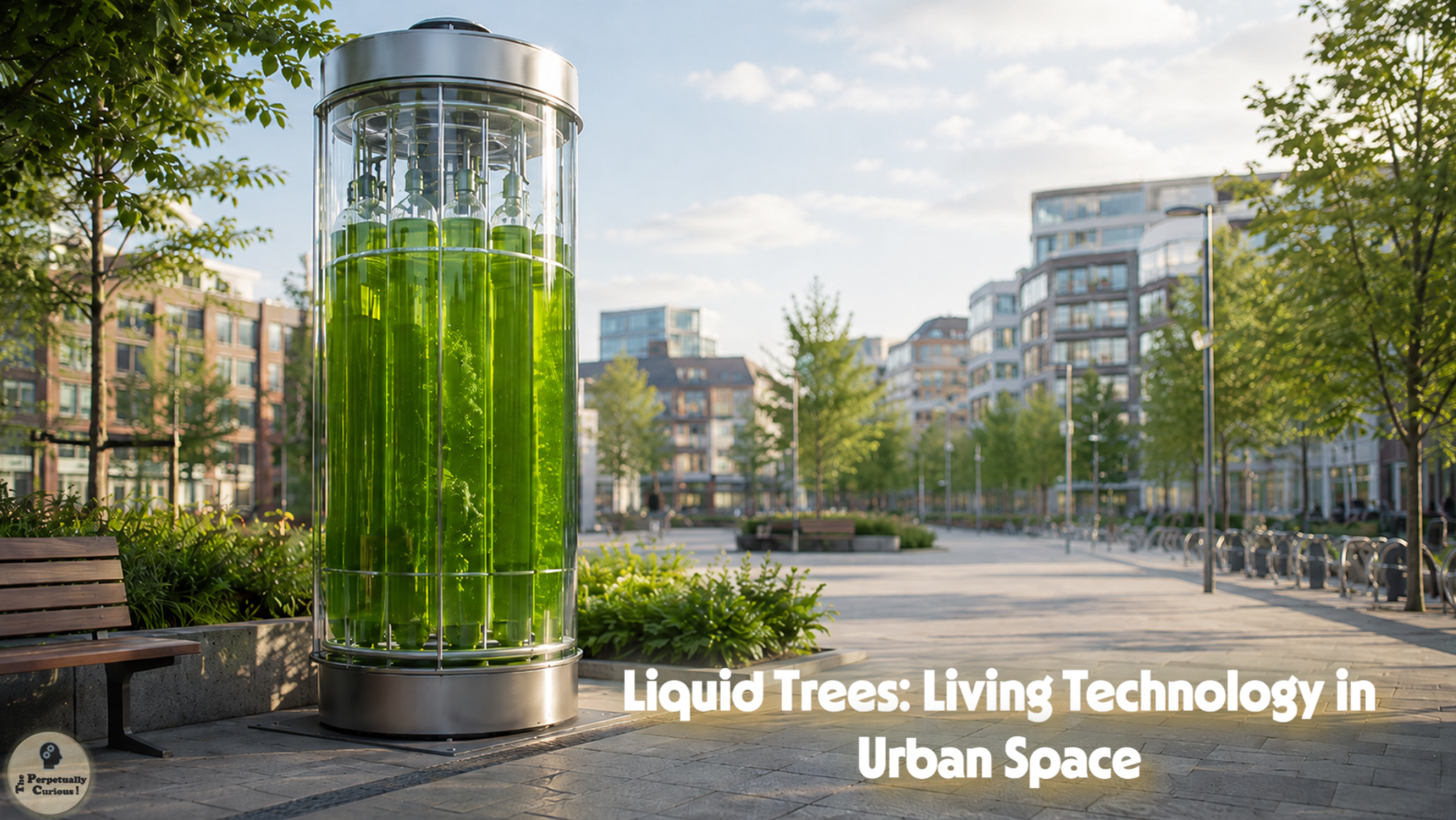
A quiet green patience rises inside the glass as the city moves around it.
Light settles into the water and becomes a small gesture of renewal.
In this stillness the algae keep their gentle rhythm and offer the air a moment of calm.
🌱 A new kind of urban presence: what a liquid tree is
A liquid tree is an informal name for a public-space photobioreactor that cultivates microalgae inside a transparent, water-filled vessel. It is not one standardized machine. Some designs resemble bench-like glass tanks, while others use taller vertical enclosures. Their dimensions and supporting equipment vary, but the underlying principle is similar: a compact system maintains a photosynthetic culture by managing light, nutrients, circulation, temperature, and gas exchange.
The vivid green color comes from microalgae suspended throughout the culture medium. Microalgae are microscopic photosynthetic organisms that are commonly unicellular, although some occur in colonies or form simple multicellular structures. Through photosynthesis, they use light energy to incorporate inorganic carbon into new cellular material while releasing oxygen. Their growth depends on the species or strain being cultivated and on conditions such as illumination, temperature, nutrient availability, mixing, pH, culture density, and carbon dioxide availability. Photobioreactors take many forms because these conditions interact differently across vessel shapes and scales.[3]
Operators start with an inoculum, a small population of living microalgae that reproduces to form the working culture. They choose a strain that grows reliably under the site’s temperature, light, and water conditions. The culture can be started under controlled conditions before it goes into the public vessel.[3]
The choice of algae also depends on the installation. The LIQUID3 team reported using single-celled freshwater algae found in Serbian ponds and lakes that could grow in tap water and tolerate a range of temperatures.[1] A culture used in one city tells us little about what is growing in another unless that project identifies its strain.
The transparent walls let light reach the culture and make the green water visible to passersby. As the culture thickens, cells closer to the surface can shade those deeper inside. Mixing changes how long individual cells spend in brighter and darker parts of the vessel.[3]
The vessel therefore contains both a living population and a managed habitat. Once the culture is established, its performance depends on how effectively air, light, nutrients, and water are brought together inside the reactor. That leads to the next question: what actually happens when urban air moves through the system?
🌞 Inside the green vessel: how air and microalgae meet
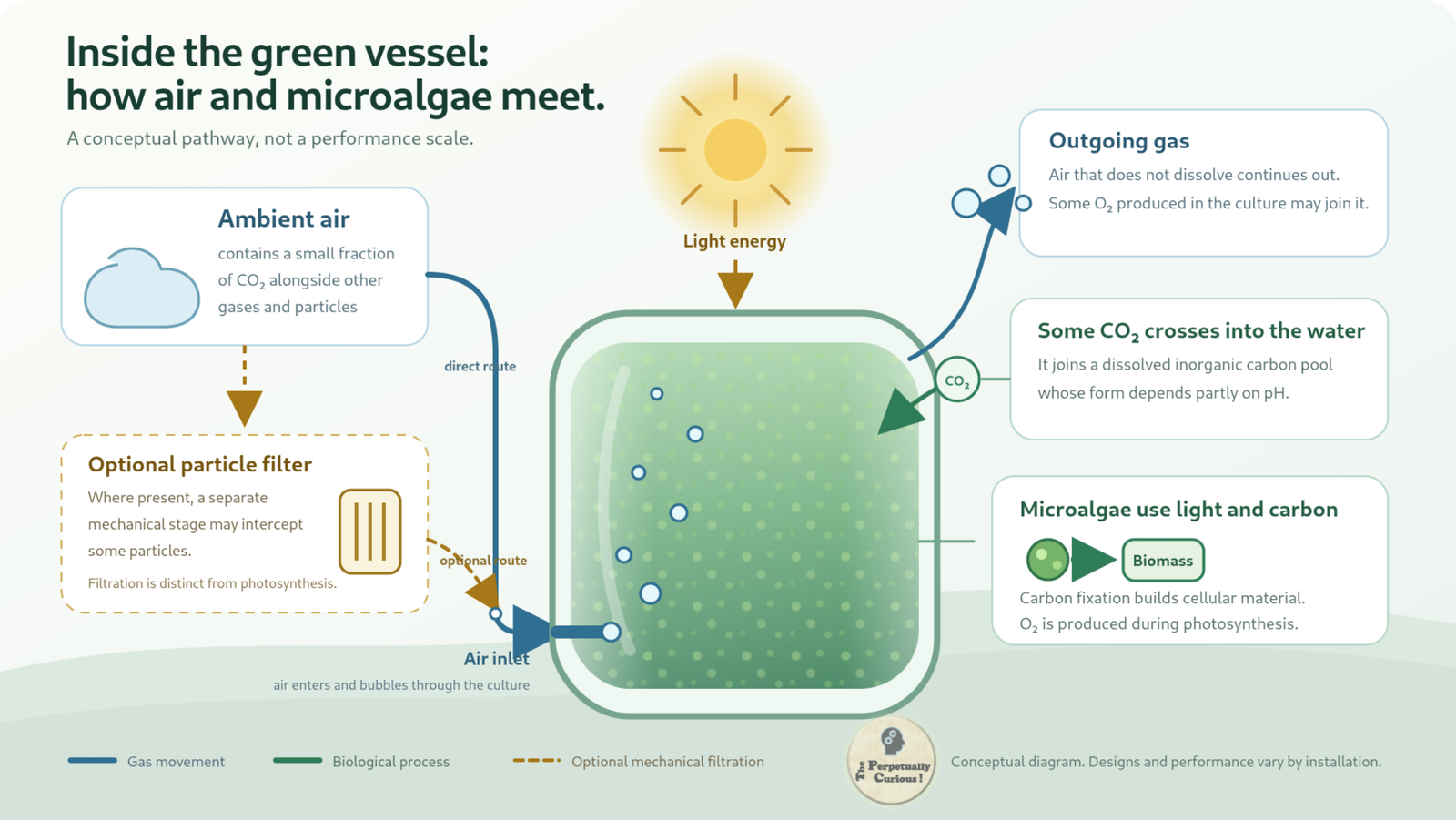
To understand how a liquid tree functions, it helps to follow both the air and the carbon moving through a particular design. In some systems, a pump releases ambient air through small openings near the bottom of the culture, producing bubbles that increase contact between the gas and the surrounding water. Other systems place a mechanical filtration stage before or alongside the biological chamber. These functions should remain distinct: a filter may intercept particulate matter, while the microalgae primarily exchange gases and build biomass through photosynthesis.[4]
As a bubble rises, some of its carbon dioxide dissolves in the culture medium. The balance among dissolved carbon dioxide, bicarbonate, and carbonate depends partly on pH. Many microalgae concentrate carbon dioxide near Rubisco, an enzyme that helps incorporate inorganic carbon into organic molecules. Light supplies energy for photosynthesis, and splitting water releases oxygen, some of which can pass back into the air.[3][4] These exchanges are a small-scale example of the carbon and oxygen cycles that link living organisms to the atmosphere.
Gas transfer and carbon fixation are two steps. Bubble size, airflow, circulation, and vessel geometry affect how much incoming carbon dioxide dissolves. Light, nutrients, and culture health then help determine how much of that dissolved carbon ends up in biomass. A culture with a high potential growth rate can still be limited by how quickly carbon dioxide reaches the cells.[3][4]
The difference matters when a unit draws ordinary street air. Many cultivation studies use carbon dioxide-enriched gas, which supplies more carbon dioxide per liter of air. The supply in a street installation depends on how much air moves through it and how much carbon dioxide transfers into the water.[4] To tell whether the unit changes the air people breathe, researchers would need measurements outside the vessel.
Particulate pollution is a separate question. PM10 generally covers inhalable particles about 10 micrometers across or smaller. PM2.5 is the finer fraction, about 2.5 micrometers or smaller, and can reach deeper into the lungs.[5] A mechanical filter may intercept particles on their way into the unit. Measuring that filter’s performance requires a known airflow, a defined particle size range, and measurements on both sides of the filter.
Each measure answers a different question. Gas-transfer efficiency describes how much incoming carbon dioxide enters the water. Biological performance describes how much carbon the culture incorporates into biomass. A filter has its own particle-removal rate. To assess the whole system, include electricity, materials, maintenance, water, nutrients, and biomass handling in the calculation.[4][6]
The fate of the harvested algae determines how long the captured carbon stays out of the atmosphere. Carbon held in living cells can return as the biomass breaks down or is burned. Any claim of lasting removal also needs to account for emissions from operating the system and processing the harvest.[6]
A useful performance figure names the installation, gives the operating period, and explains what was measured. For example, carbon fixed in the culture and a change in the air around the unit require different measurements. Keeping those questions separate makes the two installations easier to compare.
🏙️ Public liquid trees: one biological idea, different urban forms
The public installations adapt an established cultivation technology to streets and parks. Photobioreactors have long been used to grow photosynthetic organisms under controlled conditions.[3] In a public setting, the vessel can also serve as seating or make the process of cultivation visible in a place with little rooting space.
Public placement changes how the technology is encountered. Instead of operating behind laboratory or industrial walls, the green culture becomes part of an ordinary street, park, or plaza. Passersby can see changes in the density and color of the culture, observe some of the equipment that supports it, and encounter photosynthesis as an active urban process rather than an invisible scientific abstraction.
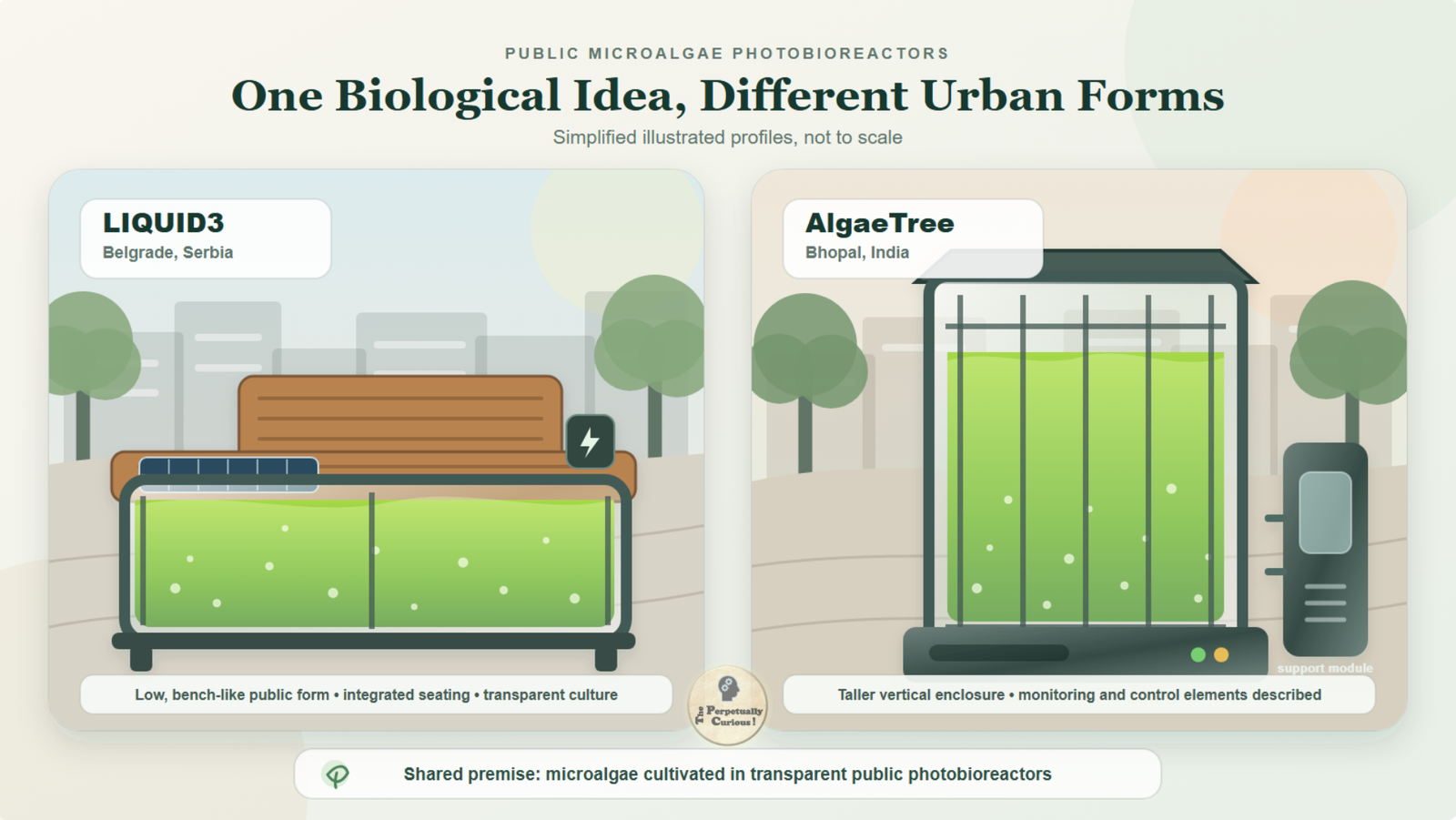
The University of Belgrade’s Institute for Multidisciplinary Research designed LIQUID3. UNDP Serbia reported its installation outside the Municipality of Stari Grad in 2021. The bench-like unit contains about 159 U.S. gallons (600 liters) of water with microalgae, alongside phone chargers and solar-powered lighting.[1] Its low profile makes it part of the street furniture.
In May 2026, Mushroom World Group’s AlgaeTree was installed at Swami Vivekananda Park in Bhopal, India.[2] The developer describes a taller enclosure that draws air through a separate particle filter before sending it to the algal chamber. Its design description includes solar power, battery backup, sensors, and controls for airflow, lighting, and nutrient delivery.[7]
The developer states a design target of 1.8 to 2 kilograms (about 4.0 to 4.4 pounds) of carbon dioxide per day and gives a corresponding estimate of 650 to 700 kilograms (about 1,430 to 1,540 pounds) per year. A separate figure on the same page shows about 1.5 tons per year. The page gives no common measurement basis for those two annual totals.[7] An annual field result would need a published method and an operating record that shows how the figure was obtained.
The two installations document different design choices. Belgrade integrates the culture into a bench. Bhopal’s developer describes separate filtration and more extensive monitoring and controls.[1][7] Tank capacity tells us how much culture a unit can hold. It does not tell us how much carbon dioxide the system captures.
Public installations give researchers and visitors a place to observe a working culture. Any claim that the installation improves the surrounding air calls for separate measurements under real operating conditions. A comparison with living trees also needs to account for what a tree contributes to the same space.
🌳 Liquid trees and living trees: different roles in the same landscape
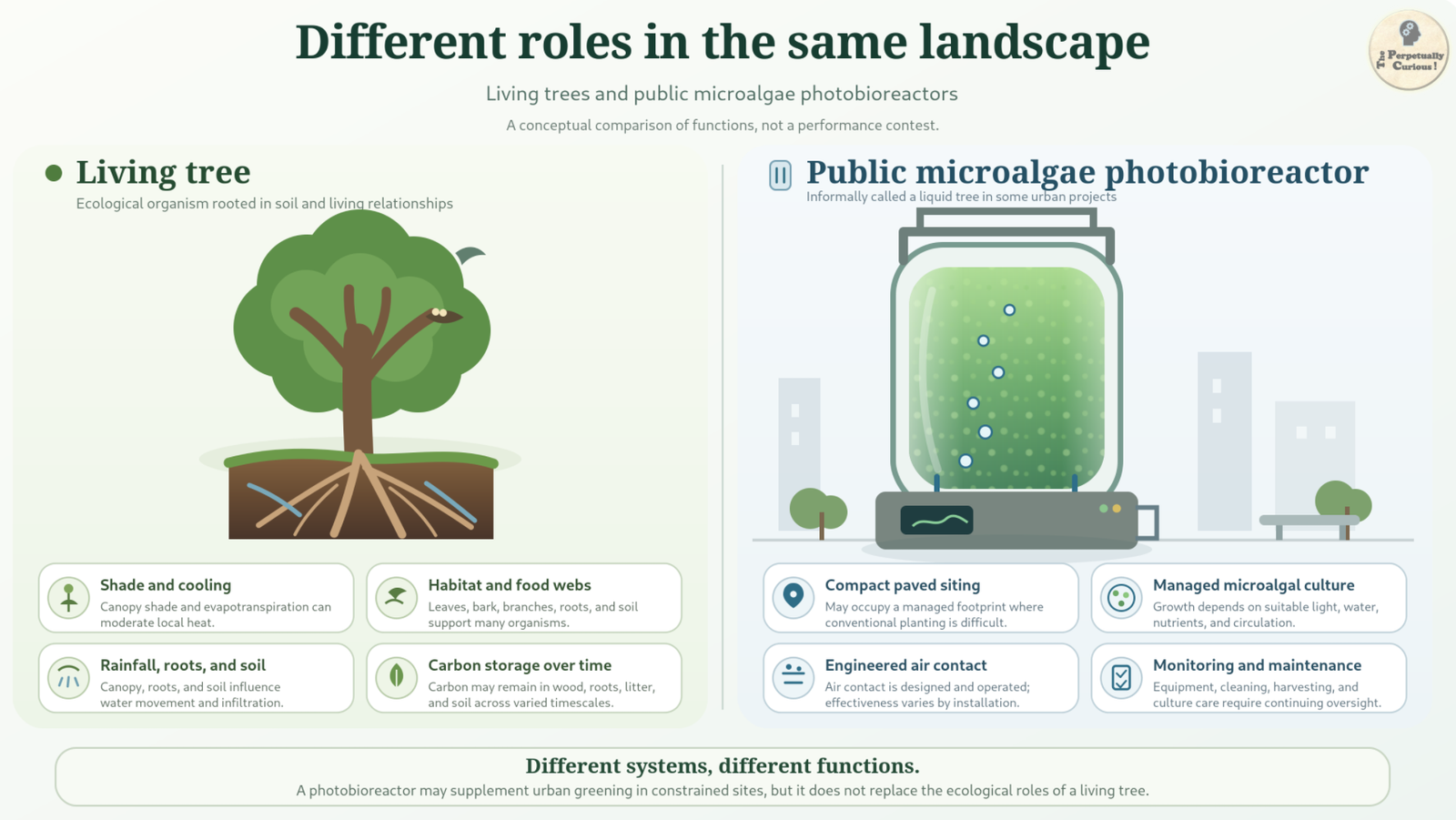
Living trees shape the places where they grow. Their canopies provide shade, intercept rain, and cool the air as water evaporates from their leaves. They also provide habitat and hold carbon in their tissues.[8] Roots help shape local drainage and soil conditions through the relationships among roots, water, and landscape.
Below ground, many trees form associations with fungi. Some are connected through mycorrhizal networks. A photobioreactor has a different set of relationships to manage inside the enclosure. Its algae depend on a supply of light and nutrients and on equipment that circulates the culture.
Its potential advantage lies in compact and controlled placement. A photobioreactor may fit into paved or highly constrained sites where shallow soil, underground utilities, narrow walkways, contaminated ground, or surrounding infrastructure make successful tree establishment difficult. It may also allow operators to monitor airflow, culture conditions, and biomass production more directly than they could assess the biological activity of an entire tree.
That control comes with trade-offs. A living tree, once successfully established, can continue functioning through natural cycles without pumps or electronic controls. A liquid tree depends on circulation, energy, nutrients, cleaning, monitoring, and periodic harvesting. A tree may suffer from drought, disease, or poor soil, while a photobioreactor may lose performance if its culture becomes contaminated, overheated, nutrient-limited, excessively dense, or affected by equipment failure. Compactness should therefore not be confused with independence from infrastructure.
Even at a suitable site, any local air-quality effect depends on the reactor’s airflow, filtration, biological productivity, operating schedule, maintenance, and surrounding weather conditions. Its influence may remain close to the installation, while the benefits of a mature tree can extend through shade, cooling, habitat, stormwater management, and soil processes. A photobioreactor is therefore better understood as a possible supplement to urban greening rather than an alternative to it.
A comparison with a living tree is useful only if it asks a specific question. To compare annual carbon uptake, identify the reactor and the trees being measured, use the same period, and state how the carbon was measured. The result will depend on how the reactor operates and on the species, size, and growth conditions of the trees.
The comparison also has to follow the carbon after uptake. A reactor moves carbon into biomass that can be harvested, processed, or broken down. A growing tree can retain some carbon in wood and roots for years.[6][8] A fair comparison puts both systems on the same footing by reporting the carbon retained and the emissions associated with each over a stated period.
Cities draw on several tools to address pollution and heat, from cutting emissions at the source to planting and maintaining trees. A compact photobioreactor may serve a particular purpose where planting is difficult. Its contribution depends on how reliably the equipment and the culture work together over time.
⚙️ The engineering beneath the surface: control, energy, and maintenance
Aeration brings gas into the vessel. Circulation distributes nutrients and dissolved gases and moves cells through areas with different light levels. Depending on the design, sensors can track temperature, pH, dissolved oxygen, culture density, or water level. Those readings help operators decide when to intervene. A system adjusts itself only if those readings feed controls that can change conditions inside the vessel.[3]
The energy budget depends on which components run, for how long, and where the power comes from. Bhopal’s developer describes solar power and battery backup.[7] Pumps, filters, supplemental lighting, or temperature control can have different power demands. A panel on the enclosure tells readers little about the full energy budget without an account of those loads.
The microalgal culture is a renewable living population rather than a disposable filter cartridge. Once established from a starter culture, it can continue reproducing while conditions remain suitable. Operators usually remove part of the growing biomass before the culture becomes so dense that cells shade one another and light penetration declines. A healthy portion can remain inside the reactor and regrow after water and nutrients are replenished. If contamination, temperature stress, nutrient imbalance, or another serious disruption occurs, part or all of the culture may need to be replaced from a clean backup culture.[3]
Routine maintenance keeps the culture productive and the equipment functioning. Operators may clean the transparent walls and check water chemistry, nutrient levels, temperature, circulation, and culture density.[3] Pumps and filters also need attention where they are fitted. Cleaning and servicing intervals depend on the design, the climate, and how intensively the unit operates.
Research has explored uses for cultivated microalgal biomass in fuels, materials, and other products.[3] An urban unit’s harvest needs to be assessed for contaminants from the air, water, or equipment before any reuse. The intended use determines what testing and processing are needed.
How the harvest is handled matters for the climate calculation. Drying consumes energy, and material destined for fuel will give its carbon back when it is burned. A project proposing a longer-lived use should explain where the biomass goes and how long that use retains the carbon.[6]
Operators need separate records for biological and mechanical performance. Culture density and harvested biomass help describe growth. Power use, water use, filter servicing, and downtime show what it took to achieve that growth. Neither set of records can replace measurements in the surrounding air.
The equipment also has a footprint. Studies of algal carbon capture distinguish the carbon taken up during cultivation from the emissions associated with growing and processing the biomass.[6] An urban project can apply the same accounting approach to materials, electricity, nutrients, maintenance, harvesting, and processing. With those requirements in view, it becomes easier to judge where an installation might make sense.
🌍 A wider view: where liquid trees may fit in future cities
Liquid trees belong to a broader set of approaches intended to improve urban environmental conditions. Their possible role is narrow and localized. They do not replace emission controls, cleaner transport, energy transitions, street trees, parks, or other forms of green infrastructure. Instead, a carefully maintained photobioreactor may serve as a supplementary system in paved or highly constrained places where limited soil, underground utilities, contamination, or surrounding structures make conventional planting difficult.
The most suitable location is not necessarily the most visible one. A useful deployment would need adequate sunlight, safe pedestrian access, reliable power and water, room for maintenance, and airflow that allows the system to interact with its surroundings. Local climate also matters. Excessive heat, freezing conditions, prolonged shade, or large seasonal changes may reduce biological performance or increase the energy needed to keep the culture within a workable range.
A field evaluation needs to distinguish reactor performance from changes in the surrounding air. Measurements at agreed locations and distances, paired with a suitable background site, help put changes near the unit in context. Wind, humidity, traffic, and the timing of measurements all matter when interpreting the sensor readings.[9]
Public reporting should show what the sensors measured, where they were placed, and when the unit was running. For example, readings near the vessel are more useful when accompanied by background measurements, local weather conditions, and operating times.[9] Data on power, maintenance, and biomass handling help readers understand what it took to keep the unit working.
Public installations may also have educational value. They can make photosynthesis, air monitoring, microbial cultivation, and environmental engineering visible to readers and passersby who might never encounter a working photobioreactor elsewhere. A display that explains what is being measured can help visitors understand the difference between an experiment and a demonstrated result.
The biology inside these systems belongs to a much older planetary story. Oxygen-producing microorganisms, including ancestral cyanobacteria, helped transform Earth’s living atmosphere over geological time.[10] The organisms in a modern photobioreactor use the same broad process of oxygenic photosynthesis, drawing on light energy to build living matter from inorganic carbon.
By placing that ancient process inside an engineered urban structure, liquid trees offer one example of living technology. Their future will depend less on whether they resemble trees than on whether they perform a clearly defined function at a reasonable environmental and economic cost. Careful design, transparent evidence, dependable maintenance, appropriate siting, and integration with larger pollution-reduction strategies will determine whether they become useful urban tools, temporary demonstrations, or something between the two.
Beyond those practical judgments lies a more human question: what does it mean to encounter a living process glowing within the built city?
🌌 A gentle reflection: the quiet glow of living water
At dusk, when the last light settles across a city, a liquid tree may appear almost luminous. The green culture behind its transparent walls catches the fading light, briefly revealing countless microscopic organisms growing within the circulating water and responding to a carefully maintained environment. What appears from a distance as a column or vessel of green water is, on closer inspection, a living population sustained by biology, engineering, and continued human care.
The installation does not breathe as a tree does, nor does it recreate the ecological world of roots, leaves, soil, fungi, and habitat. Its photosynthesis is real, but so are its pumps, power demands, maintenance needs, and limits of scale. That tension is part of what makes the liquid tree compelling. It places an ancient biological process inside a distinctly modern structure, allowing the living and the engineered to remain visible at the same time.
Liquid trees will not solve urban air pollution. Their future depends on evidence, reliable operation, responsible biomass handling, and integration with measures that reduce pollution at its source. Yet they offer a meaningful experiment in designing with living organisms rather than merely imitating their appearance. Their broader value may lie not only in what a particular installation can measurably contribute, but also in the questions it makes difficult to ignore: what should a living technology accomplish, how should its benefits be measured, and where does it genuinely belong within a city?
Pass this article along to someone curious and let the learning travel.
💡 Did You Know
🧬 Microalgae do not belong to one single branch of life. The term describes a diverse range of microscopic photosynthetic organisms whose pigments, cell structures, growth patterns, and environmental tolerances can differ substantially.
🔬 A culture that grows quickly under controlled light and temperature can behave differently outdoors. Vessel design, mixing, and how much light reaches the cells all affect growth.[3]
🌗 Mixing does more than keep the culture from settling. It moves cells repeatedly between brighter and darker regions of the vessel, creating short light-dark cycles that can influence photosynthetic performance.[3]
🧪 Photosynthesis can alter the chemistry of the culture medium as microalgae consume dissolved inorganic carbon. Operators may therefore track pH alongside dissolved oxygen, temperature, and culture density to understand how conditions inside the living culture are changing.[4]
🍃 The transparent surface of a photobioreactor performs a much narrower role than the varied leaf shapes of living plants, which reflect trade-offs involving light capture, gas exchange, cooling, water loss, rainfall interception, and structural stress.
🌍 A particle reading at the filter outlet describes air passing through the machine. A sidewalk reading describes what passersby encounter. The two measurements answer different questions.
💧 Harvested microalgal biomass usually contains a large amount of water. Separating, concentrating, and drying it can require substantial energy, so downstream processing may strongly influence the environmental balance of the overall system.[3]
What is a liquid tree?
A liquid tree is an informal name for a public-space photobioreactor that grows microalgae in water inside a transparent vessel. Belgrade’s LIQUID3 is a bench-like example with a 600-liter (about 159 U.S. gallon) tank.[1] Other installations use taller enclosures or a different mix of pumps, filters, and controls.
What inspired the idea of placing microalgae in public spaces?
Photobioreactors have long been used for scientific research, biomass cultivation, wastewater treatment, and carbon-management studies. The newer urban concept brought this established technology into visible public locations, particularly paved areas where limited soil, underground utilities, or dense infrastructure may make successful tree planting difficult. The aim was not to invent photosynthesis, but to adapt a managed photosynthetic culture to constrained city spaces.[1][3]
How does a liquid tree work?
In some designs, a pump releases ambient air into the water as small bubbles. Part of the carbon dioxide in that air dissolves into the culture medium, where microalgae can use it during photosynthesis to build sugars and other cellular material. Oxygen is produced, and some of it may transfer from the water into the surrounding air.[3][4]
Mixing helps bring the culture into contact with light, gases, and nutrients. A separate mechanical filter, where fitted, intercepts particles before or apart from the algal stage.[3][7]
Are the algae natural, laboratory-grown, or artificially synthesized?
Operators grow a working culture from a small starter population of living cells, called an inoculum.[3]
Growing the cells in a laboratory describes where they were cultivated. Whether a particular project uses a genetically modified strain depends on the strain it reports.
What kinds of microalgae are used, and are they locally native?
Projects choose strains that can grow under their operating conditions, taking into account light, temperature, water chemistry, and other cultivation needs.[3]
UNDP Serbia reports that the LIQUID3 team used freshwater algae found in Serbian ponds and lakes.[1] The source of the algae is specific to the installation.
How is the culture started and kept alive?
A healthy inoculum is introduced into water containing suitable nutrients. The microalgae reproduce when light, temperature, pH, carbon availability, and nutrient conditions remain within a workable range. Aeration or circulation helps prevent stagnation and moves cells through brighter and darker regions of the vessel.
Operators must also prevent the culture from becoming excessively dense because cells near the surface can shade those deeper inside. Contamination, nutrient imbalance, overheating, freezing, poor circulation, or equipment failure can weaken the culture. Monitoring and periodic harvesting help keep it productive.[3]
Are the algae reusable, and what happens to the harvested biomass?
Operators can harvest part of a healthy culture and let the remaining cells regrow. A badly contaminated or failing culture may need to be restarted from a clean one.[3]
Cultivated microalgae have been studied for a range of products.[3] The appropriate use of a public unit’s harvest depends on its composition, contamination testing, and the requirements for that use.
What maintenance does a liquid tree require?
Maintenance can include cleaning transparent surfaces, inspecting pumps and air lines, servicing particulate filters, checking seals and electrical components, calibrating sensors, replenishing water and nutrients, controlling culture density, and harvesting excess biomass. Temperature management may also be necessary during very hot or cold conditions.
The schedule depends on the reactor, climate, microalgal strain, local pollution, and operating intensity. A maintenance interval reported for one installation should not be presented as a universal standard. Biological performance is inseparable from the reliability of the surrounding equipment.[3]
How efficient is a liquid tree?
Efficiency can describe several different processes:
• Gas-transfer efficiency: how much carbon dioxide moves from the air into the water.
• Biological efficiency: how much dissolved carbon becomes new biomass.
• Optical efficiency: how effectively light reaches productive cells.
• Filtration efficiency: how much particulate matter is intercepted where filtration is present.
• Operational efficiency: how much energy, water, nutrients, labor, and maintenance the system requires.
• Urban effectiveness: whether the installation produces a detectable improvement in the surrounding outdoor air.
Good performance on one measure does not establish good performance on the others. To assess outdoor air quality, measure the air around the unit as well as its operation.[9]
How much carbon dioxide can one liquid tree remove?
There is no single annual figure for all liquid trees. Uptake depends on the amount of carbon dioxide delivered to the culture, available light, temperature, and how the unit is operated.[3][4]
A useful estimate gives the installation, measurement period, and calculation method. The Bhopal developer’s technical page gives design figures with different annual totals.[7]
Does a liquid tree permanently remove carbon dioxide?
Algae hold carbon while they grow. If harvested biomass is burned or breaks down, much of that carbon can return to the atmosphere. The length of storage depends on what happens to the material.
To assess the net climate effect, include emissions from running the equipment, producing nutrients, and harvesting and processing the biomass.[6]
Do liquid trees release meaningful amounts of oxygen?
Microalgae produce oxygen during photosynthesis. How much reaches the air depends partly on how quickly oxygen moves out of the water.[3] Oxygen production is a measure of what is happening inside the unit.
To find out whether the air nearby changes, measure the pollutant of interest at relevant outdoor locations.[9]
What happens inside a liquid tree at night?
When natural light falls below the level required for photosynthesis, carbon fixation and photosynthetic oxygen production slow greatly or stop. The living cells continue respiration, using stored organic material to support cellular activity. Pumps, filters, sensors, or circulation equipment may continue operating if power is available.[3]
Daily performance therefore varies with the light-dark cycle unless the system uses supplemental lighting, which introduces an additional energy demand.
Do liquid trees require freshwater and added nutrients?
Microalgae require water and nutrients, particularly sources of nitrogen, phosphorus, and essential minerals. Closed systems can recirculate much of their culture medium, but water may still be lost or removed through evaporation, harvesting, cleaning, leakage, and culture replacement.
Reclaimed water or recovered nutrients may reduce demand for new resources in some applications, but they can also introduce contaminants or competing organisms. The appropriate inputs depend on the selected organism, intended biomass use, and available monitoring.[3]
Can liquid trees remove PM2.5 and PM10, and are all airborne particles alike?
Some installations include a mechanical filter designed to capture particles. The Bhopal developer describes filtration before the algae chamber.[7] A reported removal rate needs to identify the particle size range, equipment, and conditions tested.
Airborne particles vary in size and composition.[5] For example, organic aerosols in the Great Smoky Mountains contribute to the region’s characteristic haze, while traffic and construction can contribute particles of different origins. That is why a result for one particle fraction needs to be reported separately from a general claim about air quality.
How can researchers determine whether a liquid tree improves nearby air?
Measure the pollutant outside the tank at locations relevant to the question. One possible design compares air near the unit with a background site during periods when the unit is running and when it is idle.
Account for traffic, wind, humidity, and other conditions that can affect the results. Report where sensors were placed and how their readings were checked.[9]
Can liquid trees replace living trees?
Living trees shade and cool streets, provide habitat, intercept rain, and store carbon in their tissues.[8] A compact photobioreactor performs a narrower set of functions in a managed enclosure.
A unit may still have a role at a paved site where planting is physically difficult.
What does it mean when one liquid tree is compared with several living trees?
A tree-equivalent figure is meaningful only if it identifies the metric, the actual systems being compared, and the period over which both were measured. A responsible comparison also specifies the species, size, and growing conditions of the trees.
Carbon fixed into a harvestable culture and carbon kept in a growing tree can stay out of the atmosphere for different periods. An uptake comparison should show where the carbon ends up and account for the resources used over the same period.[6][8]
Where have public liquid trees been installed?
Two documented examples are LIQUID3 outside the Municipality of Stari Grad in Belgrade and the AlgaeTree at Swami Vivekananda Park in Bhopal.[1][2] They have different designs, so operating details from one should not be assumed for the other.
How are liquid trees powered, and can they operate in cold climates?
Power arrangements vary. UNDP Serbia describes solar-powered lighting on the LIQUID3 bench, and Bhopal’s developer lists solar power and battery backup for AlgaeTree.[1][7]
In cold climates, both the culture and the equipment need to keep working through low temperatures and shorter days. A strain’s tolerance of cold is one part of the evidence needed to assess year-round operation.[3]
How do liquid trees fit into broader air-quality strategies?
Liquid trees are experimental, localized systems rather than substitutes for reducing pollution at its source. Their possible contributions include testing biological engineering, supporting site-specific monitoring, occupying constrained spaces, and making photosynthesis visible to the public.
Meaningful urban improvement still depends primarily on emission controls, cleaner transport and energy, appropriate planning, conventional greening, and other measures applied at suitable scales. A liquid tree should be evaluated as one component within that larger system rather than as a self-contained solution.
📣 Let this green breath travel farther
If this exploration of liquid trees and urban microalgae has sparked curiosity, please consider sharing it with friends, colleagues, or anyone interested in the changing relationship between biology and urban design. Each shared conversation can help more people encounter not only the possibilities of living technology, but also the evidence, maintenance, and realistic limits needed to evaluate it responsibly.
Selected sources
- United Nations Development Programme (UNDP) Serbia. (2021). The first algae air purifier in Serbia.
- Tribune News Service. (2026). Bhopal installs India’s 1st ‘algae tree’ to combat air pollution. The Tribune, May 15, 2026.
- Abdur Razzak S, Bahar K, Islam KMO, et al. (2024). Microalgae cultivation in photobioreactors: sustainable solutions for a greener future. Green Chemical Engineering, 5(4), 418–439.
- Hajinajaf N, Fallahi A, Eustance E, et al. (2024). Managing carbon dioxide mass transfer in photobioreactors for enhancing microalgal biomass productivity. Algal Research, 80, 103506.
- U.S. Environmental Protection Agency (EPA). (2026). Particulate Matter (PM) Basics.
- Fernandes de Souza M, Meers E, Mangini S. (2024). The potential of microalgae for carbon capture and sequestration. EFB Bioeconomy Journal, 4, 100067.
- AlgaeTree. (n.d.). Technology. Developer’s description and performance estimates.
- U.S. Environmental Protection Agency (EPA). (2026). Benefits of Trees and Vegetation.
- U.S. Environmental Protection Agency (EPA). (2022). The Enhanced Air Sensor Guidebook.
- Lyons TW, Reinhard CT, Planavsky NJ. (2014). The rise of oxygen in Earth’s early ocean and atmosphere. Nature, 506(7488), 307–315. [PMID: 24553238]
“Liquid Trees: Microalgae Photobioreactors and the Quiet Art of Urban Breathing.” The Perpetually Curious!, July 2026.
https://www.theperpetuallycurious.org/articles/liquid-trees/Continue Exploring
For what comes next
Site Updates gathers occasional notes, new additions, and ways to keep in touch. RSS brings new publications to your feed reader in chronological order.
Choose the path that speaks to you, and let the next curiosity find you wherever your wondering takes you.