

The atmosphere surrounding Earth is often seen as a thin blue halo, yet this delicate envelope of gases and suspended particles is organized into regions that are both intricate and quietly beautiful. From the surface upward, temperature, density, composition, and electrical behavior change in patterned ways, shaping weather, climate, radiation, and the conditions that allow life to persist. Exploring these changes reveals how an invisible medium becomes a structured planetary environment.
This journey is both physical and conceptual. Moving from the familiar air of the troposphere toward the sparse frontier of the exosphere, each region introduces a different balance of temperature, motion, chemistry, and energy. The story begins with air that sustains life and carries weather, then gradually opens toward a realm where individual atoms can travel vast distances without colliding. Before beginning that climb, it helps to look more closely at the thin atmospheric veil surrounding the rocky world below.
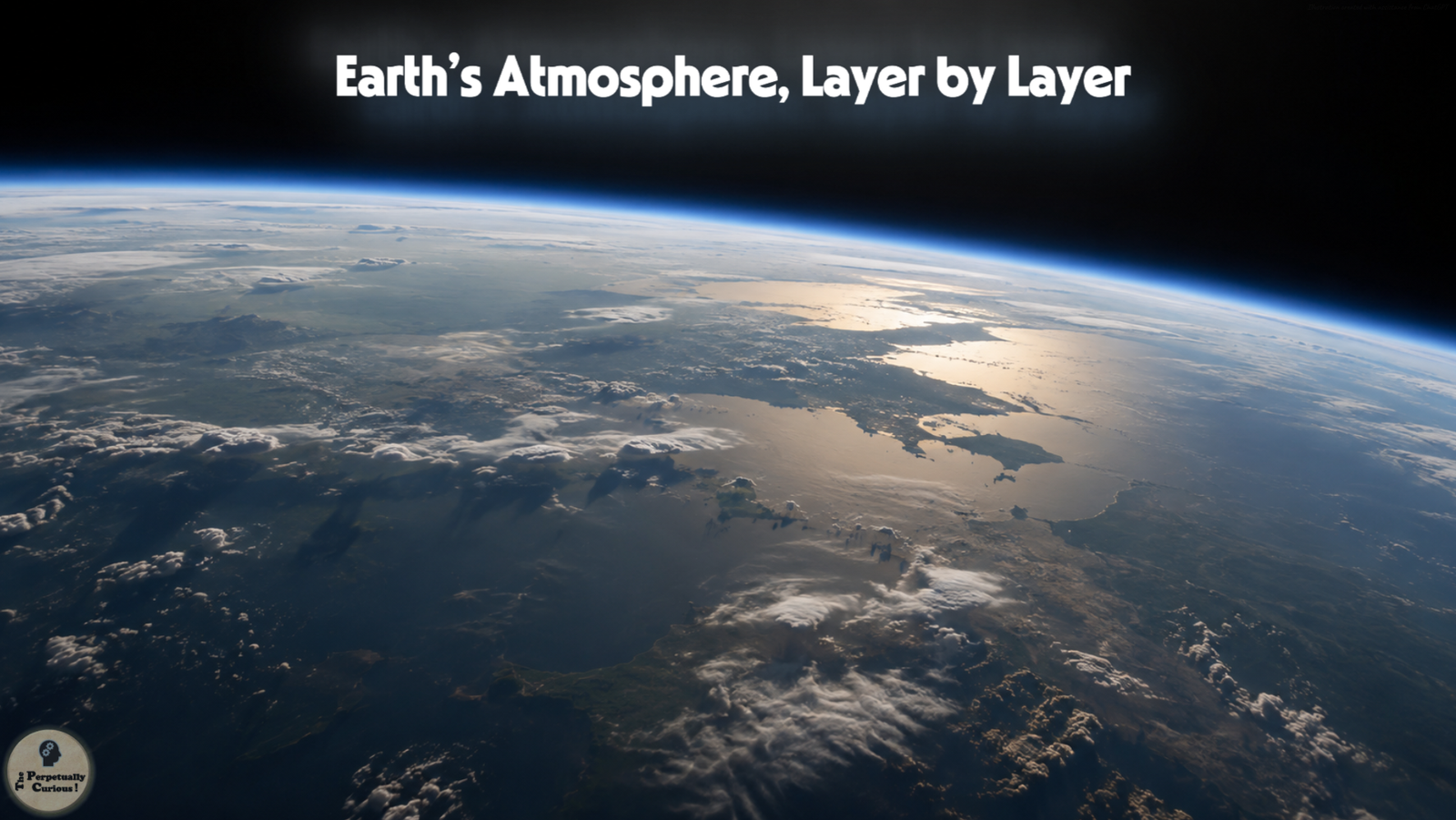
A quiet stillness rises through the layers, where drifting atoms meet the long reach of sunlight.
The sky becomes a slow and patient frontier, shaped by warmth, motion and invisible tides.
Above it all, Earth keeps its gentle hold, carrying every breath into the open dark.
🌍 A thin blue veil around a rocky world
Earth’s atmosphere is composed mainly of nitrogen and oxygen, with smaller amounts of argon, carbon dioxide, variable water vapor, and other trace gases. It also carries tiny solid and liquid particles known as aerosols, including sea salt, dust, smoke, pollen, and volcanic ash. Together, these gases and particles form Earth’s living atmosphere, a planetary envelope shaped by chemistry, circulation, sunlight, geology, and continual exchange with oceans, land, and life.
Although measurable atmospheric particles extend far beyond the familiar sky, most of the atmosphere’s mass remains concentrated close to the ground. Pressure and density generally decrease with altitude, and no sharp wall separates one atmospheric region from the next.
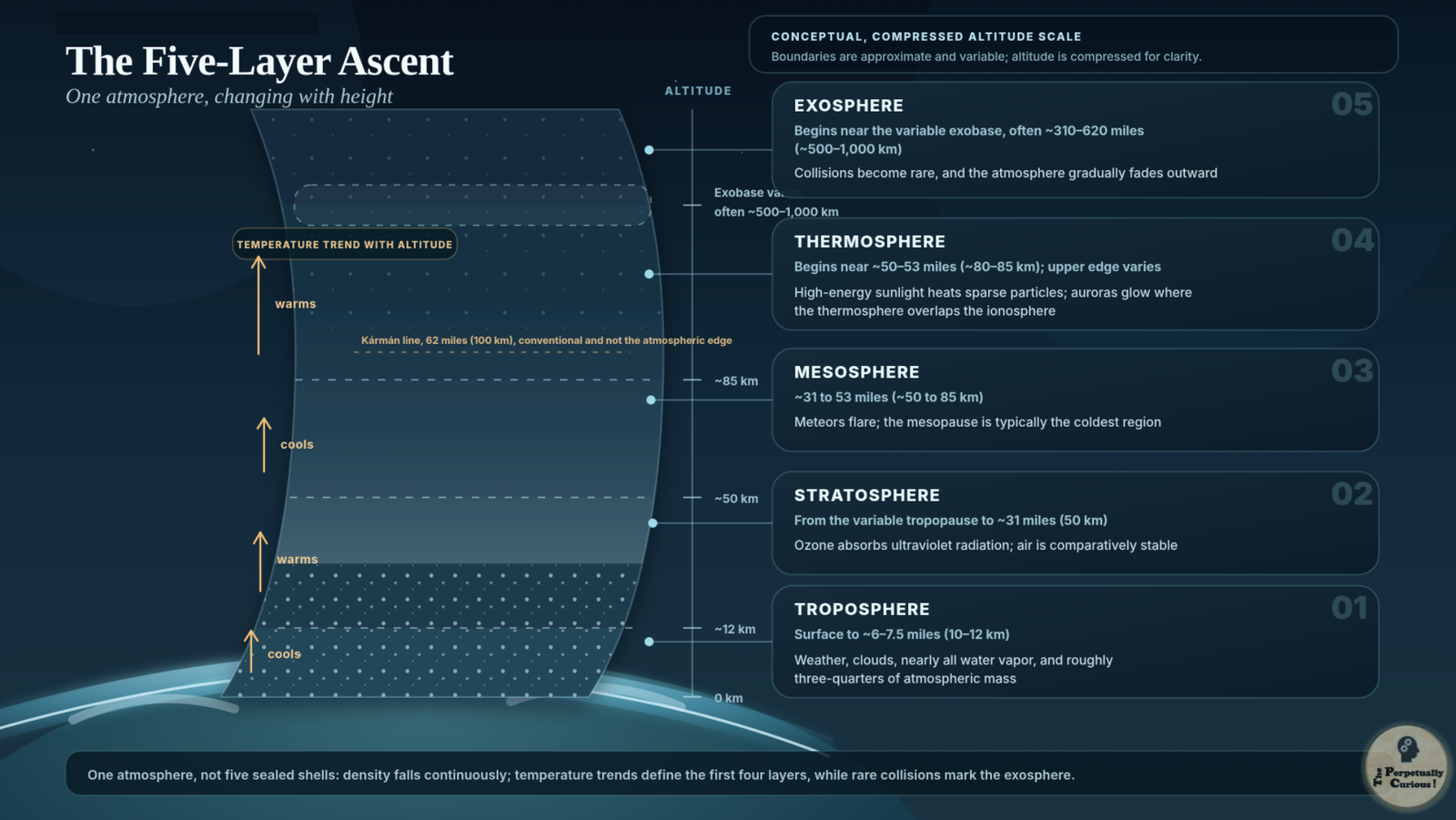
Scientists commonly describe five principal layers: the troposphere, stratosphere, mesosphere, thermosphere, and exosphere. The first four are distinguished mainly by how temperature changes with altitude. The exosphere begins near the exobase, above which collisions between particles become increasingly rare and the atmosphere gradually fades into space. Other regions, such as the ionosphere, overlap parts of these layers because they are defined by electrical properties rather than temperature alone.
Weather balloons, sounding rockets, satellites, and ground-based instruments help researchers trace these changes and map the atmosphere’s vertical structure. With that framework in place, the ascent begins in the troposphere, where the atmosphere is densest, water vapor is most abundant, and weather and life occupy the same air.
☁️ Troposphere: where weather and life share the same air
The ascent begins in the troposphere, which extends from Earth’s surface to an average height of about 6 miles to 7.5 miles (10 kilometers to 12 kilometers). Its upper boundary lies lower over the poles and higher over the equator because heating and large-scale circulation vary with latitude and season. Although comparatively shallow, the troposphere contains roughly three-quarters of the atmosphere’s mass and nearly all of its water vapor, which is why clouds, rain, snow, and most storms develop here.
Temperature generally decreases with altitude through the troposphere. Sunlight warms land and ocean surfaces, which then transfer energy to the air above them. As buoyant air rises into regions of lower pressure, it expands and cools. When that cooling brings the air to saturation, water vapor can condense onto microscopic airborne particles that act as cloud condensation nuclei, forming tiny droplets or ice crystals. These are the first steps in [cloud formation and precipitation, although the particles must grow considerably larger before they can fall from a cloud.
The troposphere is also the atmospheric region most directly shared by life at Earth’s surface. Plants, animals, microorganisms, soils, and oceans continually exchange gases with the surrounding air. Photosynthesis draws carbon dioxide into living matter and releases oxygen, while respiration and decomposition return carbon dioxide, contributing to the quiet cycling of carbon and oxygen between the atmosphere and the biosphere. One compact, engineered expression of this photosynthetic exchange appears in microalgae photobioreactors, where managed cultures use light energy to incorporate inorganic carbon into biomass while releasing oxygen.
The troposphere ends at the tropopause, a strong stabilizing transition zone that often limits vertical mixing without stopping it completely. Powerful thunderstorm updrafts can push cloud tops briefly beyond it, while circulation and wave-driven processes carry smaller amounts of air and trace substances across the boundary. Cold temperatures near the tropopause also condense much of the remaining water vapor, helping keep the stratosphere comparatively dry. Above this transition, the temperature pattern reverses and the atmosphere becomes more stably layered, preparing the way for the quieter but chemically important stratosphere.
🛡️ Stratosphere: the calm realm of the ozone shield
Beyond the cold, stabilizing tropopause, the atmosphere enters the comparatively dry and orderly stratosphere. This layer extends to the stratopause at about 31 miles (50 kilometers) above Earth’s surface. Unlike the troposphere, temperature generally increases with altitude through much of the stratosphere because ozone absorbs ultraviolet radiation from the Sun and transfers part of that energy to the surrounding air as heat.
Stratospheric ozone acts as a selective shield rather than an impenetrable barrier. It absorbs virtually all ultraviolet C and most ultraviolet B radiation before those wavelengths reach the surface. A smaller share of ultraviolet B continues downward, including the wavelengths that can initiate vitamin D synthesis in the skin. This filtering protects surface life from much harmful ultraviolet radiation while still allowing sunlight to participate in important biological processes.
The upward temperature increase makes the stratosphere more stable and less convective than the weather-filled troposphere. Air tends to remain arranged in broad layers rather than overturning vigorously. More stable does not mean motionless, however. Large-scale circulation and atmospheric waves continue to transport energy and trace gases through the region.
Commercial jetliners generally cruise in the upper troposphere, although some flight paths approach or enter the lower stratosphere, where reduced convection can provide smoother conditions. Lower air density may also support efficient cruising, but the preferred altitude depends on the aircraft, load, route, winds, and atmospheric conditions.
That broad stability is not uniform across every latitude and season. During the darkness of the polar winter, exceptionally low temperatures can allow polar stratospheric clouds to form. Many of their particles develop when nitric acid and water condense on sulfuric-acid-rich aerosols, while water-ice particles can form under still colder conditions. These clouds provide surfaces for reactions that transform chlorine- and bromine-containing compounds into more reactive forms. When sunlight returns to the polar stratosphere, those reactions can contribute to rapid seasonal ozone loss, especially over Antarctica.
The stratosphere ends at the stratopause, where the upward warming trend reaches its limit. Above this boundary, ozone-driven heating becomes less influential and temperature begins to decrease again, opening into the thinner and much colder mesosphere.
🌠 Mesosphere: the cold frontier where meteors flare
Above the stratopause, the atmosphere enters the mesosphere, extending upward to the mesopause at about 53 miles (85 kilometers) above Earth’s surface. Temperature generally decreases with altitude through this layer. Near the mesopause, it can fall to about minus 130 degrees Fahrenheit (minus 90 degrees Celsius), making this typically the coldest region of Earth’s atmosphere.
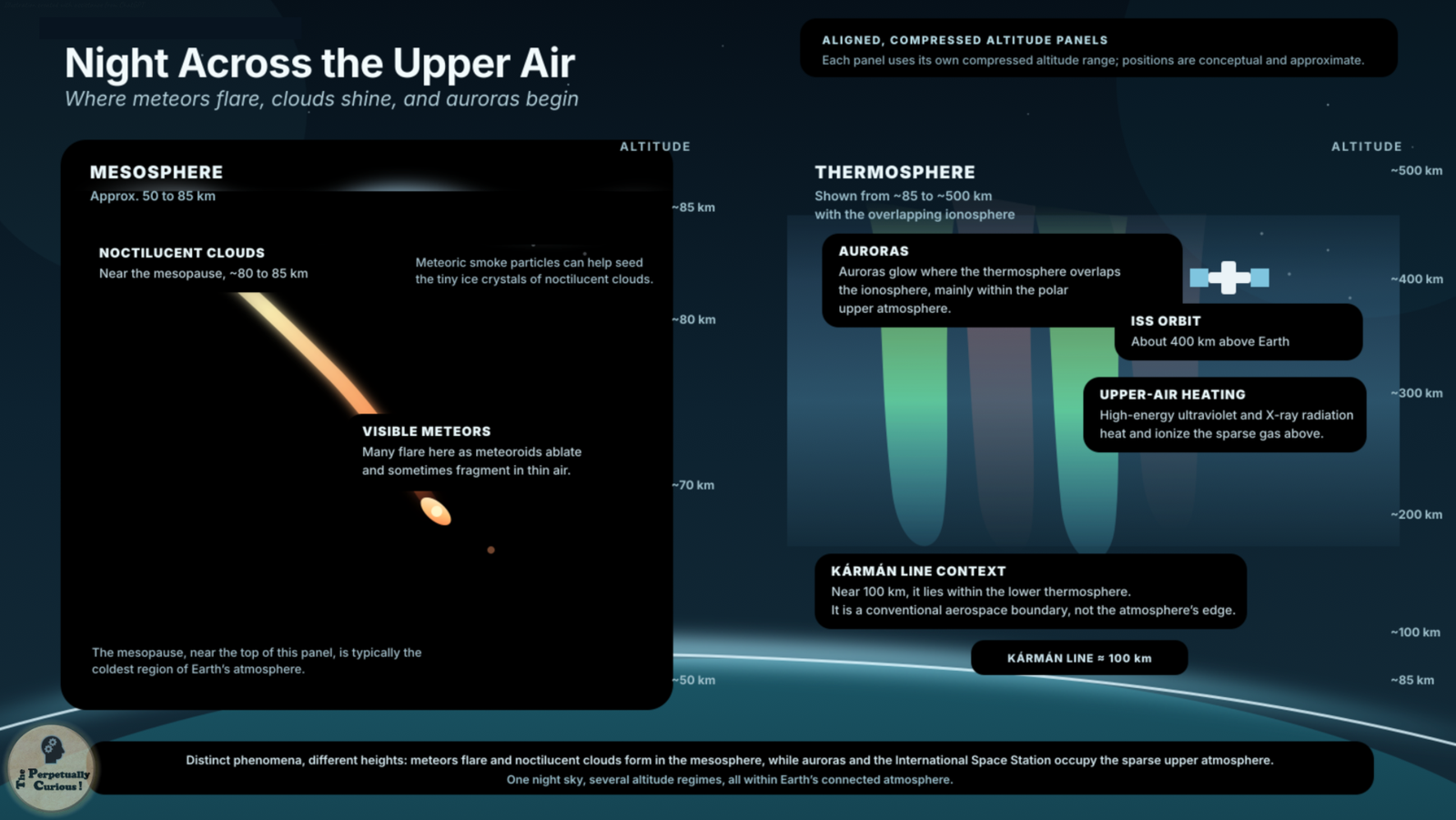
Although the air is far too thin to breathe, enough atmospheric particles remain to strongly affect incoming meteoroids. Some are asteroid fragments, while others originate from comets or interplanetary dust. As a meteoroid enters at high speed, collisions and rapid compression heat the surrounding gas and its surface. Material is stripped away through ablation, while mechanical stresses may cause the object to fragment. The heated gas and vaporized material produce the luminous path called a meteor or shooting star. Larger or denser fragments may continue into lower atmospheric layers, and any pieces that reach the ground are called meteorites.
The meteor story can continue even after the visible glow disappears. Near the top of the mesosphere, exceptionally cold conditions support noctilucent clouds, Earth’s highest clouds. Their tiny water-ice crystals can form around microscopic particles of meteoric smoke left behind by ablation. These clouds appear most often at high latitudes during summer, when the upper mesosphere is counterintuitively at its coldest. After sunset, they may remain illuminated while the lower atmosphere lies in shadow, allowing delicate blue or silvery patterns to glow against the darkening sky.
Despite hosting these striking phenomena, the mesosphere remains difficult to investigate directly. It is too high for conventional aircraft and weather balloons, yet too low for most satellites to maintain sustained orbits. Scientists therefore combine brief in-place measurements from sounding rockets with radar, lidar, and remote sensing from instruments above and below the layer. At the mesopause, the downward temperature trend ends. Higher still, energetic solar radiation begins warming the sparse atmosphere, opening into the thermosphere.
🌌 Thermosphere: rarefied air and shimmering auroras
Beyond the mesopause, the atmospheric temperature trend reverses once again. The thermosphere begins near 50 miles to 53 miles (80 kilometers to 85 kilometers) above Earth and extends several hundred miles farther, although its upper boundary shifts with solar activity and varies among scientific definitions. The air is extraordinarily thin, but temperature generally rises with altitude as sparse atoms and molecules absorb high-energy ultraviolet and X-ray radiation from the Sun. Their kinetic temperatures can reach several thousand degrees Fahrenheit, especially during heightened solar activity. Yet temperature here describes the average energy of individual particles, not the total amount of thermal energy the thin gas contains or can readily transfer to an object.
This absorption also prevents most cosmic X-rays from reaching instruments at Earth’s surface. Astronomers therefore lift X-ray detectors above most or all of the atmosphere. Scientific balloons can observe some higher-energy X-rays, while sounding rockets and orbiting observatories are used for wavelengths absorbed more strongly. The same atmospheric region that shields life below can consequently hide parts of the universe from instruments on the ground.
Absorption is only one way the upper atmosphere interacts with incoming energy and signals. Solar radiation also removes electrons from some atoms and molecules, creating the electrically active ionosphere. This region overlaps the upper mesosphere and much of the thermosphere rather than forming a separate thermal layer. Its charged particles vary with altitude, time of day, season, and solar conditions. They can refract, absorb, delay, or disrupt some radio waves, and certain frequencies can be bent strongly enough to return toward Earth.
The ionosphere and thermosphere also provide the stage for auroras. Variations in the solar wind transfer energy into Earth’s magnetosphere, where electrons and some ions can be accelerated along magnetic-field pathways toward the polar atmosphere. When these particles collide with oxygen and nitrogen, they excite the atoms and molecules. As the atmospheric particles return to lower-energy states, they release light that may appear as shifting curtains, arcs, rays, or diffuse glows across the night sky.
The effects of solar activity are not limited to light. Increased ultraviolet and X-ray radiation heats and expands the thermosphere, raising its density at a given orbital altitude and increasing drag on low-orbiting spacecraft. The International Space Station typically circles Earth at about 250 miles (400 kilometers), within the thermosphere, and requires periodic reboosts because even this extremely sparse air gradually lowers its orbit.
The same thin air that slowly alters an orbit becomes far more consequential when a spacecraft descends at hypersonic speed. A bow shock forms ahead of the vehicle as it encounters increasingly dense air, rapidly compressing and heating the gas in the shock layer. Although atmospheric-entry heating is often described loosely as friction, shock compression and the resulting flow of extremely hot gas dominate the severe thermal load around the vehicle.
The Kármán line, conventionally placed at about 62 miles (100 kilometers), lies within the lower thermosphere under the commonly used layer framework. It serves as a practical aerospace boundary between atmospheric flight and spaceflight, not as the physical end of Earth’s atmosphere. The thermosphere continues far above it until particle collisions become uncommon enough for the exosphere to begin.
🚀 Exosphere: where the last atoms drift into space
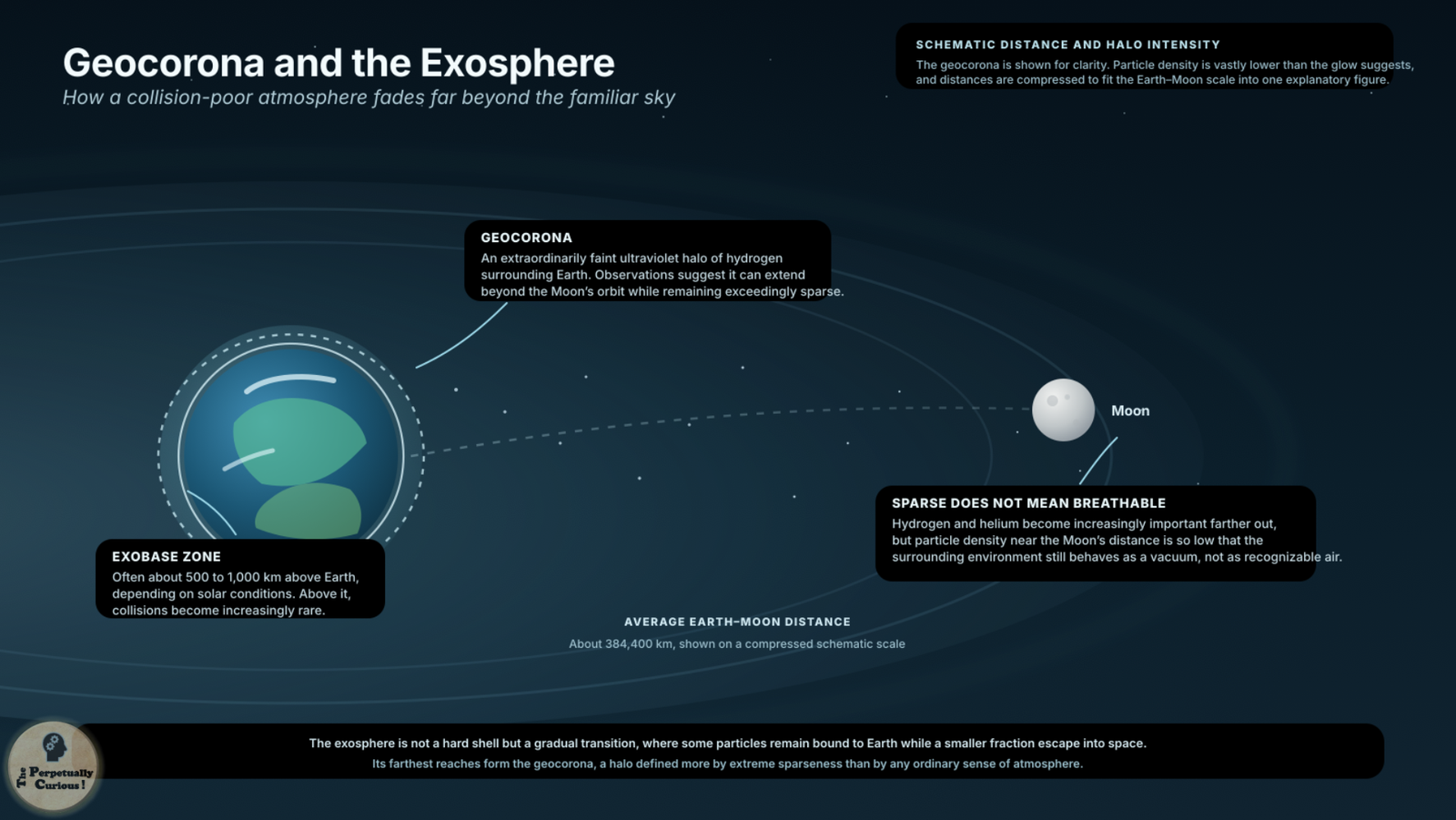
Above the thermosphere, Earth’s atmosphere does not end abruptly. It enters the exosphere, the outermost atmospheric region, beginning at the exobase. This boundary is often placed roughly 310 miles to 620 miles (500 kilometers to 1,000 kilometers) above Earth, although its altitude shifts with solar conditions and varies according to the definition being used. Beyond it, collisions become so infrequent that the gas no longer behaves like the continuous air familiar near the surface. Individual atoms and molecules instead travel along extended, largely independent paths.
The lower exosphere can still contain atomic oxygen and other species, while hydrogen and helium become increasingly prominent at greater heights. Many particles follow long, arcing trajectories under Earth’s gravity and eventually return toward denser atmospheric regions. A smaller fraction, especially among the lightest and fastest-moving particles, gains enough speed to escape into space.
Sunlit hydrogen in the outer exosphere forms the geocorona, an extremely faint ultraviolet halo surrounding Earth. Observations indicate that this halo can extend beyond the Moon’s orbit, although its particles are so sparse at that distance that the surrounding environment remains effectively a vacuum. Sunlight and changing space weather conditions can alter its density and shape, showing that even the atmosphere’s most distant reaches are not entirely still.
Some spacecraft travel through or orbit within the lower exosphere, but orbital categories such as low Earth orbit, medium Earth orbit, and high Earth orbit do not correspond one-to-one with atmospheric layers. Orbital regimes are defined by altitude, period, and geometry, while the exosphere itself has no universally fixed upper boundary.
There is therefore no sharp line where Earth’s atmosphere simply ends. The exosphere fades gradually into space as particle density falls and collisions become increasingly uncommon. At this final stage of the ascent, the atmosphere is no longer a continuous blanket of air, but a quiet frontier of wandering atoms, most still held by gravity and a smaller fraction slowly departing into the wider space environment. This gradual fading also reveals why the atmosphere cannot be understood through altitude alone: different scientific maps describe its temperature, chemistry, electrical behavior, and magnetic surroundings in overlapping ways.
🧭 One sky, more than one map
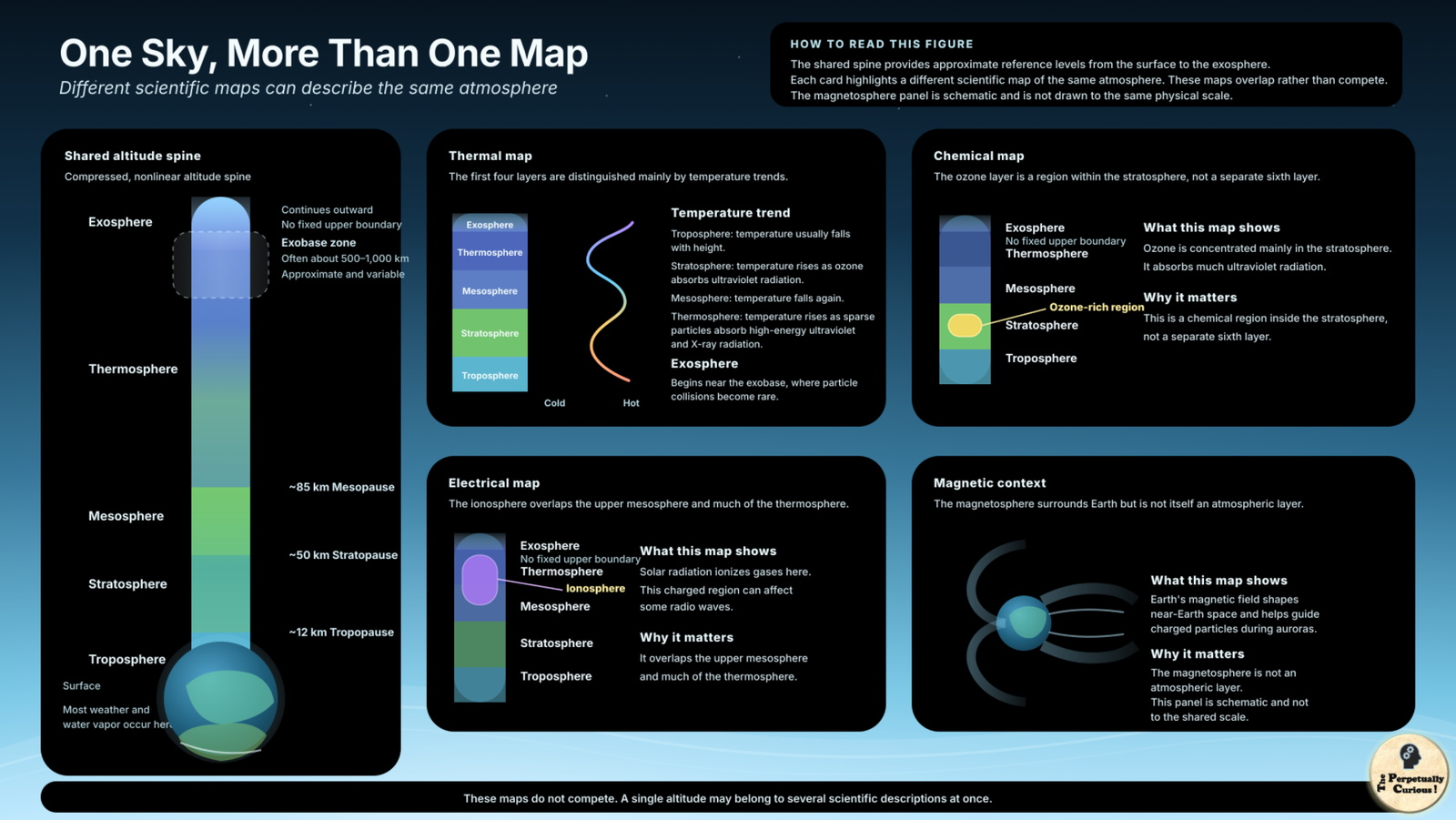
The familiar five-layer framework is one way of reading Earth’s atmosphere, but it is not the only one. The troposphere, stratosphere, mesosphere, and thermosphere are distinguished mainly by how temperature changes with altitude, while the exosphere begins near the exobase, where collisions between particles become increasingly rare. Scientists also map atmospheric and near-Earth regions according to chemistry, ionization, and magnetic influence.
The ozone layer, for example, is not a separate sixth layer. It is a chemically defined region within the stratosphere where ozone is concentrated strongly enough to absorb much of the Sun’s harmful ultraviolet radiation. The ionosphere is mapped differently. It overlaps the upper mesosphere and much of the thermosphere because it is defined by electrically charged particles created when solar radiation ionizes atmospheric gases.
Beyond and around these atmospheric regions extends the magnetosphere, a vast area of near-Earth space in which Earth’s magnetic field strongly influences the motion of charged particles. It is not an atmospheric layer, although it interacts closely with the ionosphere and upper atmosphere during auroras, geomagnetic disturbances, and changing space weather conditions.
These scientific maps do not compete with one another. Each reveals a different property of the same connected environment. The same altitude can therefore be described simultaneously as part of a thermal layer and an electrically active region, while also participating in Earth’s broader magnetic environment. Together, these overlapping maps reveal different dimensions of one connected planetary system.
🌎 From ground to space: one connected atmosphere
Seen through these overlapping scientific maps, the troposphere, stratosphere, mesosphere, thermosphere, and exosphere form one continuous atmosphere rather than a stack of sealed compartments. Energy enters, moves through, and leaves this system in different ways at different heights. Heat transferred from Earth’s surface drives much of the circulation in the troposphere. Ozone absorbs ultraviolet radiation in the stratosphere, while higher-energy ultraviolet and X-ray radiation warm the sparse particles of the thermosphere. Gravity, pressure gradients, circulation, chemistry, ionization, solar activity, and interactions with Earth’s magnetic environment connect these regions within a structure that is always changing.
Those connections also reach upward from below. Convection, thunderstorms, winds crossing mountains, and other disturbances in the lower atmosphere can generate atmospheric gravity waves that carry energy and momentum toward greater altitudes. As these waves propagate, dissipate, or break, they can alter winds, temperatures, and density in the mesosphere and thermosphere. Their influence can also reach the ionosphere, allowing weather near Earth’s surface to leave measurable signatures close to the boundary with space.
Together, these atmospheric regions help regulate Earth’s temperature and climate, sustain winds and the water cycle, filter much of the Sun’s biologically harmful ultraviolet radiation, and destroy or weaken many small meteoroids before they reach the surface. This filtering is both protective and selective. The atmosphere shelters life from hazardous radiation, yet it also absorbs or distorts some signals from the wider universe, requiring certain instruments to rise above the air to observe them clearly.
The journey from ground to space is therefore more than a sequence of altitude bands. It reveals a connected planetary system in which activity at one height can influence conditions far above or below it. The atmosphere is not a passive shell, but a dynamic meeting place through which energy, matter, weather, space, and life remain linked. Some of its most surprising connections emerge where familiar processes reach unexpected heights.
Pass this article along to someone curious and let the learning travel.
Did You Know
🌃 Even on nights without auroras, Earth’s upper atmosphere produces a faint natural glow known as airglow. It forms when atoms and molecules release energy after sunlight-driven excitation or through chemical reactions. Unlike auroras, airglow is a persistent background emission rather than a display produced mainly by incoming energetic particles.
⚡ Powerful lightning discharges can trigger sprites, brief red flashes that form roughly 31 miles to 56 miles (50 kilometers to 90 kilometers) above thunderstorms, mainly within the mesosphere. Intense electric fields generated above the storm disturb the thin upper atmosphere, creating a fleeting electrical connection between familiar weather below and the sky far above.
🌊 Earth’s atmosphere experiences global-scale tides as well as smaller gravity waves. These are vast waves moving through the air, not movements of ocean water. Driven mainly by repeating cycles of solar heating, with a smaller lunar contribution, atmospheric tides can travel upward and influence winds, electric fields, and ionospheric behavior.
🧪 Ozone can protect life or harm it depending on altitude. In the stratosphere, it filters much harmful ultraviolet radiation. Near Earth’s surface, elevated ozone concentrations can act as an air pollutant that damages lungs and vegetation.
🛰 Increased solar activity can heat and expand the thermosphere, increasing atmospheric drag on low-orbiting spacecraft and accelerating the descent of some orbital debris.
How many main layers does Earth’s atmosphere have?
Earth’s atmosphere is commonly described as having five principal layers: the troposphere, stratosphere, mesosphere, thermosphere, and exosphere. The first four are distinguished mainly by changes in temperature with altitude, while the exosphere begins where collisions between particles become increasingly rare.
Why is Earth’s atmosphere divided into layers?
Different parts of the atmosphere absorb energy in different ways. Earth’s surface warms the troposphere from below, ozone absorbs ultraviolet radiation in the stratosphere, and energetic ultraviolet and X-ray radiation warm the thermosphere. Gravity, pressure, chemistry, circulation, and particle collisions also change with altitude, producing distinct physical regions.
Is the ozone layer one of the five main atmospheric layers?
No. The ozone layer is a chemically defined region within the stratosphere where ozone concentrations are comparatively high. It is not a separate sixth thermal layer.
Why is the ionosphere not counted as a sixth main layer?
The ionosphere is an electrically active region in which solar radiation removes electrons from some atmospheric atoms and molecules. Because it is defined by ionization rather than by a particular temperature trend, it overlaps the upper mesosphere and much of the thermosphere instead of forming an independent sixth thermal layer.
Is the magnetosphere part of Earth’s atmosphere?
Not in the same sense as the five atmospheric layers. The magnetosphere is the vast region around Earth in which the planet’s magnetic field strongly influences the motion of charged particles. It interacts closely with the ionosphere and upper atmosphere, especially during auroras and geomagnetic disturbances.
What do the endings “sphere” and “pause” mean in atmospheric names?
“Sphere” identifies a broad atmospheric region, as in troposphere or stratosphere. “Pause” identifies a transition zone where the temperature trend changes, as in the tropopause, stratopause, and mesopause.
Where does most weather occur in the atmosphere?
Most weather occurs in the troposphere, which contains nearly all atmospheric water vapor. Heating from Earth’s surface drives rising air, winds, cloud development, and rain formation within this lowest layer.
Why does temperature usually decrease with altitude in the troposphere?
The troposphere is heated mainly from below by Earth’s surface. As air rises into regions of lower pressure, it expands and cools, so temperature generally decreases with altitude.
Can weather near Earth’s surface affect the upper atmosphere?
Yes. Thunderstorms, hurricanes, winds crossing mountains, and other disturbances can generate atmospheric gravity waves that carry energy and momentum upward. Some reach the mesosphere, thermosphere, and ionosphere, allowing weather far below to influence conditions near the boundary with space.
Why does temperature increase with altitude in the stratosphere?
Ozone absorbs ultraviolet radiation from the Sun and transfers part of that energy to the surrounding air as heat. This causes temperature to rise with altitude through much of the stratosphere.
Does the ozone layer block all ultraviolet radiation?
No. The atmosphere absorbs virtually all ultraviolet C and most ultraviolet B radiation, but most ultraviolet A and a smaller amount of ultraviolet B still reach the surface. This selective filtering protects life from much harmful radiation while allowing some ultraviolet-dependent biological processes to occur.
What are polar stratospheric clouds?
Polar stratospheric clouds form during exceptionally cold winters in the polar stratosphere. Depending on temperature and chemistry, their particles may contain nitric-acid compounds, supercooled mixtures of nitric acid, sulfuric acid, and water, or water ice. Reactions on their surfaces help transform chlorine- and bromine-containing compounds into forms that can rapidly destroy ozone when sunlight returns.
Why is the mesopause so cold?
Heating is comparatively weak near the mesopause, while radiative cooling and atmospheric circulation help drive temperatures downward. Together, these processes make it typically the coldest region of Earth’s atmosphere.
Why do meteors glow in the mesosphere?
A fast-moving meteoroid transfers energy to atmospheric particles and rapidly compresses the gas around it. Material stripped from the object through ablation, together with the heated surrounding gas, produces the luminous path called a meteor or shooting star.
Do all meteoroids disappear in the mesosphere?
No. Many small meteoroids ablate or fragment there, but larger or denser objects may continue into lower atmospheric layers. Any surviving fragment that reaches the ground is called a meteorite.
What are noctilucent clouds?
Noctilucent clouds are extremely high clouds made of tiny water-ice crystals near the mesopause. Some of their crystals form around microscopic particles of meteoric smoke. They can remain illuminated after the lower atmosphere has entered shadow, allowing them to glow blue or silver after sunset.
How do scientists study the mesosphere if satellites cannot remain there?
Scientists use sounding rockets for brief direct measurements and combine them with lidar, remote sensing, and specialized radar systems. Meteor radars can detect ionized trails left by meteors and use their movement to investigate winds in the upper mesosphere. The region is difficult to sample because it is too high for conventional aircraft and balloons but too low for most satellites to maintain sustained orbits.
Why can the thermosphere have such high temperatures when its air is so thin?
Temperature measures the average kinetic energy of particles. Thermospheric atoms and molecules absorb energetic ultraviolet and X-ray radiation, giving individual particles high kinetic energies. The gas is so sparse, however, that it contains relatively little thermal energy per unit volume and transfers heat inefficiently through collisions.
How does the ionosphere affect radio communication?
Charged particles in the ionosphere can refract, absorb, delay, or disrupt radio signals. The effect depends on frequency, altitude, time of day, location, and solar activity. Some frequencies can be refracted strongly enough to return toward Earth, enabling communication beyond the ordinary line of sight.
Where does the International Space Station orbit?
The International Space Station typically orbits about 250 miles (400 kilometers) above Earth, within the thermosphere. Residual atmospheric drag gradually lowers its orbit, so periodic reboosts are required.
What causes spacecraft to heat during atmospheric entry?
As a spacecraft encounters increasingly dense air at hypersonic speed, a bow shock forms ahead of it. Gas in the shock layer is rapidly compressed and heated, producing severe thermal loads around the vehicle. This process is more complex than simple rubbing or friction against the air.
Where do auroras occur, and why do they appear in different colors?
Auroras form mainly within the ionosphere, much of which overlaps the thermosphere. Energized electrons and some ions travel along Earth’s magnetic-field pathways and excite oxygen and nitrogen in the upper atmosphere. The resulting colors depend on the gas involved, the altitude and density of the interaction, and the energy of the incoming particles. Oxygen commonly produces green or red light, while nitrogen can contribute blue, violet, and reddish tones. Auroras are often visible across regions near the Arctic Circle, although the auroral oval is organized around Earth’s magnetic poles rather than the geographic Arctic Circle and can expand or shift with geomagnetic activity.
Do atmospheric layer boundaries stay fixed?
No. The tropopause shifts with latitude, season, and atmospheric conditions. The thermopause and exobase can also move substantially as changing solar activity causes the upper atmosphere to heat and expand or cool and contract. Quoted boundary heights are therefore averages or approximate ranges rather than permanent surfaces.
Do satellite orbits correspond directly to atmospheric layers?
No. Low Earth orbit, medium Earth orbit, and high Earth orbit are defined by altitude, orbital period, and geometry. These orbital regimes may overlap atmospheric regions, but they do not correspond one-to-one with the thermosphere or exosphere.
Is the Kármán line the edge of Earth’s atmosphere?
No. The Kármán line, conventionally placed at about 62 miles (100 kilometers), is a practical aerospace boundary between atmospheric flight and spaceflight. It lies within the lower thermosphere under the commonly used five-layer model, and the atmosphere continues far above it before gradually fading into space.
Is the exosphere completely empty?
No. The exosphere contains extremely sparse hydrogen, helium, atomic oxygen, and other particles. Most travel great distances without collisions, and many remain gravitationally bound to Earth even though the region behaves little like familiar air.
Does Earth’s atmosphere reach the Moon?
The dense, collision-dominated atmosphere familiar near Earth does not extend to the Moon. However, the geocorona, a faint ultraviolet glow produced by extremely sparse hydrogen in the outer exosphere, has been observed beyond the Moon’s orbit. At that distance, the particles are so widely separated that the lunar environment remains effectively a vacuum.
Why does Earth’s atmosphere not simply drift away into space?
Earth’s gravity holds most atmospheric particles close to the planet. Some lightweight and fast-moving particles, especially hydrogen, escape from the exosphere, but most remain gravitationally bound or eventually return toward denser atmospheric regions.
Why do some telescopes need to operate above Earth’s atmosphere?
Earth’s atmosphere is transparent to much visible light and selected radio wavelengths, but it absorbs X-rays, most ultraviolet radiation, and substantial portions of the infrared spectrum. Atmospheric turbulence can also blur visible observations. Placing space telescopes above the atmosphere allows astronomers to observe wavelengths and fine details that are inaccessible or distorted from the ground.
Can Earth’s atmosphere interfere with observations of the cosmic microwave background?
Yes. Atmospheric water vapor and oxygen absorb and emit microwave radiation, adding foreground signals that can interfere with extremely faint measurements. Ground-based observatories therefore favor exceptionally high, dry locations, while balloons and space observatories reduce atmospheric interference further when studying the cosmic microwave background.
Does Earth’s atmosphere shield the planet from dark matter in the same way it blocks some radiation?
Current evidence indicates no. Earth’s atmosphere can absorb, scatter, or distort electromagnetic radiation, but dark matter is not known to absorb, emit, or reflect light and appears to interact only very weakly with ordinary matter apart from gravity. Because its physical nature remains unknown, this conclusion reflects leading models and current observational constraints rather than a confirmed identification of dark matter.
Do other planets have atmospheric layers?
Many planets have vertically structured atmospheres, but their temperature patterns, chemistry, pressure, and layer thicknesses differ because of composition, gravity, distance from the Sun, and internal energy. These differences also produce varied forms of weather and precipitation across the Solar System.
Does the Moon have atmospheric layers?
The Moon has an extremely tenuous exosphere rather than a substantial layered atmosphere like Earth’s. Its lack of dense air, liquid water, and biological activity also helps explain why its lunar regolith differs so strongly from terrestrial soil.
How did Earth acquire its atmosphere?
Earth’s earliest envelope of lightweight gases was largely lost during the planet’s early history. Volcanic outgassing, volatile-bearing materials incorporated during formation, and later impacts contributed water vapor, carbon dioxide, nitrogen, and other gases to Earth’s early atmosphere. Over immense spans of time, interactions among rocks, oceans, sunlight, and living organisms transformed its chemistry. Photosynthetic life eventually increased atmospheric oxygen, helping create the atmosphere surrounding Earth today.
🌱 Let this skyward story travel farther
If this journey through Earth’s atmospheric layers brought the sky into clearer view or awakened a quiet sense of wonder, we invite you to share it with friends, family, or colleagues. Each shared curiosity helps this skyward story travel farther, allowing more readers to look upward and recognize the atmosphere as a layered, dynamic system that carries weather, filters sunlight, shelters life, and gradually opens into space.
“Sky in Slow Layers: Understanding Earth’s Atmospheric Structure.” The Perpetually Curious!, July 2026.
https://www.theperpetuallycurious.org/articles/layers-of-the-atmosphere/Continue Exploring
For what comes next
Site Updates gathers occasional notes, new additions, and ways to keep in touch. RSS brings new publications to your feed reader in chronological order.
Choose the path that speaks to you, and let the next curiosity find you wherever your wondering takes you.