

A train can move through the landscape with the smooth acceleration of electric traction while producing no diesel exhaust from its propulsion system. In many hydrogen passenger trains, compressed hydrogen serves as an onboard energy carrier. Fuel cells combine it with oxygen from the surrounding air to generate electricity, while water and heat are the principal products of the fuel-cell reaction at the point of use. From the passenger cabin, the journey can feel quiet and almost ordinary, even though the energy pathway beneath it is distinctly different.
Hydrogen trains are already operating in passenger service and demonstration programs, while other projects remain in testing or development. Their role is not to replace every diesel or overhead-electric train. Instead, they are being considered for selected regional corridors where continuous electrification may be difficult or costly and where predictable routes allow refueling to be concentrated at depots. Understanding where they fit begins with a practical question: what kinds of routes make an onboard hydrogen system worth considering? The answer begins not inside the train, but along the route itself.
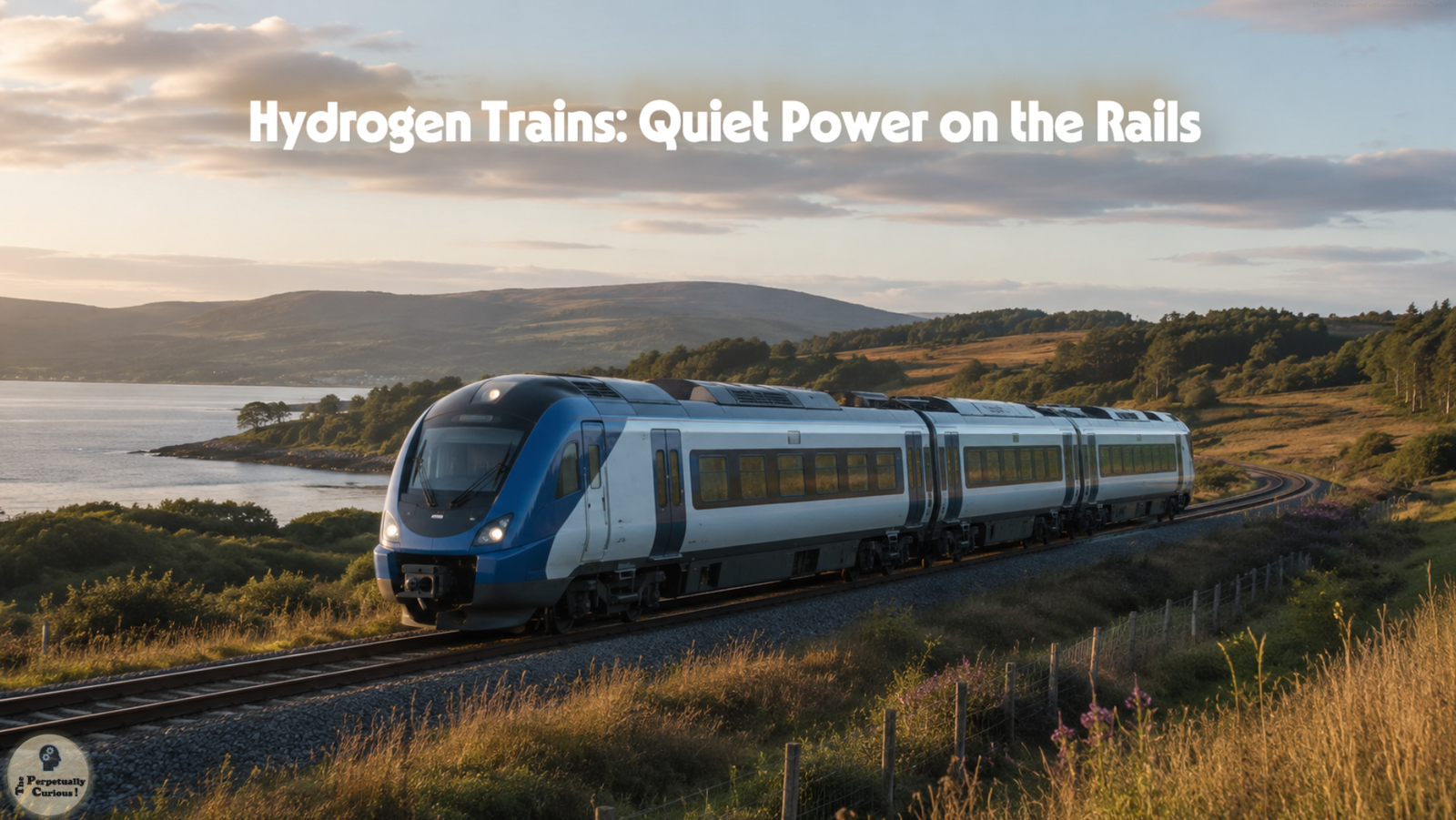
A train moves through the landscape with a calm purpose, carrying its quiet fire toward the horizon.
In the stillness between stations, its light breath of water and warmth settles into the air.
The rails continue forward, steady and patient, as new forms of motion find their place in the world.
🛤️ Why hydrogen trains emerged
Many regional rail lines operate without overhead electric wires. Extending continuous electrification across these routes requires more than installing catenary above the tracks. It may also involve substations, connections to the electrical grid, signaling adjustments, and clearance work around bridges and tunnels. On lines with lower traffic levels, constrained infrastructure, or difficult terrain, those investments may be harder to justify. Diesel trains therefore remain common because they carry their own fuel and can travel long distances, but their combustion engines release carbon dioxide and other air pollutants along the route.
Hydrogen trains offer one possible alternative on selected corridors. They carry compressed hydrogen on board and use fuel cells, supported by batteries, to generate electricity for electric traction without requiring continuous overhead wiring. At the point of use, the fuel-cell system produces water and heat rather than diesel exhaust. The broader environmental benefit, however, depends on how the hydrogen is produced, compressed, transported, and supplied to the railway.
These corridor-level conditions explain why hydrogen propulsion is being considered. They do not yet explain how stored hydrogen becomes controlled motion. That process begins inside the fuel-cell and battery system, where several streams of energy must be managed together.
🔋 How fuel cells and batteries work together
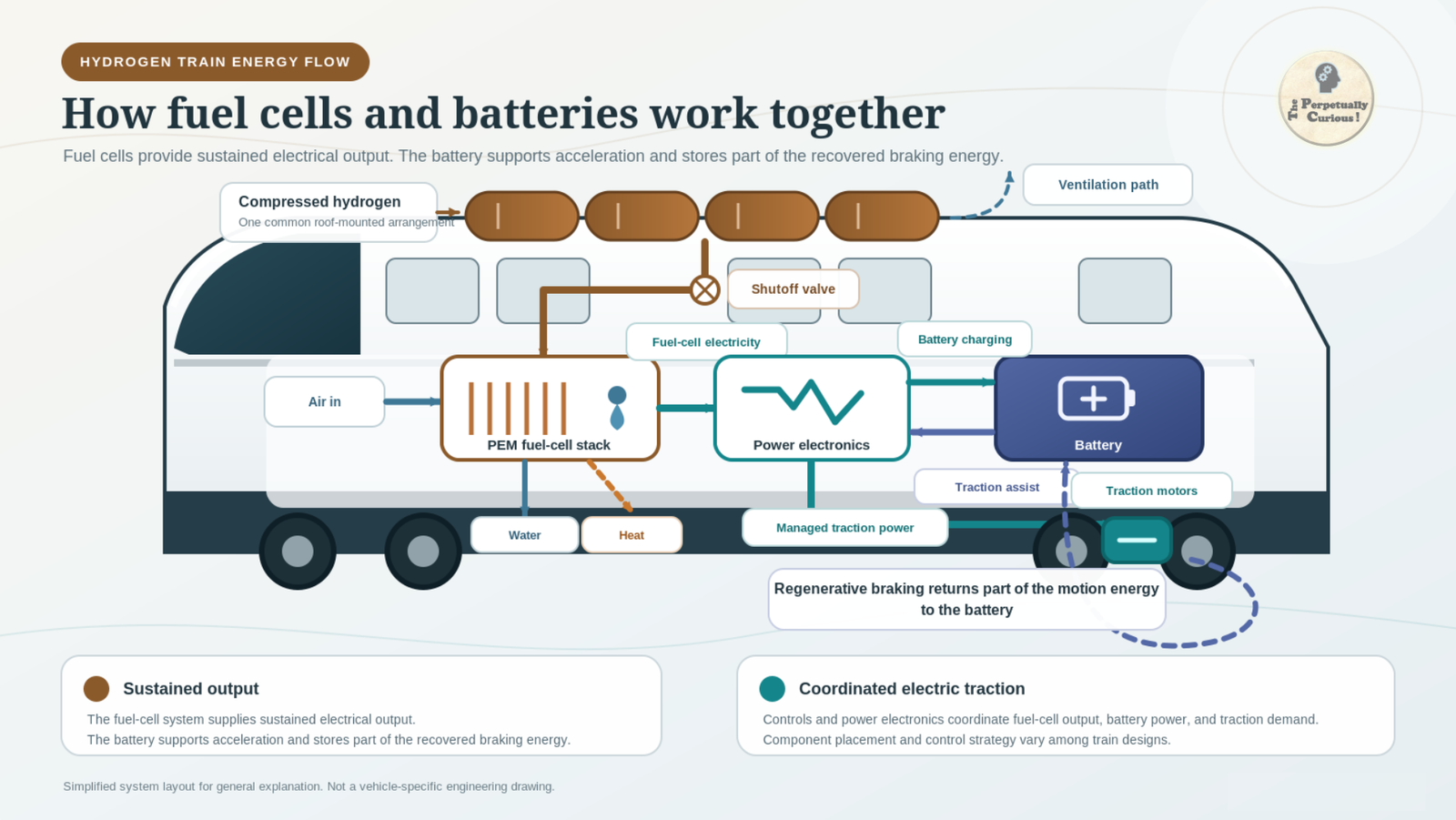
Many hydrogen passenger trains use a fuel-cell electric architecture, although the arrangement varies among multiple units, individual railcars, and locomotive-hauled designs. In a typical fuel-cell multiple unit, compressed hydrogen supplies a proton exchange membrane (PEM) fuel-cell system, while an onboard battery helps manage the changing power demands of rail travel. PEM fuel cells operate at relatively low temperatures, commonly around 176°F (80°C), which supports comparatively quick startup and makes them suitable for mobile applications. They combine hydrogen with oxygen from the surrounding air to produce electricity, water, and heat.
Hydrogen is stored in high-pressure composite tanks, with approximately 5,000 pounds per square inch (350 bar) used in prominent passenger-train designs. Tank locations vary, but roof-mounted installations and segregated equipment spaces can accommodate ventilation, protective structures, and supply lines around the storage system. A typical Type IV tank uses a polymer liner as a gas barrier, surrounded by carbon-fiber composite reinforcement that carries much of the pressure load. The complete storage system also includes valves, regulators, piping, supports, and protective components, so the engineering challenge involves both strength and efficient use of space.
Inside the fuel-cell stack, a catalyst at the anode separates hydrogen molecules into protons and electrons. The protons pass through the membrane, while the electrons travel through an external circuit and create usable electrical current. At the cathode, oxygen combines with the returning electrons and protons to form water. Onboard power electronics then manage the electrical output and direct it toward the traction motors, auxiliary systems, and battery, while heat and water are carried away from the stack.
Most fuel-cell passenger trains also use lithium-ion batteries. These batteries receive energy recovered through regenerative braking, provide additional power during acceleration, and absorb rapid changes in demand that would otherwise require the fuel cells to change output abruptly. This allows the fuel-cell system to operate within a steadier range while the battery responds to shorter power peaks. An onboard control system monitors traction demand, battery charge, and fuel-cell operation, continuously coordinating the flow of energy among the hydrogen system, battery, and motors.
Together, the fuel cells provide sustained electrical output while the battery handles faster changes in demand. This partnership shapes how the train accelerates, recovers energy, travels between refueling stops, and performs across different routes. Those operating consequences become clearer when range, speed, and refueling are considered together.
🚉 Range, speed, and refueling
Hydrogen passenger trains are being developed primarily for regional and commuter routes rather than very high-speed rail. Their performance varies with train architecture, route design, passenger load, weather, and operating requirements, so no single speed or range applies across the technology. One prominent example, Alstom’s Coradia iLint, has a maximum speed of about 87 miles per hour (140 kilometers per hour) and a specified range of up to about 621 miles (1,000 kilometers) on one filling. Normal service speeds may be lower, and an exceptional demonstration journey should not be confused with the range expected in routine operation.
Hydrogen contains substantial energy by mass. Its lower heating value is about 33.3 kilowatt-hours per kilogram, but that figure does not describe the complete onboard system. Hydrogen gas has low energy density by volume, even when compressed, while the tanks, valves, regulators, piping, and protective structures add weight and occupy space. Fuel-cell conversion also reduces the portion of the stored chemical energy that ultimately reaches the wheels. Hydrogen’s mass-based energy advantage must therefore be considered alongside the volume, weight, and complexity of the complete storage and conversion system.
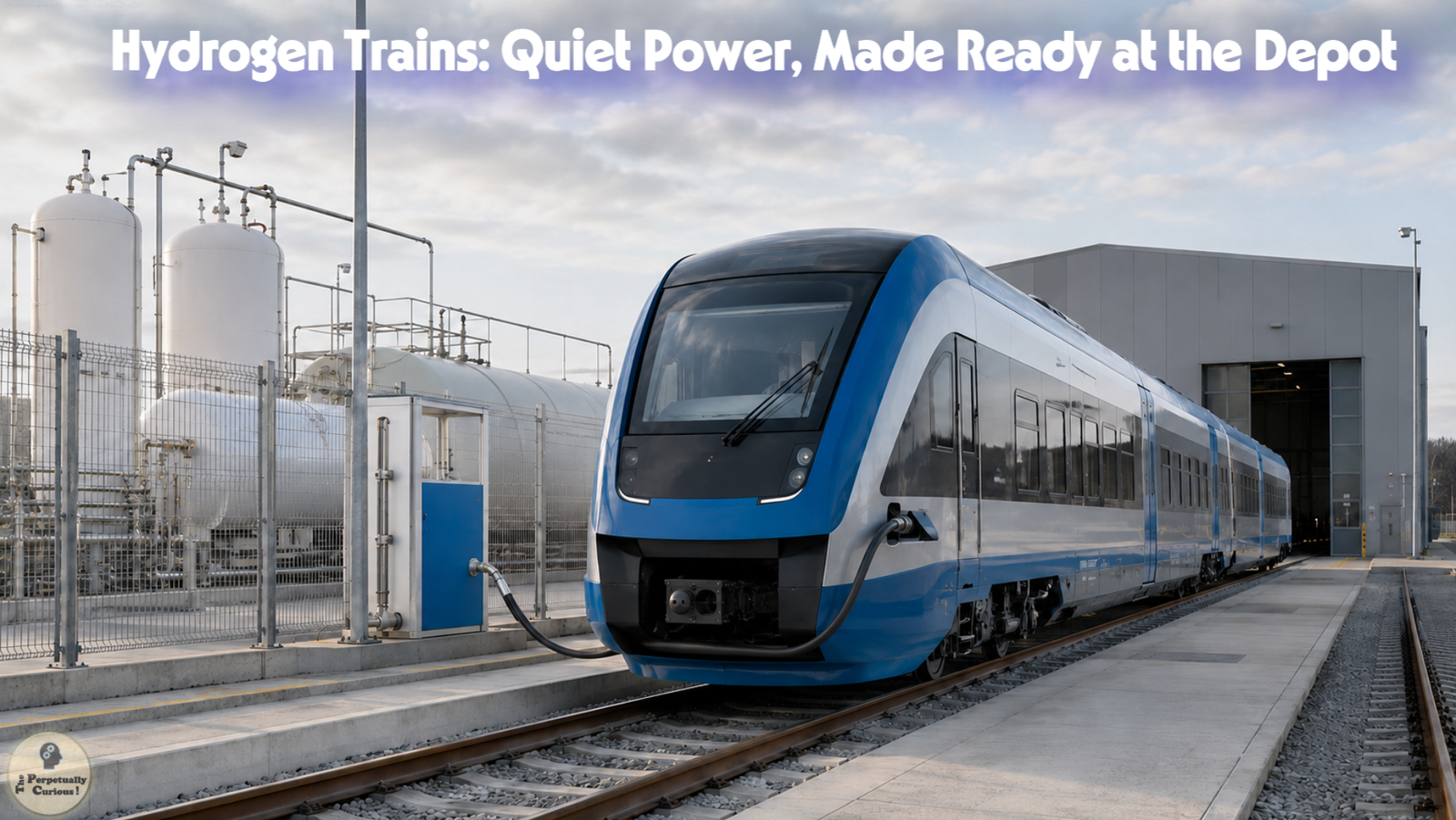
Refueling takes place at a depot, where compressed hydrogen is transferred from stationary storage or production equipment into the train’s onboard tanks. In documented German operation of the Coradia iLint, refueling has taken approximately 20 to 60 minutes, depending on the installation and operating conditions. Other trains and depot systems may differ, so refueling time should be treated as an infrastructure-dependent characteristic rather than as a universal advantage over diesel fueling or battery charging.
Range, speed, and refueling together determine whether a hydrogen train can support a particular route and timetable. Specifications alone, however, do not reveal whether a project has reached dependable passenger service. That distinction becomes clearer when operating fleets are separated from pilots, demonstrations, commissioning programs, and vehicles still under development.
🌐 Where hydrogen trains are operating and developing
As of July 2026, hydrogen rail does not represent one uniform stage of adoption. Some vehicles carry passengers on scheduled routes, while others remain in pilot operation, commissioning, demonstration, or specialized freight testing. Separating those categories gives a clearer picture than simply counting countries that possess a hydrogen-powered rail vehicle.
Germany placed two pre-series Coradia iLint trains into regular passenger service in Lower Saxony in 2018 and introduced a 14-train regional fleet in 2022. That experience also illustrates that commercial deployment depends on more than the vehicle itself. Refueling capacity, maintenance support, spare parts, and train availability must develop as one operating system. In California, the hydrogen-and-battery ZEMU entered regular Arrow passenger service between San Bernardino and Redlands in September 2025.
India inaugurated its first indigenously developed hydrogen fuel-cell passenger train on July 17, 2026, for operation on the Jind-Sonipat corridor in Haryana. The project represents an important operational pilot, although one inaugurated route should not be mistaken for a mature national hydrogen fleet. Italy remains at an earlier stage: its H2iseO trains have received authorization for commissioning and final testing, with regular passenger service planned for early 2027.
Elsewhere, the technology appears in several different forms. France has ordered dual-mode electric-hydrogen regional trains that can draw power from overhead wires on electrified sections and use fuel cells elsewhere. The United Kingdom’s HydroFLEX remains a heavy-rail demonstrator rather than a regular passenger fleet, while Japan’s HYBARI is a fuel-cell and battery test vehicle used to gather operating data. China has placed hydrogen-powered trams into commercial operation and continues developing hydrogen urban trains and other rail vehicles.
Canada illustrates another branch of the technology. CPKC is retrofitting diesel-electric locomotives with hydrogen fuel cells and batteries for freight, switching, and line-haul testing. These projects differ substantially from regional passenger multiple units, even though they share the principle of producing electric traction power from onboard hydrogen.
These examples show why simple country totals can be misleading. Hydrogen rail includes regional multiple units, dual-mode passenger trains, trams, experimental vehicles, and freight conversions, each at a different stage of technical and commercial maturity. Their presence on the rails is only one part of the wider question, since the environmental result depends heavily on how the hydrogen itself is produced and delivered.
🌱 Water vapor at the stack and the environmental picture
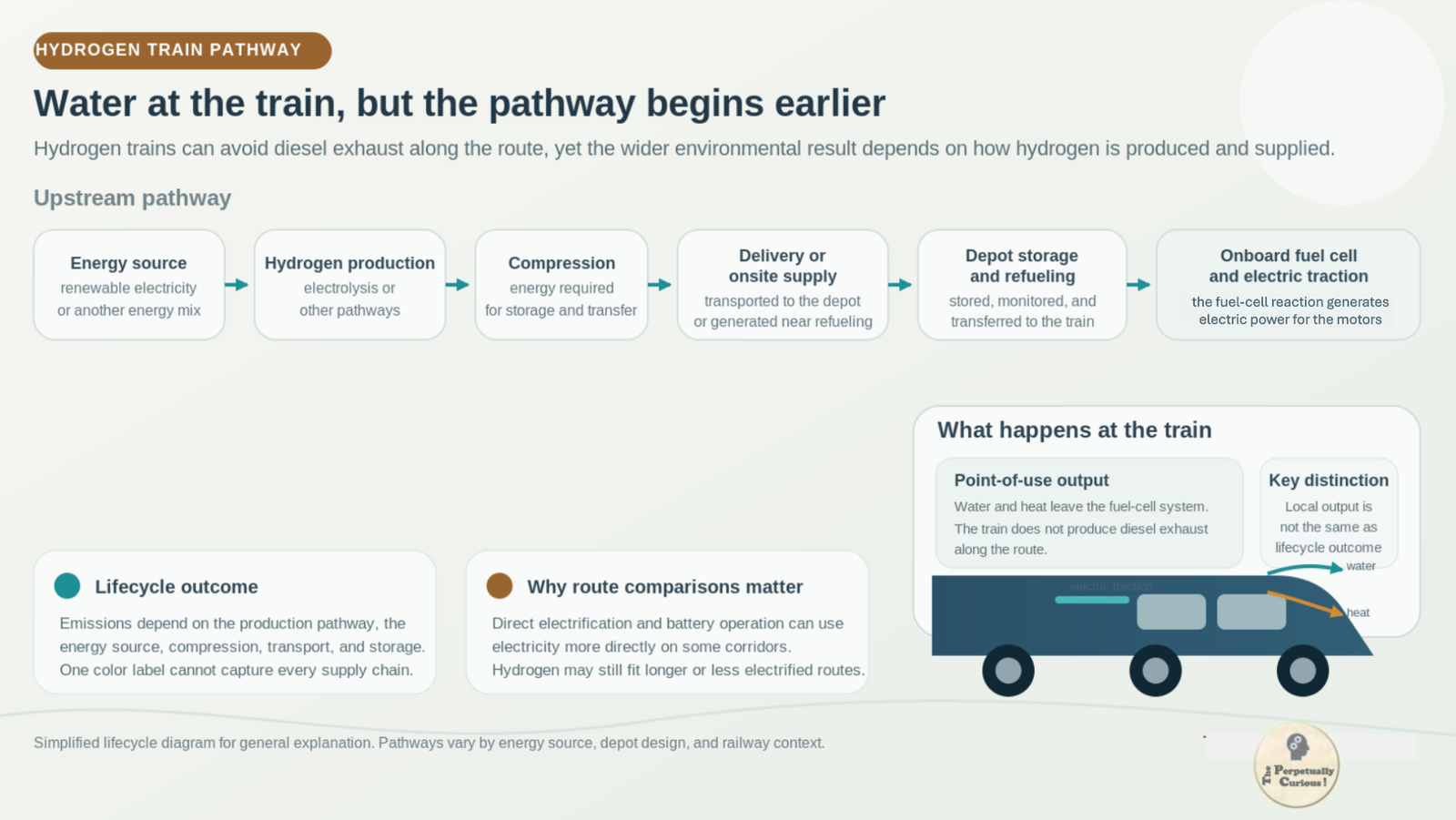
At the point of use, a fuel-cell train presents a clear contrast with diesel propulsion. Its fuel-cell system produces water and heat rather than exhaust from fuel combustion, so it does not release diesel soot or combustion-derived nitrogen oxides along the route. Depending on temperature, humidity, and system design, some of the water may appear briefly as a faint plume, while much of it may remain invisible or leave the train as liquid water.
That clean platform-level picture does not describe the train’s complete environmental footprint. Hydrogen must first be produced, compressed, transported or generated near the depot, stored, and then converted back into electricity aboard the train. Each stage requires energy and may create emissions, so the wider result depends on the complete supply pathway rather than on the fuel cell alone.
Color terms provide a convenient shorthand, but they do not represent universally standardized emissions categories. Hydrogen produced from natural gas without carbon capture is often called grey hydrogen. When carbon capture is added, it is commonly described as blue hydrogen, although the remaining footprint depends on factors such as methane leakage, capture performance, and energy use. Green hydrogen generally refers to hydrogen produced through electrolysis powered by renewable electricity, potentially including electricity from wind turbines. Electrolysis efficiency varies with the technology, operating conditions, and whether the calculation covers only the electrolyzer stack or the complete production system, so no single percentage accurately describes every installation.
Hydrogen trains can therefore eliminate diesel exhaust along the route while producing very different lifecycle outcomes depending on their hydrogen supply. Where continuous electrification or battery operation is practical, using electricity more directly avoids some of the conversion and storage losses involved in producing hydrogen and converting it back into electricity. Hydrogen may still offer an operational fit on selected longer or more difficult corridors, but its environmental value must be evaluated alongside those alternatives rather than in isolation.
The same storage system that gives a hydrogen train its onboard range also introduces a flammable gas held under high pressure. The environmental picture therefore leads naturally to another part of the engineering story: how hydrogen is contained, monitored, and controlled during normal operation and under abnormal conditions.
🛡️ Safety engineering and risk management
Hydrogen is flammable, colorless, and odorless, so safe rail operation cannot depend on human senses alone. Modern hydrogen trains are designed around railway, fuel-cell, pressure-system, and hydrogen-safety requirements that address storage, piping, ventilation, electrical interfaces, monitoring, maintenance, and emergency response. Current railway-specific standards separately cover onboard fuel-cell power systems and compressed-hydrogen fuel systems.
The storage tanks and their supporting systems must tolerate vibration, pressure cycling, environmental exposure, and the mechanical loads associated with rail operation. Protective structures, shutoff valves, pressure-relief devices, regulators, and segregated routing help reduce the likelihood that damage to one component will affect the wider train. Sensors monitor areas where hydrogen could escape, while control systems can isolate the fuel supply, stop fuel-cell operation, activate ventilation, or issue alarms when abnormal conditions are detected.
Hydrogen’s buoyancy can help an outdoor release rise and disperse, but this behavior does not eliminate risk. Inside maintenance buildings, roof spaces, or partially enclosed equipment compartments, gas movement depends strongly on ventilation, obstructions, and air circulation. Designs therefore direct possible releases away from passenger areas and use carefully positioned sensors and ventilation systems to reduce the chance of hydrogen collecting in enclosed pockets.
Engineers evaluate these systems through structured hazard and risk assessments. The precise methods vary among projects, but the purpose remains consistent: identify credible failure scenarios, reduce their likelihood through design and maintenance, and limit their consequences through detection, isolation, ventilation, pressure relief, training, and emergency procedures.
Most of this protective architecture remains outside the passenger’s awareness. What travelers encounter instead is the result of those systems working together: an electric journey whose sound, vibration, and motion can differ noticeably from diesel propulsion.
🚆 What passengers experience on a hydrogen train
Inside the passenger cabin, a hydrogen train generally feels much like another modern electric train. Electric traction provides smooth acceleration, while the absence of a continuously operating diesel engine removes much of the low-frequency rumble and vibration associated with combustion. Passengers may instead hear a quieter combination of traction motors, ventilation equipment, compressors, and wheels moving along the rails.
The actual sound level depends on the train design, speed, track condition, and auxiliary equipment, so hydrogen propulsion does not make the journey silent. Its clearest difference often appears at stations and during acceleration, where the mechanical pulses and exhaust noise of a diesel engine are absent. From the cabin, the transition between fuel-cell and battery power is managed automatically and may not be perceptible at all.
Fuel cells, hydrogen tanks, valves, and control equipment remain outside passenger spaces, commonly on the roof or within segregated technical compartments. Some operators use onboard displays or exterior markings to explain the propulsion system, but otherwise the experience can feel reassuringly familiar.
That familiarity helps frame the broader comparison. Hydrogen trains behave like electric vehicles on the rails, yet they carry, convert, and replenish energy in ways that differ from diesel trains, battery-electric trains, and trains supplied continuously through trackside electrification.
⚙️ Hydrogen, diesel, and battery trains in context
Railways can draw on several propulsion systems, and each places different demands on the vehicle, route, and supporting infrastructure. Diesel trains carry their own fuel and can travel long distances without trackside electrical equipment, but they release combustion emissions and depend on fuels supplied through petroleum refining. Trains powered continuously through overhead wires or a third rail avoid carrying most of their traction energy on board, although building and maintaining that infrastructure can be difficult to justify on lightly used or physically constrained corridors.
Battery-electric trains store electricity on board and may be especially useful where they can recharge beneath existing wires, at terminal stations, or along selected electrified sections. Their practical range depends on battery capacity, train mass, gradients, climate, timetable demands, and access to charging. Continuous electrification generally delivers electricity more directly, while batteries introduce charging and storage losses in exchange for the ability to cross unelectrified gaps.
Hydrogen trains also carry their energy on board, but fuel cells convert hydrogen into electricity that works with batteries and traction motors. This arrangement can provide greater autonomy than some battery-only configurations without requiring continuous overhead wiring. It also introduces a longer energy pathway that may include hydrogen production, compression, transport, storage, and conversion back into electricity. Dedicated refueling facilities and a dependable hydrogen supply must therefore be treated as part of the railway system rather than as external details.
When hydrogen is produced through electrolysis, those additional conversion stages generally require more electricity than supplying a train directly from an electrified track. That efficiency difference does not automatically rule hydrogen out, because infrastructure constraints, route length, depot access, and operating flexibility may outweigh energy efficiency on some corridors. It does mean that hydrogen should be compared with battery operation and continuous electrification on a route-by-route basis.
Hydrogen is therefore not simply a midpoint between diesel and batteries. It is one corridor-specific option within a broader rail toolkit. The most suitable choice depends on route length, traffic intensity, existing electrical infrastructure, charging or refueling opportunities, energy supply, maintenance capacity, and the railway’s emissions goals. Those same factors also reveal the practical constraints that must be examined before hydrogen can move from demonstration to dependable daily service.
⚠️ Limitations and considerations
Hydrogen trains can offer long onboard range, electric traction, and freedom from continuous overhead wiring, but those advantages come with technical and operational trade-offs. Their suitability depends on the complete railway system rather than on the train alone.
🌫️ Upstream emissions vary. Hydrogen production may create substantial emissions when it relies on fossil fuels, while lower-emission pathways depend on the electricity source, production method, compression, transport, and delivery chain.
⚡ The energy pathway is comparatively long. Producing hydrogen, compressing or transporting it, storing it, and converting it back into electricity introduces losses that direct electrification and some battery systems can avoid.
🏗️ Refueling infrastructure requires investment. Depots need a dependable hydrogen supply, storage, compression, dispensing equipment, monitoring systems, and trained personnel. The fueling system must also deliver enough hydrogen at the right times to support the railway timetable.
🧯 Onboard storage uses space. High-pressure tanks and their protective equipment can occupy substantial roof or equipment-compartment volume. Tank placement may also influence vehicle layout, weight distribution, clearance requirements, and maintenance access.
🔋 Hybrid integration and component life matter. Fuel-cell stacks, batteries, power electronics, valves, sensors, compressors, and thermal-management equipment must operate as one coordinated system while aging in different ways. Rail operators therefore need condition monitoring, trained technicians, replacement planning, and dependable spare-parts support.
🚄 Hydrogen is not generally aimed at very high-speed rail. Current projects are concentrated mainly in regional passenger service, commuter routes, trams, switching operations, and selected freight applications.
Taken together, these constraints shift the central question from whether hydrogen trains can work to where the complete operating system can work reliably. That question leads naturally from technical feasibility to the quieter significance of hydrogen rail within the wider energy transition.
🔄 A quiet shift in rail energy
Fuel-cell hydrogen trains show how regional rail can change its energy system without changing the familiar structure of the journey. Tracks, stations, timetables, and electric traction remain, while the source of onboard power shifts from combustion toward electrochemistry. Compressed hydrogen is stored in reinforced tanks, converted into electricity through fuel cells, and balanced with battery power as the train moves along its route.
Much of this transformation remains hidden from passengers. A hydrogen train may resemble another modern regional unit, and the transition between fuel-cell and battery power is managed automatically. What changes most clearly is the machinery behind the motion: diesel combustion and exhaust are replaced at the point of use by fuel cells, power electronics, batteries, and electric motors. The result is often quieter at stations and during acceleration, while the broader environmental outcome still depends on how the hydrogen is produced and delivered.
Hydrogen rail is not a universal replacement for diesel, batteries, or continuous electrification. Its significance lies in the possibility that certain routes may gain another carefully engineered option. A traveler who wonders how a train can cross an unelectrified landscape without burning diesel may find the answer in a coordinated system of membranes, catalysts, compressed gas, batteries, and motors working quietly beneath an otherwise familiar journey.
Pass this article along to someone curious and let the learning travel.
💡 Did You Know?
🧩 A fuel-cell stack is built from many individual cells Each PEM cell produces only a modest voltage, so engineers connect many cells in series to create a stack with useful electrical output. The exact number of cells depends on the voltage and power requirements of the train’s propulsion system.
🗜️ Light hydrogen does not mean compact storage Hydrogen is the lightest element, but hydrogen gas also has low energy density by volume. Even when compressed, a train needs substantial reinforced tanks together with valves, regulators, piping, supports, and protective equipment to carry a useful quantity of fuel.
💧 Most of the water mass comes from the surrounding air A fuel cell combines onboard hydrogen with oxygen drawn from the air. Through this reaction, 1 kilogram of hydrogen can form about 9 kilograms of water, which may leave the system as liquid water or vapor depending on the train’s design and operating conditions.
❄️ Cold-weather preparation can begin at shutdown Water remaining inside a PEM fuel-cell system can freeze at sufficiently low temperatures. Freeze-protection strategies may therefore include removing water during shutdown, warming selected components, and carefully managing the next startup.
🔥 A hydrogen flame may be difficult to see Pure hydrogen can burn with a pale blue flame that is difficult to detect in daylight and produces relatively little radiant heat. Hydrogen systems therefore rely on gas and flame detectors rather than human sight, smell, or heat sensation alone.
♻️ Regenerative braking cannot recover all of the train’s motion energy During regenerative braking, traction motors operate as generators and return part of the train’s kinetic energy to the battery. Conversion and storage losses prevent complete recovery, but the captured energy can support later acceleration and reduce the immediate demand placed on the fuel-cell system.
What is a hydrogen train?
In the fuel-cell designs discussed here, a hydrogen train carries compressed hydrogen on board and converts its chemical energy into electricity. That electricity powers traction motors, usually with a battery helping to manage acceleration, recovered braking energy, and changing power demand.
Why are hydrogen trains mainly used on regional routes?
Current hydrogen-train projects are concentrated mainly on regional routes because these often combine moderate speeds, predictable daily distances, regular returns to depots, and sections without continuous overhead wiring. Those conditions may make centralized hydrogen refueling more practical than it would be for very high-speed or heavily used rail networks.
How far can a hydrogen train travel on one refueling?
Range varies among designs and operating conditions. Alstom’s Coradia iLint is specified for up to about 621 miles (1,000 kilometers) on one refueling, although passenger load, weather, gradients, reserve requirements, and timetable demands can change the distance achieved in routine service.
How is hydrogen stored on a train?
Hydrogen is stored in reinforced high-pressure tanks. Approximately 5,000 pounds per square inch (350 bar) is used in prominent passenger-train designs such as the Coradia iLint, although storage pressure and tank arrangement can differ among vehicles. The complete system also includes valves, regulators, piping, supports, and protective equipment.
Can a hydrogen train also use overhead electricity?
Some designs can. Dual-mode trains may draw electricity from overhead wires on electrified sections and use hydrogen fuel cells on stretches without catenary. Other hydrogen trains are self-contained fuel-cell and battery vehicles, so their available power modes depend on the vehicle architecture and the route for which they were designed.
Are hydrogen trains considered safe?
Hydrogen trains are engineered with high-pressure storage systems, leak and flame detection, ventilation, shutoff valves, isolation systems, pressure relief, and emergency procedures. Their safety requirements must also account for rail-specific vibration, mechanical loads, maintenance conditions, and the behavior of hydrogen in enclosed spaces.
Do hydrogen trains produce emissions?
At the point of use, the fuel-cell system produces water and heat rather than diesel-combustion exhaust. The wider environmental footprint depends on how the hydrogen is produced, compressed, transported, and stored. Renewable electricity from sources such as wind turbines can power electrolysis, but the complete pathway still requires energy and supporting infrastructure.
How do hydrogen trains compare with battery-electric and continuously electrified trains?
Continuous electrification generally supplies electricity most directly but requires extensive trackside infrastructure. Battery trains can work well where charging or partial electrification is available. Hydrogen may provide greater onboard autonomy than some battery configurations, but it requires refueling infrastructure and introduces additional energy-conversion stages. No option is best for every corridor.
Where are hydrogen passenger trains currently operating?
As of July 2026, Germany pioneered regular hydrogen passenger operation with two pre-series Coradia iLint trains in 2018 and introduced a 14-train fleet in 2022. California’s hydrogen-and-battery ZEMU is in regular Arrow commuter service. India inaugurated a hydrogen passenger pilot on the Jind-Sonipat corridor in July 2026. Italy’s H2iseO trains remain in final testing rather than regular service, with passenger operation planned for early 2027. Other countries have demonstrators, trial programs, trams, or freight-locomotive projects.
Can hydrogen trains operate in cold climates?
Yes, but low temperatures require careful thermal and water management. Water inside a PEM fuel-cell system can freeze, so designs may warm components, manage shutdown conditions, and control startup to protect the stack and maintain performance.
Are hydrogen trains quieter than diesel trains?
They are often quieter at stations and during acceleration because they use electric traction rather than a continuously operating diesel engine. Passengers still hear traction motors, ventilation equipment, compressors, wheels, and track noise, so the journey is quieter rather than silent.
Do hydrogen trains require special tracks?
They do not require a new kind of rail solely because they use hydrogen and can operate on conventional railway infrastructure appropriate to the vehicle and route. However, the train still requires certification, suitable loading clearances, compatible signaling and maintenance facilities, trained personnel, and dedicated hydrogen refueling infrastructure.
Can existing diesel trains be converted to hydrogen power?
Some diesel-electric locomotives can be retrofitted with hydrogen fuel cells, batteries, power controls, and hydrogen storage while retaining their electric traction motors. This is a substantial engineering conversion rather than a simple fuel substitution, and it still requires structural assessment, cooling and ventilation changes, safety approval, maintenance preparation, and refueling infrastructure.
⭐ Let the quiet journey travel farther
If this exploration offered a new way to see the engineering beneath familiar rail journeys, we warmly invite you to share it with friends, colleagues, and fellow curious minds. A thoughtful question passed from one reader to another can carry these evolving stories of energy, engineering, and motion farther along the line.
“Quiet Power on the Rails: Understanding Hydrogen Trains and Their Emerging Role.” The Perpetually Curious!, July 2026.
https://www.theperpetuallycurious.org/articles/hydrogen-trains/Continue Exploring
For what comes next
Site Updates gathers occasional notes, new additions, and ways to keep in touch. RSS brings new publications to your feed reader in chronological order.
Choose the path that speaks to you, and let the next curiosity find you wherever your wondering takes you.