

From a distance, a wind turbine can look unhurried. One blade rises, crosses the sky, and dips toward the ground. Air passes through the circle traced by the blade tip. Some of the wind’s energy makes its way into the electrical grid.
That journey begins with uneven heating of Earth’s surface. Differences in heating help create differences in air pressure, which set air in motion. Earth’s rotation shapes large-scale winds, while terrain and surface friction alter the flow closer to the ground. A windmill could put a turning shaft to work grinding grain or pumping water. A modern wind turbine uses the same kind of motion to drive a generator.
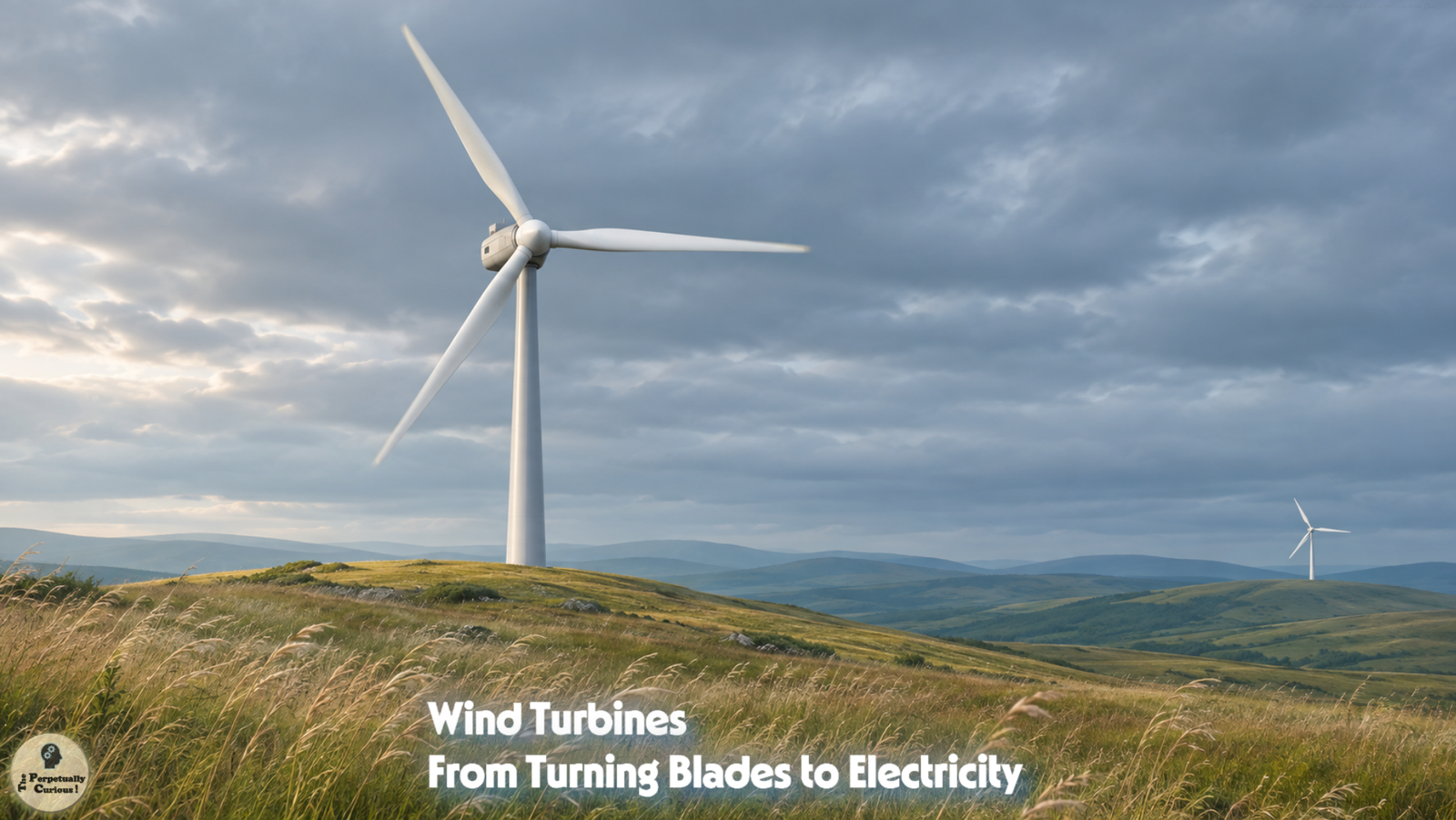
The wind moves on, leaving no mark we can hold, yet something of its passing continues beyond the turning blades.
In that quiet exchange, motion becomes a current carried farther than the eye can follow.
🔄 How a blade turns moving air into rotation
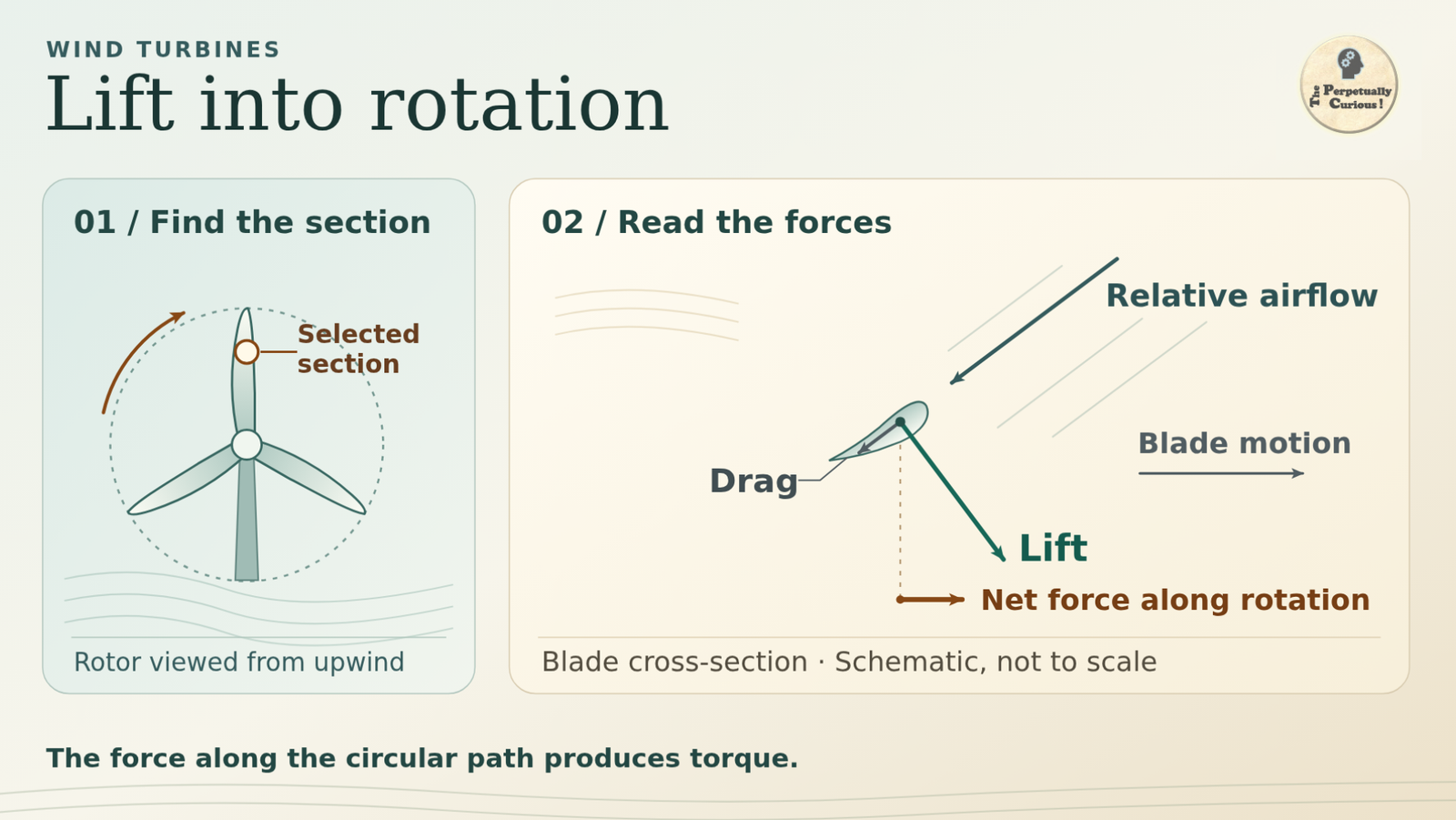
A turbine blade is shaped like a wing. As air flows around it, the blade turns the flow and experiences different pressures across its surfaces. These are two views of the same interaction. The resulting aerodynamic force includes lift, which acts perpendicular to the airflow relative to the blade. Part of that force acts along the blade’s circular path, producing the turning effect engineers call torque.
Each blade section meets the wind at an angle shaped in part by its own motion. The tip travels farther per turn than a point near the hub, so it moves faster and meets the local flow at a different angle. The blade twists along its length so each section can meet the flow at a useful angle. The angle between the oncoming flow and a line joining the section’s leading and trailing edges is its angle of attack. If that angle becomes too steep, the flow can separate and the section can lose lift. Engineers call this stall.
The blades and hub together form the rotor. The circle traced by the blade tips encloses its swept area. At the same wind speed and air density, a larger swept area puts more wind power within reach.[1] The rotor supplies the turning motion that drives the generator.
⚙️ How a generator turns motion into electricity
Behind the rotor sits the nacelle, the housing at the top of the tower. In a geared turbine, the gearbox takes the rotor’s slow, high-torque rotation and delivers faster rotation to the generator. A direct-drive turbine couples the rotor to a generator designed to work at rotor speed.
Inside the generator, rotation changes how the magnetic field passes through coils of wire. That change in magnetic flux induces a voltage, which can drive current when the circuit is closed. This is electromagnetic induction. The same conversion of rotation into electricity happens in diesel-electric locomotives, where a diesel engine supplies the motion and a generator produces electricity for the traction motors.
The generator depends on rotation, and the wind that drives it rarely holds steady.
🎛️ How a turbine responds to changing wind
On a typical upwind turbine, the yaw system turns the nacelle so the rotor faces the wind. The pitch system rotates the blades around their own long axes, changing how they meet the air. Yaw points the rotor. Pitch changes how strongly the wind drives it.
For the same swept area and air density, a 20 mph wind (about 9 m/s) carries eight times as much power as a 10 mph wind (about 4.5 m/s). The power available in the wind rises with the cube of its speed.[1] A turbine’s electrical output follows its own pattern. Below the cut-in speed it delivers no useful power. Above cut-in, output generally rises until it reaches rated power, the turbine’s specified full-power electrical output. Many turbines then adjust blade pitch to limit output and mechanical loads. At a model-specific high-wind threshold, a turbine may shut down to protect the machinery.
🔌 How electricity reaches the grid
The rotor of a variable-speed turbine can turn faster or slower as the wind changes, while the grid operates at a common frequency. Some variable-speed turbines use a full converter. Its power electronics change the generator’s alternating current (AC) into direct current (DC), then convert it back to AC synchronized with the grid. The intermediate DC step lets the grid-side electronics set the output frequency independently of the generator’s frequency. Other turbine designs connect the generator to the grid differently.
A transformer raises the voltage for the cables that collect power from the turbines. At higher voltage, the same amount of power can travel at lower current under comparable conditions, which reduces heating losses in the conductors. From the collection system, power passes through a substation, where another transformer can raise the voltage again for transmission on the wider network.
🦇 How turbines interact with wildlife
The electricity moves on through the grid, while the turbines remain part of the landscape or seascape. Near the turbines, birds and bats can collide with the blades, and the risk varies by species, season, and site. At some land-based projects, limiting blade rotation in low winds during periods of high bat activity can reduce bat fatalities.[2] Offshore, pile driving for some fixed foundations can produce underwater noise that affects marine mammals. The effects depend in part on the installation method and the animals present.[3]
From a distance, the blades still seem unhurried. Air leaves the circle and moves on. Some of the energy it brought to the rotor continues by wire.
💡 Did you know?
📐 Even an ideal rotor has a ceiling. Under the assumptions of the Betz model, a rotor can capture at most about 59.3 percent of the power in the undisturbed wind passing across its swept area.[1] Air has to keep moving through the rotor for it to keep drawing energy from the flow. The Betz limit describes aerodynamic capture, while electricity delivered to the grid also reflects losses farther down the chain.
🌀 A turbine leaves a wake of slower air that is often more turbulent. In a wind farm, that wake can reach another rotor and reduce its output. Under some wind conditions, turning an upstream rotor slightly away from the wind can move the wake enough to increase the farm’s total output, even as the upstream turbine gives up some power. This is called wake steering.[4]
🔋 In the late 1880s in Cleveland, Charles F. Brush used a wind-driven generator to charge batteries. The stored electricity helped light his home with incandescent bulbs.[5] Long before wind farms fed public grids, the turning of one rotor could supply light even after the wind died down.
Pass this article along to someone curious and let the learning travel.
Why are wind turbine towers so tall?
Near the ground, friction with the surface tends to slow the wind. A taller tower can place the rotor in faster air. How much that helps depends on the terrain and how wind speed changes with height at the site.
What happens when the wind drops?
A turbine stops generating when the wind at its rotor falls below cut-in speed. Across the grid, operators balance changes in wind generation against demand using resources such as other generators, power transfers, and storage where available.
Why might a wind turbine stand still on a windy day?
Wind at rotor height can differ from what you feel on the ground. If it exceeds the turbine’s operating limit, the machine may shut down to protect its equipment. A turbine may also be stopped for maintenance or because of operating restrictions.
What is the difference between rated power and capacity factor?
Rated power is an output level, expressed in units such as megawatts. Capacity factor compares the electricity actually generated over a given period with the amount the turbine would have generated by running at its rated power throughout that same period. Two turbines with the same rating can therefore deliver different amounts of electricity over a year.
Does a water turbine generate electricity the same way?
The generator can use the same principle of electromagnetic induction. In a hydroelectric plant, flowing water turns the turbine instead of air turning the blades. The story of hydroelectric power at Niagara Falls shows how water is shared between power generation and the falls themselves.
How do offshore turbines stay upright?
Fixed-bottom turbines stand on structures anchored to or resting on the seabed. Floating turbines sit on buoyant platforms held in position by mooring lines connected to seabed anchors. The platform is designed to move within limits as wind and waves act on it.
🪁 Let the story travel
If the next turning blade catches your eye, share this piece with someone who might pause to watch it with you.
Educational context
This article describes the principles of grid-connected wind turbines. Turbine designs, operating conditions, and wildlife interactions vary by site.
Selected sources
- U.S. Department of Energy. (n.d.). Small Wind Guidebook.
- Whitby MD, O’Mara MT, Hein CD, et al. (2024). A decade of curtailment studies demonstrates a consistent and effective strategy to reduce bat fatalities at wind turbines in North America. Ecological Solutions and Evidence, 5(3), e12371.
- ICF. (2021). Comparison of Environmental Effects from Different Offshore Wind Turbine Foundations. U.S. Department of the Interior, Bureau of Ocean Energy Management.
- Howland MF, Lele SK, Dabiri JO. (2019). Wind farm power optimization through wake steering. Proceedings of the National Academy of Sciences, 116(29), 14495-14500. [PMID: 31262816]
- The Mills Archive Trust. (n.d.). Charles Brush (1849-1929).
“The Turning Wind: How Wind Turbines Generate Electricity.” The Perpetually Curious!, November 2026.
https://www.theperpetuallycurious.org/articles/how-wind-turbines-generate-electricity/Continue Exploring
For what comes next
Site Updates gathers occasional notes, new additions, and ways to keep in touch. RSS brings new publications to your feed reader in chronological order.
Choose the path that speaks to you, and let the next curiosity find you wherever your wondering takes you.