

The stars can make time look still. A familiar point of light returns each season, apparently unchanged, while generations pass beneath it. Yet stars are not fixed lights. Across their lives, nuclear reactions reshape their interiors, the balance of pressure and gravity adjusts, and the conditions that sustain their light gradually change.
Our Sun offers a nearby way into this immense story. About 4.6 billion years old, it is partway through its long hydrogen-burning chapter. Following what happens next reveals why some stars swell into giants, why others end in explosions, and why the material left behind matters to worlds that have yet to form.
The stars seem permanent because their changes unfold beyond the span of a human life.
Yet their story is not one of stillness, but of transformation, where fading lights help prepare the material for lights yet to come.
⚖️ A star keeps its balance
The story begins with star formation, when gravity gathers gas into an object whose center eventually becomes hot and dense enough to sustain hydrogen fusion. Once fusion in the core becomes its enduring energy source, the star joins the main sequence, the longest active phase for most stars.
Gravity keeps pulling inward. A pressure gradient in the hot interior provides support against that pull, while nuclear fusion replaces energy escaping into space. Unlike an ordinary fire, this energy source does not require combustion with oxygen. The balance of pressure and gravity, called hydrostatic equilibrium, continues as the star evolves.
In a main-sequence star like the Sun, thermal feedback helps maintain this stability. If the core contracts, it heats up and fusion generally increases. Extra heating can then promote expansion, which cools the core and slows the reactions. This feedback helps the star adjust to disturbances while continuing its long hydrogen-burning chapter.
The pace depends strongly on mass. Astronomers compare stars using solar mass, with the Sun defining one unit. More massive main-sequence stars generally develop hotter cores and radiate energy much faster. Their greater fuel supply is outweighed by their much greater rate of consumption, so the most massive stars live only a few million years.[1]
At the other end of the scale, the smallest red dwarfs use hydrogen so slowly that models predict lifetimes of trillions of years. Their eventual endings remain forecasts: the universe, about 13.8 billion years old, has not existed long enough for such stars to finish their ordinary evolution.
Between these extremes lies the Sun. Its main-sequence phase lasts roughly 10 billion years in total. Even during this comparatively steady interval, however, its interior is preparing the next chapter.
☀️ The quiet changes inside the Sun
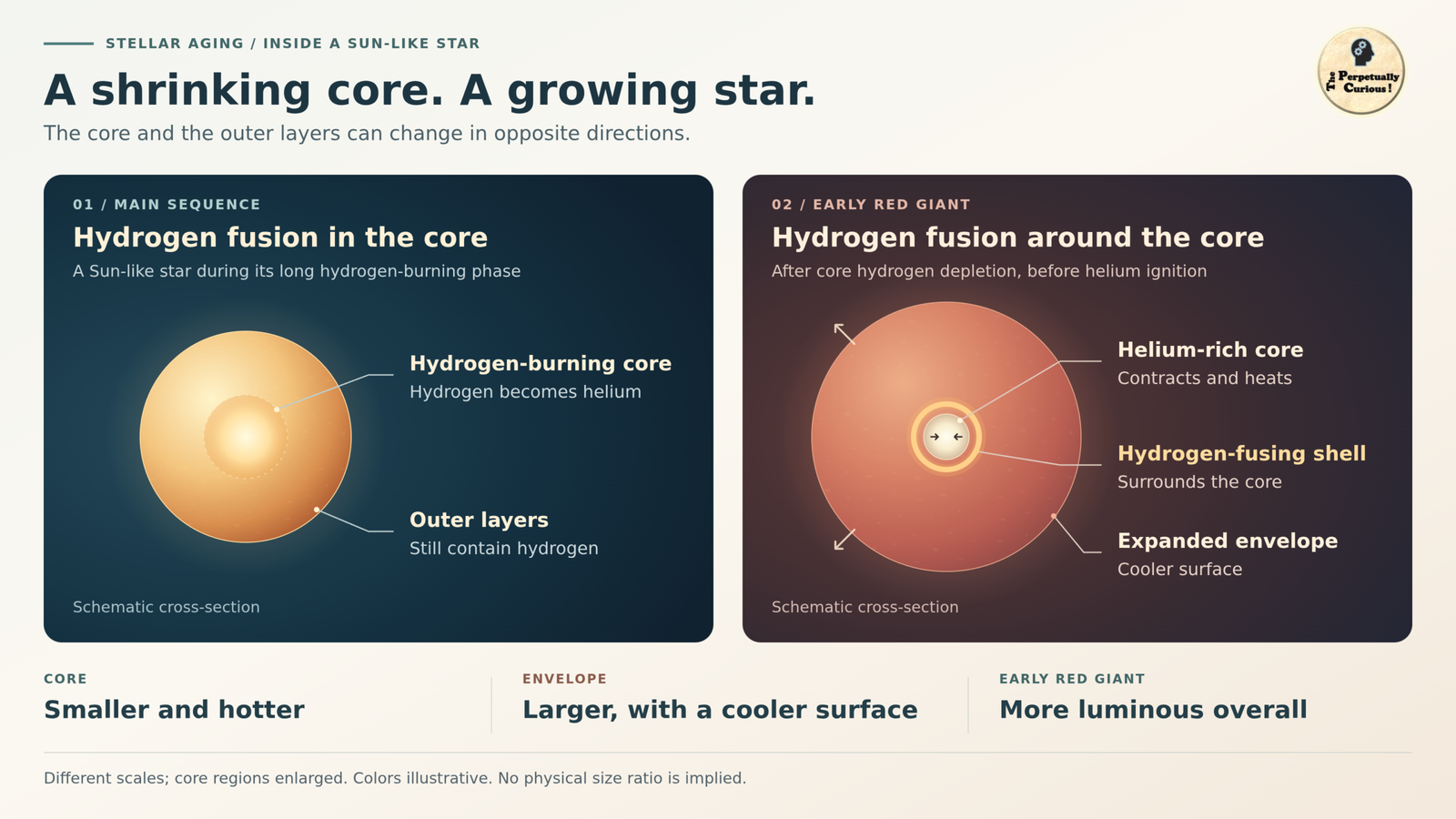
As hydrogen fuses, helium accumulates in the Sun’s core. The changing composition leads the core to contract and heat gradually, increasing the rate of energy production. The Sun therefore becomes brighter over long timescales, although this slow trend is quite different from its shorter cycles of magnetic activity.
Astronomers distinguish this intrinsic energy output, or luminosity, from how bright a star looks at a particular distance. A star can change its true output even when the difference is far too gradual for a human observer to notice.
The important limit is not the disappearance of all hydrogen from the star. It is the depletion of hydrogen available for fusion in the core. Considerable hydrogen remains farther out, but the star’s existing internal arrangement can no longer sustain the same pattern of burning.
That distinction explains the apparent paradox of what follows: an aging star can expand enormously while its center contracts.
🔴 Why the core shrinks while the star grows
When core hydrogen becomes depleted in a Sun-like star, the helium-rich core contracts and grows hotter. Hydrogen fusion continues in a shell around it. The changing core and increasingly powerful shell source reshape how energy moves through the star, driving the outer envelope to expand.
The star passes through a subgiant stage and climbs the red giant branch. Its surface cools as it expands, giving it a redder appearance. Yet its much larger emitting area allows it to radiate more energy overall. A cooler surface does not necessarily mean a dimmer star.
The Sun is expected to begin leaving its present main-sequence phase in roughly 5 billion years. Its later giant stages unfold over additional time; it does not suddenly reach its largest size at that date.
Meanwhile, deep beneath the expanded envelope, contraction is bringing the core toward conditions that can unlock a different nuclear fuel.
🔥 Helium opens a second chapter
In a star like the Sun, helium fusion begins when the core reaches roughly 180 million degrees Fahrenheit (100 million kelvin). The triple-alpha process combines three helium nuclei into carbon through a short-lived intermediate nucleus. Further helium capture can build oxygen.
Helium ignition is unusually abrupt in these stars because their dense cores are supported largely by electron degeneracy pressure, a quantum effect arising from how electrons occupy available states. Initially, heating does not produce the prompt expansion that would regulate fusion in an ordinary gas. Reactions accelerate rapidly in an event called the helium flash.
Despite its name, the flash does not make the star explode or flare conspicuously in the sky. Much of its energy goes into expanding and restructuring the core. The transition to settled helium burning involves further internal readjustments rather than one visible burst.[2]
The star then becomes more compact than it was near the tip of the red giant branch and enters a period of stable core helium burning. More massive stars can ignite helium more gently because their cores reach the necessary conditions without the same strong degeneracy. The flash is one route through stellar aging, not a universal stage.
Helium provides another interval of stability. What happens when that fuel is depleted depends on whether gravity can compress the core enough to ignite still heavier nuclei.
⚪ The quieter ending of a Sun-like star
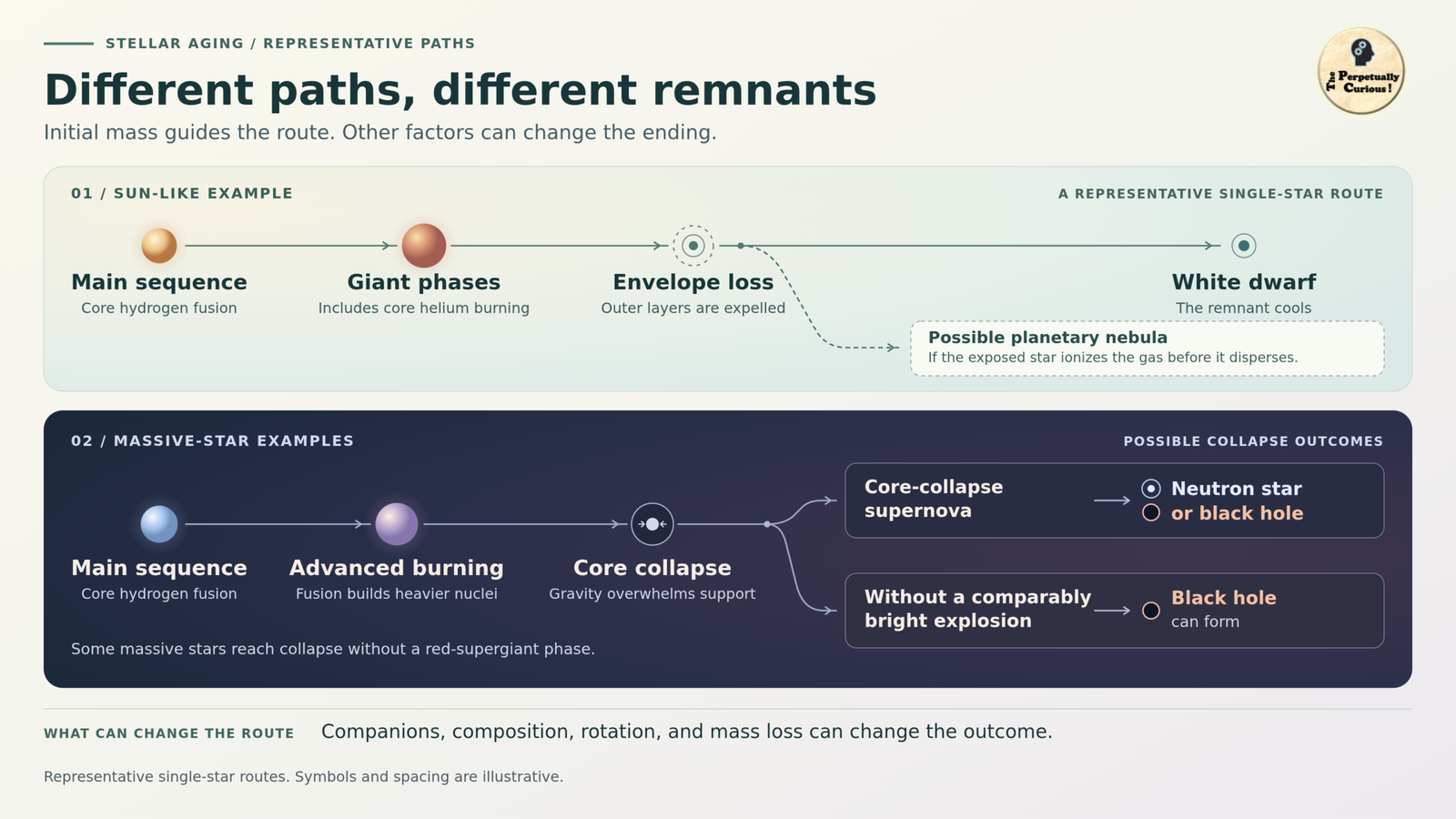
The Sun will not become hot enough to sustain carbon fusion in its core. After core helium is exhausted, it will expand again during the asymptotic giant branch phase. Hydrogen and helium burn in shells around a mostly carbon-and-oxygen core, while pulses and strong outflows help remove the outer envelope.
Expelled gas can become a planetary nebula if the exposed central star becomes hot enough to illuminate it before the gas disperses. These glowing shells are a striking outcome of stellar mass loss, although not every star following this broad route produces an observable nebula.
What remains is a white dwarf, typically comparable to Earth in size.[1] It contains a substantial fraction of the star’s original mass and has no sustained core fusion to replace the energy it radiates. Supported by electron degeneracy pressure, it gradually cools and fades.
The Sun’s future therefore includes a long afterglow beyond its roughly 10-billion-year main-sequence phase. That hydrogen-burning interval is not its total existence. More massive stars can compress and heat their cores enough to ignite heavier nuclei, extending the sequence of nuclear fuels beyond the Sun’s reach.
💥 When a massive star reaches its limit
Stars born with roughly eight or more times the Sun’s mass can enter advanced stages of nuclear burning, although the boundaries and outcomes depend on composition, mass loss, and other conditions. Many develop successive burning regions that build heavier nuclei toward the iron group. The late stages become dramatically shorter as energy losses, especially through neutrinos, increase.
Iron-group nuclei mark a crucial limit: further fusion does not provide the net energy needed to sustain the star. As the core becomes unstable, it can collapse. A successful core-collapse supernova expels much of the surrounding star, leaving a neutron star or, in some cases, a black hole. Other collapses may form black holes without a comparably bright explosion.
There is no single compulsory sequence from blue star to red supergiant to supernova. Winds can strip away outer layers, and some massive stars finish their lives in hotter, more compact states. The remaining core and envelope help determine each star’s outcome, so initial mass alone does not specify the ending.
Nor does every star age alone. That adds another reason why stellar evolution follows branching paths rather than a single timetable.
🤝 A companion can change the story
In a close binary system, an expanding star can transfer material to its companion. One star loses part of its envelope while the other gains mass; some pairs eventually merge. Such interactions can change internal mixing, the available fuel, and the eventual remnant. If a companion supplies material to a white dwarf, surface fusion can produce novae; under particular conditions, a white dwarf in a binary can instead undergo a disruptive thermonuclear supernova.
Rotation and chemical composition also influence the path. Rotation can mix material within a star, while composition affects how radiation passes through stellar matter and how strongly winds remove it. Initial mass remains a central guide, but it is not an isolated verdict.
To distinguish these possible histories, astronomers need evidence of what is happening inside stars. How can their light reveal changes that usually unfold far beyond a human lifetime?
🔭 Reading a lifetime from scattered light
Astronomers build the sequence by comparing many stars rather than waiting for one to complete its entire life. A Hertzsprung-Russell diagram places stars according to luminosity and surface temperature, revealing populations associated with different internal states.
Star clusters are especially useful because their members often formed within a relatively short interval but have different masses. The more massive members use their core hydrogen faster and leave the main sequence first. The mass and luminosity of stars now reaching this turnoff therefore provide a clock: comparing their positions with stellar models helps estimate the cluster’s age.
Spectra add information about composition, while asteroseismology uses stellar oscillations to probe interiors. These vibrations can distinguish, for example, hydrogen-shell-burning giants from stars also burning helium in their cores. Different observations constrain different parts of the same history.
Some changes are visible within a human lifetime, but they need careful interpretation. Observations and modeling of Betelgeuse’s Great Dimming in 2019 and 2020 support an explanation involving changes near its surface and newly formed dust that obscured its light.[3] It did not establish that a supernova was imminent. Pulsations, dust, and surface activity can alter appearance without marking the start of a new evolutionary phase.
Observations therefore do more than illustrate a finished story. They test and refine the models, including how stars mix their interiors, lose mass, and reach their endings. The evidence also traces something that outlasts any individual star: the material returned to space.
⚛️ What the fading light leaves behind
Stars help build the chemical richness of the universe. Helium fusion produces carbon and oxygen, while later burning in massive stars builds nuclei toward the iron group. Other pathways extend the story: slow neutron capture in evolved stars contributes many heavier nuclei, and neutron-star mergers provide environments for rapid neutron capture.[4]
This is not a claim that every element was made by ordinary stellar fusion. Much of the universe’s hydrogen and helium originated in the early universe, and different elements have different production histories. The atomic number identifies an element by its proton count; nuclear reactions can change that identity, creating a chemical inheritance that later generations receive.
Winds, explosions, and other outflows return some of this processed material to interstellar space. Mixed into gas and dust, it can become part of later stars and planetary systems. The formation of Earth was one later chapter in this inheritance, as material around the young Sun assembled into a rocky world. The carbon in living tissue and the oxygen in water belong to this wider history, even though the exact ancestry of an individual atom is usually beyond recovery.
The familiar light that returns each season comes from interiors that do not stand still. Stars change, leave remnants, and return material that can enter other worlds. In the night sky, permanence is an impression. Continuity is the deeper story.
Pass this article along to someone curious and let the learning travel.
💡 Did you know?
💎 A white dwarf can change internally even after its sustained core fusion has ended. As it cools, dense carbon-and-oxygen material in its interior can crystallize. Energy released during this process delays its cooling. Gaia observations showed a buildup of white dwarfs at particular brightnesses and colors, which researchers interpreted as evidence of a cooling delay associated with crystallization.[5]
🔵 Blue does not always mean young. A hot, massive main-sequence star can be short-lived, while a hot white dwarf is already a stellar remnant. Color helps reveal surface temperature, but age requires additional context.
🌑 No fully cooled black dwarf is expected to exist yet. White dwarfs take longer than the universe’s present age to fade to that hypothetical state, so this final darkness belongs to the predicted future.
👁️ The stars easiest to see are not a representative sample of all stars. Luminous giants can be visible across great distances, while numerous faint red dwarfs remain beyond unaided vision. The familiar sky favors conspicuous light.
🫧 A giant star has no solid surface. Its extended atmosphere gradually thins outward, so a quoted radius depends on how the visible boundary is defined and measured. That is one reason comparisons among the largest known stars carry uncertainty.
🌟 Sirius pairs a bright main-sequence star, Sirius A, with a white dwarf, Sirius B. The latter began as the more massive star and evolved faster. Companions can therefore share a long history while occupying very different chapters of stellar life.
How much time does the Sun have left, and will it explode?
The Sun has roughly 5 billion more years of core hydrogen burning ahead, within a total main-sequence interval of about 10 billion years. Later giant stages take additional time, so leaving the main sequence does not mean immediately reaching its largest size or becoming a white dwarf. The Sun lacks the mass needed for a core-collapse supernova. It is expected to shed its outer layers and leave a white dwarf that cools over a much longer afterglow. Thermonuclear supernovae involving white dwarfs require particular binary circumstances and are not the expected future of our Sun.
Will every red dwarf eventually become a red giant?
No. Models predict that the lowest-mass red dwarfs mix hydrogen through much of their interiors, allowing material farther from the center to contribute to the fuel supply. They do not build the same strongly separated core-and-envelope structure that leads a Sun-like star up the red giant branch. Over extremely long periods, they are expected to become hotter before ending as helium white dwarfs. This is a forecast from stellar models: the universe has not existed long enough for these smallest stars to complete the process.
Are brown dwarfs and white dwarfs different stages of the same life?
No. Brown dwarfs never sustain ordinary hydrogen fusion, while white dwarfs are compact remnants left after stellar evolution. A brown dwarf gradually cools without having completed the ordinary hydrogen-burning life of a star. A white dwarf has a different history: its precursor did undergo stellar fusion before losing its outer layers. Their shared name does not imply a common origin or a sequence from brown dwarf to white dwarf.
Can astronomers determine a star’s exact age?
Usually they estimate an age with an uncertainty range. Chronological age and evolutionary stage are related but different: a massive star can reach an advanced stage while a much older low-mass star is still on the main sequence. Astronomers combine clues such as mass, luminosity, surface temperature, composition, cluster membership, and oscillations with stellar models. Rotation can help date some stars, but the relationship is not equally reliable at every age. Mass exchange or a merger can further complicate the inference by changing the star’s structure and fuel supply.
What will happen to Earth as the Sun ages?
Increasing solar luminosity is expected to make Earth’s surface unsuitable for present-day life long before the Sun reaches its largest giant stages. The timing depends on models of climate, atmospheric chemistry, and solar evolution. Later, solar mass loss tends to expand planetary orbits, while tidal interactions with the swollen Sun can draw a planet inward. Some detailed calculations predict that Earth will be engulfed despite the outward effect of mass loss. The sequence is better established than a single exact date for each transition.
Can planets remain after a star becomes a white dwarf?
Yes. Planetary companions and planetary debris have been observed around white dwarfs. Wider planets may avoid direct engulfment, while changing stellar mass and gravitational interactions can rearrange the system. A planet now found close to a white dwarf need not have occupied that same orbit while the star was a giant. Its presence demonstrates that a planetary system can persist or be reconfigured after stellar evolution, but does not by itself prove unchanged survival at the same location.
Is Betelgeuse about to explode?
Betelgeuse is an evolved massive star expected eventually to undergo core collapse, but astronomers cannot give a dependable date. Its visible behavior does not provide a simple countdown. The Great Dimming involved newly formed dust associated with a cooler region near the surface, illustrating how a large change in appearance can arise without establishing an imminent explosion.[3] Determining an eventual ending and predicting its precise timing are different scientific problems.
How do a helium flash, a nova, and a supernova differ?
A helium flash begins deep inside a low-mass red giant and helps the core move toward stable helium burning; it does not blow the star apart.[2] A classical nova is a surface thermonuclear eruption on a white dwarf that has accumulated material from a companion. The white dwarf survives, and the system may erupt again. A supernova is a much more disruptive event: it can accompany the collapse of a massive stellar core or a thermonuclear explosion involving a white dwarf. Similar-sounding names therefore describe different locations, triggers, and outcomes.
Why do the final burning stages of massive stars pass so quickly?
The clock depends on both the usable nuclear energy and how rapidly energy is lost. Advanced fuels generally release less energy per unit mass than hydrogen fusion, while the increasingly hot core loses enormous amounts of energy through neutrinos. These particles interact weakly with matter and can escape with energy that does not emerge as ordinary starlight. The core must process its available fuel rapidly to compensate. Having heavier nuclei left to burn therefore does not mean that each new stage can last as long as the first.
Does a dying star return all of its material to space?
No. Stellar recycling is partial. Winds and explosions can expel some original material and some newly produced elements, while a remnant retains the rest. A Sun-like star can leave much of the carbon and oxygen made in its core inside a white dwarf. Other evolutionary paths leave neutron stars or black holes. The material returned to interstellar space therefore depends on mixing, mass loss, and the ending itself. What a star returns, rather than everything it makes, shapes its contribution to later worlds.
✨ Let the story travel
If this journey offered a new way to see a familiar sky, we kindly invite you to share it with friends and colleagues. A small exchange of curiosity can carry the long story of the stars a little farther.
📘 Educational context
This article provides a general educational overview of stellar evolution. Inferred ages, evolutionary boundaries, and future planetary outcomes depend on observations and physical models and may be refined as the evidence develops.
Selected sources
- National Aeronautics and Space Administration (NASA). Stars. Updated August 12, 2026.
- Bildsten L, Paxton B, Moore K, et al. (2012). Acoustic Signatures of the Helium Core Flash. The Astrophysical Journal Letters, 744(1), L6.
- Montargès M, Cannon E, Lagadec E, et al. (2021). A dusty veil shading Betelgeuse during its Great Dimming. Nature, 594(7863), 365-368. [PMID: 34135524]
- Kobayashi C, Karakas AI, Lugaro M. (2020). The Origin of Elements from Carbon to Uranium. The Astrophysical Journal, 900(2), 179.
- Tremblay PE, Fontaine G, Gentile Fusillo NP, et al. (2019). Core crystallization and pile-up in the cooling sequence of evolving white dwarfs. Nature, 565(7738), 202-205. [PMID: 30626942]
“The Long Light: How Stars Age and What They Leave Behind.” The Perpetually Curious!, November 2026.
https://www.theperpetuallycurious.org/articles/how-stars-age/Continue Exploring
For the curious mind: want to explore this theme through a few questions? Visit the Classic Quiz Studio, nestled under Explorations opens in a new tab ,and see where a few well-placed questions lead: Cosmic Exploration Quizzesopens in a new tab
For what comes next
Site Updates gathers occasional notes, new additions, and ways to keep in touch. RSS brings new publications to your feed reader in chronological order.
Choose the path that speaks to you, and let the next curiosity find you wherever your wondering takes you.