

The Great Smoky Mountains rise in soft blue layers along the border of Tennessee and North Carolina, a landscape that often appears to exhale. Morning light may reveal a veil of mist suspended between ridges, while evening shadows gather in the folds of ancient valleys. These mountains invite curiosity not only through their beauty, but also through their remarkable age, ecological richness, and cultural depth. To understand the Smokies is to follow a story that begins in deep time and continues through forests, streams, and human histories that have shaped the region for generations.
This article moves through that story in a deliberate arc. It begins with the geological foundations that created the mountains, then follows the rise of forests and the formation of the blue haze. It continues into the world of biodiversity, explores the human presence woven into the landscape, and concludes with a reflection on conservation and wonder. Each section builds on the previous one so that the Smokies emerge not as a simple destination, but as a living system shaped by time, climate, and memory.
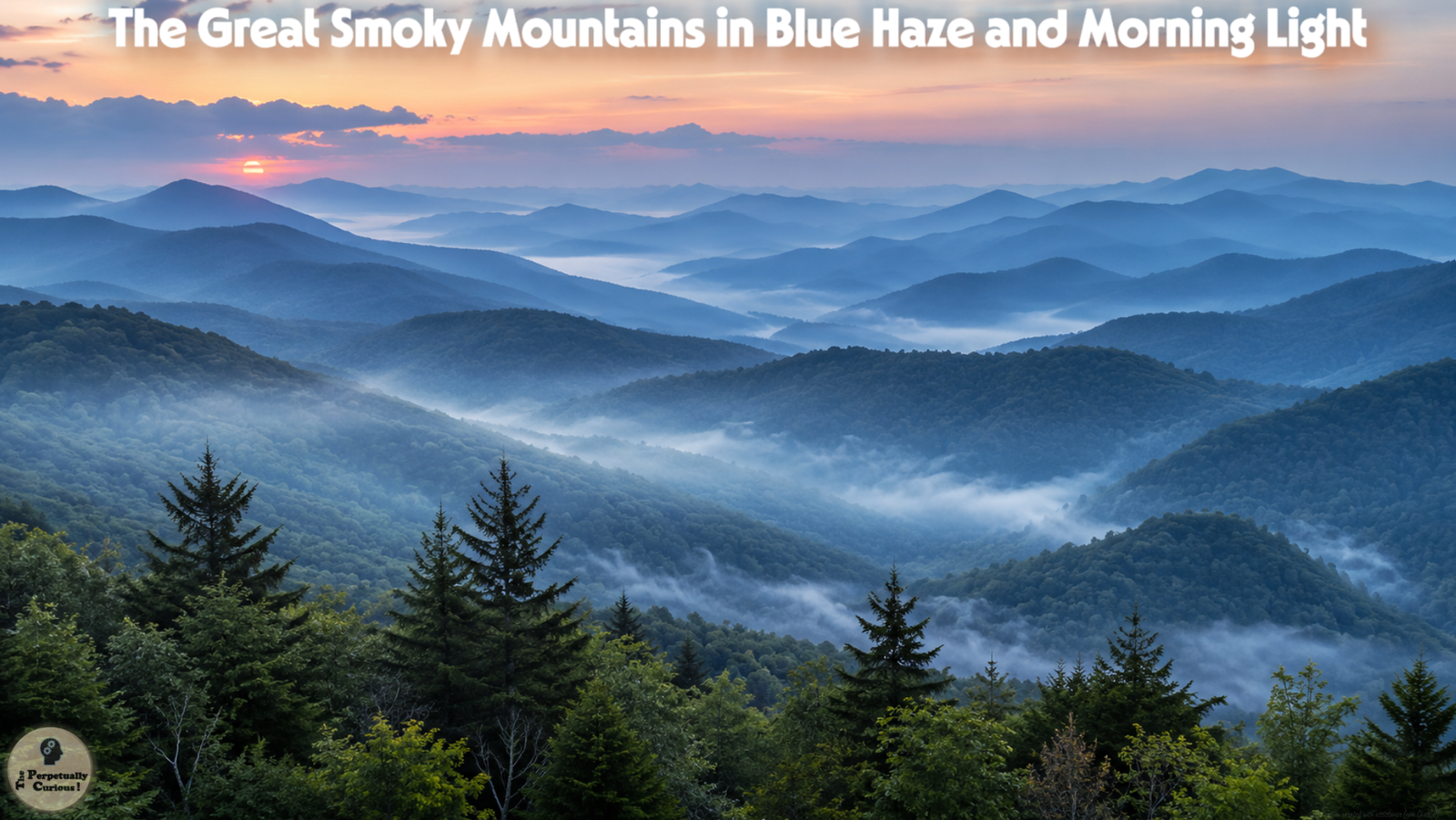
The ridges fade into blue distance, carrying the memory of ancient seas and shifting seasons.
The forests breathe in quiet rhythms shaped by rain, stone, and time.
In the hush between valleys and sky, the Smokies continue their slow unfolding.
🌄 Roots in deep time: how the Smokies became mountains
The story of the Great Smoky Mountains reaches far into deep time, long before the first forests took root. Some of the oldest rocks associated with the park are metamorphic and igneous rocks more than 1 billion years old, while many of the rocks that help form the Smokies began as sand, silt, mud, and gravel deposited along ancient marine margins. Over immense spans of time, these sediments accumulated in thick layers and were later altered by heat and pressure into rocks such as sandstone, slate, schist, and quartzite.
During the late Paleozoic, around 270 million years ago, ancestral North America and Africa collided during the Alleghanian mountain-building episode. The collision generated enormous pressure, folding and faulting older rock layers and uplifting the Appalachian region. The Great Smoky Mountains form one part of this ancient Appalachian system, whose once higher and more rugged relief has been softened by long erosion.
Since that uplift, the Smokies have continued to change. Wind, rain, freezing, thawing, and flowing water gradually wore down once sharper peaks and carried loosened material into valleys and streams. During the Pleistocene Epoch, about 2.58 million to 11,700 years ago, colder climates influenced the region even though continental glaciers did not cover the Smokies directly. Freeze-thaw action fractured rock and helped create boulder fields and streamside stones that still record the work of ice-age climates.
This geological foundation sets the stage for everything that follows. The folded rocks, varied elevations, and long history of erosion help explain why the Smokies support such a wide range of habitats and species. The mountains are ancient in origin, but they are not frozen in the past. They continue to evolve, shaped by weather, water, gravity, and time.
🌲 A vertical journey: elevation, climate, and forest mosaics
From the bedrock of deep time, the narrative rises into the forests that blanket the Smokies. The folded and eroded shape of the mountains is not only a geological inheritance; it also creates the elevation gradients that shape climate, moisture, and forest life. Within Great Smoky Mountains National Park, elevations range from about 875 feet (roughly 267 meters) in the low valleys to 6,643 feet (about 2,025 meters) at Kuwohi, formerly designated Clingmans Dome. Sixteen peaks within the park rise above 6,000 feet (around 1,829 meters). This vertical relief creates a natural climate gradient that has often been compared to traveling from Georgia to Maine simply by moving from low to high elevations.
Temperature often decreases by roughly 3 to 3.5 degrees Fahrenheit for every 1,000 feet of elevation gain, though local conditions vary with slope, exposure, cloud cover, and season. As a result, the lower elevations support rich hardwood forests with oaks, hickories, and tulip poplars. These forests thrive in warmer conditions and fertile soils, creating habitats that are among the most diverse temperate forest ecosystems in North America.
At middle elevations, cooler temperatures support northern hardwood forests with American beech, birch, and maples. These forests contribute to the vivid autumn colors that many visitors associate with the Appalachian region, as leaf pigments respond to changing light, temperature, and seasonal timing. Higher still, especially along the upper ridges and in the highest-elevation zones, the climate becomes cooler and wetter. Spruce-fir forests appear there, resembling boreal forests found in northern regions such as parts of Maine and Canada. Mosses and lichens cling to trunks and rocks, and the air often feels noticeably cooler and more humid.
Nearly 95 percent of Great Smoky Mountains National Park is forested, and about one quarter of that forested area is considered old growth. In these older stands, trees may reach ages of several centuries, and the structure of the forest reflects long periods with relatively limited disturbance. These forest mosaics, layered along elevation and shaped by climate, provide the living backdrop for the extraordinary biodiversity that defines the Smokies.
💧 Water and mist: streams, rainfall, and the “smoky” haze
The transition from forests to water is natural, because the same elevation-driven climate that supports lush vegetation also feeds an intricate network of streams and rivers. In the high country of the Smokies, average annual rainfall can exceed 85 inches (about 216 centimeters). This abundant precipitation, combined with steep slopes, produces more than 2,100 miles (around 3,380 kilometers) of streams and rivers within the park. Waterfalls form where flowing water meets sharp changes in elevation, and these falls are part of a larger hydrological system that continues to shape the landscape.
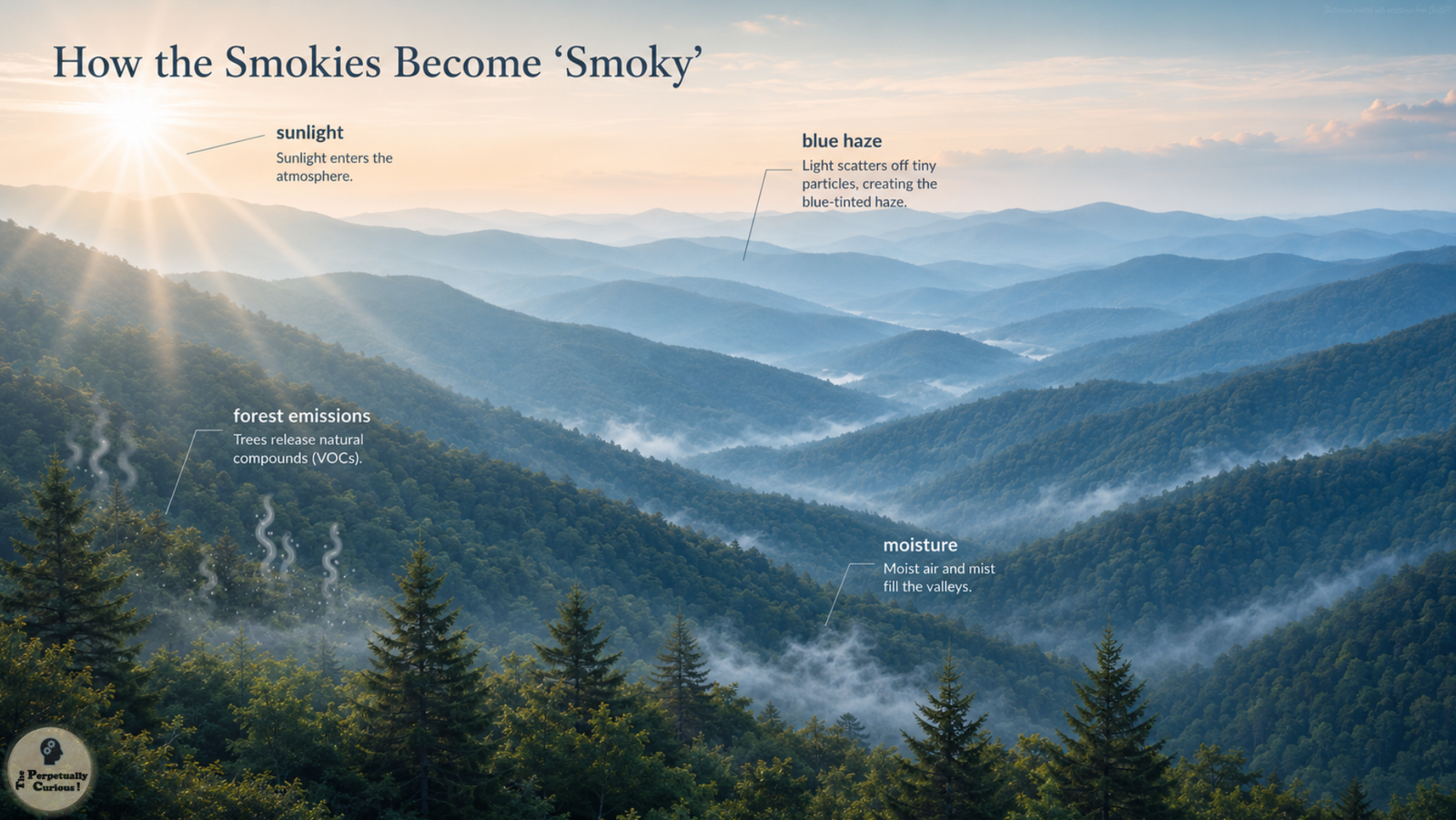
The name “Smoky” is closely tied to the interaction between vegetation, moisture, and light. The soft haze that often drapes the mountains is not simply ordinary fog. Trees and other plants release volatile organic compounds that react in the air and help form tiny organic aerosols. When sunlight moves through these particles, shorter wavelengths of light, especially blue and violet, scatter more strongly than longer wavelengths. This process connects the Smokies’ blue appearance to the wider physics of atmospheric scattering, while humidity and frequent fog add to the softened, misty look of the ridges.
Air pollution can also influence visibility, sometimes adding a separate whitish haze that differs from the natural blue cast associated with forest chemistry. For that reason, the Smokies’ atmosphere reflects both natural processes and modern air-quality pressures. Understanding this haze connects the visual experience of the mountains to the underlying physics, chemistry, and ecology of the landscape.
The abundance of water and mist creates cool, saturated habitats where life can persist in extraordinary variety. Streams, mossy stones, shaded soils, and humid forest floors all become part of the same living system, preparing the way for the Smokies’ remarkable biodiversity.
🐾 A refuge of life: biodiversity and living communities
From water and mist, the narrative turns to the organisms that depend on these conditions. Great Smoky Mountains National Park is often described as the most biologically diverse national park in the United States. As part of the ongoing All Taxa Biodiversity Inventory, more than 22,000 species of plants, animals, fungi, and other organisms had been recorded in the park as of January 2026, including more than 1,100 species found to be new to science. Scientists expect that many more remain undocumented.
This richness is partly a result of history. During past glacial periods, many species that could not survive farther north found refuge in the relatively milder climates of the Southern Appalachians. As climates shifted, some species remained, while others moved along elevation gradients, creating a complex pattern of distribution. The combination of varied elevations, abundant moisture, long ecological continuity, and multiple forest types provides habitats for an exceptional range of organisms.
The Smokies are home to more than 100 native tree species and more than 1,500 flowering plant species. The park also supports a diverse bird community, with more than 240 bird species recorded. Insects are especially abundant, with thousands of documented species, including many groups still being studied through ongoing field surveys. The region is also known for its dense black bear populations, with roughly 1,500 bears living within the park according to National Park Service estimates.
The Smokies are particularly famous for their salamanders. Streams, mosses, shaded soils, and humid forest floors provide ideal conditions for these amphibians. The park is recognized as one of the foremost centers of salamander diversity in the world, especially for lungless salamanders in the family Plethodontidae, with 25 of the park’s 31 documented salamander species belonging to this family. These amphibians play important roles in nutrient cycling, food webs, and ecosystem health.
Fungal diversity is also significant. Fungi form essential partnerships with trees, help decompose organic matter, and contribute to soil formation. These relationships place the Smokies within the wider story of fungal networks, where roots, soils, and decomposers help sustain forest structure. Although less visible than plants or animals, fungi are vital to the functioning of forest ecosystems.
Researchers and park managers use tools such as field surveys, long-term monitoring, and species distribution modeling to better understand where particular organisms are likely to occur. By combining observations with information about slope, elevation, forest type, temperature, and other habitat characteristics, these tools help guide conservation efforts and deepen scientific understanding.
Yet these mountains have never existed apart from human presence. The same forests and streams that shelter salamanders, fungi, birds, insects, and bears have also shaped the lives, memories, and identities of people for thousands of years.
🏡 Human stories in a mountain landscape: Cherokee homelands and Appalachian communities
After considering the physical and biological dimensions of the Smokies, it is important to acknowledge the human histories woven into this landscape. Long before the establishment of Great Smoky Mountains National Park in 1934, Indigenous peoples lived in and around these mountains. The Cherokee presence in the Southern Appalachians reaches far beyond modern park boundaries, and Cherokee place names, including Kuwohi, preserve relationships with land, memory, and meaning that remain important today.
Cherokee communities developed cultural, spiritual, and practical connections to the mountains, rivers, and forests. The landscape provided food, materials, travel routes, and places of ceremony, and it formed part of a broader homeland later disrupted by forced removals and changing political boundaries. The forced removal of the 1830s, known historically as the Trail of Tears, displaced thousands of Cherokee people from ancestral lands, while the Eastern Band of Cherokee Indians continues to maintain deep ties to the region, including from the Qualla Boundary near the park.
In the nineteenth and early twentieth centuries, European American settlers established small farming and logging communities in the coves and valleys. Structures such as cabins, barns, churches, schools, and mills formed the fabric of daily life. Logging became a major economic activity, and extensive timber harvesting altered large areas of forest before the creation of the national park shifted the region toward preservation.
When Great Smoky Mountains National Park was established, many residents relocated, and some communities were transformed or absorbed into the protected area. Today, the park preserves and maintains more than 90 historic structures, including houses, barns, outbuildings, churches, schools, and gristmills. These sites offer glimpses into past ways of life and invite reflection on how conservation decisions intersect with human communities.
This human dimension connects the scientific story of the Smokies to questions of memory, identity, and stewardship. The mountains are not only ecosystems and geological formations; they are also places where people have lived, worked, traveled, gathered, and told stories for generations.
🌍 A protected landscape: conservation, recognition, and ongoing challenges
The movement from human history to conservation is natural, because the creation of the park and its later recognitions are closely tied to both ecological and cultural values. Great Smoky Mountains National Park was formally established in 1934 and has since become the most visited national park in the United States, with more than 12 million recreational visits recorded in 2024. The park was designated a UNESCO World Heritage Site in 1983 and later recognized as part of an International Biosphere Reserve, reflecting its global significance for biodiversity, natural heritage, and ecological research.
Protection has allowed large areas of forest to recover from past logging, and many streams and habitats now function as relatively intact systems. At the same time, conservation is an ongoing process rather than a completed task. Non-native species, such as the hemlock woolly adelgid, pose threats to key tree species, and park managers have used monitoring, chemical treatment, and biological control efforts to help protect hemlock stands. Air pollution can affect visibility and ecosystem health. Climate change may alter temperature and precipitation patterns, influencing species distributions, seasonal cycles, and plant timekeeping across elevation zones.
Long-term monitoring programs help researchers track changes in forest health, water quality, vegetation, and wildlife populations. These efforts provide valuable information for understanding how ecosystems respond to environmental pressures. Educational materials, research programs, and collaborative projects also help build a shared understanding of the park’s changing conditions without reducing conservation to a single finished task.
In this sense, the Smokies are both a protected landscape and an evolving one. Conservation is a continuing conversation shaped by science, history, and the lived experiences of the people who care about these mountains. As the article moves toward its closing reflection, the Smokies remain a place where ancient forces, living communities, cultural memory, and modern stewardship meet.
🌅 A landscape of wonder: experiencing the Smokies as a living narrative
Having moved through geology, forests, water, biodiversity, human history, and conservation, the narrative returns to the experience of the mountains themselves. The Great Smoky Mountains can be seen as a layered story, where each ridge and valley carries traces of deep time, ecological complexity, cultural memory, and continuing stewardship.
Standing on a high overlook, one might see waves of blue-tinted ridges fading into the distance, each one shaped by ancient collisions of continents and by long ages of wind, rain, and erosion. In the coves below, old-growth trees may rise from rich soils, their roots intertwined with fungi and their branches alive with birds, insects, and seasonal change. Streams may carry cool water over stones shaped by weathering, gravity, and ice-age climates, while salamanders shelter beneath rocks and black bears move through forest corridors.
The Smokies invite a sense of wonder that is grounded in careful observation and scientific understanding. They are not simply a backdrop for recreation; they are a living, breathing world, where geology, climate, life, culture, and conservation meet. To learn about the Great Smoky Mountains is to follow a narrative that begins in ancient seas and continues into the present, with each chapter connected to the next. The mist that rises from the ridges becomes a reminder of the forces that shaped the mountains and the stories that continue to unfold within them.

Pass this article along to someone curious and let the learning travel.
💡 Did You Know
🌧️ Specific high-elevation, moisture-rich zones of the Smokies receive more than 85 inches (about 216 centimeters) of rainfall each year, helping create lush, humid conditions that resemble temperate rainforest environments in some areas.
⛰️ The Appalachian Mountains, including the Smokies, are far older than ranges such as the Himalayas, and their rounded peaks reflect hundreds of millions of years of uplift, weathering, and erosion.
🌿 The Smokies contain one of the largest remaining tracts of old-growth forest in the eastern United States, offering rare examples of long-developed temperate ecosystems shaped by centuries of natural processes.
🦎 The Smokies are recognized as one of the foremost centers of salamander diversity in the world, with 25 of the park’s 31 documented salamander species belonging to the lungless family Plethodontidae.
🌫️ The blue haze that gives the mountains their name arises partly from natural compounds released by trees, which help form tiny airborne particles that scatter blue wavelengths of sunlight.
🧬 The All Taxa Biodiversity Inventory has recorded 22,893 species in Great Smoky Mountains National Park, including 1,111 species found to be new to science as of January 2026.
🏔️ Kuwohi, formerly designated Clingmans Dome, had its Cherokee name officially restored in 2024. The name means “mulberry place” and reflects the mountain’s significance within Cherokee homelands.
✨ The Smokies are home to 19 species of fireflies, including the synchronous firefly, Photinus carolinus, whose coordinated flashes occur during a brief seasonal window and are thought to be linked to mate signaling.
🌾 Some limestone coves, including places such as Cades Cove, contain fertile soils that support diverse plant communities and historically attracted agricultural settlements.
🐦 More than 240 bird species have been recorded in the Smokies, and the region lies along important migratory pathways that bring seasonal waves of warblers, thrushes, and other songbirds.
🐛 The park’s rich leaf litter and moist soils support a wide variety of invertebrates, including millipedes, beetles, and soil-dwelling organisms that play essential roles in nutrient cycling.
🧭 The main crest of the Smokies extends for more than 36 miles (about 58 kilometers), helping shape local weather patterns and the movement of moisture across the landscape.
Why are the Great Smoky Mountains considered “smoky”?
The “smoky” appearance comes from a combination of forest chemistry, moisture, fog, and light scattering. Trees and other plants release volatile organic compounds that help form tiny airborne particles, and those particles scatter shorter blue wavelengths in ways that give distant ridges their blue cast.
How old are the Great Smoky Mountains?
The Smokies preserve several layers of deep geological history. Some of the oldest rocks associated with the park are more than 1 billion years old, while many sedimentary rocks formed hundreds of millions of years ago. The major Appalachian mountain-building episode that helped uplift the region occurred around 270 million years ago during the Alleghanian orogeny.
What makes the Smokies so biologically diverse?
Several factors contribute to the park’s biodiversity, including varied elevations, abundant rainfall, multiple forest types, long ecological continuity, and past climate shifts that allowed many species to find refuge in the Southern Appalachians.
What is the All Taxa Biodiversity Inventory?
The All Taxa Biodiversity Inventory is an ongoing scientific effort to document the living species of Great Smoky Mountains National Park. It has recorded more than 22,000 species so far, including more than 1,100 species found to be new to science.
How do scientists estimate how many species live in the Smokies?
Scientists combine field surveys, specimen records, genetic studies, expert identification, long-term monitoring, and habitat modeling. Because many insects, fungi, and small soil organisms are difficult to detect, species totals are continually refined as new surveys are completed.
How large is Great Smoky Mountains National Park?
The park covers more than 800 square miles (over 2,070 square kilometers), with elevations ranging from low valleys to high peaks.
What is the significance of Kuwohi?
Kuwohi, formerly designated Clingmans Dome, is the highest point in the Smokies at 6,643 feet (about 2,025 meters). Its Cherokee name, meaning “mulberry place,” was officially restored in 2024 and reflects the mountain’s significance within Cherokee homelands.
Why are old-growth forests ecologically significant?
Old-growth forests contain complex structures such as large trees, standing dead wood, fallen logs, layered canopies, and rich soil communities. These features support diverse communities of plants, animals, fungi, and microorganisms.
How does elevation influence species distributions?
Elevation affects temperature, rainfall, fog, growing season length, and soil conditions. These changes allow warm-adapted species to thrive in lower valleys while cooler-adapted species persist on higher ridges.
How do climate patterns shape the Smokies?
Moist air often rises along the mountains, cools, and condenses, producing frequent rainfall and fog. These patterns influence forest composition, stream flow, soil moisture, and the habitats available to plants and animals.
What kinds of fungi are found in the Smokies?
The park hosts many kinds of fungi, including mycorrhizal fungi that form partnerships with tree roots, decomposers that break down organic matter, and rare species associated with old-growth forests and moist soils.
How do salamanders contribute to the ecosystem?
Salamanders help regulate small invertebrate populations, move nutrients through forest food webs, and serve as sensitive indicators of environmental conditions because their bodies depend strongly on moisture and temperature.
Why are synchronous fireflies associated with the Smokies?
The Smokies provide moist forest habitats for many firefly species, including the synchronous firefly, Photinus carolinus. Its coordinated flashing is thought to be linked to mate signaling and connects naturally with the broader science of firefly bioluminescence.
How do scientists study biodiversity in the Smokies?
Researchers use field surveys, species distribution modeling, genetic analysis, specimen collections, and long-term monitoring to study biodiversity and track ecological change across elevation zones and habitat types.
Why is the Smokies’ cultural history important to understanding the landscape?
The region’s cultural history, including Cherokee homelands and later Appalachian communities, provides context for how people have lived with, used, interpreted, and helped preserve the mountain landscape over time.
Did glaciers cover the Great Smoky Mountains?
No. Continental glaciers did not cover the Smokies directly, but colder Pleistocene climates still shaped the region. Freeze-thaw cycles fractured rock, cooler habitats shifted across elevations, and the Southern Appalachians served as a refuge for many species during colder periods.
Are the Smokies considered a temperate rainforest?
The Smokies as a whole are not classified as a temperate rainforest biome. However, parts of the Smokies, especially high-elevation and very wet forest zones, have conditions similar to temperate rainforests because of abundant rainfall, frequent fog, and lush vegetation. It is more precise to describe these areas as rainforest-like rather than calling the entire park a temperate rainforest.
🌱 Spreading the story of the Smokies
If this piece helped bring the Great Smoky Mountains into clearer view, please feel free to share it with friends, family, or fellow curious readers. A shared story may help others see the Smokies not only as a beautiful landscape, but as a living world shaped by deep time, biodiversity, cultural memory, and care.
“Mist Over Ancient Ridges: The Great Smoky Mountains as a Living, Breathing World.” The Perpetually Curious!, June 2026.
https://www.theperpetuallycurious.org/articles/great-smoky-mountains/Continue Exploring
For what comes next
Site Updates gathers occasional notes, new additions, and ways to keep in touch. RSS brings new publications to your feed reader in chronological order.
Choose the path that speaks to you, and let the next curiosity find you wherever your wondering takes you.
🎥 Watch the Smokies in Motion
Some qualities of the Great Smoky Mountains are best felt through movement: mist drifting between ridges, light shifting across forested slopes, streams moving through shaded valleys, and blue layers fading into the distance. The video below extends the article as a visual and musical companion, allowing the landscape to linger after the geology, biodiversity, cultural history, and conservation story have unfolded.
The Great Smoky Mountains in Atmosphere and Motion
This montage offers a quiet visual close to the article, showing the Smokies through scenery, movement, and music rather than explanation. It is meant to complement the written piece by returning the reader to the mood of the mountains themselves: layered, mist-filled, ancient, and alive.