Explore by topic, question, or idea. Find articles, reflections, videos, puzzles, and curiosity pathways gathered across the site.
Press Enter or select Search. A newly typed query starts globally; filters are applied only through the visible rail.
6 results for “mud color”
- The Perpetually Curious! › Canonical › Cosmic ExplorationArticle
🌟 Brown Dwarfs: Between Giant Planets and the Smallest Stars
From section: ⚖️ What defines a brown dwarf… Astronomer Jill Tarter introduced it in 1975, more than a decade after Shiv Kumar had predicted very-low-mass objects that could never sustain hydrogen fusion. The name is not a literal description of their color, but it endured as a practical label for an otherwise unnamed class. …
- The Perpetually Curious! › Canonical › Cosmic ExplorationArticle
🌌 Why Space Feels Cold Among So Many Suns: The Quiet Physics of Cosmic Warmth
From section: 💡 Did You Know?… Under otherwise similar illumination and geometry, two surfaces that look alike in visible light can settle at different temperatures because color alone does not reveal how strongly each absorbs the full solar spectrum or emits infrared radiation.
- The Perpetually Curious! › Canonical › Cosmic ExplorationArticle
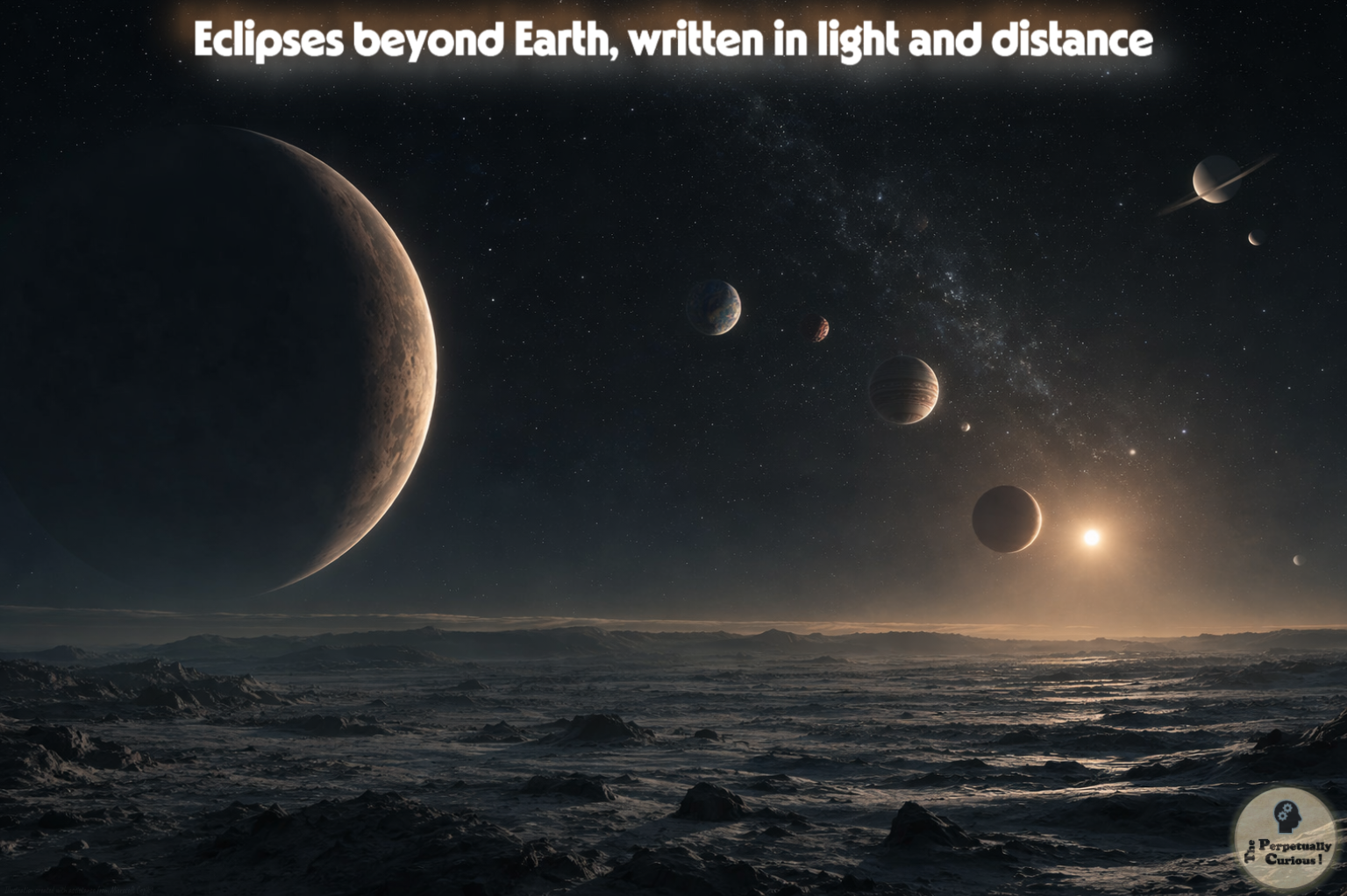
🌑 Shadows Across the Solar System: How Eclipses Unfold Beyond Earth
From section: 🌞 Solar eclipses across the Solar SystemSaturn’s moons, including Titan and Rhea, can cover the Sun’s disk from certain locations. Titan’s thick, hazy atmosphere softens the light, creating a muted eclipse. The Sun appears as a small, filtered disk, and the eclipse unfolds through layers of muted amber rather than bright color.
- The Perpetually Curious! › Canonical › Cosmic ExplorationArticle
🌌 Why Space Looks Dark in a Universe Filled with Light: Understanding the Quiet Cosmos
From section: 🚀 Sunlight, astronauts, and a black skyOn Earth, sunlight enters Earth’s atmosphere and interacts with molecules of nitrogen, oxygen, and other gases. Shorter wavelengths of light are scattered more efficiently, which gives the sky its blue color. …
- The Perpetually Curious! › Canonical › Cosmic ExplorationArticle
🌌 The Universe’s Ancient Whisper: Decoding the Cosmic Microwave Background
In 1964, radio astronomers Arno Penzias and Robert Wilson were troubled by a faint hiss in the Holmdel Horn Antenna at Bell Labs. The noise came from every direction. They checked the receiver, considered interference, and cleaned contamination from the antenna, including…
- The Perpetually Curious! › Archives › Cosmic ExplorationArticle
🌘 Eclipses Across the Solar System: When Shadows Travel
From section: Atmosphere, rings, and distanceA moon without much atmosphere would experience a sharper edge, while a world with clouds, haze, or scattered particles may turn the same geometry into a muted wash of color.