Explore by topic, question, or idea. Find articles, reflections, videos, puzzles, and curiosity pathways gathered across the site.
Press Enter or select Search. A newly typed query starts globally; filters are applied only through the visible rail.
32 results for “where earth turns to quiet ink”
- The Perpetually Curious! › Archives › Cosmic ExplorationArticle
🌞 The Solar Wind: When the Sun Breathes Across Space
🌠 Introduction Have you ever looked up at the night sky and wondered why shimmering curtains of green, red, and other hues ripple across the poles? These auroras are the visible traces of the solar wind’s interaction with Earth’s magnetic field, where charged particles guided…
- The Perpetually Curious! › Archives › Cosmic ExplorationArticle
When the Sky Falls: Extraordinary Precipitation Across Our Solar System 🌧️
We call it rain when water falls from Earth's clouds, but that simple word stretches and transforms across our solar system into phenomena that challenge our earthbound vocabulary. Should we call it rain when methane cascades onto Titan's hydrocarbon shores?
- The Perpetually Curious! › Archives › Cosmic ExplorationArticle
🌌 The Cosmic Silence: Unraveling the Fermi Paradox in an Age of Discovery
In 1950, physicist Enrico Fermi posed a question that still feels disarmingly direct: “Where is everybody?” It was not a claim about what must exist, but a moment of clear reasoning in a universe that seems generous with stars and unexpectedly quiet with replies.Read more »
- The Perpetually Curious! › Archives › Cosmic ExplorationArticle
The Moon's Ancient Dance: Understanding Lunar Phases Through Science and Story 🌙
Every approximately 29.5 days, Earth’s sole natural satellite completes a shape-shifting performance that has captivated humanity since our species first gazed skyward.
- The Perpetually Curious! › Archives › Cosmic ExplorationArticle
Lunar Regolith: The Moon's Ancient Chronicle Written in Dust 🌙
Opening Reflection ✨ Imagine holding a handful of powder made from rocks that formed long before life emerged on Earth, each grain a microscopic witness to billions of years of cosmic history.
- The Perpetually Curious! › Archives › Cosmic ExplorationArticle
💥 Neutron Stars: Cosmic Heavyweights That Defy Imagination
What Is a Neutron Star, and Why Do They Matter? Imagine holding a teaspoon that weighs more than every skyscraper on Earth combined. Neutron stars are cosmic heavyweights, dense beyond anything we know and filled with mysteries at the frontier of physics. Read more »
- The Perpetually Curious! › Archives › Cosmic ExplorationArticle
The Cosmic Journey: Understanding Our Galactic Year 🌌
Right now, you are racing through space at an astonishing 514,000 miles per hour (828,000 kilometers per hour), carried on a journey so vast that comprehending it challenges human intuition. This relentless motion never stops.
- The Perpetually Curious! › Canonical › Cosmic ExplorationArticle
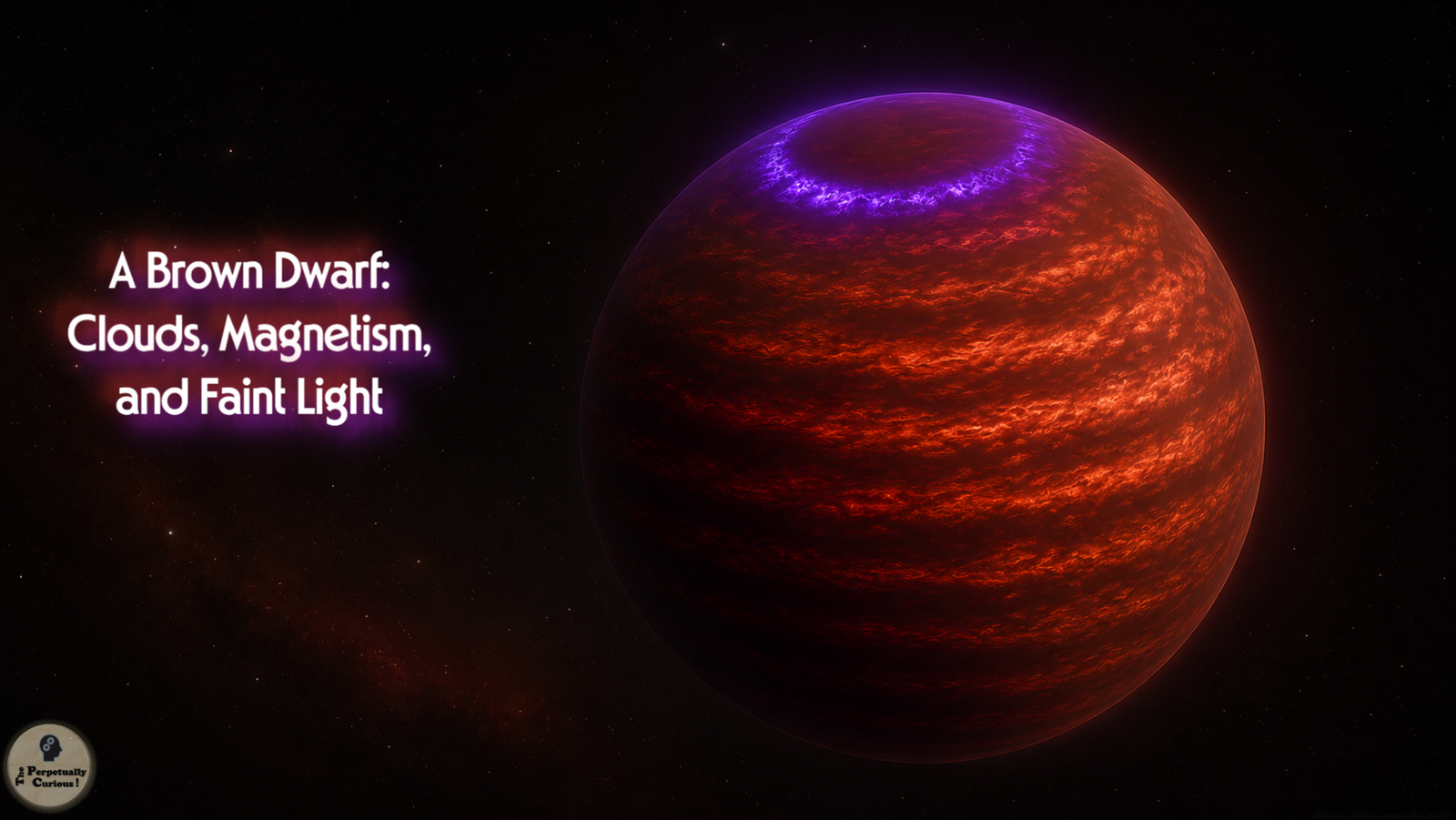
🌟 Brown Dwarfs: Between Giant Planets and the Smallest Stars
A brown dwarf drifts through the long night, carrying the quiet memory of a star that never came to be.Its light softens with age, yet its presence endures, a patient witness to the slow turning of the galaxy.In its fading glow, the boundary between what almost was and what still is becomes a gentle place to rest.
- The Perpetually Curious! › Canonical › Cosmic ExplorationArticle
🌌 The Hunt for the Invisible: Understanding Dark Matter Through Science’s Greatest Detective Story
In the quiet architecture of the cosmos, unseen matter shapes the paths of galaxies and the stories they tell.Its presence is felt in every curve of starlight, a patient influence woven through the structure of space.We stand within this vast design, aware of only a fraction of what holds the universe together.
- The Perpetually Curious! › Archives › Cosmic ExplorationArticle
🌟 Brown Dwarfs: Why Stellar Ignition Never Takes Hold
From section: 🌌 A life powered by stored heatThat distinction turns a narrow difference in mass into an entirely different cosmic biography, revealing how gravity, heat, pressure, and quantum physics divide the smallest stars from the dark worlds beside them.