Explore by topic, question, or idea. Find articles, reflections, videos, puzzles, and curiosity pathways gathered across the site.
Press Enter or select Search. A newly typed query starts globally; filters are applied only through the visible rail.
148 results for “why space looks dark”
- The Perpetually Curious! › CanonicalGateway
About Us
The Perpetually Curious! is an independent space for inquisitive minds, shaped by the belief that curiosity can open pathways into the many wonders of our world.
- The Perpetually Curious! › Archives › Cosmic ExplorationArticle
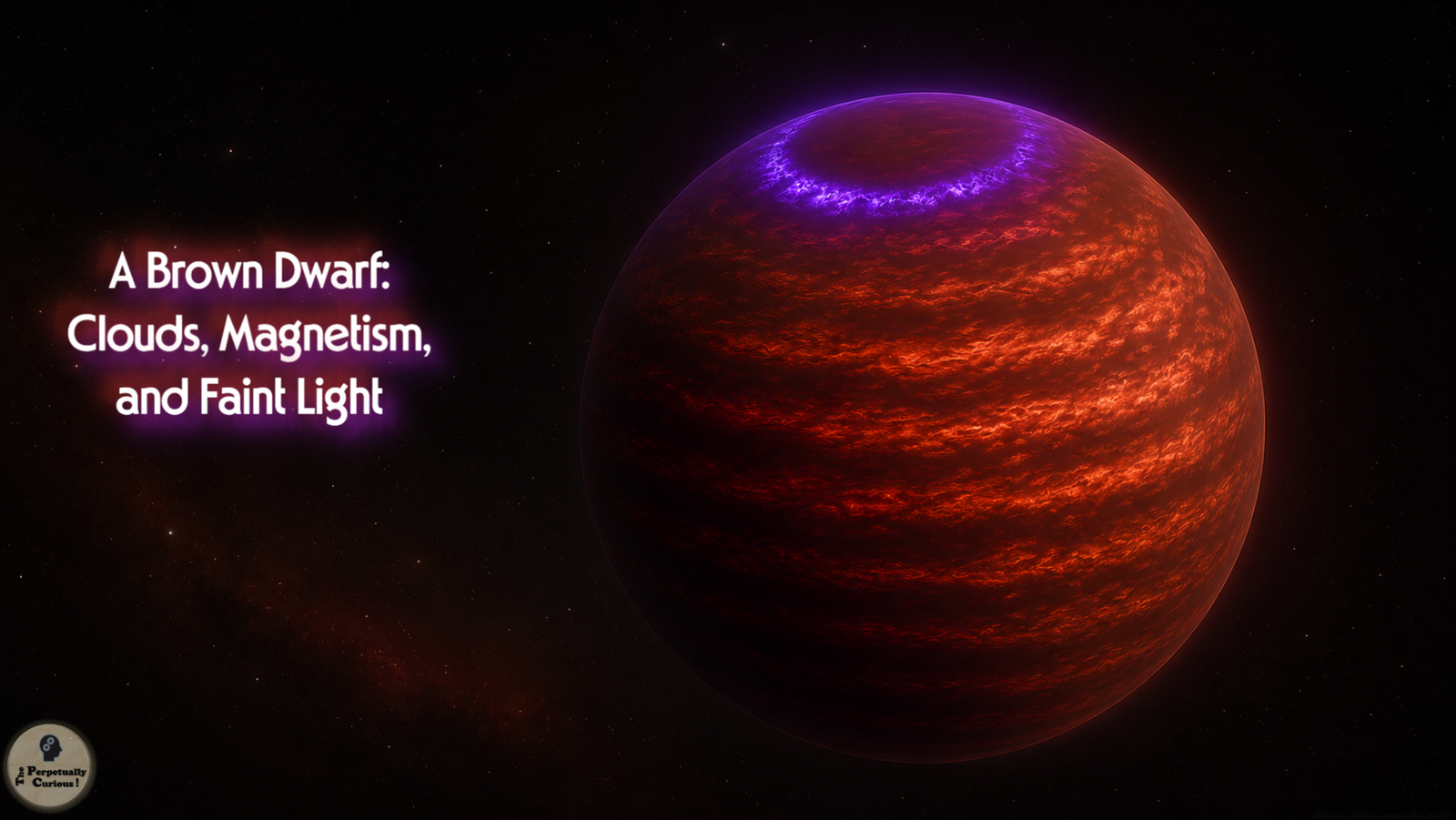
🌟 Brown Dwarfs: Why Stellar Ignition Never Takes Hold
From section: 🔥 When contraction almost makes a starNuclear reactions must release energy consistently enough to offset what the object radiates into space.
- The Perpetually Curious! › Archives › Planet EarthArticle
❄️ Antarctica: Southernmost Continent’s Frozen Symphony of Silence and Light
From section: ❓ FAQ… Antarctica is the world's best meteorite hunting ground. Dark space rocks stand out against white ice, and the slow-moving ice sheet acts as a conveyor belt, concentrating meteorites in specific areas. …
- The Perpetually Curious! › Archives › Botanical WondersArticle
Rubber Production Explained: From Tree Latex to Durable Elasticity 🌿
From Milky Latex to Elastic Resilience, and the Quiet Science Behind It A tire hums over rain-dark pavement. A rubber band stretches, and returns. A gasket holds pressure where metal meets metal. A glove yields to motion without tearing.
- The Perpetually Curious! › Archives › Cosmic ExplorationArticle
The Cosmic Journey: Understanding Our Galactic Year 🌌
Right now, you are racing through space at an astonishing 514,000 miles per hour (828,000 kilometers per hour), carried on a journey so vast that comprehending it challenges human intuition. This relentless motion never stops.
- The Perpetually Curious! › Archives › Cosmic ExplorationArticle
Worlds Beyond Worlds: The Extraordinary Story of Exoplanets 🌌
In the vast theater of space, thousands of alien worlds dance around distant stars, each one rewriting our understanding of what a planet can be.Read more »
- The Perpetually Curious! › Canonical › Cosmic ExplorationArticle
🌍 When Earth First Took Shape: A Planet Born from Cosmic Dust
From section: 🌋 Fire within: Differentiation and the shaping of Earth’s interiorThe next major chapter follows from this restless beginning. Earth had grown large enough to reorganize itself from within, but it still moved through a crowded young Solar System. Another large body, traveling through the same region of space, would collide with proto-Earth and change the planet’s future.
- The Perpetually Curious! › CanonicalReflection
Starlight as Memory
… This is not metaphor but physics. Light travels at approximately 186,000 miles per second (300,000 kilometers per second), fast enough to circle Earth seven times in a heartbeat, yet space is so vast that even this tremendous speed becomes a crawl across cosmic distances. …
- The Perpetually Curious! › Canonical › Engineering & TechnologyArticle
🖋️ Printing Ink: The Science and Living History Behind the Printed Page
From section: 🌈 A material of quiet wonderInk is a material of quiet power. It is engineered with precision, yet it appears in familiar forms such as books, labels, and photographs. It carries stories, instructions, and identities across time and space. The way ink absorbs and scatters light shapes how colors appear to the human eye.
- The Perpetually Curious! › Canonical › Cosmic ExplorationArticle
🛰️ When Fire Meets Air: How Spacecraft Reenter Earth’s Atmosphere
From section: Frequently Asked Questions+… Missions often define an entry interface at roughly 62 to 75 miles (100 to 120 kilometers), depending on the vehicle and trajectory. The Kármán line at 62 miles (100 kilometers) is a widely used conventional boundary between atmosphere and space, not a sharp atmospheric edge.