Explore by topic, question, or idea. Find articles, reflections, videos, puzzles, and curiosity pathways gathered across the site.
Press Enter or select Search. A newly typed query starts globally; filters are applied only through the visible rail.
91 results for “hd 100546 b unraveling a cosmic mystery”
- The Perpetually Curious! › Archives › Cosmic ExplorationArticle
The Moon's Ancient Dance: Understanding Lunar Phases Through Science and Story 🌙
From the thinnest crescents to the bright fullness that lights entire nights, the Moon’s changing face is not a mystery of motion on the surface, but a steady consequence of how sunlight meets a moving world.
- The Perpetually Curious! › Archives › Cosmic ExplorationArticle
🌌 The Hunt for the Invisible: Understanding Dark Matter Through Science's Greatest Detective Story
Its discovery story reads like a cosmic detective tale, where the evidence surrounds us everywhere we look, yet the culprit remains tantalizingly out of reach.Read more »
- The Perpetually Curious! › Archives › PhysicsArticle
🚀⚡ Pioneering Power in Deep Space: The Essential Role of Radioisotope Thermoelectric Generators (RTGs)
This article also belongs naturally within the wider cosmic exploration collection, where deep-space power, spacecraft motion, distant signals, and observation technologies come together as parts of the same larger story.
- The Perpetually Curious! › CanonicalReflection
Starlight as Memory
… This is not metaphor but physics. Light travels at approximately 186,000 miles per second (300,000 kilometers per second), fast enough to circle Earth seven times in a heartbeat, yet space is so vast that even this tremendous speed becomes a crawl across cosmic distances. …
- The Perpetually Curious! › CanonicalReflection
Empty Rooms and Ancient Light
… Even in the best vacuums scientists can create, quantum fields still fluctuate, and perfect nothingness remains more concept than condition. The space between stars, once imagined as blank, carries cosmic rays, magnetic fields, and thin traces of matter drifting across immense distances. …
- The Perpetually Curious! › CanonicalReflection
Starborn Memory Within
… These atoms you have borrowed will continue their journey, perhaps becoming part of new life, new stars, new possibilities. You are not a permanent structure but a temporary pattern in the cosmic flow, a form that arose, developed consciousness, and will eventually release its components back to the larger dance.
- The Perpetually Curious! › Canonical › Planet EarthArticle
🌌 Sky in Slow Layers: Understanding Earth’s Atmospheric Structure
From section: Frequently Asked Questions+Does the ozone layer block all ultraviolet radiation? The atmosphere absorbs virtually all ultraviolet C and most ultraviolet B radiation, but most ultraviolet A and a smaller amount of ultraviolet B still reach the surface. …
- The Perpetually Curious! › Canonical › Biology & HealthArticle
😮💨 When A Breath Becomes a Yawn: Why We Yawn and What This Quiet Reflex May Reveal
A yawn often arrives softly, as if carried on an internal tide. A slow, deep inhalation gathers the body, the jaw opens wide, the eyes close for a moment, and then a long exhalation follows. It is a gesture so familiar that it often passes without notice, yet it carries a quiet mystery.
- The Perpetually Curious! › Archives › PhysicsArticle
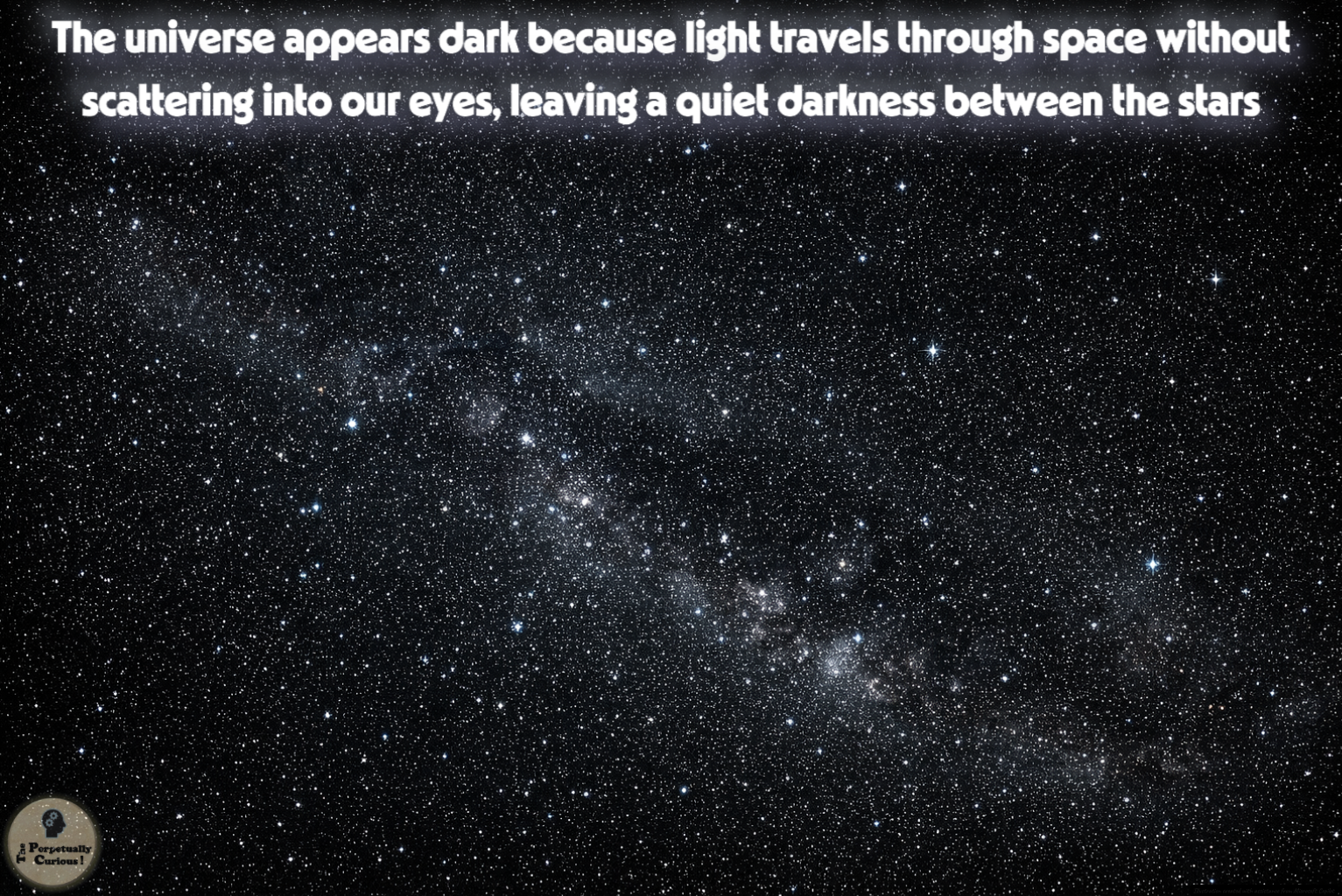
🌌 Why Space Looks Dark: Light, Matter, and the Quiet Cosmos
From section: Where the fuller cosmic question beginsWhere the fuller cosmic question begins The same idea also opens the door to a larger astronomical puzzle.
- The Perpetually Curious! › Archives › Cosmic ExplorationArticle
🌌 The Silent Storm Above: Understanding Our Orbital Debris Challenge
The night sky appears serene and infinite, yet beyond our atmosphere swirls an invisible tempest of our own making. ESA estimates about 140 million debris fragments in the 0.04 to 0.4 inch (1 mm to 1 cm) range, plus about 1.2 million objects between 0.4 and 4 inches (1 to 10…