Explore by topic, question, or idea. Find articles, reflections, videos, puzzles, and curiosity pathways gathered across the site.
Press Enter or select Search. A newly typed query starts globally; filters are applied only through the visible rail.
40 results for “sky in slow layers understanding earth atmospheric structure”
- The Perpetually Curious! › Canonical › Cosmic ExplorationArticle
🌌 The Universe’s Ancient Whisper: Decoding the Cosmic Microwave Background
From section: 💡 Did You Know🧭 CMB lensing reveals intervening structure. Galaxies, galaxy clusters, and the wider matter distribution bend CMB photons through gravitational lensing, allowing researchers to reconstruct maps of matter between the last-scattering surface and Earth.
- The Perpetually Curious! › Archives › Cosmic ExplorationArticle
🌌 When Stars Become Worlds: A Journey Through the Largest Stars We Know
The largest stars in the universe are not simply scaled-up versions of the Sun. They are vast, unstable, and luminous structures whose outer layers drift in slow, turbulent motion. Their atmospheres are so extended that the idea of a clear surface begins to dissolve into gradients of thinning gas.
- The Perpetually Curious! › Archives › Cosmic ExplorationArticle
🌌 The Silent Storm Above: Understanding Our Orbital Debris Challenge
The night sky appears serene and infinite, yet beyond our atmosphere swirls an invisible tempest of our own making. ESA estimates about 140 million debris fragments in the 0.04 to 0.4 inch (1 mm to 1 cm) range, plus about 1.2 million objects between 0.4 and 4 inches (1 to 10…
- The Perpetually Curious! › Archives › Cosmic ExplorationArticle
The Moon's Ancient Dance: Understanding Lunar Phases Through Science and Story 🌙
Every approximately 29.5 days, Earth’s sole natural satellite completes a shape-shifting performance that has captivated humanity since our species first gazed skyward.
- The Perpetually Curious! › Archives › Cosmic ExplorationArticle
🌞 The Solar Wind: When the Sun Breathes Across Space
🌠 Introduction Have you ever looked up at the night sky and wondered why shimmering curtains of green, red, and other hues ripple across the poles? These auroras are the visible traces of the solar wind’s interaction with Earth’s magnetic field, where charged particles guided…
- The Perpetually Curious! › Archives › Cosmic ExplorationArticle
The Cosmic Clock: How Stars Age Through Billions of Years ⏰
When we gaze at the night sky, the stars appear eternal and unchanging. Yet our Sun offers the perfect window into stellar aging. Currently 4.6 billion years old and middle-aged by stellar standards, it demonstrates the stable hydrogen burning that characterizes stellar prime.
- The Perpetually Curious! › Archives › Cosmic ExplorationArticle
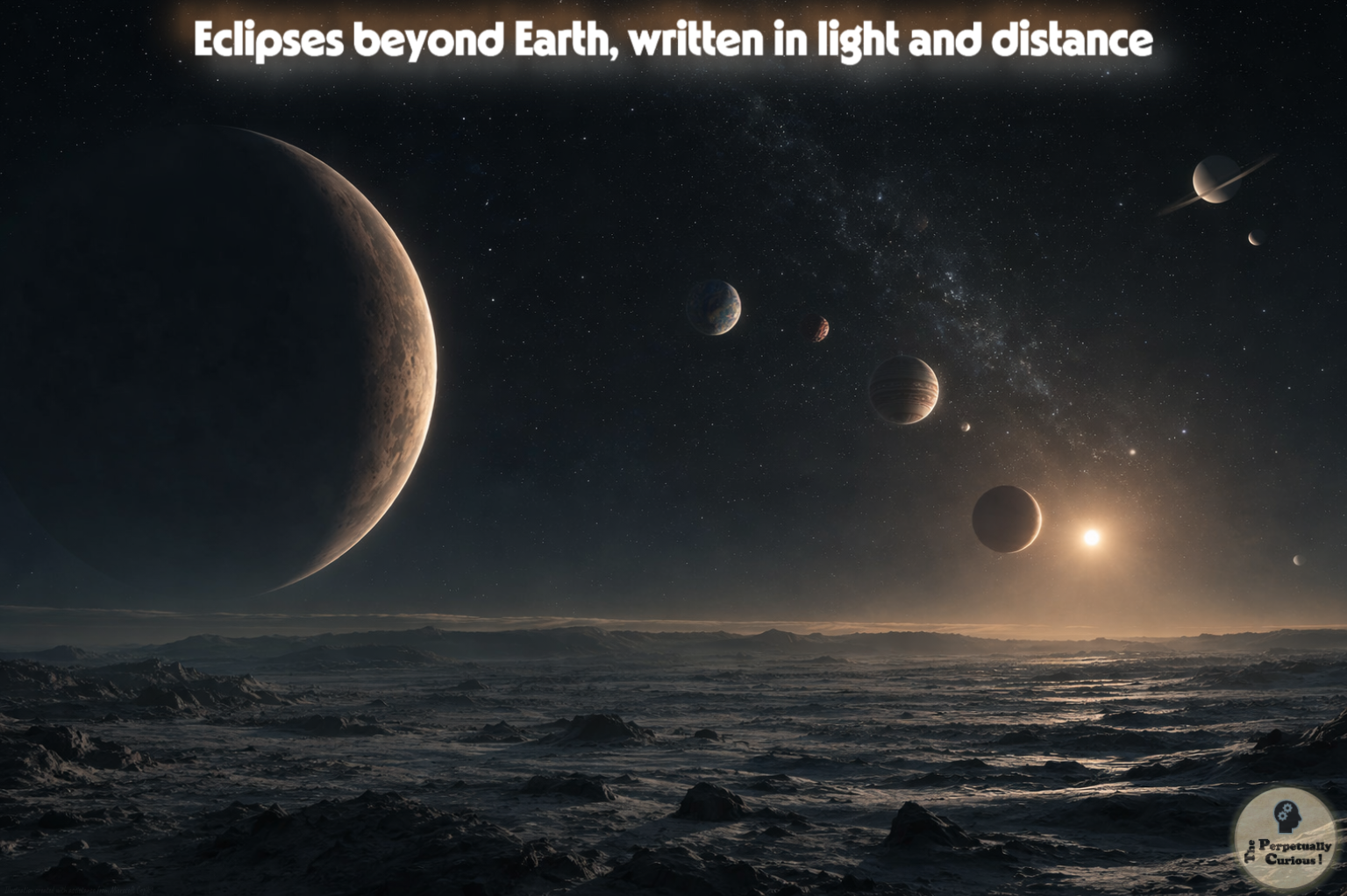
🌘 Eclipses Across the Solar System: When Shadows Travel
From section: A simple alignment, many possible shadowsThat is why eclipses beyond Earth are not simply copies of the familiar sky.
- The Perpetually Curious! › Archives › Cosmic ExplorationArticle
🌌 The Hunt for the Invisible: Understanding Dark Matter Through Science's Greatest Detective Story
The universe is keeping a secret from us. About 85 percent of all the matter that exists remains stubbornly invisible, refusing to interact with light yet shaping everything we see. This invisible substance, which scientists call dark matter, represents one of the most profound…
- The Perpetually Curious! › Archives › Cosmic ExplorationArticle
💫 When Galaxies Feast: The Quiet Art of Cosmic Cannibalism
Among these gradual processes is galactic cannibalism, a slow and cumulative form of growth in which a large galaxy gradually absorbs smaller companions.
- The Perpetually Curious! › Archives › Cosmic ExplorationArticle
The Asteroid Belt: Ancient Fragments of Our Solar System's Story 🌌
On New Year's Day 1801, Italian astronomer Giuseppe Piazzi made a discovery that would transform our understanding of the solar system. While searching for a suspected planet between Mars and Jupiter, he found something else entirely: the first of millions of rocky fragments…