Explore by topic, question, or idea. Find articles, reflections, videos, puzzles, and curiosity pathways gathered across the site.
Press Enter or select Search. A newly typed query starts globally; filters are applied only through the visible rail.
223 results for “small islands in the skin why moles form and why most stop growing”
- The Perpetually Curious! › Canonical › Cosmic ExplorationArticle
🌌 Borrowing the Orbits of Giants: How Gravity Assists Carry Spacecraft into the Deep
This article follows that journey from the challenge of reaching distant planets to the elegant physics that makes gravity assists possible. It traces how a subtle idea in orbital mechanics became one of the most important tools in cosmic exploration, and how it continues to shape the paths of spacecraft today.
- The Perpetually Curious! › CanonicalReflection
The Paradox of the Threshold
… Seasons flow through endless transitions marked only by our human need for calendar boundaries. Within our bodies, some cells like those in our skin renew every few weeks, liver cells regenerate over years, while most neurons remain with us throughout life, yet their connections constantly rewire. …
- The Perpetually Curious! › CanonicalReflection
Starborn Memory Within
… These atoms you have borrowed will continue their journey, perhaps becoming part of new life, new stars, new possibilities. You are not a permanent structure but a temporary pattern in the cosmic flow, a form that arose, developed consciousness, and will eventually release its components back to the larger dance.
- The Perpetually Curious! › CanonicalReflection
The River of Now
From Reflections on Time ⏳ 👁️ Time is not a line we walk, but a river that carries us. Every moment is both departure and arrival, a current that never returns in the same form. A Quiet Descent into the Reflection Our language betrays a fundamental confusion about time.
- The Perpetually Curious! › Canonical › Planet EarthArticle
🌊 Where the Waves Leave Their Footprints: Why Beaches Carry Sand
From section: ⚖️ Why Sand Stays While Other Sediments Drift AwayThis distinction between sand and mud is not only a matter of size but also a reflection of the environment in which each material forms. Beaches are shaped by more active movement, while mudflats and marshes often form where water is calmer.
- The Perpetually Curious! › Archives › Planet EarthArticle
❄️ Antarctica: Southernmost Continent’s Frozen Symphony of Silence and Light
From section: ❓ FAQ… Yes, but visits are strictly regulated under the Antarctic Treaty System. Most tourists arrive via expedition cruise ships from South America. Recent seasons have seen visitor numbers ranging from tens of thousands to over 100,000 annually. …
- The Perpetually Curious! › Archives › Wilderness & Homestead CreaturesArticle
🐧 Penguin Diversity: Exploring Species, Adaptations, and Habitats
Prelude: Beyond the Ice When most people picture penguins, they imagine black and white birds waddling across Antarctic ice. But the truth is far richer. Penguins are classified into about eighteen species across six genera: great, brush tailed, crested, banded, little, and yellow eyed.
- The Perpetually Curious! › Archives › Botanical WondersArticle
🍊 Citrus Family Tree: How Ancient Lineages Became Familiar Fruits
Much of the diversity people recognize today grew from a small ancestral core, followed by repeated hybridization and human selection.
- The Perpetually Curious! › Archives › Wilderness & Homestead CreaturesArticle
🦈 Scars That Speak: Shark Survival Stories Etched in Skin
Introduction 🌊 Every scar on a shark tells a story, each a record as unique as the path that shark has traveled through its environment. These marks are not just wounds. They are survival records that reveal the hidden dramas of the ocean.
- The Perpetually Curious! › Archives › Cosmic ExplorationArticle
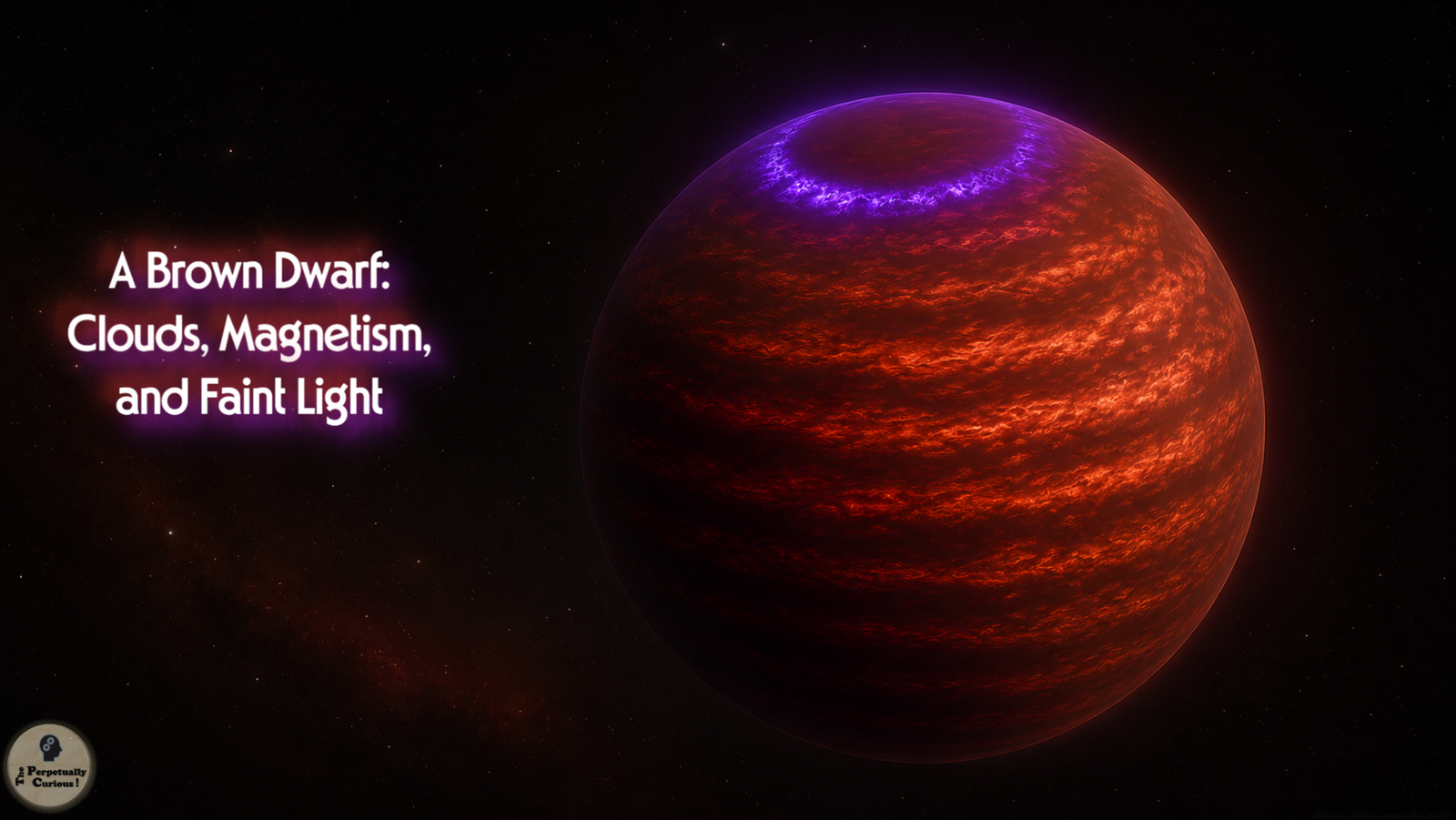
🌟 Brown Dwarfs: Why Stellar Ignition Never Takes Hold
From section: 🔥 When contraction almost makes a star… 🔥 When contraction almost makes a star A young brown dwarf can form through fragmentation and gravitational collapse broadly similar to the formation of a low-mass star.