Explore by topic, question, or idea. Find articles, reflections, videos, puzzles, and curiosity pathways gathered across the site.
Press Enter or select Search. A newly typed query starts globally; filters are applied only through the visible rail.
4 results for “understanding the world traditional medicine systems a cultural and historical perspective”
- The Perpetually Curious! › Canonical › Environment & SustainabilityArticle
🔄 Tides of Plastic: Microplastic Pollution in the Oceans and Its Journey Back to Us
From section: 🧬 Within us: what microplastics may mean for human healthWith this perspective in mind, the narrative can return to the wider loop. The particles that begin as discarded materials do not simply vanish into the ocean. They move through water, organisms, food, and air, while research works to trace those pathways back toward the human systems that first produced them.
- The Perpetually Curious! › Canonical › Environment & SustainabilityArticle
🕸️ Ghost Nets, Silent Drifters: How Lost Fishing Gear Haunts the Ocean
From section: Frequently Asked Questions+How do scientists estimate ghost gear quantities? Scientists use field surveys, fisher reports, diver observations, remote sensing, drift models, and known gear-loss rates. Because fisheries, gear types, reporting systems, and ocean conditions vary widely, estimates often use ranges rather than a single global number.
- The Perpetually Curious! › Canonical › Environment & SustainabilityArticle
🌿 Liquid Trees: Microalgae Photobioreactors and the Quiet Art of Urban Breathing
From section: ⚙️ The engineering beneath the surface: control, energy, and maintenanceA liquid tree depends on far more than the green culture visible through its walls. Pumps or aeration systems move air into the vessel, while circulation helps distribute dissolved gases, nutrients, heat, and light exposure throughout the culture.
- The Perpetually Curious! › Archives › Environment & SustainabilityArticle
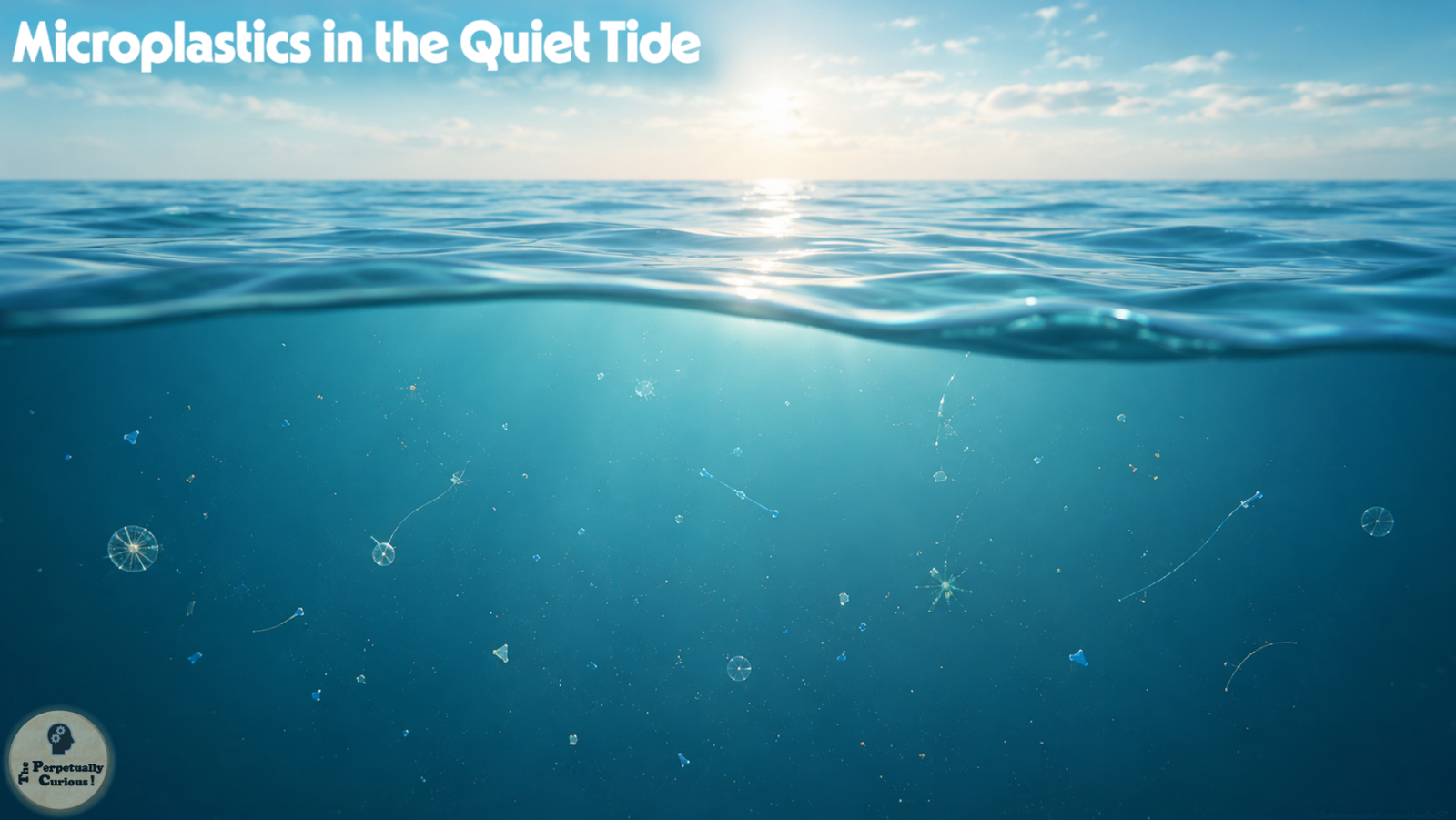
🌊 Microplastics in the Ocean: How Tiny Fragments Travel
Microplastics in the ocean are not only small pieces of plastic. They are mobile fragments, shaped by weathering, water movement, and the living systems they pass through.