

A glass of water can appear perfectly clear and still carry a record of the ground beneath it. As water moves through soil, limestone, chalk, dolomite, and other mineral-bearing layers, it can gather calcium and magnesium ions that change how it behaves without changing how it looks. These dissolved minerals create hardness, a familiar but often misunderstood part of water chemistry that can influence soap performance, leave scale on surfaces, and affect equipment ranging from household heaters to industrial systems.
Water quality is a much larger story, shaped by many physical, chemical, and biological factors. Here, the focus rests on one particular thread: how hardness begins, how it becomes visible in daily life, and how chemistry and engineering work together to soften water for different needs. Within that quiet transformation lies a wider meeting of geology, materials, infrastructure, and human attention.
A glass of water carries a quiet memory of stone and soil.
Its minerals shift with gentle intention, shaped by chemistry and care.
In that small transformation, the landscape moves a little closer to the hand.
🌍 Where hardness begins: minerals in motion
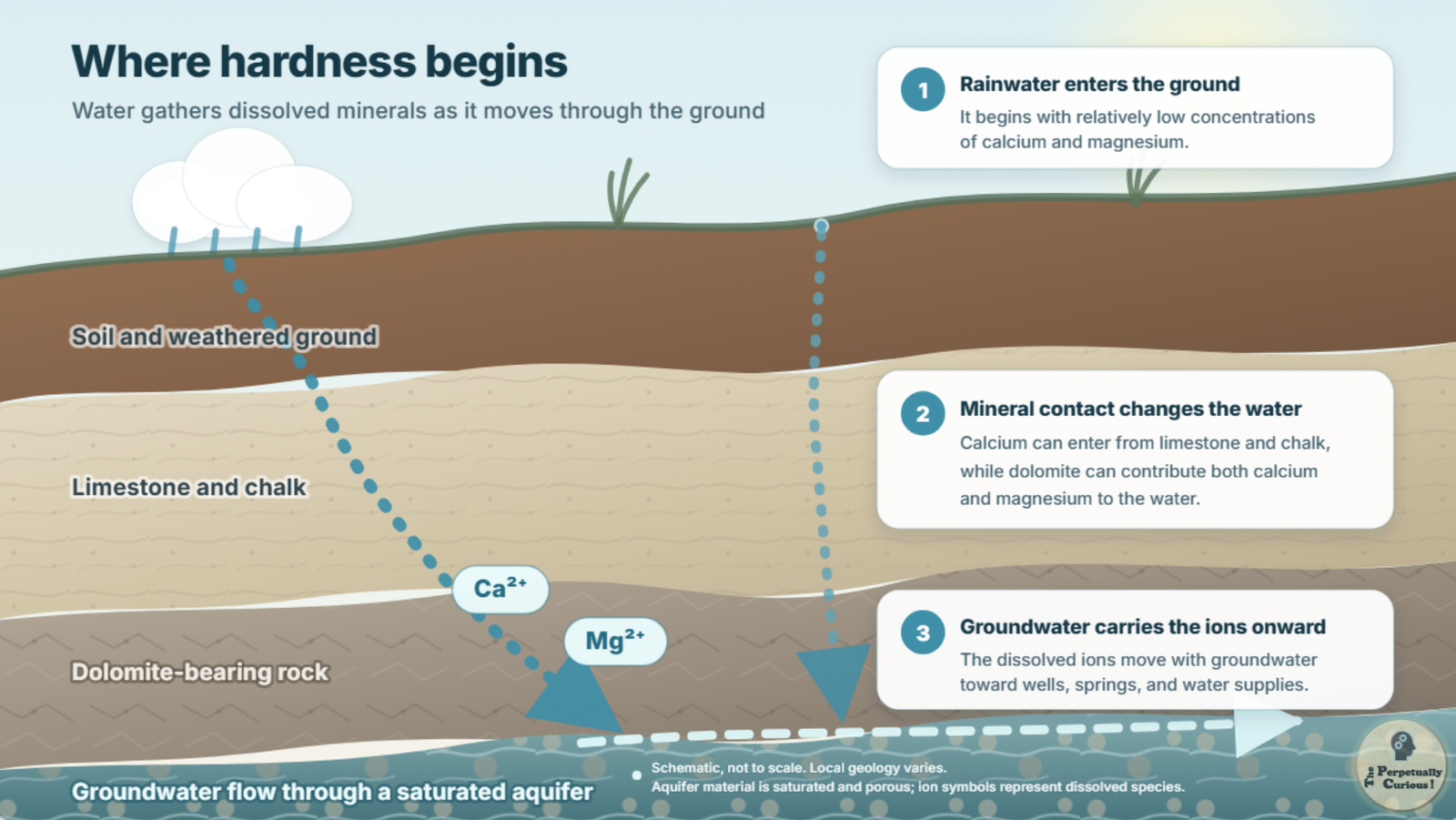
Hardness begins long before water reaches a faucet. Rainwater generally contains only low concentrations of calcium and magnesium, although it is not chemically pure. As it filters through soil and moves across or through carbonate-rich rocks such as limestone, chalk, and dolomite, it can dissolve calcium- and magnesium-bearing minerals, releasing calcium and magnesium ions into the water. The amount dissolved depends partly on the surrounding geology, the water’s chemistry, and how long it remains in contact with mineral-bearing layers.
Hardness is commonly reported as a calcium carbonate equivalent, even when several dissolved compounds contribute to it. Using one widely applied classification, water with a hardness of about 3.5 grains per gallon (gpg), or 60 milligrams per liter (mg/L), or less is considered soft. Water above 3.5 and up to 7 gpg (61 to 120 mg/L) is moderately hard, water above 7 and up to 10.5 gpg (121 to 180 mg/L) is hard, and water above about 10.5 gpg (more than 180 mg/L) is very hard.
When bicarbonate-rich hard water is heated, evaporates, or loses dissolved carbon dioxide, its chemical balance can shift and encourage calcium carbonate to precipitate as a solid. Magnesium-bearing deposits may also form under suitable conditions. These reactions produce the familiar pale scale found on heating elements, showerheads, faucets, and the inner surfaces of pipes.
Hardness is therefore one chemical characteristic of water, not a complete measure of its quality or safety. Yet as dissolved ions leave the landscape and enter homes and infrastructure, geology begins to make itself visible in everyday life.
🚿 Hard water in daily life: from quiet deposits to visible scale
Hard water often reveals itself through gradual, familiar signs. A chalky ring around a bathtub, a haze on shower glass, or a pale crust on a faucet can form as dissolved minerals precipitate and collect on surfaces. These deposits may begin invisibly, but over time they can change how water interacts with plumbing, appliances, and everyday cleaning.
The chemistry behind soap bubbles also changes in hard water. Calcium and magnesium ions react readily with true soap molecules, forming insoluble calcium and magnesium salts commonly known as soap scum. This reduces lather and can leave films on skin, clothing, fixtures, and other surfaces. Many modern synthetic detergents are less affected because their surfactants generally remain more soluble in mineral-rich water.
Scale can create more than a visible nuisance. On heating elements and heat-transfer surfaces, mineral deposits may act as an insulating layer, reducing efficiency and increasing the energy needed to heat water. Inside narrow pipes, valves, or channels, continued accumulation may gradually restrict flow and increase maintenance demands.
These effects explain why hardness is sometimes managed rather than simply accepted as a natural feature of water. Water softening begins with that practical goal: reducing the calcium and magnesium ions most responsible for scale and soap interference while recognizing that hardness is only one part of the wider chemistry of water.
⚗️ The concept of water softening: reducing hardness, not erasing water
Water softening reduces the calcium and magnesium ions most responsible for scale and interference with true soaps. The aim is not to remove every dissolved substance or make water chemically pure, but to bring hardness within a range suited to a particular household, municipal, or industrial need.
Low hardness can result from very different forms of treatment or natural water chemistry. Naturally soft water contains little calcium and magnesium from the beginning. In ion-exchange-softened water, much of the calcium and magnesium has been exchanged for sodium or potassium, while membrane-treated or demineralized water may contain far fewer dissolved substances overall. These waters may register similarly low hardness even though their remaining dissolved composition is not the same.
Whether softening is appropriate depends on the incoming water chemistry, the equipment or process being protected, the desired finished-water characteristics, maintenance and waste-management requirements, and local regulations. Once the treatment goal is defined, the next question is how calcium and magnesium can be selectively removed or exchanged, beginning with one of the most widely used methods: ion exchange.
🧪 Ion exchange softening: a quiet exchange of ions
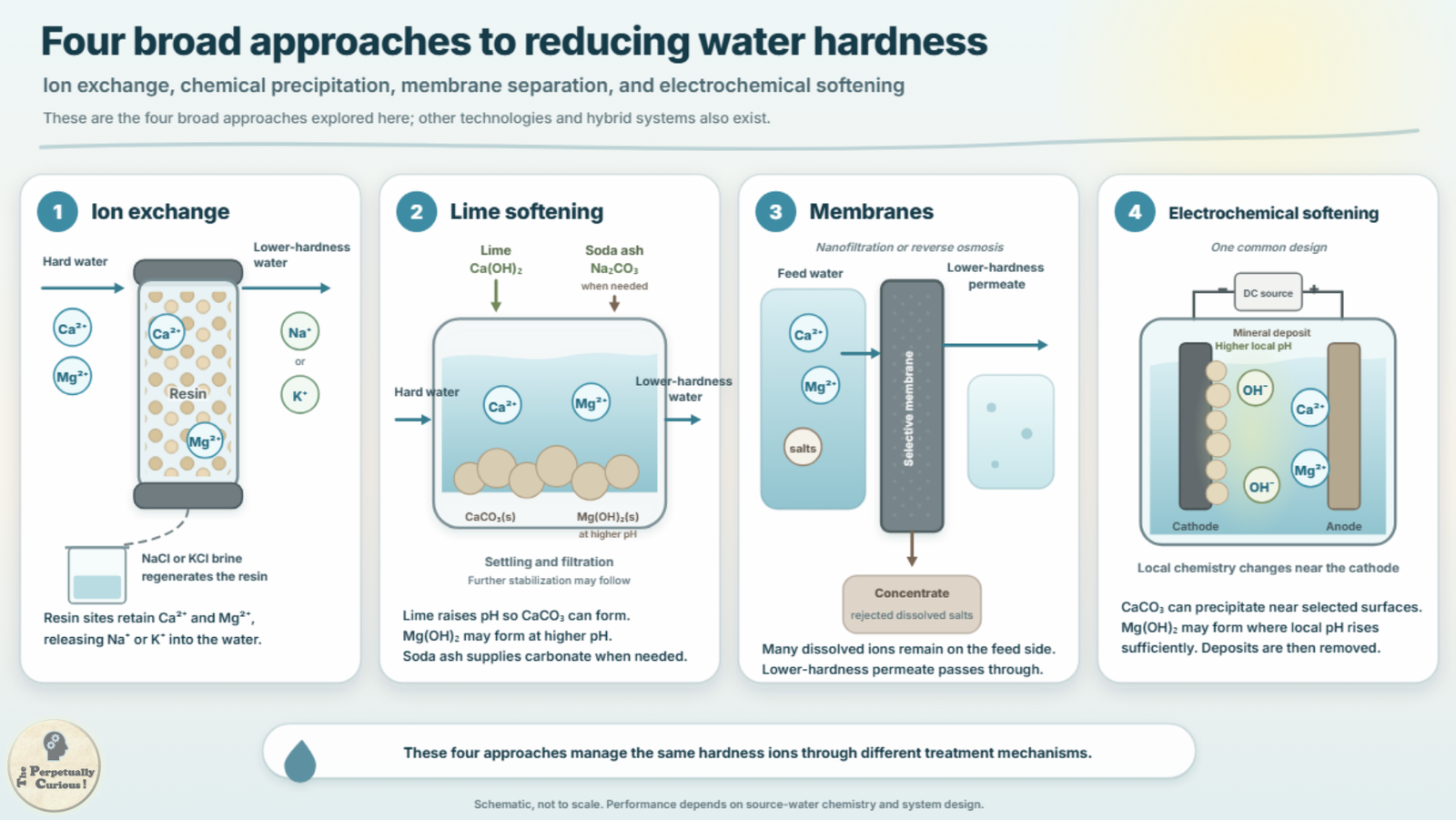
Ion exchange is one of the most widely used methods of water softening. Water passes through a bed of resin beads containing fixed negatively charged sites that initially hold sodium or potassium ions. Calcium and magnesium ions have a greater affinity for these sites under typical operating conditions, so they displace the sodium or potassium as hard water moves through the resin.
Because calcium and magnesium each carry two positive charges, one of these ions generally replaces two sodium or potassium ions. The differing ionic charges of calcium, magnesium, sodium, and potassium reflect broader patterns in the periodic table, where atomic structure helps shape how elements form ions and participate in chemical reactions. The released sodium or potassium remains dissolved in the treated water.
Over time, the resin becomes increasingly loaded with calcium and magnesium and loses softening capacity. Regeneration restores that capacity by flushing the resin with a concentrated sodium chloride or potassium chloride solution. The large excess of sodium or potassium displaces the accumulated hardness ions, which leave the system in a salt-rich brine waste stream.
Whether ion exchange is appropriate depends on the incoming hardness, water-use pattern, flow rate, resin capacity, desired finished-water chemistry, maintenance requirements, economics, and local rules governing salt and brine discharge. Although familiar in household systems, ion exchange is also used in commercial and industrial treatment. For larger centralized systems, hardness may instead be removed by encouraging calcium and magnesium compounds to precipitate from the water.
🧱 Lime softening and precipitation: guiding minerals out of solution
Lime softening is commonly used in municipal and industrial treatment, where large volumes of water must be handled efficiently. Lime, or calcium hydroxide, is added to raise the pH and shift the water’s carbonate balance. Under these conditions, dissolved calcium can precipitate as calcium carbonate, while magnesium generally requires a higher pH and is commonly removed as magnesium hydroxide.
Soda ash, or sodium carbonate, may also be added when additional carbonate is needed, particularly to remove noncarbonate calcium hardness. The resulting mineral particles are allowed to form, grow, settle, and separate from the water through sedimentation and filtration. Treatment may then include pH adjustment or stabilization before storage or distribution.
Lime treatment is especially effective when bicarbonate, or carbonate, hardness dominates, but lime-soda softening can also remove part of the noncarbonate hardness. In this process, hardness ions are not exchanged for other dissolved ions. Instead, the water chemistry is adjusted so that calcium- and magnesium-bearing compounds precipitate and can be removed as solids. Precipitation therefore offers one route to softening. Membrane treatment follows a different principle, separating dissolved ions from water through selective barriers rather than converting them into removable particles.
🚰 Membranes and separation: hardness at the boundary
Membrane systems such as nanofiltration and reverse osmosis reduce hardness by allowing water to pass through a selective barrier while retaining many dissolved ions. Nanofiltration preferentially rejects many divalent ions, including calcium and magnesium, while reverse osmosis removes a broader range of dissolved salts and other small constituents.
These systems are especially useful when hardness is only one of several water-quality concerns being addressed. Their selectivity, however, also creates practical challenges. As water passes through the membrane, retained minerals become concentrated on the feed side, producing a reject or concentrate stream that must be managed. Calcium- and magnesium-bearing salts may also accumulate on membrane surfaces if operating conditions allow them to precipitate, reducing flow and treatment efficiency.
Pretreatment, controlled recovery rates, careful pressure and pH management, periodic cleaning, and antiscalant use can help limit fouling and mineral scale. When treatment produces water with very low mineral content, blending or stabilization may also be needed before storage, distribution, or specialized use.
Membranes soften water through separation rather than by exchanging ions or converting them into settleable solids. Emerging electrochemical methods take another approach, using electrical reactions to alter local conditions and encourage hardness minerals to collect at selected surfaces.
⚡ Emerging electrochemical softening: directing ions with current
Electrochemical softening uses electrical reactions to change the local chemistry near selected surfaces. In several designs, reactions at or near a cathode generate hydroxide ions and raise the surrounding pH. This shift can encourage dissolved calcium to precipitate as calcium carbonate and, where the local pH rises sufficiently, magnesium to precipitate as magnesium hydroxide.
The resulting mineral deposits may collect on electrodes, removable surfaces, or suspended particles, depending on the system design. This can reduce the hardness remaining in the water, but the accumulated solids must still be removed, and electrode surfaces may require periodic cleaning to maintain performance.
Research continues to examine energy demand, electrode scaling, mineral selectivity, reactor configuration, and integration with other treatment steps. Electrochemical softening may be useful in industrial water systems where hardness must be controlled carefully, although its suitability depends on source-water chemistry, operating conditions, and the efficiency of the specific design.
Together, these methods show how the same hardness ions can be managed through exchange, precipitation, separation, or electrically driven reactions. The next distinction lies not in chemistry alone, but in scale: whether treatment occurs for an entire community, an industrial process, or a single household.
🏙️ Municipal and household softening: different scales, shared chemistry
Municipal softening decisions reflect regional geology, source-water chemistry, infrastructure needs, treatment capacity, and regulatory requirements. Some communities reduce hardness centrally to limit scale in distribution systems and improve compatibility with household and industrial equipment. Others distribute harder water and leave softening decisions to individual households or facilities.
At the municipal level, hardness cannot be considered in isolation. Utilities must also account for pH, alkalinity, corrosion control, pipe materials, and the stability of the finished water. Lower hardness is not automatically better if the resulting chemistry increases corrosion risk or requires additional stabilization before distribution.
Private wells create a different household context. Well water is not automatically hard, but groundwater may acquire substantial calcium and magnesium as it moves through mineral-bearing rock and aquifer materials. Because a private well is not managed by a municipal utility, responsibility for monitoring the wider water chemistry often rests with the well owner rather than a public utility. A softener can reduce calcium and magnesium, but it does not by itself address microorganisms or unrelated dissolved contaminants.
Household systems, commonly based on ion exchange, allow treatment to be tailored to local hardness and individual use. They can reduce scale and improve the performance of true soaps, but they also require salt or potassium chloride, periodic regeneration, maintenance, and management of the resulting brine.
Whether treatment occurs across an entire community, an industrial facility, or a single household, the same calcium and magnesium ions remain at the center of the process. What changes is the scale of treatment, the degree of oversight, and the balance between performance, water quality, maintenance, and environmental tradeoffs.
🌍 Environmental and conservation perspectives: balancing benefits and impacts
Water softening can reduce scale, improve the performance of heating and process equipment, and lower the amount of soap or detergent needed for some cleaning tasks. These benefits, however, must be weighed against the resources consumed and the residual streams produced by each treatment method.
Ion-exchange systems use water during regeneration and produce a salt-rich brine containing sodium or potassium together with the calcium and magnesium removed from the source water. Lime softening generates mineral residuals that must be collected and dewatered before reuse in suitable settings or disposal. Nanofiltration and reverse osmosis produce a concentrate stream in which rejected salts and other dissolved substances become more concentrated. Electrochemical systems require electricity and may also involve electrode cleaning, deposit removal, and periodic replacement of working components.
Energy demand varies widely among technologies and operating conditions. Membrane pressure, pumping requirements, regeneration frequency, source-water chemistry, and treatment scale all influence the environmental footprint. At the same time, limiting mineral scale may improve heat transfer, reduce maintenance, and extend the useful life of water heaters, boilers, membranes, and other equipment.
For this reason, no softening method carries the same balance of benefits and impacts in every setting. The most suitable approach depends on local water chemistry, treatment goals, energy sources, waste-management options, infrastructure, and regulatory requirements. Water softening is therefore not simply the removal of minerals, but a careful negotiation between performance, resource use, and the broader systems through which water moves.
🌊 A quiet conclusion: minerals, memory, and gentle water
Hardness records part of water’s contact with stone and soil, while softening reshapes that chemistry for particular needs. The process does not make water universally better or purer. Instead, it changes the balance of calcium and magnesium through exchange, precipitation, separation, or electrically driven reactions.
What feels simple at the tap is supported by a layered field of chemistry and engineering. Each treatment method brings its own benefits, limitations, energy demands, and residual streams, and no single approach is suitable for every source, system, or community.
A glass of water can therefore hold more than clarity. It can reflect geology, infrastructure, and deliberate choices about how water is prepared for use. Looking closely at hardness reveals how an ordinary material can connect landscapes, technologies, and everyday life.
Pass this article along to someone curious and let the learning travel.
💡 Did You Know?
🧭 Hardness can vary over short distances
Neighboring communities may receive water with very different hardness levels when their supplies come from different aquifers, reservoirs, rivers, or blended sources.
🧼 Softened water may feel different on the skin
Ion-exchange-softened water may feel smoother or slightly slick because true soap remains more soluble and forms less mineral soap scum. The sensation reflects a change in soap behavior rather than a coating left by the softened water itself.
📏 Hardness is measured in more than one unit
One grain per gallon is equal to about 17.1 milligrams per liter when hardness is expressed as a calcium carbonate equivalent. This conversion allows household test results and laboratory measurements to be compared more easily.
💧 Softened water may still leave marks as it dries
Reducing calcium and magnesium does not remove every dissolved substance. Sodium, potassium, silica, and other constituents may remain, so evaporating droplets can sometimes leave marks that differ chemically from hard-water scale.
Is hard water considered safe to drink?
Hardness itself is generally not considered a health concern at concentrations commonly found in drinking-water supplies. Its most noticeable effects usually involve taste, scale formation, soap performance, and equipment maintenance. Hardness does not, however, indicate whether water is microbiologically safe or free from unrelated contaminants.
Does hardness affect taste?
Hardness can give water a mild mineral character. The effect depends on the concentrations of calcium, magnesium, bicarbonate, sulfate, and other dissolved substances, as well as on individual preference.
How can you tell whether water is hard?
Common signs include mineral scale on fixtures and heating elements, cloudy or spotted glassware, reduced lather from true soap, and soap scum. These clues may suggest hardness, but they do not measure it precisely. A water test is needed to determine the hardness concentration.
Why does soap behave differently in hard water?
Calcium and magnesium ions react with true soap molecules to form insoluble salts commonly known as soap scum. This reduces lather and may leave residues on skin, clothing, fixtures, and other surfaces. Many synthetic detergents are less affected because their cleaning agents remain more soluble in mineral-rich water.
Can boiling remove hardness?
Boiling can reduce some carbonate hardness by shifting bicarbonate equilibria and encouraging calcium carbonate to precipitate. Noncarbonate hardness generally remains and requires another treatment method.
Does softening change mineral nutrition?
Softening reduces calcium and magnesium in the treated water. The contribution of drinking water to mineral intake varies with the composition of the supply and a person’s diet and can be meaningful in some regions.
Does ion-exchange softening add sodium to water?
Yes. Sodium-cycle ion exchange replaces calcium and magnesium ions with sodium ions. The amount added depends on the hardness removed and the system’s operating conditions. Potassium-cycle systems similarly add potassium.
Is softened water the same as purified water?
No. Softened water has reduced calcium and magnesium, but it may still contain many other dissolved substances. Purification processes such as reverse osmosis remove a broader range of dissolved constituents.
Does a conventional water softener reduce total dissolved solids?
Not substantially in most cases. Sodium-cycle ion exchange replaces calcium and magnesium with sodium rather than broadly removing dissolved material. Total dissolved solids may remain similar or increase slightly, depending on the source-water chemistry and how TDS is estimated or measured. Membrane processes such as reverse osmosis remove a broader range of dissolved constituents.
Is a water conditioner the same as a water softener?
Not necessarily. The term water conditioner is used broadly for several technologies. A true water softener reduces calcium and magnesium hardness, most commonly through ion exchange, while some conditioners aim to influence how scale forms or adheres without substantially lowering measured hardness.
Does hardness interact with plumbing materials?
Hardness can contribute to scale inside pipes, valves, and fixtures, which may gradually restrict flow. Corrosion behavior, however, also depends on pH, alkalinity, dissolved salts, pipe materials, temperature, and water-stabilization practices.
Do all households need a softening system?
No. The need for softening depends on local hardness, household preferences, appliance sensitivity, water use, maintenance expectations, economics, and local rules concerning salt and brine discharge.
Does softening remove other contaminants?
Conventional ion-exchange softeners mainly target calcium and magnesium. They are not designed to remove most microorganisms, organic compounds, or a broad range of dissolved contaminants. This distinction is especially important for private well water, where hardness may occur alongside unrelated microbiological or chemical concerns. Softening therefore does not establish the microbiological or broader chemical quality of a private well supply.
Does softened water affect cooking?
Water chemistry can influence cooking. Calcium and magnesium may slow the softening of beans, legumes, and some vegetables by interacting with pectin-rich cell structures. The effect varies with the food and the composition of the water.
Can hardness influence appliance lifespan?
Scale may reduce the efficiency of water heaters, kettles, dishwashers, and other equipment. Over time, continued mineral buildup can increase maintenance needs and may shorten useful service life.
Does hardness vary seasonally?
Hardness can change when utilities blend different sources or when seasonal conditions alter the relative contributions of groundwater, reservoirs, and rivers. Private wells may also show variation when groundwater levels, recharge, or pumping conditions change, although the degree of change depends on the local aquifer.
🌱 Let curiosity travel a little farther
We kindly invite you to share this article with friends, colleagues, or anyone who may enjoy seeing how geology, chemistry, and engineering meet within an ordinary glass of water. A small act of sharing may carry that curiosity into another conversation.
“When Water Turns Gentle: The Science and Story of Water Softening.” The Perpetually Curious!, July 2026.
https://www.theperpetuallycurious.org/articles/water-softening/Continue Exploring
For the curious mind: want to explore this theme through a few questions? Visit the Classic Quiz Studio, nestled under Explorations opens in a new tab ,and see where a few well-placed questions lead: Chemistry Quizzesopens in a new tab
For what comes next
Site Updates gathers occasional notes, new additions, and ways to keep in touch. RSS brings new publications to your feed reader in chronological order.
Choose the path that speaks to you, and let the next curiosity find you wherever your wondering takes you.