

The story of train engines is a story of how societies learned to move people and goods across landscapes that once felt impossibly vast. It begins with wooden rails, gravity, and horses, then grows into the thunderous age of steam, the practical reach of diesel power, and the quiet precision of electric traction. From there, the story expands beyond locomotives alone into high-speed rail, magnetic levitation, and experimental low-pressure tube concepts. Across this long arc, rail travel reveals how engineering, infrastructure, imagination, and public ambition have shaped the way people move across continents and through time.
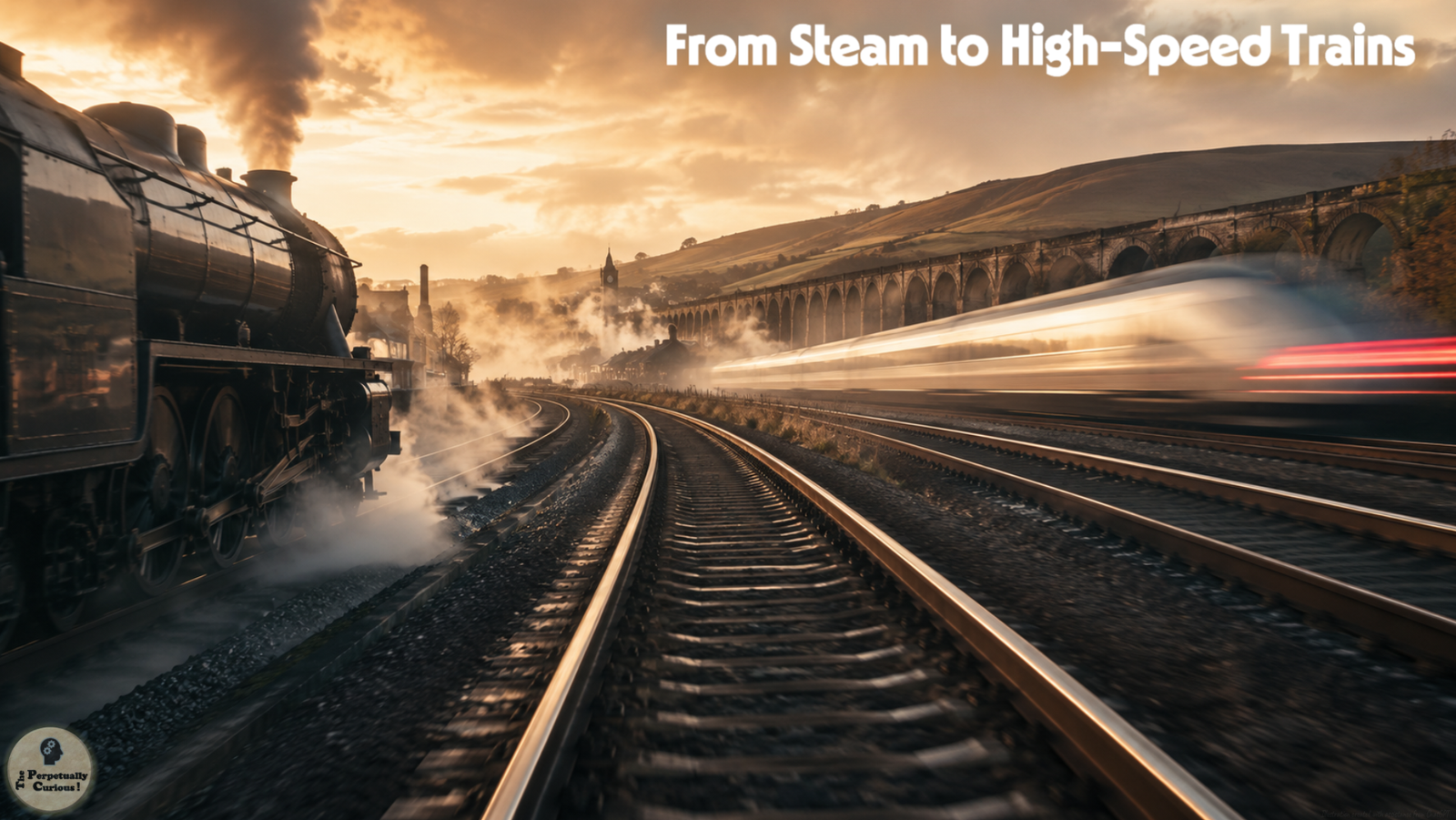
A line of motion becomes a quiet thread through the world, carrying the memory of steam, steel, and light.
Every guided path holds a trace of human intention, shaped by landscapes, materials, and the patience of engineering.
In the stillness between departures, the long story of travel continues, moving forward in its own calm and steady way.
🐎 Before the engine: rails, gravity, and horse-drawn power
Early rail systems emerged in mining regions where heavy loads had to be moved with less resistance than ordinary roads allowed. In parts of Europe and Britain, wooden rails guided carts that were pushed by workers or pulled by horses, helping ore, coal, and stone move more efficiently. Gravity carried loaded wagons downhill, while animals often hauled lighter or empty wagons back uphill. The essential insight was simple but powerful: a guided wheel on a fixed track could carry heavy loads with far less effort than a wheel struggling across uneven ground.
As mines, quarries, and industrial towns demanded more movement over longer distances, the limits of animal power became increasingly clear. Horses could pull carts with reliability, but they tired, required food and care, and could not provide the continuous mechanical force that expanding industry needed. These early railways did not yet have engines, but they created the physical logic that engines would soon inherit: a fixed path, a guided wheel, and a growing demand for power that did not fatigue. That need set the stage for steam.
🔥 Steam awakens: the birth of the locomotive
Steam engines first proved their value as stationary machines, especially in mines where they pumped water and later helped drive industrial equipment. Thomas Newcomen’s atmospheric engines showed how steam power could serve heavy industrial work, while James Watt’s improvements, including the separate condenser and later rotary applications, made steam engines more efficient and versatile. Over time, engineers refined boiler construction, pressure control, pistons, valves, and rotary motion, making steam power increasingly adaptable.
The decisive change for rail came when compact steam engines were placed on wheels and asked to move themselves along iron rails. Richard Trevithick’s Penydarren locomotive in Wales, tested in 1804, marked one of the early turning points in that transformation. These first locomotives were slow by modern standards, often moving at only a few miles per hour, but their importance did not come from speed alone. They showed that mechanical power could replace horses, pull heavy loads, and keep working without the biological limits of animal labor.
As designs improved, locomotives gained stronger boilers, better wheels, more reliable running gear, and greater control over power delivery. What began as an experiment on rails became a practical signal that steam could transform transport, industry, and distance itself.
🚃 The age of steam: power, speed, and expansion
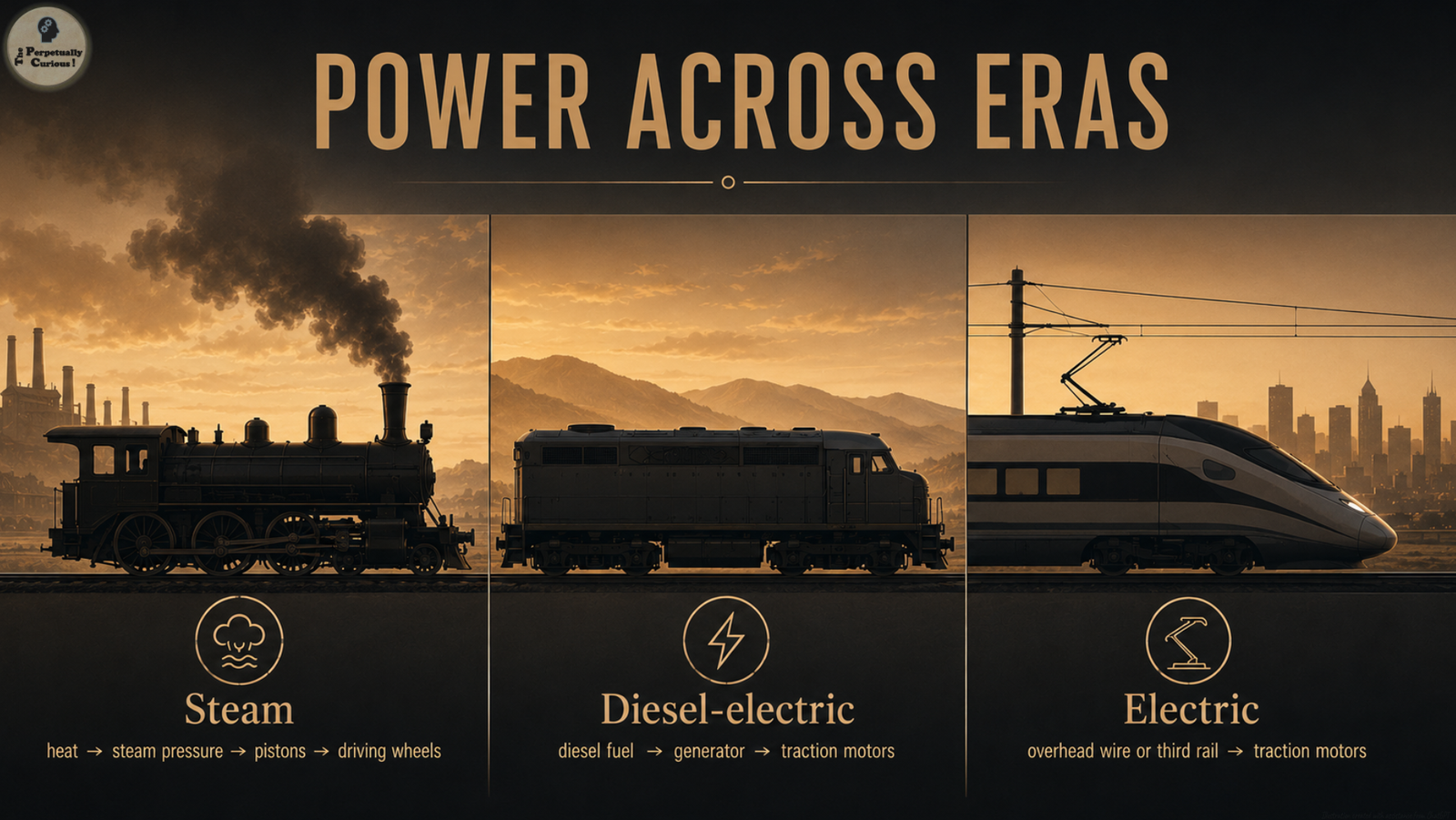
During the nineteenth century, steam locomotives became the dominant source of rail motive power across many expanding railway networks. Their boilers burned coal, wood, or oil to heat water, producing steam that drove pistons connected to large driving wheels. Passenger trains commonly traveled at about 30 to 40 miles per hour (about 48 to 64 kilometers per hour), while express services could run faster when track quality, schedules, gradients, and locomotive design allowed.
Steam also gave railways a powerful sensory identity. The rhythmic exhaust, glowing firebox, metal rods, whistles, heat, smoke, and rising plumes turned locomotives into moving symbols of industrial power. In later steam history, record-setting engines such as Britain’s Mallard, which reached 126 miles per hour (203 kilometers per hour) in 1938, showed how far the technology could be refined. Yet the same machines that inspired awe also demanded constant fuel, water, cleaning, inspection, and skilled labor. As railways grew busier, steam’s strengths became inseparable from its burdens, leading operators to search for power that could move trains with less daily strain.
⚙️ Limits of steam: efficiency, maintenance, and change
Steam locomotives were powerful, durable, and adaptable, but they were also demanding machines. Their overall thermal efficiency was often low, with much of the fuel’s energy escaping as waste heat through the boiler, exhaust, smokebox, and surrounding metal. A locomotive also needed a steady supply of water, since every mile of work turned part of that water into steam. On long routes, water stops, fueling points, ash removal, lubrication, inspection, and repair became part of the railway’s daily rhythm.
Running a steam locomotive also required a skilled crew. The fire had to be managed, boiler pressure watched, valves controlled, and mechanical parts monitored under heat, vibration, soot, and noise. Smoke and cinders affected air quality, especially in tunnels, stations, and crowded urban corridors. As rail networks became busier, these burdens mattered more. Railways needed power that could start heavy trains, run with fewer servicing stops, reduce labor demands, and operate more cleanly at the point of use. Electric traction offered one of the clearest answers to that challenge.
⚡ Lines of current: the rise of electric locomotives
Electric locomotives draw power from overhead wires or third rails and convert that electricity into motion through traction motors. They deliver strong torque at low speeds, which is valuable for starting heavy trains, climbing grades, and accelerating smoothly from stations. Compared with steam locomotives, electric traction can achieve higher operating efficiency and produces no exhaust at the point of use, although its wider environmental footprint depends on how the electricity is generated and delivered.
Early electric railways grew from experiments in urban transit, short demonstration lines, and steep routes where precise control mattered. Werner von Siemens demonstrated an early electric railway at the Berlin Trade Exhibition in 1879, helping prove that electricity could move rail vehicles directly. Over time, electrification expanded to tramways, mountain railways, commuter networks, major passenger corridors, and dense freight routes. India offers a modern example of this broader electrification path, with Indian Railways reporting that about 99.2 percent of its broad-gauge network had been electrified by November 2025. Modern electric trains commonly operate at about 125 to 186 miles per hour (about 200 to 300 kilometers per hour) on dedicated high-speed lines, with some specialized services running faster under suitable infrastructure and signaling.
Electrification, however, is not simply a matter of changing the locomotive. It requires substations, wires or third rails, power control, maintenance crews, and major capital investment along the route. Where traffic is dense, frequent, and predictable, that investment can be justified by performance and efficiency. Where distances are long, routes are lightly used, or infrastructure budgets are limited, another solution offered more flexibility: diesel power carried on board the train itself.
🛢️ Diesel arrives: internal combustion on the rails
Diesel locomotives carry their power source with them. Their internal combustion engines burn diesel fuel to generate mechanical energy, but in most mainline locomotives that energy does not drive the wheels directly. Instead, the engine turns a generator or alternator, which supplies electricity to traction motors mounted near the axles. This diesel-electric arrangement combines the range and flexibility of onboard fuel with the smooth control of electric traction.
Diesel engines were generally more efficient than steam locomotives, required less day-to-day servicing, and did not depend on frequent water stops. The diesel fuel inside these locomotives also begins in the wider world of petroleum refining, where crude oil is separated and processed into usable fuel streams. Across much of North America, Europe, and other rail systems, diesel traction expanded rapidly during the mid-twentieth century, especially on routes where full electrification was difficult to justify. Freight railways often coupled multiple diesel-electric locomotives together to share the work of pulling heavy trains, while passenger diesel locomotives became common on non-electrified routes.
Diesel traction offered a practical compromise between steam and full electrification. It avoided the large fixed infrastructure of electric rail while reducing the water, labor, and maintenance burdens of steam. Yet diesel did not end the search for faster, smoother, and more efficient rail travel. As intercity passenger demand grew, engineers increasingly looked beyond the locomotive alone and toward the complete system: dedicated tracks, electric traction, signaling, aerodynamics, and trainsets designed for high-speed motion.
🚄 High-speed rail emerges: Japan’s Shinkansen and the global transformation
High-speed rail represents a new chapter in guided travel because it depends on more than a powerful locomotive. It is a complete system of electric traction, dedicated or upgraded tracks, aerodynamic trainsets, advanced signaling, and carefully controlled operations. A common benchmark defines new high-speed lines as those built for about 155 miles per hour (250 kilometers per hour) or more, while upgraded lines may qualify at lower thresholds, often around 124 miles per hour (200 kilometers per hour), depending on the system and definition.
Japan’s Shinkansen, introduced in 1964 on the Tokaido route between Tokyo and Osaka, showed the world that trains could travel at sustained high speeds with extraordinary reliability. Early Shinkansen services reached about 130 miles per hour (about 210 kilometers per hour), and later generations achieved higher speeds on purpose-built tracks engineered for stability, safety, and frequent service. The idea then spread in different forms. France developed the TGV, Germany expanded ICE services, Eurostar connected high-speed routes across parts of Western Europe, China built a vast high-speed network with Fuxing trains, and South Korea and Taiwan adapted high-speed rail to dense Asian corridors shaped by geography, population, and intercity demand.
Other regions show that high-speed rail can also be a story of transition rather than completion. India’s Mumbai-Ahmedabad high-speed rail corridor represents an emerging dedicated high-speed system, while Vande Bharat trainsets show a semi-high-speed modernization path on existing and upgraded conventional routes. In Canada, the proposed, not-yet-operational Alto network between Toronto and Québec City points toward a future high-speed corridor built around dedicated, electrified tracks. In the United States, Amtrak’s Acela on the Northeast Corridor shows a more constrained model, where high-speed trainsets must work within a historically layered and heavily used rail corridor.
Modern high-speed trains commonly operate at about 155 to 200 miles per hour (about 250 to 320 kilometers per hour), while selected Fuxing services, including on the Beijing-Shanghai high-speed railway, operate at about 217 miles per hour (350 kilometers per hour). These systems changed public expectations of rail travel by linking major cities with fast, predictable, city-center to city-center movement. Yet wheel-on-rail systems still face limits from rolling contact, aerodynamic drag, track geometry, noise, and energy demand. To reduce one of those limits even further, engineers began exploring trains that could move without wheels touching rails at all.
🧲 Magnetic levitation: floating on fields of force
Magnetic levitation, or maglev, uses magnetic fields to lift, guide, and propel trains without ordinary wheel-to-rail contact during high-speed operation. By removing rolling contact as a major source of friction and wear, maglev systems can achieve very high speeds with exceptionally smooth motion. Japan’s superconducting SCMAGLEV has reached about 374.7 miles per hour (603 kilometers per hour) under test conditions, while commercial maglev operation has been demonstrated on routes such as Shanghai’s airport line.
Maglev is not one single design. Electromagnetic suspension systems use attractive magnetic forces to hold a vehicle near the guideway, while electrodynamic suspension systems use repulsive and stabilizing magnetic forces, often involving superconducting magnets. Clearance also varies by system. Some superconducting maglev designs levitate by about 4 inches (10 centimeters), while other systems operate much closer to the guideway. In every case, the technology depends on precise control, dedicated guideways, and infrastructure built specifically for the train.
Maglev can reduce mechanical noise and allow rapid acceleration, but it does not remove every limit. Aerodynamic drag, tunnel pressure effects, energy demand, route alignment, safety systems, and construction cost still matter. That combination explains why maglev remains limited to specialized corridors where investment, geography, and passenger demand align. Even so, the idea of removing wheel contact pushed guided travel into a new imaginative space. Once rolling friction had been reduced, engineers began asking whether air resistance itself could be reduced as well.
🧭 Emerging concepts: low-pressure tubes and Hyperloop ideas
Conceptual proposals such as Hyperloop imagine moving passenger or freight capsules through low-pressure tubes, where reduced air density would lower aerodynamic drag. In theory, such systems have been proposed at speeds of about 500 to 700 miles per hour (about 800 to 1,120 kilometers per hour). The idea is not simply to make a train faster, but to rethink guided travel in an environment where both rolling contact and much of the surrounding air resistance are reduced.
These concepts remain experimental and commercially unproven. They require extensive engineering research, emergency planning, passenger-comfort validation, pressure management, switching systems, stations, land acquisition, maintenance strategies, and large-scale infrastructure investment. Several ventures have tested components or prototypes, but no passenger Hyperloop route has entered regular public service. That gap between theory and operation is important, because safe transportation depends not only on peak speed, but also on reliability, evacuation planning, comfort, capacity, and daily maintainability.
Even so, low-pressure tube concepts belong in the longer imagination of rail and guided motion. They show how each generation asks a similar question in a new technical language: what happens if a familiar limit can be reduced? Steam challenged the limits of animal labor. Electric and diesel traction changed the source of power. High-speed rail refined the wheel-on-rail system. Maglev reduced rolling contact. Low-pressure tube concepts extend that same curiosity toward the resistance of air itself.
🌿 The human factor: comfort, physiology, and perception at high speed
High-speed travel is shaped not only by machines, rails, and power systems, but also by the human body. Acceleration, braking, and curves must be managed so that speed does not feel abrupt or unsettling. At more than 150 miles per hour (about 240 kilometers per hour), even small vibrations, pressure changes, and shifts in sound can affect how motion is perceived inside the cabin.
Engineers therefore design high-speed trains around comfort as well as velocity. Sealed cabins help manage pressure changes, especially when trains enter tunnels or pass each other at speed. Suspension systems, wheel and track maintenance, sound insulation, lighting, seat layout, window placement, and interior materials all shape the passenger experience. The result is a careful paradox: the train may be moving with extraordinary speed, while the person inside feels steady, calm, and almost still.
🌄 The geography of speed: landscapes that shape rail design
Geography plays a powerful role in high-speed rail because fast trains need routes that are stable, gentle, and predictable. Japan’s mountainous terrain shaped Shinkansen planning through long tunnels, viaducts, careful gradients, and carefully engineered curves. France’s broader plains helped support TGV lines that could stretch across open countryside with long, smooth alignments. In densely settled or rugged regions, high-speed rail often becomes as much a landscape-engineering project as a train project.
Maglev systems make this relationship even more demanding. Because they depend on dedicated guideways and precise alignment, they are best suited to corridors where the route can be controlled with exceptional care. The landscape does not simply sit beneath the railway. It helps decide where speed is possible, where tunnels are necessary, where curves must widen, and where the cost of building a fast route becomes difficult to justify.
🔬 The physics of motion: friction, lift, and air resistance
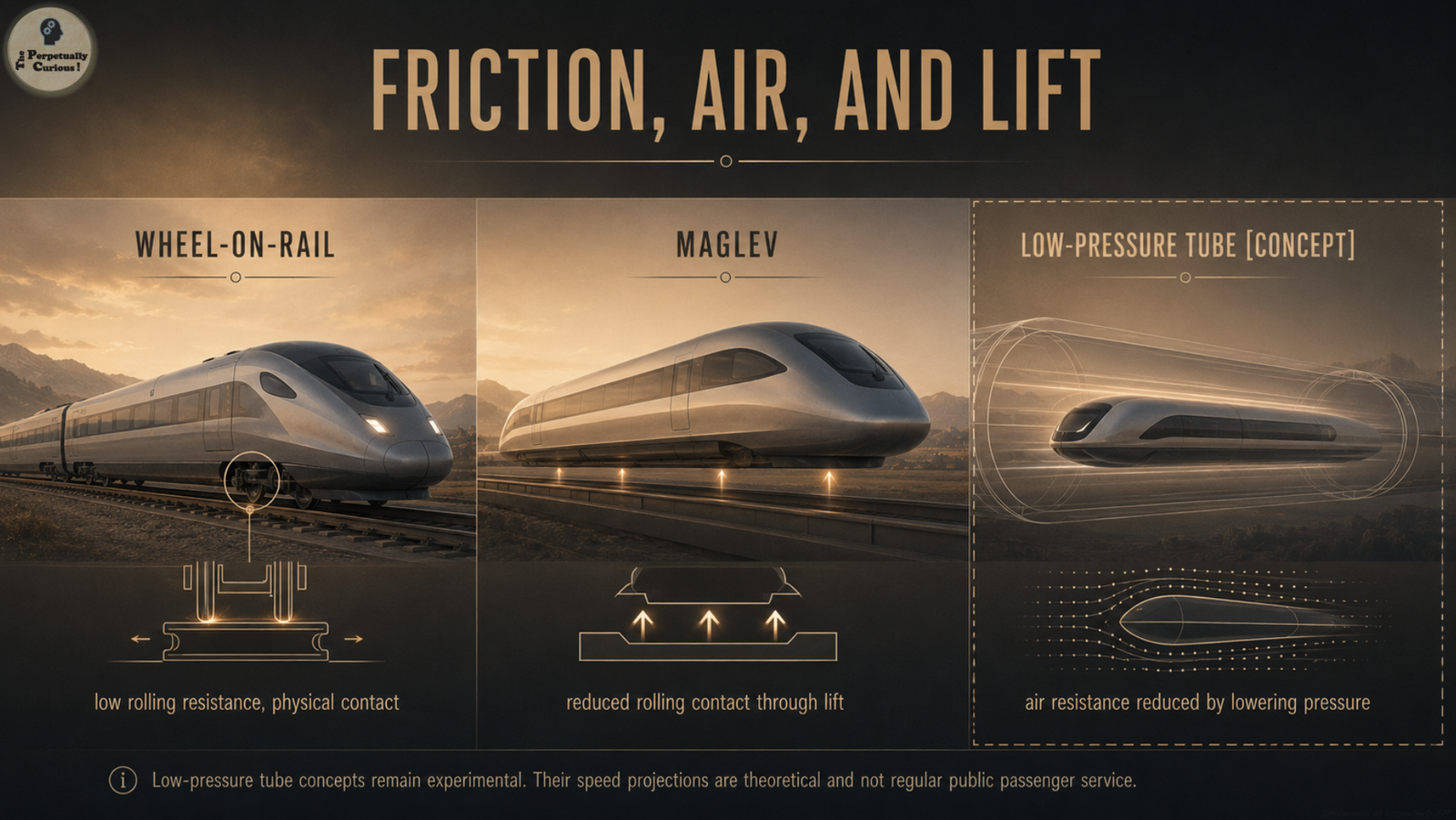
Every form of guided travel must negotiate the same physical forces. At low and moderate speeds, wheel contact, traction, weight, and rolling resistance matter greatly. At high speeds, air becomes one of the dominant obstacles. Aerodynamic drag rises sharply as speed increases, so train noses, roofs, undercarriages, pantographs, and gaps between cars are shaped to reduce turbulence and energy loss.
Wheel-on-rail systems remain highly efficient because steel wheels on steel rails create low rolling resistance, but they still depend on physical contact for support, guidance, and traction. Maglev changes that relationship by lifting the vehicle away from ordinary rolling contact, reducing mechanical friction and wear. Low-pressure tube concepts go one step further in theory by lowering air pressure around the vehicle, reducing drag as well as contact-related resistance. Each technology is therefore a different answer to the same physics question: how can a guided vehicle move faster while wasting less energy to friction, vibration, and air?
🎎 The cultural symbolism of high-speed rail
High-speed rail is not only a transportation system. It can also become a public symbol of coordination, confidence, and technological maturity. Japan’s Shinkansen became closely associated with precision, punctuality, and postwar modernization. France’s TGV became associated with national engineering style, elegance, and long-distance rail ambition. Maglev systems, where they appear, often carry a different symbolism: the desire to make transportation feel futuristic, frictionless, and almost weightless.
These associations should not be treated as simple national labels, since every rail system is shaped by many economic, geographic, political, and technical choices. Still, the symbolism matters. Fast trains do more than shorten journeys. They can change how people imagine distance, cities, progress, and the relationship between everyday travel and public infrastructure.
🎚️ The acoustics of motion: shaping sound at high speed
Sound is part of the experience of motion, and at high speeds it becomes an engineering problem as well as a sensory one. Wheel and rail contact, motors, airflow, tunnels, pantographs, doors, windows, and underbody equipment can all contribute to what passengers hear. Outside the train, aerodynamic noise grows more important as speed rises, especially around the nose, roof equipment, gaps between cars, and the underside of the train.
Engineers respond by shaping train noses, smoothing exterior surfaces, refining pantographs, sealing cabins, isolating vibration, and using sound-absorbing materials inside the cars. The goal is not absolute silence, but a controlled sound environment where speed does not feel harsh or fatiguing. A quiet high-speed train is therefore not quiet by accident. Its calm interior is the result of aerodynamic design, mechanical precision, acoustic materials, and careful maintenance working together.
🌐 The choreography of rail traffic: coordinating motion at scale
High-speed rail corridors depend on precise coordination because trains moving faster than 150 miles per hour (about 240 kilometers per hour) cannot rely on ordinary visual stopping distances alone. Modern systems use signaling, automated train protection, centralized traffic control, and continuous monitoring to maintain safe spacing between trains. In many corridors, control systems supervise speed, track occupancy, route settings, and braking behavior so that human operators and automated safeguards work together.
Dispatch centers add another layer of coordination. They monitor trains, stations, switches, power systems, delays, weather disruptions, and maintenance windows across entire corridors. When one train slows, the effect can ripple through a timetable, so traffic control is not merely a background function. It is part of the railway’s nervous system, quietly coordinating motion at a scale passengers rarely see.
🧪 The materials science of speed: metals, composites, and track geometry
High-speed trains depend on materials that can remain strong, light, stable, and durable under repeated stress. Steel remains essential in rails, wheels, axles, and many structural components because it can carry heavy loads while preserving precise contact with the track. Aluminum alloys and composite materials can reduce vehicle weight in selected parts of the train, improving acceleration, energy use, and wear without sacrificing safety.
The track itself is also a materials system. Rails, sleepers or slab track, ballast or concrete support, fasteners, bridges, tunnels, and foundations must hold alignment within tight tolerances. Gentle curves, gradual transitions, smooth gradients, and careful maintenance allow high-speed trains to move without abrupt vibration or instability. The contrast with asphalt roads also shows why rails are a distinct kind of engineered pathway, trading route flexibility for guidance, low rolling resistance, and controlled alignment. At this scale, speed is not produced by the train alone. It is produced by the relationship between vehicle, material, track, and ground.
🌍 Looking ahead: the future of guided motion
The future of guided travel will likely involve several paths rather than one single replacement for everything that came before. Electric traction will remain central where dense corridors can support the necessary infrastructure. Diesel, hybrid, battery, and hydrogen systems may continue to serve routes where full electrification is difficult or uneconomical. Freight rail, meanwhile, will continue to prioritize pulling power, efficiency, braking control, network capacity, and reliability more than headline speed. High-speed rail will keep refining the wheel-on-rail system, while maglev and low-pressure tube concepts will test how far guided motion can be pushed when friction and air resistance are reduced.
Each approach reflects a different balance of speed, capacity, energy use, cost, geography, maintenance, and public need. Some regions will build new dedicated corridors, some will modernize existing routes, and others will combine conventional rail, semi-high-speed trainsets, and selective electrification. That is why the story of train engines does not end with one final invention. It becomes a broader story of systems: power sources, tracks, guideways, signaling, materials, stations, freight networks, passenger comfort, and daily operations working together.
Across all these developments, the central purpose remains steady. Guided travel seeks to move people and goods safely, reliably, and efficiently along defined paths. The details may change, but the underlying idea endures: a vehicle joined to a route, carrying motion forward through engineering, imagination, and time.
Pass this article along to someone curious and let the learning travel.
💡 Did You Know?
🚂 Some early and experimental steam locomotives used vertical boilers, which allowed compact designs before horizontal boiler layouts became more common in larger railway locomotives.
⚙️ Britain’s Mallard, a streamlined steam locomotive, reached 126 miles per hour (203 kilometers per hour) in 1938, setting a steam locomotive speed record that still stands.
⚡ Early electric railways often used direct current systems, which offered smooth speed control and made them well suited to urban railways, tramways, and short electrified routes.
🛢️ Many mainline diesel locomotives are diesel-electric. Their diesel engines generate electricity, and that electricity powers traction motors that turn the wheels.
🚆 Some long freight trains use distributed power, placing locomotives at more than one point in the train to improve traction, braking control, and stress distribution along the couplers.
🔋 Regenerative braking can turn some of a train’s motion back into electricity. Depending on the system, that energy may be used by nearby trains, returned to the power supply, stored where storage exists, or dissipated if it cannot be absorbed.
🚄 Early Shinkansen trains combined purpose-built tracks, carefully designed bogies, suspension systems, and strict maintenance standards to create smooth travel at more than 130 miles per hour (about 210 kilometers per hour).
🌬️ High-speed train noses are often tested and refined to manage airflow, reduce noise, and limit pressure effects when trains enter tunnels or pass each other at speed.
🧲 Some superconducting maglev systems, such as Japan’s SCMAGLEV, levitate by about 4 inches (10 centimeters), while other maglev designs use different clearances and suspension methods.
🌀 Conceptual low-pressure tube ideas such as Hyperloop aim to reduce aerodynamic drag by lowering the amount of air around a capsule, but they remain experimental and commercially unproven.
🌐 High-speed rail corridors are often designed with long, gentle curves and gradual transitions so trains can maintain speed without abrupt changes in direction.
📐 Long before modern high-speed rail, the mathematical idea of the fastest path down, or brachistochrone, showed how a curved path can change travel time under gravity. It is not a rail-design rule, but it offers a useful echo of how geometry and motion can meet.
🌄 In mountainous regions, high-speed rail may require long tunnels, viaducts, and carefully controlled gradients so trains can preserve speed while crossing difficult terrain.
🔭 Engineers use laser measurement systems and other track-monitoring tools to check rail geometry, helping high-speed corridors remain within tight alignment tolerances over time.
What defines high-speed rail?
High-speed rail usually refers to passenger rail systems designed for sustained operation at about 155 miles per hour (250 kilometers per hour) or higher on new dedicated lines. Upgraded lines may qualify at lower speeds, often around 124 miles per hour (200 kilometers per hour), depending on the definition used.
Why was the Shinkansen so important?
Japan’s Shinkansen, introduced in 1964, showed that high-speed rail could operate not only quickly, but also reliably, frequently, and safely on purpose-built infrastructure. It helped establish the modern idea of high-speed passenger rail as a complete system.
How do high-speed rail systems differ around the world?
High-speed rail develops differently depending on geography, population density, infrastructure history, and public investment. Japan’s Shinkansen, France’s TGV, Germany’s ICE, China’s Fuxing services, South Korea’s KTX, Taiwan High Speed Rail, India’s Mumbai-Ahmedabad high-speed rail corridor, Canada’s proposed Alto network, and Amtrak’s Acela in the United States all reflect different ways of adapting fast rail travel to local conditions.
How does magnetic levitation work?
Magnetic levitation uses controlled magnetic fields to lift, guide, and propel a train without ordinary wheel-to-rail contact during high-speed operation. This reduces mechanical friction and wear, although air resistance, guideway design, and energy demand still matter.
Are maglev trains widely used?
Maglev trains are not widely used compared with conventional rail. They require dedicated guideways and specialized infrastructure, so they are usually considered only where geography, demand, cost, and political commitment support the investment.
What speeds could Hyperloop systems theoretically reach?
Hyperloop concepts have proposed speeds of about 500 to 700 miles per hour (about 800 to 1,120 kilometers per hour) in low-pressure tubes. These systems remain experimental and commercially unproven, with no regular public passenger service in operation.
How do traction motors work in electric and diesel-electric locomotives?
Traction motors convert electrical energy into rotational motion at or near the axles. They provide strong torque at low speeds, which helps trains start from rest, climb grades, and accelerate smoothly.
Why are many diesel locomotives called diesel-electric?
In most mainline diesel-electric locomotives, the diesel engine does not directly turn the wheels. Instead, it drives a generator or alternator that supplies electricity to traction motors. The fuel itself comes from petroleum refining, while the final wheel-turning force comes through electric motor control.
What determines the maximum speed of a locomotive-hauled train?
Maximum speed depends on locomotive power, track quality, signaling, braking capacity, gradients, curves, suspension, and the design of the passenger cars or freight wagons being hauled.
Why do high-speed trains often need dedicated tracks?
Dedicated tracks allow high-speed trains to use gentler curves, smoother alignments, controlled access, advanced signaling, and stricter maintenance standards. These features help trains run safely and comfortably at high speeds.
How do maglev trains accelerate without wheels driving rails?
Maglev trains use linear motors and controlled magnetic fields along the guideway. Instead of turning wheels against rails, the system creates magnetic forces that pull or push the train forward.
How do engineers reduce noise inside high-speed trains?
Engineers reduce noise through aerodynamic shaping, smoother exterior surfaces, sealed cabins, vibration isolation, sound-absorbing materials, refined pantographs, and careful wheel, rail, and track maintenance.
Why do tunnels matter so much for high-speed trains?
When a high-speed train enters a tunnel, it pushes air ahead of it and creates pressure changes. Train nose shape, tunnel design, sealed cabins, and pressure-control strategies help reduce discomfort and noise.
Why are low-pressure tube systems theoretically faster than conventional high-speed rail?
Low-pressure tube systems reduce the amount of air around the vehicle. With less aerodynamic drag, a capsule could theoretically reach speeds beyond conventional wheel-on-rail or maglev systems, but the engineering and safety challenges remain substantial.
How do dispatch centers coordinate high-speed rail traffic?
Dispatch centers use real-time monitoring, signaling systems, automated train protection, route control, and schedule management to maintain safe spacing and respond to delays, maintenance needs, and changing corridor conditions.
How do engineers test aerodynamic designs for high-speed trains?
Engineers use wind tunnels, computational simulations, scale models, full-size prototypes, and field testing to study airflow around train noses, roofs, pantographs, sides, undercarriages, and gaps between cars.
✨ Carrying the Journey Forward
If this story of steam, steel, electricity, and motion sparked your curiosity, we warmly invite you to share it with friends, colleagues, and fellow travelers of thought. Every shared article helps this journey move a little farther, carrying the wonder of guided motion from one curious mind to another.
Educational Note: This article is intended for general-interest and educational reading. It presents publicly known rail technologies at a high level and does not offer engineering, operational, safety, procurement, or infrastructure guidance. References to low-pressure tube systems are conceptual and do not imply current public passenger service. The visuals are editorial illustrations and renderings, not depictions of specific operators, branded trainsets, or proprietary designs.
“Echoes of Steam, Currents of Steel: Train Engines and the Rise of High-Speed Motion.” The Perpetually Curious!, June 2026.
https://www.theperpetuallycurious.org/articles/train-engines/Continue Exploring
For what comes next
Site Updates gathers occasional notes, new additions, and ways to keep in touch. RSS brings new publications to your feed reader in chronological order.
Choose the path that speaks to you, and let the next curiosity find you wherever your wondering takes you.