
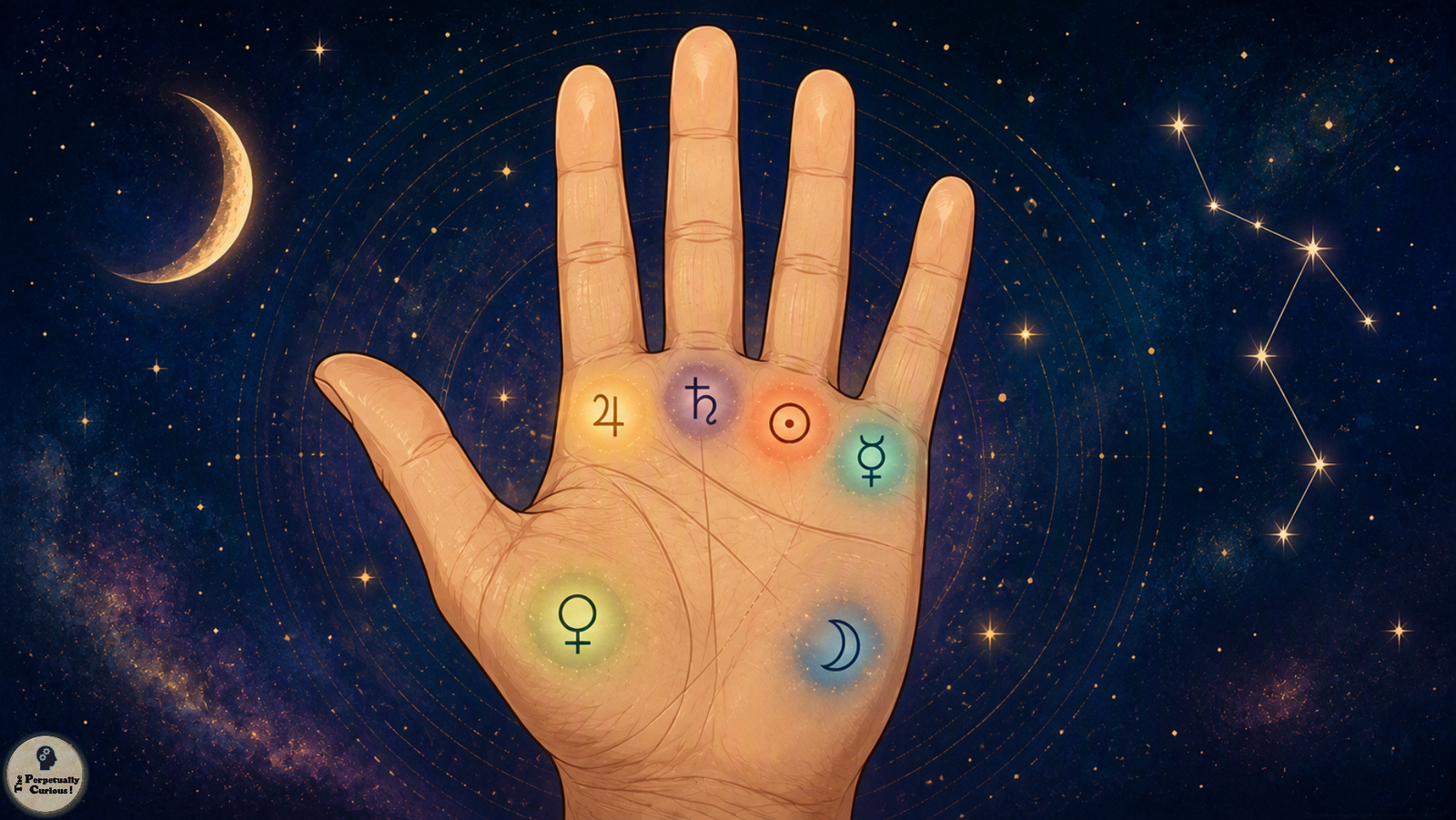
A palm can be described in anatomical terms: folds, pads, ridges, joints, and skin shaped by development and movement. Yet in some palmistry traditions, the same hand becomes a symbolic map. Raised areas of the palm are given celestial names such as Venus, Jupiter, Saturn, Apollo, Mercury, and Luna, and their shape or markings are interpreted within a divinatory system. The sky, in effect, is mapped onto the hand.
Palmistry, also called chiromancy, has never been one uniform tradition. Historical records from South Asia and from medieval Arabic, Byzantine Greek, and Latin traditions show that hand reading was practiced and transmitted across different cultural settings, sometimes closely linked with astrology and sometimes not. That diversity matters here because the planetary map of the palm belongs to particular interpretive systems, not to every form of palm reading.
In astrological forms of palmistry, the correspondence system gives different regions of the hand different symbolic associations. The area at the base of the thumb, for example, is commonly called the Mount of Venus, while areas beneath the fingers may be associated with Jupiter, Saturn, Apollo, and Mercury. A reader may interpret the prominence of a mount, the course of a line, or the presence of a mark through qualities traditionally assigned to those celestial figures. The system is symbolic rather than astronomical: planets do not physically create those features of the hand.
The features being interpreted are nevertheless real anatomy. The major palm lines form during fetal development and serve the mechanics of a moving hand. Scientific research does not establish that their length, branching, or position can predict personality or future events. Palmistry is therefore best understood here as a cultural and divinatory tradition, not as an evidence-based forecasting method.
That distinction allows the practice to be examined without either endorsing its predictions or dismissing its history. Human cultures have often placed inherited meaning onto visible patterns. Different societies, for example, have traced different constellations across the same night sky while the stars themselves remain physical objects. The comparison is not an equivalence, but it helps show how an ordinary pattern can become a map of meaning when a tradition teaches people how to read it.