
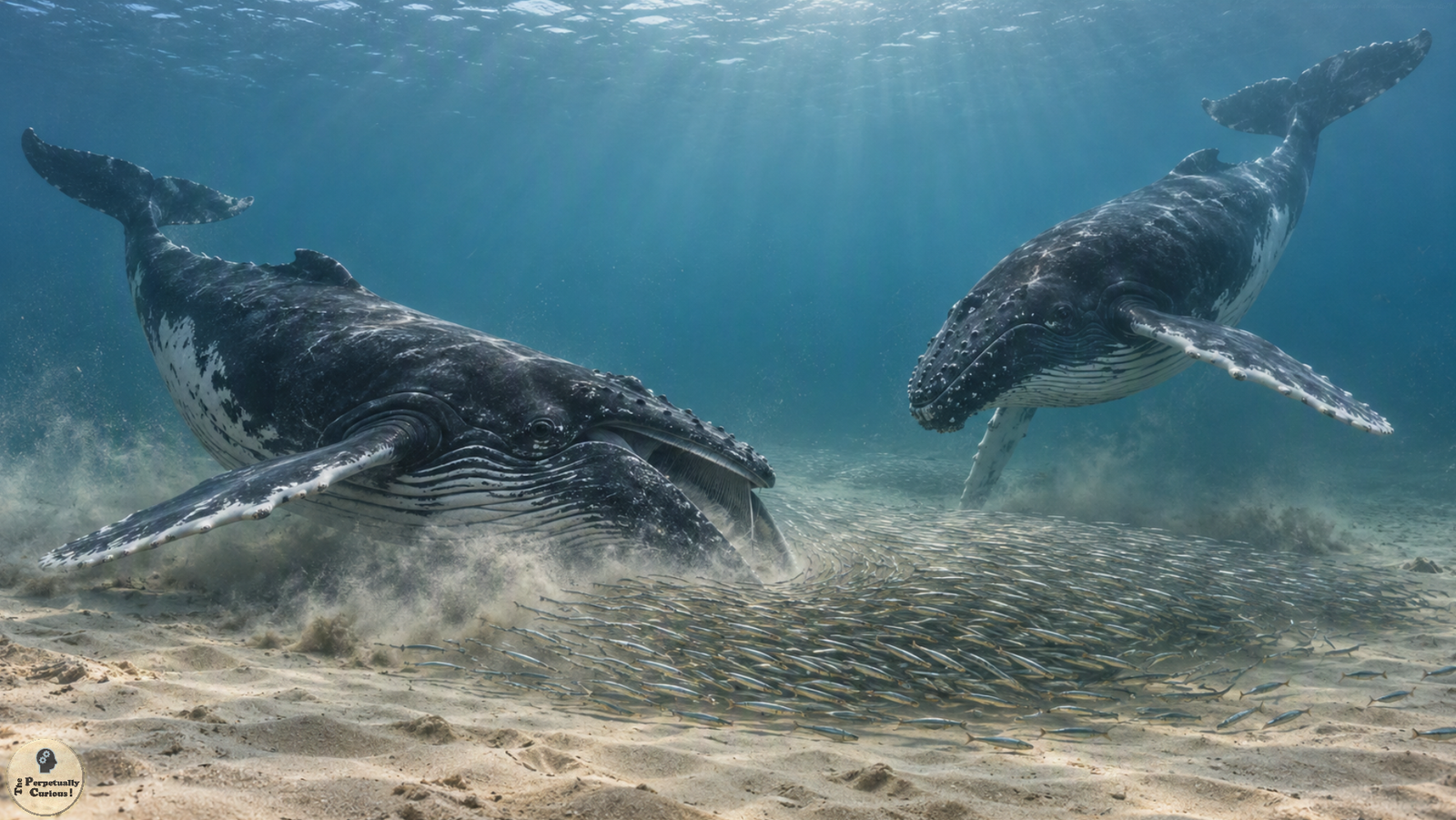
Several humpbacks surfacing near the same concentration of prey can resemble a family moving and feeding together. Sometimes that impression is correct in the simplest sense: a mother and calf are closely bonded. Yet when several humpbacks feed near one another, proximity alone does not reveal whether they are relatives.
At productive feeding grounds, currents and local ocean conditions can concentrate prey and draw whales into the same area. Around Stellwagen Bank, for example, nutrient-rich waters support dense prey, including sand lance. Food can therefore bring individuals together even when family ties are not what holds the group together.
What happens next can be far more organized than a chance gathering. Humpbacks may feed alone, but they also use bubbles, sounds, the seafloor, and coordinated movement to corral fish. In a 2026 study from the southern Gulf of Maine, researchers analyzed 110 seafloor hunting events recorded by tags on seven humpbacks. In 79 percent of those events, the tagged whale hunted with one to three others. Partners approached one another, adjusted their positions, and often opened their mouths within seconds of one another as they trapped sand lance between them.
This is genuine cooperation, but cooperation is not the same as kinship. Humpbacks have a fluid, fission-fusion social system in which individuals may join a feeding group and later separate as conditions change. Maternal lineages can influence some affiliations, and a mother-calf pair is a real family unit, but feeding groups are not generally organized as stable families. Seeing whales hunt together therefore cannot tell an observer how, or whether, they are related.
That distinction makes the scene more interesting, not less. Unlike cohesive packs that coordinate their hunts, humpbacks can adjust their actions to one another without the feeding group itself being a stable family unit. To an observer, the visible group is therefore best read as a partnership first and a family only when identification or longer-term evidence supports it.
A feeding ground can gather whales. A coordinated hunt can reveal cooperation. Neither, by itself, draws a family tree.