
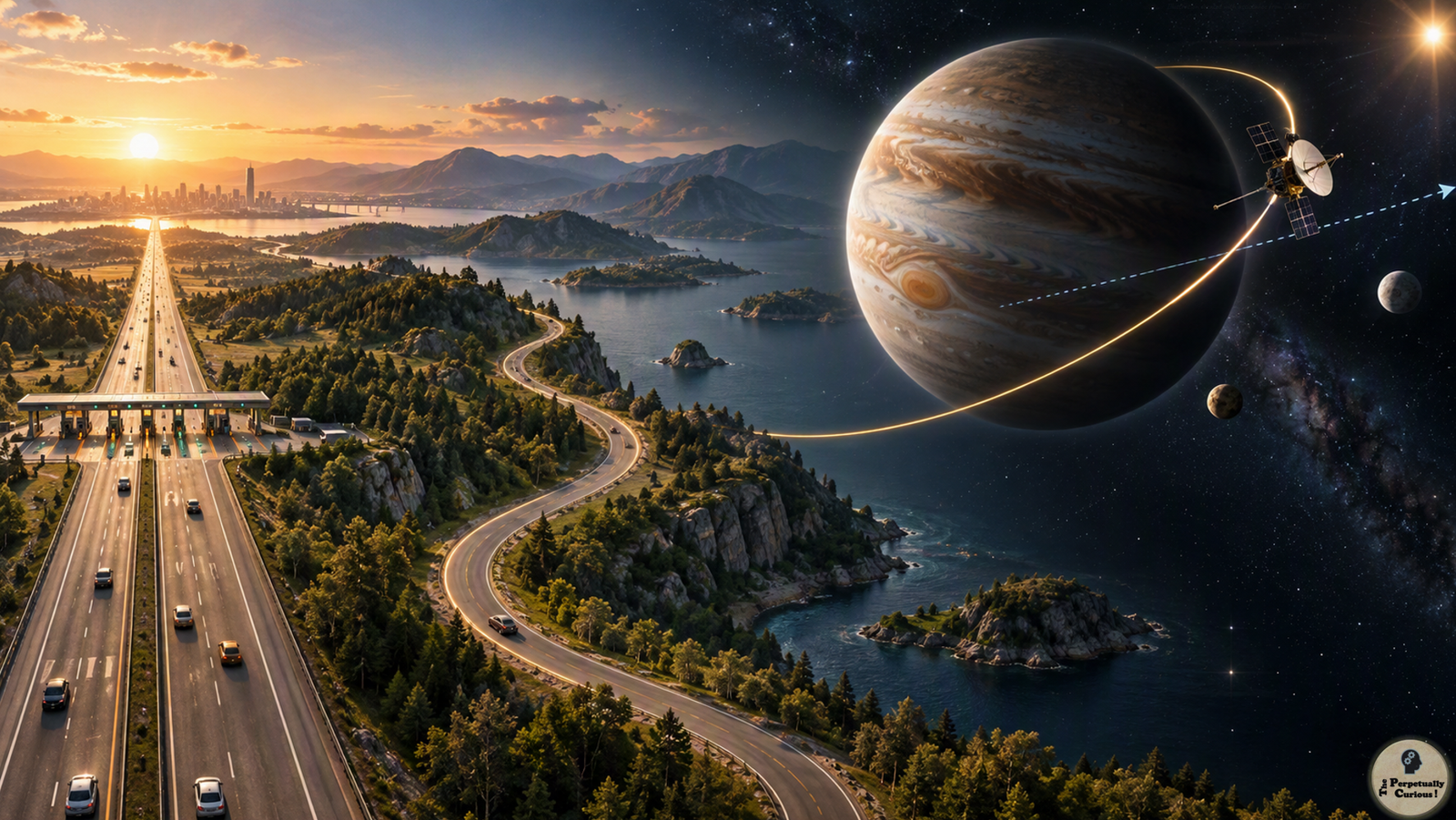
A navigation app may offer two ways to reach the same destination. One is faster and uses a toll road. The other avoids the toll, adds distance or time, and saves money. Neither route is automatically “better.” The choice depends on what matters most.
Interplanetary flight can pose a surprisingly similar question. Mission planners do not always seek the geometrically shortest path between two worlds. A more direct transfer may demand more launch capability or more propellant to change a spacecraft’s speed. In gravity-assist flight, a spacecraft instead passes a moving planet or moon so that gravity redirects its trajectory and can change its speed relative to the Sun. The encounter can reduce how much of that change must come from the spacecraft’s own propulsion system.
That is where the toll-road analogy helps, but also where it must stop. A driver saves money simply by avoiding a fee. A spacecraft does not save propellant because a longer path is inherently economical. It can save onboard propellant because a carefully timed encounter lets planetary motion and gravity provide part of the required change in velocity, reducing the propulsive delta-v that the spacecraft itself must supply.
The route may indeed be longer or take more time. Cassini, for example, reached Saturn only after flybys of Venus, Earth, and Jupiter. Yet a gravity assist does not always impose a time penalty. New Horizons used Jupiter to gain speed on its way to Pluto, shortening its voyage by about three years. The apparent detour can therefore save propellant, save time, or make a mission possible within the limits of its launch vehicle and spacecraft.
The deeper connection is not “longer routes are cheaper.” It is that efficiency depends on what is being optimized. On a road, the competing quantities might be distance, time, fuel, and tolls. In spaceflight, they may include travel time, launch capability, propellant, trajectory geometry, and mission constraints.
A straight-looking route can be expensive. A curved route can be efficient. What appears to be a detour may simply be a path designed around a different resource.
Related path: The fastest path is not always the shortest.