
A parrot says “hello” from the next room. For a moment, you expect a person to step through the doorway. How does a bird with a beak produce something so familiar? You might expect a macaque, with lips and a tongue more like ours, to come closer to sounding like us.
There is a difference between making a sound, learning to copy it, and using it to say something new. Speech is one way to express language. People can also use signed languages, with their own grammar. In either case, familiar words or signs can make a new message, from a request for water to a story about an imaginary place. The mechanics of making a sound are easy to hear in the small change that turns one vowel into another.
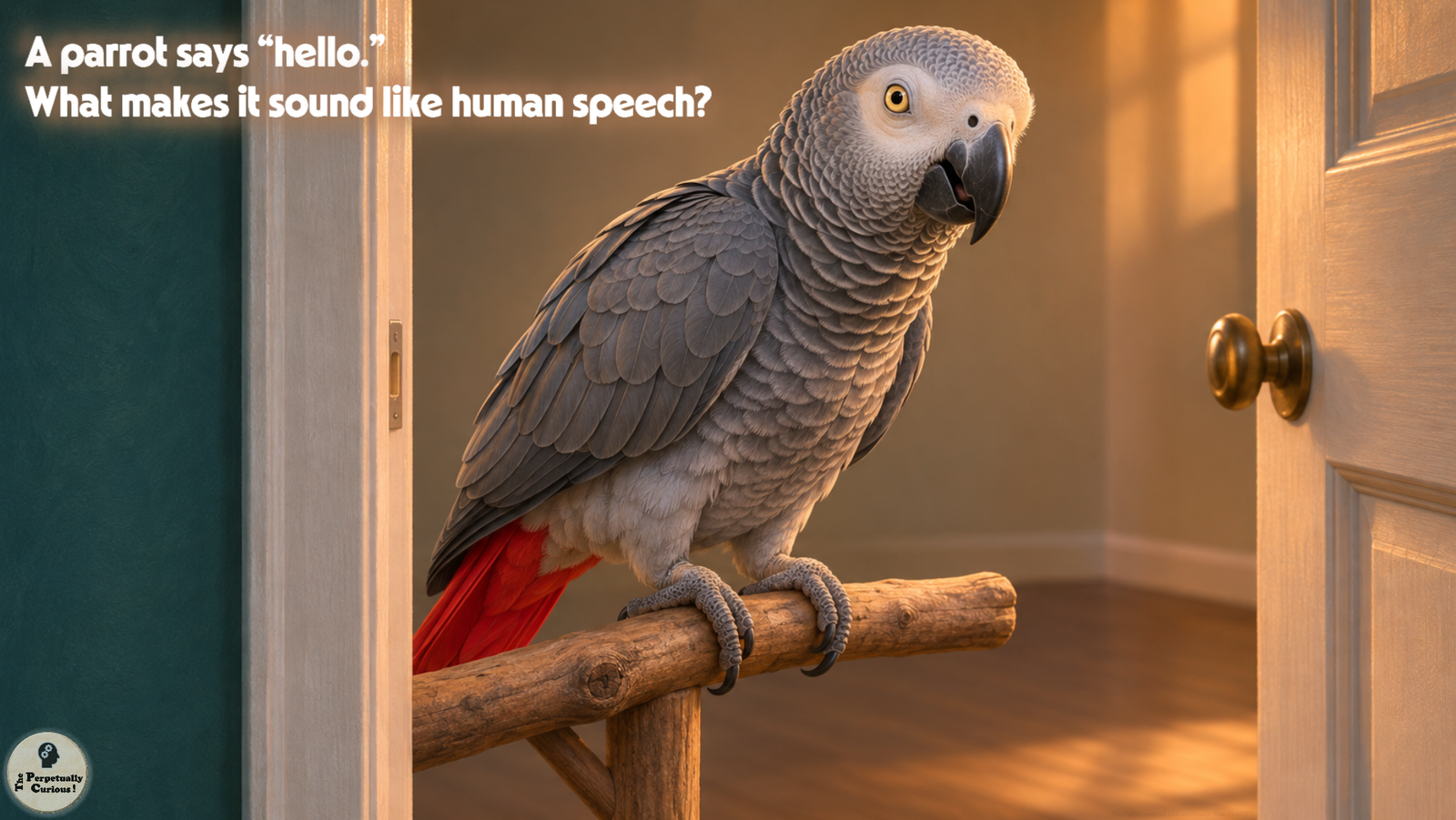
The word itself may be familiar, yet the deeper question lingers beyond it.
Across forests, oceans, grasslands, and skies, living creatures exchange signals shaped by bodies, senses, and lives very different from our own.
Perhaps the greatest lesson in listening is not hearing ourselves reflected back, but learning to hear another voice on its own terms.
🗣️ What a vocal tract can do
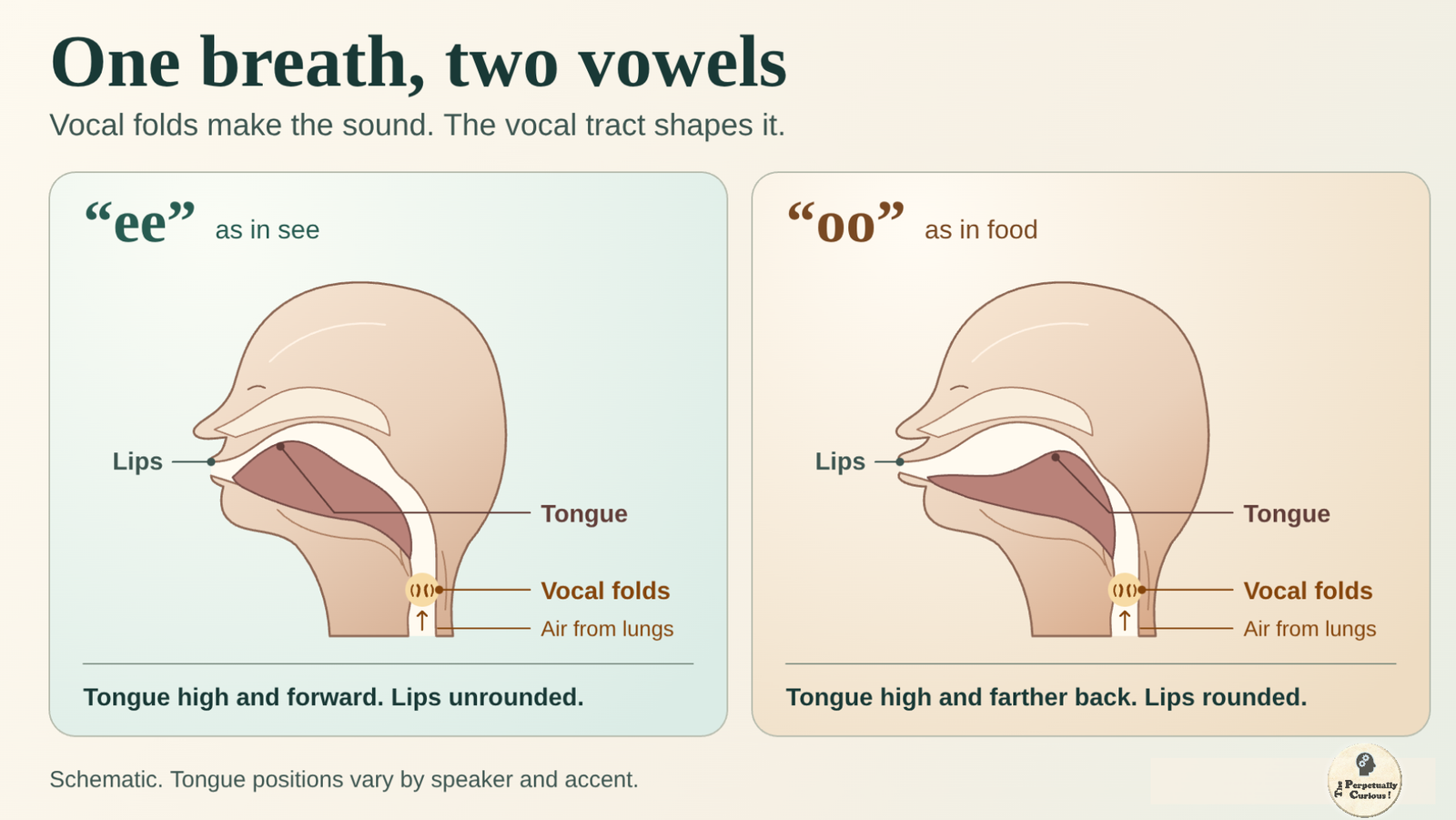
On a single breath, “ee” can turn into “oo.” Air from the lungs sets the vocal folds in the larynx vibrating while the tongue, lips, and jaw help shape the space above them. Much of what we hear as a change of vowel comes from a change in the shape of that space.
Researchers used X-ray video to see what shapes the vocal tract could take in living long-tailed macaques as they called, moved their faces, and ate. A computer model built from those shapes produced distinct vowel-like sounds. The researchers argued that the tract could support a wider range of speech sounds if the animal could control it differently. The monkeys provided the shapes. The model made the speech-like sounds.[1]
Even with that range of shapes, the quality of the underlying vibration matters. Compared with other primates examined, humans lack thin extensions of the vocal folds called vocal membranes. Experiments and models suggest that losing these membranes may have helped make human voicing steadier.[2]
🧠 How the brain shapes speech
A steady sound is just the starting point for a spoken word. The tongue can start moving toward the next sound while the current one is still audible. Recordings from the human brain during speech show overlapping patterns of activity linked to the lips, jaw, tongue, and larynx. What sounds like a single word to a listener is a sequence of finely timed movements for the speaker.[3]
The importance of that timing becomes clear when planning the movements is difficult. Certain variants of FOXP2, a gene that helps regulate the activity of other genes, can cause a disorder whose core feature is childhood apraxia of speech. People with the condition have difficulty planning and sequencing the movements of speaking.[4] A parrot faces a related challenge when it learns to turn a sound it hears into movements it can repeat.
🦜 How a parrot learns a sound
Some parrots can change the sounds they make based on what they hear, an ability called vocal production learning. A parrot makes sound with its syrinx, an organ near the point where the windpipe divides toward the lungs. Its tongue can help shape the sound.
Researchers recorded brain activity as four budgerigars, a kind of parrot, made calls and song sounds. In a region involved in vocal control, some neurons were more active at particular pitches across those sounds. This resembles how parts of the human brain organize features of speech sounds. In the zebra finches studied, the corresponding region showed a different pattern of activity.[5]
A familiar sound can also become a learned label. In Irene Pepperberg’s experiments, an African grey parrot named Alex used labels for color, shape, and material to say how two objects were alike or different. If color was the feature they shared, “color” was the answer to what was the same. He could also answer “none” when the question asked about a similarity or difference that was absent.[6] Pepperberg could choose what to ask Alex. In the wild, researchers often begin with the sounds themselves and look for a pattern they can test.
🐋 What a signal does for its listener
Humpback whales learn songs from other whales. Researchers studying recordings identified recurring sequences and found a pattern in how often they appeared. A few occurred often and many occurred rarely. Units of human language, such as words, often follow a similar pattern. The study tells us about the organization of the song. To ask what whales take from a particular sequence, we would need evidence about how they respond to it.[7]
In Botswana, researchers studying communication in African wild dog packs could look for a visible outcome. Would the pack set off after gathering? Departures were more likely when the researchers heard more sneeze-like sounds during the gathering. When a dominant dog started the gathering, departures tended to follow fewer of those sounds.[8]
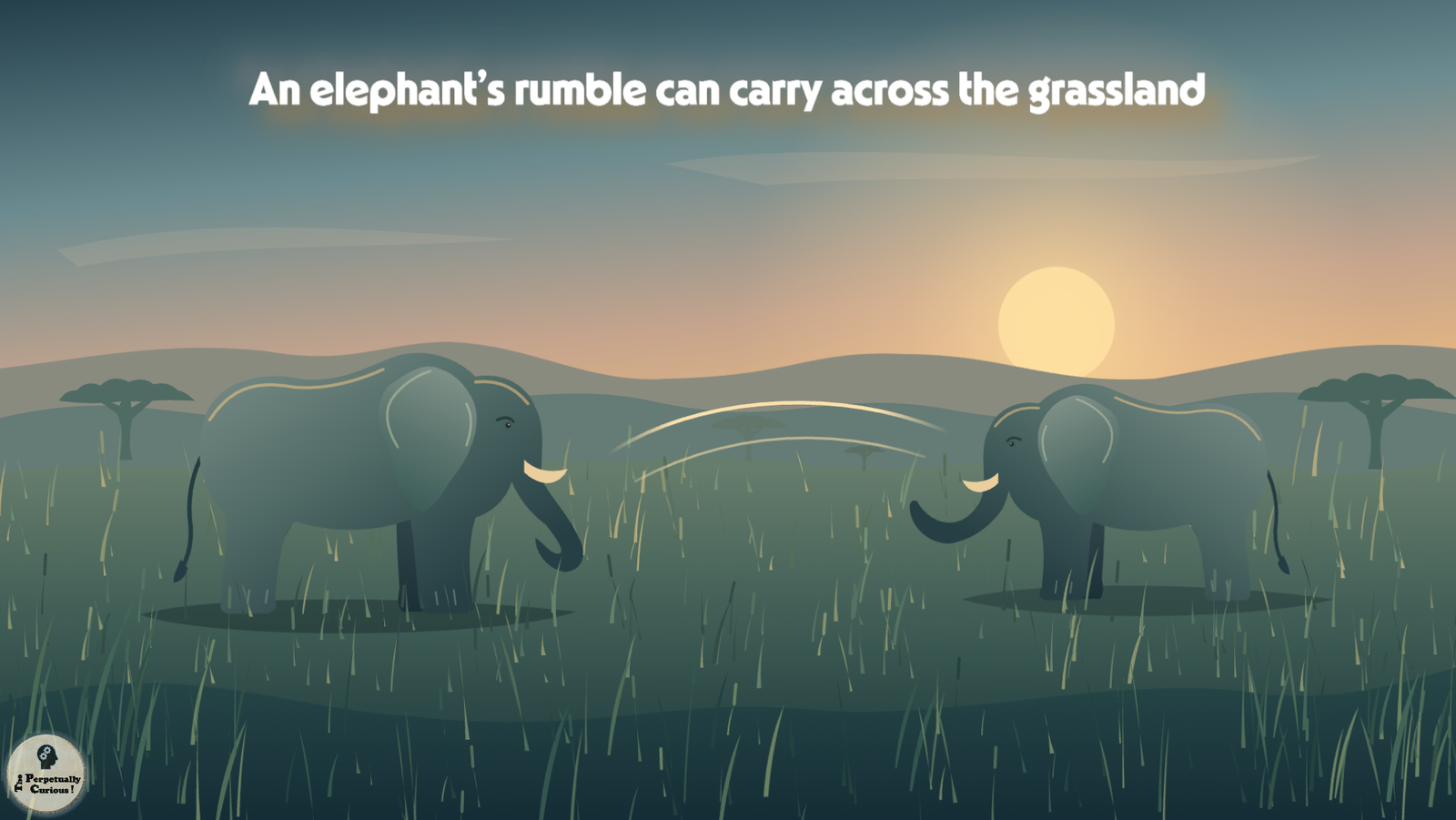
Sometimes the question is which animal a call is for. Low rumbles are part of how elephants keep in touch when they are out of sight of one another. In a playback study, African savanna elephants called sooner and more often in response to recordings of calls originally directed at them than to calls from the same caller directed at another elephant.[9]
👂 What we hear when we listen
The parrot says “hello” again. A sound with the shape of a human word made us turn toward the doorway. Now we can ask how the bird learned to make it, when it uses it, and what happens when someone hears it. The questions that follow can keep us listening long after the word has faded.
Pass this article along to someone curious and let the learning travel.
💡 Did you know?
🐘 An Asian elephant named Koshik placed the tip of his trunk inside his mouth while vocalizing, changing the shape of his vocal tract. When native Korean speakers listened to recordings, they recognized imitations of Korean words. The experiment measured how closely Koshik could match those sounds. What the words meant to him remains an open question.[10]
🐝 In a honeybee’s waggle dance, a run straight up a vertical comb tells nestmates the food lies in the direction of the Sun. A run at an angle gives them a bearing to one side of it. How long the bee waggles helps indicate distance. Nestmates may then set off toward a food source they have yet to see.[11]
🐦 Southern pied babblers use one call to recruit companions and another to alert them to a nearby, low-urgency threat. They can combine the calls when they encounter a predator on the ground. When researchers played the combination, listeners grew more alert and approached the speaker sooner than when they heard either kind of call on its own.[12]
What would count as language in another species?
Learning a label or combining calls in a particular situation can reveal part of what an animal can communicate. To look for the kind of flexibility found in human language, researchers would ask whether animals can combine familiar signals in new ways to express new meanings, and whether listeners can make sense of those combinations. Human languages can do this through speech or sign.[13]
Can a chimpanzee make a sound that resembles a human word?
A phonetic analysis of archival footage found that two chimpanzees raised around humans made sounds recognizable as “mama.” That gives us evidence about the sounds the chimpanzees could approximate. What those sounds meant to them, and how flexibly they could use them, remain open questions.[14]
Did Neanderthals speak?
Ancient DNA shows that the Neanderthals studied shared two changes in the FOXP2 protein sequence with modern humans. That is a clue to our shared biology. Whether they spoke, and what a spoken exchange might have sounded like, remain open questions.[15]
Can an animal send a signal without making a sound?
Yes. In many firefly species, a flying male flashes and a female may answer after a characteristic delay. These firefly courtship flashes convey information through timing and light. Male house mice leave chemical signals in territorial scent marks that other mice can detect after the sender has moved on.[16]
How do researchers test what an animal call might mean?
In a playback experiment, researchers can play recordings from the same spot and watch what the animals do. Using calls from the same caller helps test whether the response depends on who each call was directed at.[9] Playing two call types separately and together can reveal whether the combination changes how a listener responds.[12]
↗️ Let the question travel
Share this piece with someone who would pause at the doorway with you.
Educational context
Here, speech refers to the vocal expression of language. The animal studies describe specific species and settings, and the evidence can differ for a sound, a learned label, and a listener’s response.
Selected sources
- Fitch WT, de Boer B, Mathur N, et al. (2016). Monkey vocal tracts are speech-ready. Science Advances, 2(12), e1600723. [PMID: 27957536]
- Nishimura T, Tokuda IT, Miyachi S, et al. (2022). Evolutionary loss of complexity in human vocal anatomy as an adaptation for speech. Science, 377(6607), 760-763. [PMID: 35951711]
- Bouchard KE, Mesgarani N, Johnson K, et al. (2013). Functional organization of human sensorimotor cortex for speech articulation. Nature, 495(7441), 327-332. [PMID: 23426266]
- Morgan A, Fisher SE, Scheffer I, et al. (2016, updated 2023). FOXP2-Related Speech and Language Disorder. GeneReviews. University of Washington, Seattle. [PMID: 27336128]
- Yang Z, Long MA. (2025). Convergent vocal representations in parrot and human forebrain motor networks. Nature, 640(8058), 427-434. [PMID: 40108457]
- Pepperberg IM. (1988). Comprehension of “absence” by an African Grey parrot: Learning with respect to questions of same/different. Journal of the Experimental Analysis of Behavior, 50(3), 553-564. [PMID: 16812572]
- Arnon I, Kirby S, Allen JA, et al. (2025). Whale song shows language-like statistical structure. Science, 387(6734), 649-653. [PMID: 39913578]
- Walker RH, King AJ, McNutt JW, et al. (2017). Sneeze to leave: African wild dogs (Lycaon pictus) use variable quorum thresholds facilitated by sneezes in collective decisions. Proceedings of the Royal Society B: Biological Sciences, 284(1862), 20170347. [PMID: 28878054]
- Pardo MA, Fristrup K, Lolchuragi DS, et al. (2024). African elephants address one another with individually specific name-like calls. Nature Ecology & Evolution, 8(7), 1353-1364. [PMID: 38858512] Author correction (2025), 9(8), 1527-1528. [PMID: 40676146]
- Stoeger AS, Mietchen D, Oh S, et al. (2012). An Asian elephant imitates human speech. Current Biology, 22(22), 2144-2148. [PMID: 23122846]
- Riley JR, Greggers U, Smith AD, et al. (2005). The flight paths of honeybees recruited by the waggle dance. Nature, 435(7039), 205-207. [PMID: 15889092]
- Engesser S, Ridley AR, Townsend SW. (2016). Meaningful call combinations and compositional processing in the southern pied babbler. Proceedings of the National Academy of Sciences, 113(21), 5976-5981. [PMID: 27155011]
- Klinedinst N. (2025). Compositionality in human and animal communication. Animal Cognition, 28(1), 90. [PMID: 41193881]
- Ekström AG, Gannon C, Edlund J, et al. (2024). Chimpanzee utterances refute purported missing links for novel vocalizations and syllabic speech. Scientific Reports, 14(1), 17135. [PMID: 39054330]
- Krause J, Lalueza-Fox C, Orlando L, et al. (2007). The derived FOXP2 variant of modern humans was shared with Neandertals. Current Biology, 17(21), 1908-1912. [PMID: 17949978]
- Hurst JL, Robertson DHL, Tolladay U, et al. (1998). Proteins in urine scent marks of male house mice extend the longevity of olfactory signals. Animal Behaviour, 55(5), 1289-1297. [PMID: 9632512]
“More Than a Tongue: Why Animals Do Not Speak Like Humans.” The Perpetually Curious!, November 2026.
https://www.theperpetuallycurious.org/articles/why-animals-cannot-talk/Continue Exploring
For the curious mind: want to explore this theme through a few questions? Visit the Classic Quiz Studio, nestled under Explorations opens in a new tab ,and see where a few well-placed questions lead: Wilderness & Homestead Creatures Quizzesopens in a new tab
For what comes next
Site Updates gathers occasional notes, new additions, and ways to keep in touch. RSS brings new publications to your feed reader in chronological order.
Choose the path that speaks to you, and let the next curiosity find you wherever your wondering takes you.