

Hold a cup of green tea beside a cup of black tea. One may be pale and grassy, the other amber and brisk. Both began with Camellia sinensis, the tea plant. What happened after the leaves were picked helps explain how two cups from the same species can seem so far apart.
Black tea offers a useful route through five familiar stages: plucking, withering, rolling or crushing, oxidation, and drying.[1] Green, white, and oolong teas take different paths through some of those same decisions.[2] The first choice comes in the garden, where harvesters decide how much of the growing shoot to take.
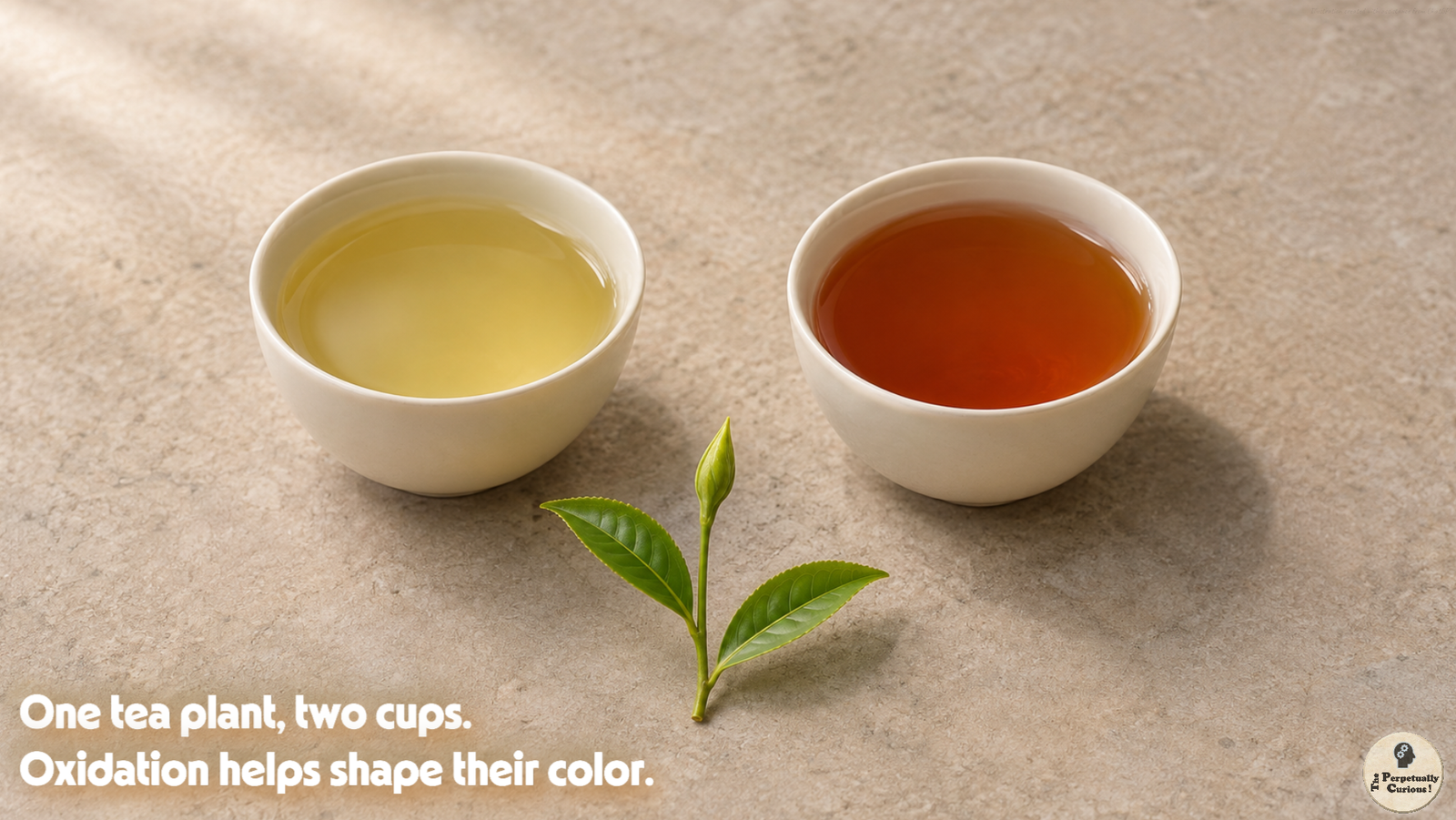
Long before the water begins to steam, part of the journey is already written in the leaf.
The colors, aromas, and flavors that rise from the cup carry faint traces of choices made in gardens, on drying racks, and in quiet rooms where time and air meet the harvest.
🌱 Plucking sets the starting point
One familiar plucking standard is two young leaves and the unopened bud at the tip of a shoot. The harvest can also include more mature leaves, depending on the tea being made. Tender shoots and older leaves differ in texture and chemical makeup, and different varieties of the tea plant can taste different even when processed the same way.[1] Once gathered for black tea, the leaves need time to soften.
🍃 Withering softens the leaf
On trays or in troughs, freshly picked leaves lose enough moisture to bend more easily. As the leaf softens, its chemistry also changes, including the mix of amino acids and aroma compounds.[1]
For traditional white tea, withering and drying do most of the work. Some oxidation can occur during withering, even without a separate stage for it.[2] A withered black tea leaf takes a different path. It can now fold and twist under pressure, which breaks open some of its cells.
🌀 Rolling changes what meets the air
Orthodox rolling twists and bruises the leaves, often leaving them in larger pieces. The crush, tear, curl method, known as CTC, breaks them into smaller particles. Both methods damage cells, allowing enzymes to act on leaf compounds in the presence of oxygen.[1]
Oolong makers may toss the leaves to bruise their edges, then let them rest between rounds. In many green teas, rolling serves mainly to shape leaves that have already been heated.[2] By the time the rolled or crushed leaves reach the next stage of black tea processing, oxidation is already underway.[1]
🎨 Oxidation changes color and taste
What happens inside the bruised leaf has a familiar parallel in a cut apple. The exposed flesh darkens as enzymes act in the presence of oxygen. In tea, an enzyme called polyphenol oxidase helps transform compounds called catechins. Among the products are theaflavins and thearubigins, which help give brewed black tea its amber to reddish-brown color and its brisk, sometimes mouth-drying character.[1]
During the dedicated oxidation stage, black tea makers give the reaction time to continue. Oolong makers allow a more limited degree of oxidation before heating the leaves.[2] The timing helps explain why the two cups look different. Early heat limits oxidation in green tea.[3] In black tea, more of the compounds that give the brew its amber color have time to form.[1]
🔥 Heat sets the direction and dries the leaf
The early heating step in green tea is called fixation. Heat inactivates the enzymes that drive browning, limiting further oxidation. Steaming is common for Japanese green teas, and pan heating is common in many Chinese green tea traditions.[3]
In black tea, drying follows the main oxidation stage. Oxidation can continue briefly as the leaves warm. Heat inactivates the enzymes and drives off moisture, leaving the tea more stable in storage.[1]
Drying prepares many teas for storage. Other styles make deliberate use of moisture to change the leaf further.
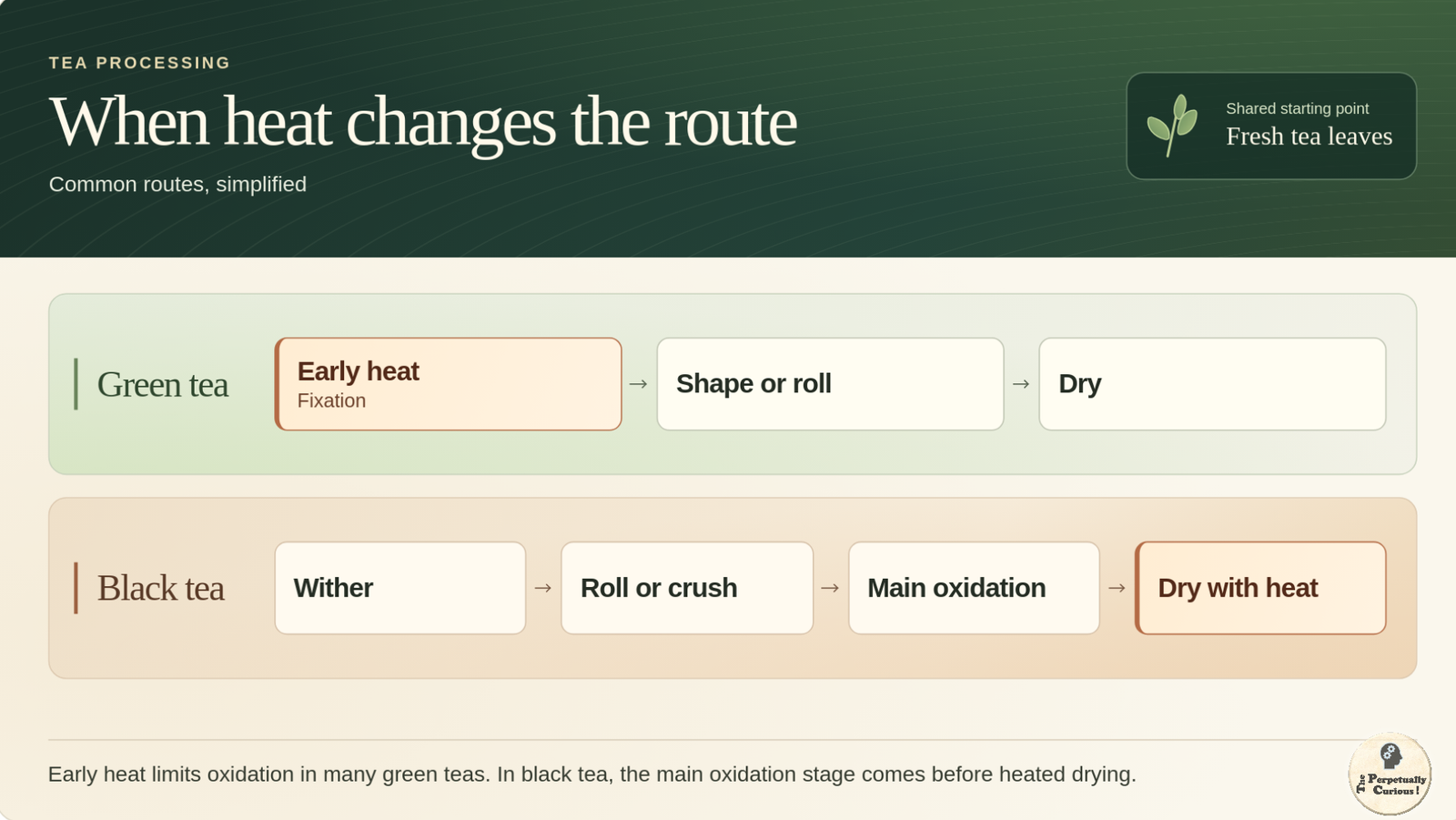
⏳ What changes when tea takes another route?
Yellow tea takes a route close to green tea and adds a warm, moist resting step after fixation. That step, called yellowing, helps shape the tea’s color.[2] In one study, a sensory panel described the finished yellow tea as sweet and mellow.[4]
Pu-erh, a tea associated with Yunnan, China, changes through microbial fermentation. Raw pu-erh can continue to change during storage as its microbial community shifts.[5] For ripe pu-erh, makers pile moistened leaves to speed up fermentation.[5] Black tea makers also use the word fermentation in its traditional trade sense, for oxidation driven mainly by the leaf’s own enzymes.[1]
Set the two cups side by side again. The grassy aroma of the green tea and the amber color of the black tea carry traces of what happened before brewing, down to when heat met the leaf.
Pass this article along to someone curious and let the learning travel.
💡 Did you know?
🏷️ In Sri Lankan black tea grading, Orange Pekoe (OP) is a whole-leaf grade, while Broken Orange Pekoe (BOP) is a smaller-leaf grade.[6] Size can affect brewing, too. In a study of two teas made by the crush, tear, curl (CTC) method, smaller particles infused faster than larger ones under the same brewing conditions.[7]
🌼 In traditional jasmine tea production in Fujian, China, makers bring fresh jasmine blossoms into contact with the tea leaves. They can repeat the scenting with fresh blossoms so the floral aroma builds from one round to the next.[8]
🍵 To make matcha, producers steam shade-grown leaves and dry them without rolling. They grind the resulting tencha into a fine powder.[9] When matcha is whisked into water, the powdered leaf becomes part of what you drink.
Can one harvest become several types of tea?
Yes. Researchers have divided leaves from a single tea cultivar and processed them into different tea types. Commercial growers also select cultivars and leaf grades suited to particular styles, so the starting material and the processing both matter.[2]
Are herbal teas made from the same plant?
Herbal teas such as peppermint and chamomile are infusions made from other plants. The processing routes described here begin with the leaves and buds of Camellia sinensis.
Are fixation and roasting the same thing?
Fixation uses heat to limit enzymatic browning.[3] Heat can also shape aroma later in processing. In one study of Wuyi rock oolong, firing strengthened woody notes.[10]
Does a darker cup of tea contain more caffeine?
Color is a poor guide. In one study of commercial brewed teas, white, green, and black teas overlapped in caffeine content, and steeping time affected how much reached the cup.[11] How much is in a drink is a separate question from why people respond differently to caffeine.
↗️ Share a cup of curiosity
Share this piece with a friend or colleague who would enjoy tracing the color in their cup back to the leaf.
Related reading
The journey from coffee cherry to cup follows the seeds of the coffee fruit through harvest, drying, roasting, and brewing.
Educational context
This article explores how plant biology, food chemistry, and tea-making traditions shape the finished leaf and the brewed cup.
Selected sources
- Aaqil M, Peng C, Kamal A, et al. (2023). Tea Harvesting and Processing Techniques and Its Effect on Phytochemical Profile and Final Quality of Black Tea: A Review. Foods, 12(24), 4467. [PMID: 38137271]
- Li Y, Yu S, Yang S, et al. (2023). Study on taste quality formation and leaf conducting tissue changes in six types of tea during their manufacturing processes. Food Chemistry: X, 18, 100731. [PMID: 37397192]
- D’Auria JC, Cohen SP, Leung J, et al. (2022). United States tea: A synopsis of ongoing tea research and solutions to United States tea production issues. Frontiers in Plant Science, 13, 934651. [PMID: 36212324]
- Sun L, Wen S, Zhang S, et al. (2024). Study on flavor quality formation in green and yellow tea processing by means of UPLC-MS approach. Food Chemistry: X, 22, 101342. [PMID: 38665631]
- Zhang Y, Skaar I, Sulyok M, et al. (2016). The Microbiome and Metabolites in Fermented Pu-erh Tea as Revealed by High-Throughput Sequencing and Quantitative Multiplex Metabolite Analysis. PLoS ONE, 11(6), e0157847. [PMID: 27337135]
- Tea Exporters Association Sri Lanka. Tea Grades.
- Farakte RA, Yadav G, Joshi B, et al. (2016). Role of Particle Size in Tea Infusion Process. International Journal of Food Engineering, 12(1), 1-16.
- Zhang C, Zhou C, Tian C, et al. (2023). Volatilomics Analysis of Jasmine Tea during Multiple Rounds of Scenting Processes. Foods, 12(4), 812. [PMID: 36832885]
- Ministry of Agriculture, Forestry and Fisheries of Japan. Uji Tea. Traditional Foods in Japan.
- Guo X, Ho CT, Wan X, et al. (2021). Changes of volatile compounds and odor profiles in Wuyi rock tea during processing. Food Chemistry, 341(Pt 1), 128230. [PMID: 33038771]
- Chin JM, Merves ML, Goldberger BA, et al. (2008). Caffeine Content of Brewed Teas. Journal of Analytical Toxicology, 32(8), 702-704. [PMID: 19007524]
“How Tea Is Made: Five Stages from Leaf to Cup.” The Perpetually Curious!, November 2026.
https://www.theperpetuallycurious.org/articles/how-tea-is-made/Continue Exploring
For what comes next
Site Updates gathers occasional notes, new additions, and ways to keep in touch. RSS brings new publications to your feed reader in chronological order.
Choose the path that speaks to you, and let the next curiosity find you wherever your wondering takes you.